
Why Data Governance Programs Fail: 7 Reasons and How to Avoid Them
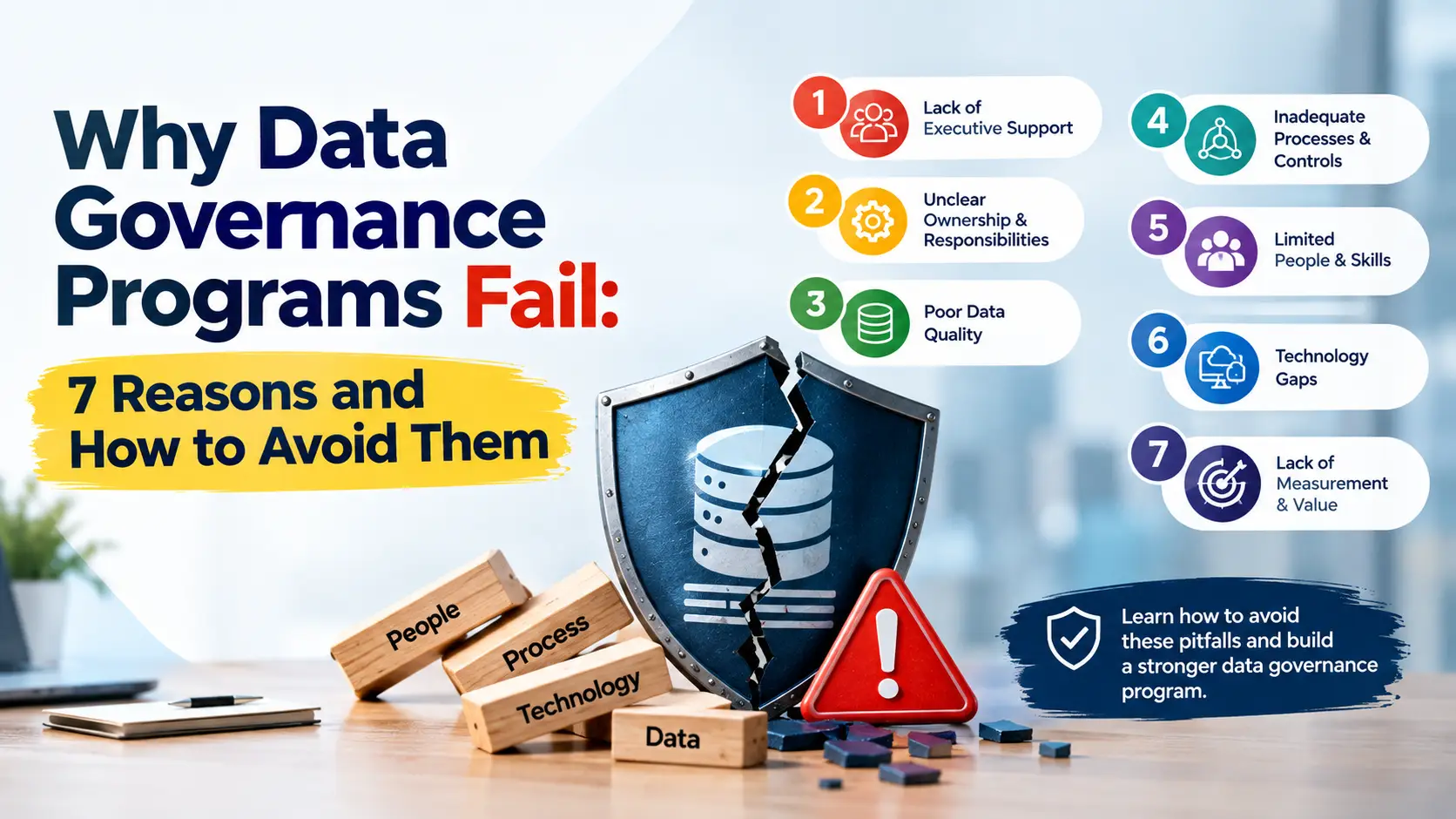
Quick Answer: Why Do Data Governance Programs Fail?
Most data governance programs fail for organizational reasons, not technical ones. The seven most common causes are:
- The program isn't tied to a business outcome.
- No executive sponsor, or no clear ownership.
- It is run as an IT or software project.
- Policies are written but never enforced, or they are too heavy to follow.
- Data quality isn't measured.
- Stewards have a title but no time, authority or training.
- The scope is too big, and progress is never reported.
The fixes are mostly the opposite: start from a specific business problem, name accountable owners, keep rules light, and measure results. Gartner has predicted that 80% of data and analytics governance initiatives will fail by 2027, which is a forecast, not a measured failure rate, but it matches what many practitioners see.
What Is Data Governance?
IBM describes data governance as "the data management discipline that focuses on the quality, security and availability of an organization's data." Microsoft puts it in practical terms: governance makes sure the data used in business operations, reports and analysis is discoverable, accurate, trusted and protected.
In short, it is the set of roles, rules and routines that decide who owns data, who can use it, and how good it has to be. If you want the full build-out, our data governance framework guide walks through it step by step. This article focuses on a narrower question: why programs that start with good intentions stall, and what to do about it.
Introduction
A typical failed program looks like this. A company has a data scare: a failed audit, a report that two departments can't agree on, or a regulator's letter. Leadership forms a governance council, hires a consultant, buys a data catalog and writes a 60-page policy. Six months later, the council meets less often, the catalog is half-filled, and the people who create the data have never read the policy.
Nothing about that story is unusual. Governance sits between departments, which makes it nobody's day job, and its benefits (fewer errors, less risk) are hard to see because they show up as problems that never happened.
The good news is that the failure patterns are predictable. Below are seven of them, with the warning signs for each and what to do instead.
What the Research Says About Governance Failure
Three sources frame the problem:
- Gartner (2024): Gartner predicted that by 2027, 80% of data and analytics governance initiatives will fail due to a lack of a real or manufactured crisis. Gartner VP Analyst Saul Judah said, "A D&A governance program that does not enable prioritized business outcomes fails." Gartner contrasts a strategic, business-centric approach with a tactical one in which teams run governance reactively and focus on data alone. Judah advises leaders to stop taking a "center-out, command-and-control approach" and to rescope governance to target tangible business outcomes, stay sensitive to opportunity and risk, and remain agile and scalable. Gartner analysts also say the typical "one-size-fits-all" approach is not what most organizations need.
- Harvard Business Review (2017): Tadhg Nagle, Thomas Redman and David Sammon studied data quality in companies and reported that on average 47% of newly created data records had at least one critical error, and only 3% of the data quality scores were in the acceptable range. The sample was small and focused on Irish companies, so treat it as a warning sign and not a universal average. You can read it as Only 3% of Companies' Data Meets Basic Quality Standards.
- IBM: IBM lists lack of sponsorship among the main governance challenges, noting that without executive and contributor-level support, policies may go unenforced.
The common thread is that governance fails when it is disconnected from the work people actually do.
Reason 1: No Link to a Business Outcome
What it looks like: The program's goal is "better data governance." Nobody can say which decision, cost or risk it improves.
Why it fails: Governance costs time and attention from people who already have jobs. If they can't see what they get back, they stop participating. Gartner's point about needing a "real or manufactured crisis" is really a point about urgency: programs survive when they solve something leadership already cares about.
How to avoid it:
- Start with one painful, visible problem. Examples: two teams report different revenue numbers, a regulatory report takes three weeks to compile, or a customer is contacted twice because duplicate records weren't merged.
- Write the goal as a sentence with a number: "Cut month-end reporting from ten days to five by agreeing one definition of revenue."
- Pick the first data domain based on where the business hurts, not where the data is tidiest.
This is also where governance connects to analytics. If your dashboards disagree, governance is the reason. See our explainer on what business intelligence is for how reports depend on trusted definitions.
Reason 2: No Executive Sponsor and Unclear Ownership
What it looks like: A committee "owns" the data. Everyone attends, nobody is accountable. Decisions are deferred to the next meeting.
Why it fails: Governance often needs one department to change how it works for another department's benefit. Without a senior person who can settle disputes, those conflicts never resolve. And when ownership is shared by a group, the practical result is that no individual owns it.
How to avoid it:
- Name an executive sponsor with budget and authority, such as a chief data officer, CFO or COO, and give them a short, regular report.
- Assign a named data owner to each important dataset: a business leader accountable for its definition, quality and access. Microsoft's Purview documentation uses this same split, with a central data office setting policies, data owners registering assets and managing access, and data stewards handling quality, glossary and lineage.
- Write down who decides what. A simple responsibility chart (who decides, who is consulted, who is informed) prevents most turf arguments.
Reason 3: Treating It as an IT or Software Project
What it looks like: The first big move is buying a data catalog or governance platform. The project plan is mostly about installation and connectors.
Why it fails: Tools record decisions. They don't make them. A catalog full of unowned, undefined datasets is just a well-organized mess. When governance sits entirely in IT, business users see it as something done to them, and the people who truly understand the data aren't involved.
How to avoid it:
- Decide roles, definitions and rules first, then pick tools to support them.
- Use a federated model. Microsoft describes this as a middle ground between centralized and decentralized governance: the central data office sets the rules, while people in departments who understand the data are trusted to govern it appropriately.
- Run a small pilot on a spreadsheet and a shared glossary before committing to enterprise software. If the process doesn't work with simple tools, it won't work with expensive ones.
If you're comparing platforms, our piece on Microsoft Fabric vs traditional data governance platforms explains the trade-offs. If the terms themselves are blurring together, our guide to data governance vs data quality vs data security separates them.
Reason 4: Policies Without Enforcement, or Rules Too Heavy to Follow
What it looks like: Either the policies sit in a shared folder that nobody opens, or the approval process is so slow that teams quietly work around it.
Why it fails: These are opposite problems with the same result. A rule that is never checked is optional. A rule that blocks all progress gets bypassed, and shadow spreadsheets multiply, which is exactly what governance was meant to stop.
How to avoid it:
- Build rules into the workflow. A required field in the source system beats a policy that says "please enter this field."
- Make the compliant path the easy path. If getting approved access takes two days, offer a self-service request with clear criteria.
- Apply controls in proportion to risk. Personal data and financial reporting need strict rules. An internal marketing list doesn't.
- Automate what you can, such as lineage capture and audit logs. IBM lists this among its recommended practices.
Reason 5: Data Quality Isn't Measured
What it looks like: Everyone agrees data quality matters, but nobody can say how good the data is today or whether it is improving.
Why it fails: Without a baseline, you can't show progress, and you can't prioritize. The HBR study above is a reminder that quality problems are often much worse than leaders assume until someone actually checks.
How to avoid it:
- Pick a handful of critical data elements, such as customer ID, product code and invoice amount, and measure them. Common measures are completeness, validity, uniqueness and timeliness.
- Sample real records the way the HBR researchers did: take the last 100 units of work, check the key fields, and count the error-free ones. It takes an afternoon and produces a baseline.
- Fix issues at the source, where the data is created, not downstream in the warehouse. Our guide to data warehouses, data lakes and lakehouses shows why cleaning data late in the pipeline gets expensive.
- Publish a simple quality score for each important dataset so users know what to trust.
Reason 6: Stewards With a Title but No Time, Authority or Training
What it looks like: Someone is named a "data steward" on top of a full-time job. They have no allocated hours, no decision rights and no training. Within a quarter the role is empty.
Why it fails: Governance is carried out day to day by stewards. If the role is unpaid overtime, it doesn't happen. Culture is part of this too: people won't follow rules they don't understand or believe in.
How to avoid it:
- Allocate real time. Even a few hours a week, written into the person's objectives, is better than an unofficial role.
- Give stewards clear authority to approve definitions and flag issues, and make sure their managers know it counts.
- Train people on why the rules exist. Short, role-specific sessions work better than a one-time company announcement.
- Recognize the work. Teams that fix data problems should be visible to leadership.
This is closely related to what happens when staff feel their work doesn't matter. Our article on the hidden cost of employee disengagement explains why unrecognized work tends to fade.
Reason 7: Boiling the Ocean, and Never Reporting Progress
What it looks like: The plan is to govern all data across the whole company at once. The roadmap is 18 months long with no visible wins until the end.
Why it fails: Big-bang programs lose sponsorship before they deliver. Leaders who can't see results will redirect the budget, and the program quietly shrinks.
How to avoid it:
- Work in small cycles. Choose one domain, deliver a result in 60 to 90 days, then expand.
- Track a few metrics and report them on a regular schedule: share of critical data elements with an owner, quality score trends, time to find or request data, and number of policy exceptions.
- Review the program every quarter. Retire rules that nobody uses and add ones that address new risk.
- Plan for AI. AI systems inherit the quality of the data they use, so basic governance should be in place before you deploy them. Our guides on what AI governance is and AI governance vs AI compliance explain how data governance feeds into AI oversight.
Warning Signs Your Program Is in Trouble
| Warning sign | Likely root cause |
|---|---|
| Council meetings get shorter, then canceled | No sponsor, or no outcome to discuss |
| Teams keep their own spreadsheets | Rules too slow, or no trusted source |
| Catalog entries have no owner or description | Tool-first approach, no stewards |
| Same metric, different numbers in two reports | No agreed definitions |
| Nobody can say what quality score is today | Quality isn't measured |
| Stewards can't say how much time the role takes | No allocated time or authority |
| Leaders ask "what did we get for this?" | No outcome, no reporting |
A 90-Day Plan to Restart a Stalled Program
This is a practical outline, not an industry standard. Adjust it to your size and risk profile.
Days 1 to 30: Pick the problem and the people
- Interview five to ten business leaders and list their top data complaints.
- Choose one problem with a clear cost, such as inconsistent revenue figures.
- Name the sponsor, the data owner for that domain and one or two stewards. Agree on their time.
Days 31 to 60: Fix the basics for that one domain
- Write the definitions for the handful of metrics that matter, in plain language.
- Measure current data quality on the critical fields and record the baseline.
- Set the minimum rules: who can change the data, who can see it, and how errors are reported.
Days 61 to 90: Show results and decide what's next
- Fix the top three data quality causes at the source.
- Report before and after: a faster process, fewer disputed numbers or fewer errors.
- Use the result to win approval for the next domain, and only then review tooling.
Tools Help, but They Come Second
Governance platforms from vendors such as Microsoft Purview, IBM, Collibra and others provide catalogs, lineage, access workflows and quality checks. They can save real time once the people and process exist. Microsoft's documentation, for example, describes a workflow that starts by assigning a governance administrator and scanning data assets, then building domains and curating data products.
Treat any tool purchase as the end of the planning stage, not the start. For a closer look at BI and reporting software that relies on governed data, see our comparison of the best business intelligence tools.
Common Mistakes When Rescuing a Governance Program
- Launching a new committee instead of fixing accountability. Another group doesn't help if no individual is accountable.
- Writing more policy. If people aren't following the current one, a longer one won't change that.
- Skipping the baseline. Without a starting measurement, you can't prove improvement.
- Hiding the program from the business. Governance that is only visible to IT won't get business support.
- Measuring activity, not outcomes. Counting meetings or catalog entries says little about whether decisions improved.
- Ignoring the link to analytics and AI. Reports and models are only as reliable as the data feeding them. See our look at why AI proof-of-concept projects never reach production for a related failure pattern, and how to measure AI ROI for tying results to numbers.
Frequently Asked Questions
Why do data governance programs fail? Mostly for organizational reasons: no link to business outcomes, no executive sponsor, unclear ownership, weak enforcement, unmeasured data quality, stewards without time or authority, and scopes that are too big. Technology problems are rarely the main cause.
What percentage of data governance programs fail? There is no single reliable figure. Gartner predicted in 2024 that 80% of data and analytics governance initiatives will fail by 2027, but that is a forecast based on its own analysis, not a measured rate across all companies.
What is the most common reason for failure? Missing or weak executive sponsorship is one of the most frequently cited causes, and IBM lists lack of sponsorship as a major challenge. A close second is a program with no clear business outcome.
Is data governance an IT responsibility? IT supports it, but the business should own it. Data owners and stewards are usually business roles, because they understand what the data means and how it is used.
What is a data steward? A data steward looks after the quality, definitions and proper use of a specific set of data. In Microsoft's Purview model, stewards ensure data quality, discovery, glossary, consistency and lineage, working with the central data office.
How do you start data governance in a small company? Pick one painful problem, name one owner, write down the definitions, measure the current quality, and fix the biggest cause. A shared document and a regular short meeting are enough to begin. You don't need a platform yet.
Do you need a data governance tool? Not at the start. Tools help with cataloging, lineage and access workflows at scale, but they won't fix missing ownership or unclear rules. Decide roles and rules first.
How long does it take to see results? A focused pilot on one domain can show results in 60 to 90 days. Company-wide change takes longer, which is why delivering in small steps matters.
How do you measure data governance success? Track a few measures: share of critical data elements with an owner, data quality scores over time, time to find or request data, number of policy exceptions and business outcomes such as faster reporting. See our data governance framework guide for more metrics.
What is federated data governance? A model in which a central data office sets standards while people in each business area govern their own data within those standards. Microsoft describes it as a middle ground between centralized and decentralized approaches.
Does AI make data governance more important? Yes. AI systems depend on the quality of the data they are trained on and use. Basic governance and data quality should be in place before you deploy AI use cases.
Can a failed governance program be restarted? Yes. Restart smaller: choose one business problem, name accountable owners, measure a baseline and report results in 90 days. A narrow success is easier to build on than another company-wide launch.
Conclusion
Data governance programs rarely fail because the idea is wrong. They fail because they float free of the business: no problem to solve, no one accountable, no way to show progress. The seven reasons above are variations on that theme, and each has a practical fix.
Key takeaways
- Start with one business problem and a measurable goal.
- Name an executive sponsor and a data owner for each important dataset.
- Decide roles and rules before buying tools.
- Build rules into workflows and apply controls in proportion to risk.
- Measure data quality and report results every quarter.
- Give stewards real time, authority and training.
- Work in 60 to 90 day cycles, one domain at a time.
Next step: write down the single data problem that costs your company the most today, then name who would own the fix. That is your first governance project.
Sources
- IBM, What Is Data Governance?
- Microsoft, Learn about data governance with Microsoft Purview, Microsoft Learn