
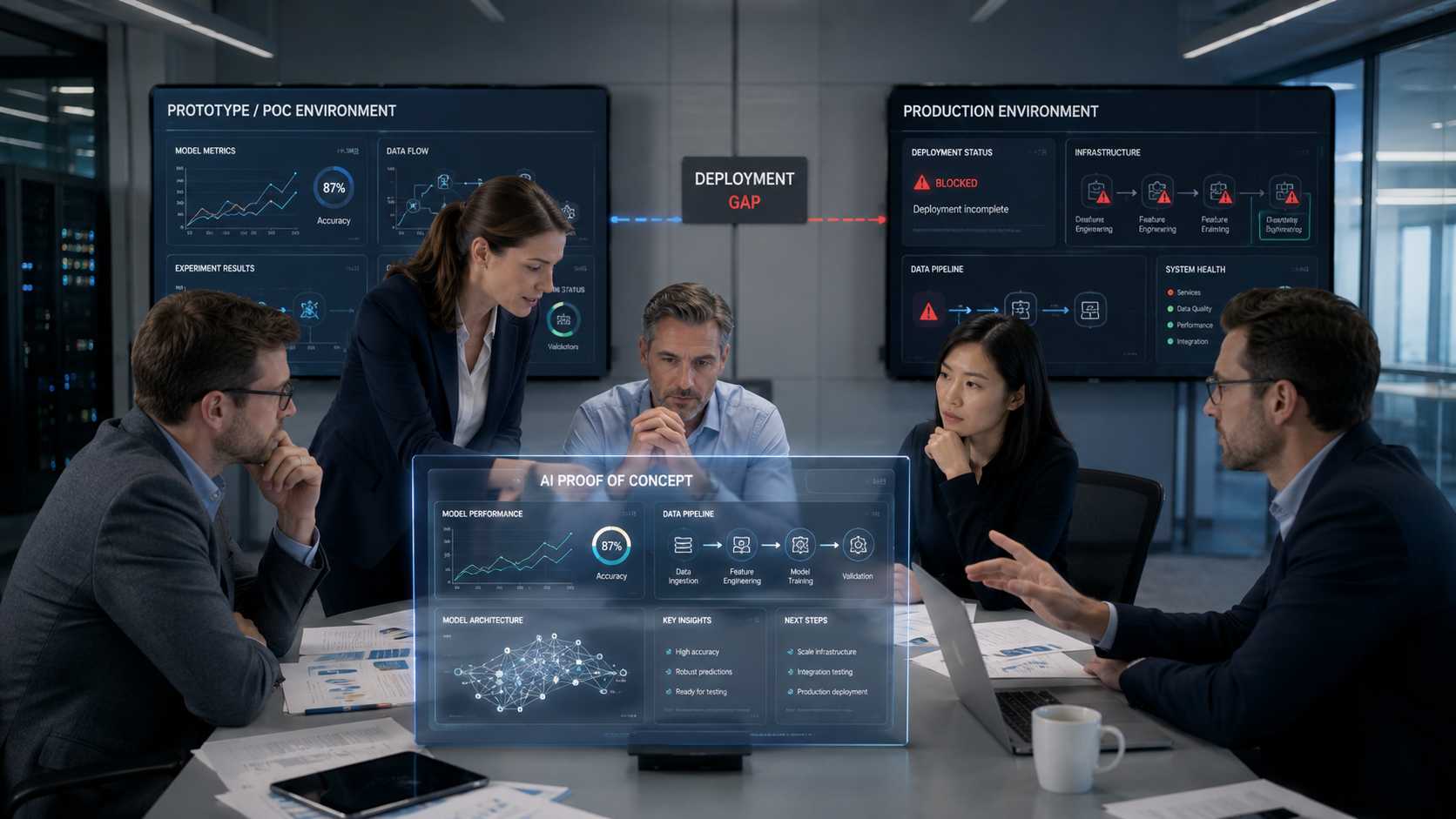
You've seen the headlines. You've felt the pressure from the board. "Competitors are investing in AI. We need an AI strategy. Get something running in the next quarter."
So you do what most organizations do: you launch a proof-of-concept. You assign a data science team. You set aside budget. You run some experiments. Within weeks or months, you have something that works. An algorithm that produces predictions. A model that solves a problem. Your team demos it to the C-suite. Everyone's impressed.
Then silence.
Six months later, that promising AI initiative is still in the lab. The demo that impressed executives is gathering dust. The data science team has moved on to the next project. And you're no closer to having AI that actually runs your business.
This isn't unusual. In fact, it's become the default path for enterprise AI initiatives. Studies suggest that 70-90% of AI proof-of-concept projects never reach production. Not because the technology doesn't work. Not because the idea wasn't good. But because organizations don't understand what it actually takes to move from "works in a notebook" to "runs in production."
The gap between AI proof-of-concept and production-ready systems has become the hidden crisis of enterprise digital transformation. And until you understand what creates that gap, your AI initiatives will keep following the same dead-end path.
Let me explain what's really happening-and why the problem is more organizational than technical.
Understanding the AI Proof-of-Concept Stage
Before we talk about failure, let's be clear about what a proof-of-concept actually is.
An AI POC is a time-bound experiment designed to validate whether an AI solution can solve a specific business problem. It's not production software. It's not meant to scale to millions of transactions. It's not designed to integrate with your existing systems. It's meant to answer a single question: Does this idea have merit?
In that narrow scope, POCs are actually quite effective. They let organizations experiment with AI technologies without massive capital investment. They let data scientists test hypotheses quickly. They prove that a problem is solvable.
The problem emerges when organizations treat a successful POC as proof that they're ready for production. They're not. In fact, they're usually nowhere close.
A POC typically has:
- Curated, clean data (often manually prepared)
- Simplified problem definitions
- Offline processing (no real-time constraints)
- Single-user or small-batch workloads
- Minimal integration requirements
- No accountability for accuracy at scale
Production systems need:
- Real data (messy, variable, constantly changing)
- Complex problem definitions with edge cases
- Real-time processing and latency constraints
- Multi-user, high-throughput workloads
- Deep integration with existing systems
- Governance, monitoring, and explainability frameworks
These aren't the same things. Not even close.
The Reality Behind AI Project Failures
Here's what we know from studying hundreds of enterprise AI initiatives: organizations consistently underestimate the gap between POC and production by a factor of 5-10x.
When you ask a team, "How long will it take to move this from POC to production?" they'll estimate three to six months. In reality, it typically takes 18-36 months. That's not because the technology is harder than expected. It's because production requirements are fundamentally different from POC requirements.
The second thing we know: enthusiasm for AI far exceeds organizational readiness to deploy it.
I've watched countless organizations get excited about AI possibilities but struggle when confronted with questions like:
- Where is the production data actually coming from?
- How do we monitor model accuracy when deployed to millions of users?
- What happens when the model makes mistakes?
- How do we integrate this with systems built in 2003?
- Who is accountable if this model causes a business problem?
- How do we ensure this complies with data privacy regulations?
These aren't interesting technical questions. They're infrastructure, governance, and organizational questions. And most AI teams are neither equipped nor incentivized to solve them.
The third thing we know: building a demo is fundamentally different from building a system.
A demo can be fragile. It can have hardcoded assumptions. It can fail gracefully in ways that work for a presentation. A production system needs to handle edge cases you didn't anticipate. It needs to work with data quality issues you can't predict. It needs to fail in ways that don't break your business.
This is why organizations can build impressive POCs-data scientists are excellent at building demos. But they're not excellent at building production systems. Those are different skills. And most organizations don't have both.
Key Reasons AI Proof-of-Concept Projects Never Reach Production
Let me walk through the specific reasons AI initiatives stall between POC and production. These aren't hypothetical-I've watched each of these derail real projects worth millions of dollars.
1. Unclear Business Objectives
The most common reason AI projects fail isn't technical-it's strategic.
When an organization decides to "do AI," they often start with the technology first. "Let's build a machine learning model." "Let's experiment with generative AI." "Let's see what we can do with our data."
But AI doesn't work that way. You can't start with the technology and work backward to business value. You have to start with the problem.
I watched a financial services company spend 18 months building an AI model to optimize loan underwriting. The POC was technically impressive-it accurately predicted default risk. But when we asked, "What business problem does this solve?" the answer was vague. The existing underwriting process was already working. There was no clear metric showing that the AI would improve outcomes, reduce costs, or create competitive advantage.
The project stalled immediately when faced with a simple question from the CFO: "Why should we spend $2 million to deploy this when the current system works?"
Compare that to a retail company that started differently. They identified a specific problem: customers were abandoning shopping carts at a 35% rate, costing the company $2 million annually. Then they built AI to personalize checkout experiences and reduce abandonment. They had a clear business target. When the POC showed a 12% improvement in the pilot, moving to production was straightforward-the ROI was obvious.
Start with the business objective. Everything else flows from that.
2. Poor Data Quality and Data Availability
This is where AI projects die most frequently.
A successful POC typically uses hand-curated, preprocessed data. The data science team spends weeks cleaning it, removing outliers, handling missing values. They create a dataset that's ideal for training models. Then they're surprised when real production data is completely different.
Real data is messy. It's incomplete. It changes over time. It contains anomalies. It reflects real-world complexity that training data doesn't capture.
I've seen organizations that assumed they "had plenty of data" discover during POC-to-production transition that:
- Data was stored across incompatible systems
- Historical data quality was poor and unreliable
- Data definitions were inconsistent across departments
- Critical data points were missing or incomplete
- Data governance was non-existent (no one tracked what data meant or where it came from)
One energy company wanted to build AI to optimize power grid performance. Their POC worked beautifully-on historical data from a single region, carefully prepared. When they tried to deploy it across the entire network, they hit a wall. Different regions used different data formats. Data collection methods varied. Quality standards differed. The POC's assumptions fell apart in the face of real production data.
This is why successful AI initiatives almost always start with data foundation work. Not with algorithms. Not with models. With boring, unglamorous data engineering: inventory systems, data governance, quality standards, integration pipelines.
3. Lack of Scalability Planning
POCs are usually small. A few thousand data points. A model trained on a single server. Processing a batch of transactions once daily.
Production systems need to scale 100x or 1000x. They need to process thousands of transactions per second. They need to train models on billions of data points. They need to serve real-time predictions at scale.
Organizations rarely think about scalability during POC. Why would they? A POC doesn't need to scale.
But when you move to production, scalability becomes critical. And most POCs are built in ways that simply won't scale.
I've watched data scientists build elegant Python scripts that work beautifully for 10,000 data points but grind to a halt when you try to process 10 million. I've seen models that were developed on a single GPU that need to be distributed across dozens of GPUs in production. I've seen batch processes that took 20 minutes in POC and need to complete in 20 seconds in production.
The technical challenge of scaling a model is solvable. The organizational challenge is harder. By the time you're trying to scale, you've already committed resources to the initial approach. Rearchitecting for scale means admitting the initial approach wasn't production-ready. It means delays. It means cost overruns. It means the project loses momentum.
This is why successful teams plan for scale from day one. They assume production volumes from the beginning. It's more work upfront, but it prevents the scaling crisis later.
4. Infrastructure Limitations
Data science teams typically develop in isolated environments. A laptop. A small cloud instance. A sandbox system.
But production systems need to integrate with enterprise infrastructure. They need to talk to data warehouses. They need to pull data from multiple sources. They need to write predictions back to operational systems. They need to integrate with security frameworks, logging systems, monitoring systems.
Most organizations aren't prepared for this.
I once worked with a manufacturing company that spent 14 months building a predictive maintenance POC. The model was excellent. It predicted equipment failures with 94% accuracy. But when it came time to deploy, they hit a fundamental problem: the factory operated on a closed network with no connection to the cloud where the model was trained. The IT department's security policy prohibited cloud-based ML models accessing operational systems.
Moving the model to on-premises infrastructure required six months of additional work. By then, the project had lost momentum. Budget had been redirected. Key team members had moved on.
This is why production deployment requires infrastructure planning. It means involving IT, security, database teams, systems engineers-people who are never part of the initial POC. It means understanding your technology landscape before you start building. It means asking hard questions: Where will this run? How will data get there? How will predictions get back to the business?
5. Unrealistic Stakeholder Expectations
POCs create unrealistic expectations. They work too well.
An executive sees a demo. The model predicts customer churn with 85% accuracy. It seems obvious: deploy this, reduce churn, win. What could be simpler?
What executives don't see is the careful setup behind that demo. The hand-selected test data. The simplified problem. The decision rules that were tuned specifically to the test scenario. The edge cases that were carefully avoided.
Real production requires different performance standards. A model that's 85% accurate on historical data might be 73% accurate on real-world data you've never seen. That's still useful. But it's not the 85% accuracy the executive was promised. The conversation becomes uncomfortable.
I've watched executives get frustrated when told that production deployment will take longer and cost more than the POC suggested. They feel misled. They question the team's competence. Trust deteriorates. Project momentum dies.
The solution is transparency. From the beginning, clearly communicate the difference between POC performance and expected production performance. Explain that you're validating the concept first, then you'll build the production system. Don't let executives assume the POC is production-ready.
6. Difficulty Integrating with Existing Systems
Most organizations have decades of operational systems. Legacy banking platforms. Aging ERP systems. Disconnected databases. Proprietary systems no one fully understands anymore.
AI doesn't exist in isolation. It needs to integrate with these systems. It needs to consume data from them. It needs to write predictions back to them. It needs to work within the constraints they impose.
Integration is the unglamorous, expensive part of AI deployment that nobody wants to discuss during the POC phase.
A financial services company wanted to build AI to personalize offers to customers. The POC was successful-the algorithm correctly identified which offers each customer would likely accept. But integration was a nightmare. Customer data lived in three different systems. Offer rules were encoded in legacy mainframe code. The infrastructure to deliver personalized offers to customers didn't exist.
Moving from POC to production required rebuilding significant portions of the customer data architecture. It took 18 months and millions of dollars.
This is why production-ready AI requires understanding your entire technology landscape. You can't treat the AI model as separate from the systems it serves. You need to plan for integration from day one.
7. Security, Privacy, and Compliance Concerns
POCs typically ignore security, privacy, and compliance. They're experimental. They use sample data. They're not connected to production systems. Why worry about those things?
Production systems can't ignore them. They handle real customer data. They're subject to regulations. They're vulnerable to security risks. They have privacy implications.
I've watched organizations build successful POCs on personally identifiable information (PII) without considering GDPR, CCPA, or other privacy regulations. When they tried to deploy to production, they had to completely rearchitect how data was handled. Some used anonymization. Some used differential privacy. Some used federated learning. All of it added complexity and cost.
Security is similarly underestimated. A POC might use API keys stored in code or configuration files. Production systems need key management, encryption, audit trails. It's boring infrastructure work, but it's mandatory.
Organizations that move successfully from POC to production plan for these constraints early. They don't wait until deployment to figure out compliance requirements. They don't discover security issues after launching.
8. Skills and Talent Shortages
Building a POC requires specific skills: machine learning expertise, statistical knowledge, data analysis.
Building production systems requires different skills: software engineering, DevOps, infrastructure management, systems design.
Most organizations have the POC skills. They hire data scientists. They build models. But they don't have the production skills-or they have them, but they're deployed elsewhere, working on existing systems.
When it comes time to move to production, organizations face a talent gap. The data scientists who built the POC aren't interested in production engineering (it's boring). And the software engineers aren't familiar with ML systems (it's unfamiliar). Neither team is incentivized to bridge the gap.
Successful organizations solve this by building cross-functional teams from the start. They pair data scientists with software engineers. They involve DevOps and infrastructure teams early. They create shared accountability for production outcomes, not just POC outcomes.
9. Rising Operational and Maintenance Costs
Nobody budgets for the operational cost of production ML systems.
A model in production requires:
- Data pipelines to keep it updated
- Monitoring systems to track performance
- Retraining cycles as data changes
- Version management
- Rollback capabilities
- Support and maintenance
These costs are typically 10-50% of the initial development cost annually.
I've watched organizations deploy a $500K AI system and then discover that maintaining it costs $150K per year. The project was budgeted for development. There was no budget for operations. The system degrades over time as model performance drifts. Nobody maintains the data pipelines. The system becomes less reliable, not more.
This is why successful AI organizations treat ML as operational infrastructure, not one-time projects. They budget for ongoing maintenance. They allocate resources to monitoring and retraining. They understand that deployment is the beginning, not the end.
10. Lack of AI Governance and Accountability
This is the most important reason AI projects fail, and nobody talks about it.
In a POC, nobody is accountable. If the model is wrong, it doesn't matter. It's an experiment. In production, someone is accountable. The business is relying on these predictions. If the model fails, there are consequences.
Organizations often don't establish governance frameworks until after they've deployed. By then, it's too late to do it well. They're retrofitting accountability into systems that weren't designed for it.
Real production AI requires:
- Clear ownership and accountability
- Decision frameworks for when to trust the model and when not to
- Monitoring for bias and fairness issues
- Processes for handling model failures
- Documentation of how and why decisions are made
- Regular audits and reviews
Most organizations don't have these frameworks. Data scientists aren't trained to think about them. Business leaders don't understand why they matter.
But governance is what separates successful AI systems from failed ones. Without it, organizations lose trust in their models. They stop using them. The system dies.
The Hidden Cost of Staying in the Proof-of-Concept Phase
The real cost of failing to move from POC to production isn't the failed project. It's the organizational damage.
First, there's wasted investment. You spent millions building something that delivers no business value. That money is gone. It's not invested in systems that work.
Second, there's lost momentum. Your organization started this AI journey with enthusiasm. You invested. You experimented. Then nothing happened. Employees who were excited about AI become cynical. "We tried that. It didn't work." Next time you propose an AI initiative, people are skeptical.
Third, there's reduced stakeholder confidence. The executive team approved the budget because they believed the business case. When the project stalls, they question their judgment. They become reluctant to invest in new initiatives. They want "safer" investments.
Fourth, there's competitive disadvantage. Your competitors aren't stalling in POC. They're deploying. They're getting business value from AI. You're not. That gap widens over time.
Finally, there's organizational attrition. Your best people move on to companies that can execute on their ideas. The team that built the POC is demoralized. They leave. You lose capability.
This is why moving from POC to production is so critical. It's not just about deploying a system. It's about sustaining momentum, building organizational capability, and proving that you can actually execute on AI initiatives.
How Successful Organizations Bridge the Gap
Organizations that successfully move from POC to production don't follow a different path. They follow a different philosophy.
Start with Business Outcomes, Not Technology
Successful organizations begin with a specific, measurable business objective. Not "explore AI." Not "build a model." But a concrete outcome: reduce customer churn by 15%, decrease fraud losses by 20%, increase sales by 10%.
With a clear outcome, decisions become easier. You know what success looks like. You can measure progress. You can justify investment.
Build Strong Data Foundations
Before building the model, successful organizations invest in data infrastructure. Data governance. Data quality. Data integration. It's boring. It's expensive. It doesn't produce impressive demos. But it's fundamental.
Organizations that treat data infrastructure as the foundation, not a side effect, move to production much faster.
Create Scalable Architectures from Day One
Successful organizations plan for production scale during POC development. They design systems that can scale. They select technologies that scale. They test with realistic data volumes.
It's more work upfront. But it prevents scaling crises later.
Establish AI Governance Frameworks
Successful organizations define governance before deploying. They establish clear ownership. They define decision processes. They build monitoring and audit frameworks.
Governance isn't about restriction. It's about clarity and accountability. It's what makes stakeholders trust the system.
Invest in Cross-Functional Collaboration
Successful organizations pair data scientists with software engineers, DevOps specialists, and business stakeholders from the beginning. They create shared ownership of outcomes. They force conversations between teams that wouldn't naturally talk to each other.
This cross-functional collaboration is what moves projects from POC to production.
Measure Business Value Continuously
Successful organizations don't just measure model accuracy. They measure business impact: Did this actually reduce churn? Did it actually prevent fraud? Did it actually increase sales?
Model accuracy is a technical metric. Business impact is what matters. Organizations that focus on business impact make decisions differently. They're willing to deploy "good enough" models if they're delivering business value. They're willing to pause perfect models if they're not delivering business value.
Emerging Trends Shaping AI Deployment Success
Several emerging trends are making it easier for organizations to move from POC to production.
Agentic AI Systems are shifting focus from predictions to autonomous execution. Rather than building models that just predict something, organizations are building systems that actually take action. This changes the deployment story-agents must be production-ready from day one.
AI Observability is making it easier to monitor and understand models in production. Rather than deploying models as black boxes, organizations are gaining visibility into why models make decisions, when they're drifting, and when they need retraining.
MLOps and LLMOps are providing standardized approaches to deploying and maintaining ML systems. Just as DevOps solved infrastructure deployment challenges, MLOps is solving model deployment challenges.
Responsible AI Practices are building governance and compliance into systems from day one, rather than retrofitting it afterward.
Enterprise AI Platforms are providing integrated environments that handle infrastructure, integration, monitoring, and governance-reducing the complexity organizations need to manage.
These trends are gradually removing excuses for staying in POC. Organizations that adopt these practices move to production much faster.
Future Outlook: From Experimentation to Operational AI
The AI landscape is shifting. We're moving from an era where "exploring AI" was acceptable to an era where "deploying AI" is expected.
In this new era, the bottleneck isn't building models. Data scientists are excellent at that. The bottleneck is everything else: infrastructure, integration, governance, operations.
Organizations that win in this environment won't be the ones with the best data scientists. They'll be the ones with the best execution. The best infrastructure. The best governance. The best organizational alignment.
This is uncomfortable for many AI teams. Building models is intellectually interesting. Building production infrastructure is not. But that's where the value is.
The future belongs to organizations that understand that AI success isn't about the model. It's about the system around the model. It's about infrastructure, governance, and organizational capability.
Conclusion
The reason 70-90% of AI proof-of-concept projects never reach production isn't technical. It's organizational.
The gap exists because organizations conflate POC success with production readiness. They treat demos as if they're deployable systems. They treat data scientists as if they're production engineers. They treat model accuracy as if it's business value.
Then they're surprised when moving from POC to production requires infrastructure work, governance frameworks, cross-functional collaboration, and 10-20x more investment than the POC suggested.
But this gap is closing. Organizations that understand the gap-that invest in data foundations, build scalable architectures, establish governance, and create cross-functional teams-are successfully moving AI to production. They're getting business value. They're building organizational capability. They're winning competitively.
The question isn't whether AI will move from POC to production. It will. The question is whether your organization will be among the ones that figure out how to make that happen. That's increasingly becoming the only AI question that matters.
The companies that win won't necessarily have the best models. They'll have the best execution.
FAQ: AI Proof-of-Concept to Production
Why do most AI projects fail to move from POC to production?
Most AI projects fail not because of technology limitations, but because organizations underestimate the gap between experimental POCs and production systems. POCs typically use curated data, simplified problem definitions, and isolated environments. Production systems must handle real data quality issues, complex integration requirements, scale to millions of transactions, and operate under strict governance and compliance frameworks. Organizations rarely plan for these production requirements during the POC phase, leading to discoveries that require significant additional investment and rework.
What's the difference between a successful POC and a production-ready AI system?
A successful POC validates that an idea is technically feasible and can solve a problem. It uses carefully prepared data, operates offline, and handles small-scale workloads. A production-ready system, by contrast, must handle real-world data (messy and variable), operate reliably under load, integrate with existing business systems, maintain model accuracy over time, enforce security and compliance requirements, and include monitoring and governance frameworks. These are fundamentally different engineering challenges-POC is about proof-of-concept; production is about reliability, scale, and accountability.
How long does it typically take to move an AI POC to production?
While many organizations estimate 3-6 months, the actual timeline is typically 18-36 months. The gap exists because moving to production requires substantial additional work beyond the POC: building data pipelines, creating scalable infrastructure, establishing governance and compliance frameworks, integrating with existing systems, and setting up monitoring and operations. The longer timeline reflects not that the technology is harder than expected, but that production requirements are vastly more complex than POC requirements. Organizations that plan for production from the beginning of POC development can compress this timeline significantly.
What is the most common reason AI projects stall between POC and production?
The most frequent cause is unclear business objectives. Organizations often start with "let's build an AI model" rather than "let's solve this specific business problem." Without a clear objective, it's difficult to justify the investment required to move to production, especially when the ROI isn't obvious. Additionally, poor data quality frequently derails projects. POCs typically use curated, clean data, but production systems must handle real-world data with inconsistencies, missing values, and quality issues that weren't visible in the POC phase. Many projects fail when teams discover that real production data doesn't match the assumptions made during POC.
What should organizations do to ensure AI projects move successfully from POC to production?
Successful organizations follow several practices: (1) start with specific, measurable business outcomes rather than technology, (2) invest in data infrastructure and governance early, (3) plan for production scale during POC development, (4) establish governance and accountability frameworks before deployment, (5) build cross-functional teams pairing data scientists with software engineers and business stakeholders, and (6) measure business impact continuously, not just model accuracy. Additionally, organizations should involve IT, security, and operations teams from the beginning to ensure infrastructure and integration requirements are understood. These practices require more upfront investment but significantly accelerate the move to production and increase the probability of success.
Key Takeaways for Business Leaders
-
AI success is an execution problem, not a technology problem. The difference between organizations that deploy AI successfully and those that don't isn't model sophistication-it's infrastructure, governance, and organizational capability.
-
Plan for production from day one. Don't treat POCs as exploratory experiments. Build them with production requirements in mind. Involve cross-functional teams. Plan for scale, integration, and governance from the beginning.
-
Start with business outcomes, not algorithms. Define what success looks like in business terms: reduced cost, increased revenue, improved customer experience. Then build AI to achieve that outcome. Don't start with "let's build a model."
-
Invest in data infrastructure before building models. The most valuable AI work happens before data scientists write any code: governance, quality, integration, pipelines. Organizations that prioritize this move to production much faster.
-
Establish governance and accountability frameworks early. Production AI requires clear ownership, decision processes, monitoring, and audit trails. Build these before you deploy, not after.
-
Budget for operations, not just development. Successful AI systems require ongoing maintenance, monitoring, retraining, and support. Budget for this from the beginning. It typically costs 10-50% of initial development annually.
-
Build cross-functional teams. Pair data scientists with software engineers, DevOps, business stakeholders, and IT. Force collaboration between teams. Create shared accountability.
-
Measure business impact, not just model accuracy. Model accuracy is a technical metric. Business impact is what matters. Focus on what the AI actually delivers: reduced churn, prevented fraud, increased sales.
The companies winning in AI aren't those with the smartest data scientists. They're the ones with the best execution, the strongest governance, and the clearest alignment between AI capabilities and business outcomes.
That execution capability is becoming the primary competitive advantage in AI. And it's something any organization can build, regardless of their starting point.