
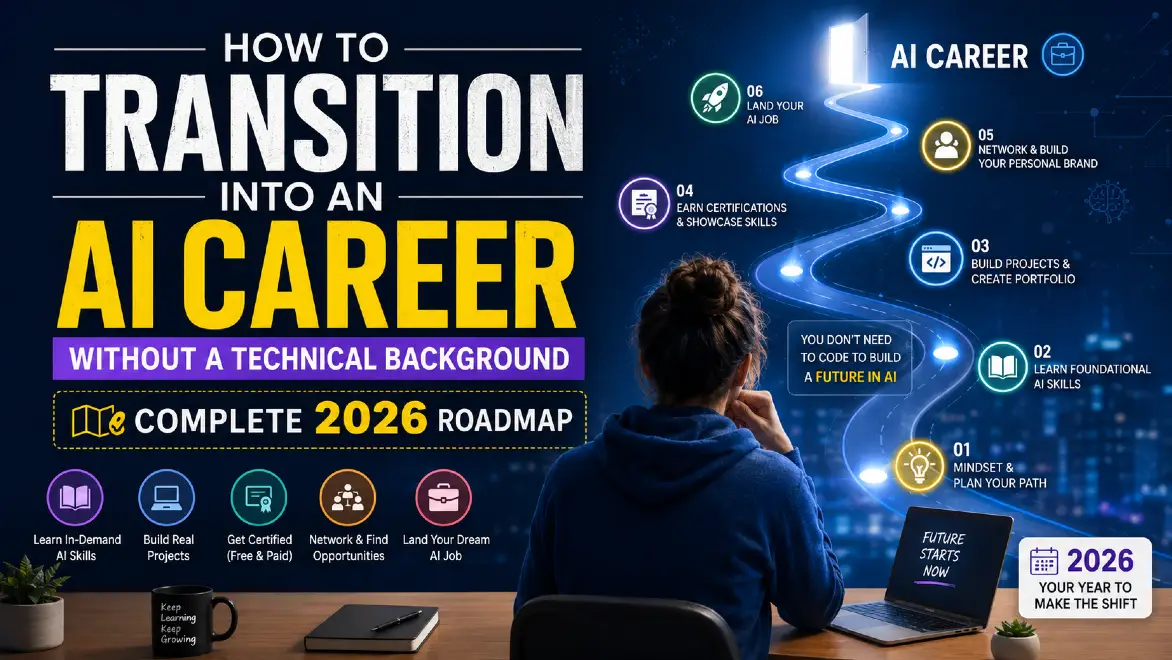
How to Transition into an AI Career Without a Technical Background (Complete 2026 Roadmap)

Jul 15, 202613 min read
KrishAI
How to Transition into an AI Career Without a Technical Background (Complete 2026 Roadmap)

If you've been putting off a move into AI because you can't write Python, you're operating on outdated information. A huge share of the AI hiring happening right now has nothing to do with training models. It's about people who can explain AI to a sales team, write the workflow that makes a chatbot actually useful, or figure out whether a new tool is worth the budget.

This guide is for the marketer who wants to stop watching from the sidelines. The HR manager who keeps getting asked "what's our AI policy?" and has no good answer yet. The teacher, the recruiter, the operations coordinator, the freelance writer. If you've never touched a line of code and don't plan to, you can still build a real, well-paid career around AI in 2026. You just need a different map than the one built for engineers.

We're going to cover which roles genuinely don't require coding, what they pay based on real 2026 salary data, which certifications are worth your time and money, and a ten-step roadmap you can start today. Every number and claim here is sourced, and where sources disagree (which happens a lot with salary data), we'll tell you so instead of pretending there's one clean answer.

Can You Work in AI Without Coding?

Yes, and the data backs this up more clearly than it did even a year ago. According to LinkedIn's Chief Economist, writing for the World Economic Forum, occupations that were historically far removed from technology, including recruiters, marketers, sellers, and healthcare professionals, are now seven times more likely to add AI skills than just six years ago. That's not a story about engineers. That's a story about everyone else catching up.

If you've already found yourself wondering whether "Prompt Engineer" specifically is a title worth chasing, our deep dive on AI Prompt Engineer jobs covers that question on its own.

The AI job market splits fairly cleanly into two camps. Technical roles (machine learning engineer, AI research scientist, data engineer) require programming, statistics, and usually a computer science or math background. Non-technical roles sit on top of that infrastructure: product management, consulting, training, operations, marketing, customer success, business analysis, and change management. These roles need you to understand what AI can and can't do, how to evaluate its outputs, and how to translate that into business value. They don't need you to build the model.

Microsoft's 2025 Work Trend Index, based on survey data from 31,000 workers across 31 countries, found that 78% of leaders are considering hiring for AI-specific roles, and that number jumps to 95% among "Frontier Firms," companies furthest along in AI adoption. The roles they listed as priorities weren't all engineering titles. They included AI trainers, data specialists, AI agent specialists, ROI analysts, and AI strategists in marketing, finance, customer support, and consulting.

There's a real hiring signal buried in LinkedIn's data too: on the platform, AI literacy skills increased more than sixfold in job postings over the past year, even though only about one in 500 jobs explicitly lists "AI literacy" as a requirement. Translation: employers want it, even when they haven't figured out how to write the job description yet. That gap is your opening.

Here's the balanced part. Non-technical AI roles are real and growing, but they're also more crowded than they were two years ago, because everyone read the same headlines you did. The people who actually get hired combine AI fluency with a domain they already know cold: healthcare, law, finance, retail, education, manufacturing. "I understand AI" is a much weaker pitch than "I understand claims processing, and I can show you exactly where AI saves us time and where it creates risk."

Why Companies Hire Non-Technical AI Professionals

Building an AI model is maybe 20% of what it takes to get value out of AI inside a real company. The other 80% is business problems: figuring out which process to automate first, training staff who are scared of the tool, writing the governance policy so legal doesn't shut the project down, and measuring whether the thing actually worked.

A few forces are driving this demand specifically:

AI adoption has outpaced AI fluency. The World Economic Forum's Future of Jobs Report 2025, drawing on data from over 1,000 employers representing 14 million workers, found that nearly 40% of job skills are expected to change by 2030, and 63% of employers cite the skills gap as their primary barrier to business transformation. Companies bought the tools. They don't have enough people who know how to use them well.

Governance and compliance are now board-level issues. With regulations like the EU AI Act taking effect and U.S. federal guidance evolving, companies need people who can document how AI is used, where humans review outputs, and how bias or error gets caught before it becomes a lawsuit.

Change management is the actual bottleneck. Microsoft's research found that while 67% of leaders report familiarity with AI agents, only 40% of employees do. That gap doesn't close itself. It closes because someone runs training sessions, writes documentation, and answers the same nervous questions from staff twenty times over.

Customer-facing AI needs a human translator. When a company rolls out an AI chatbot or AI-assisted support tool, someone has to make sure it doesn't embarrass the brand, mishandle a refund, or hallucinate a policy that doesn't exist. That's an operations and customer success job, not an engineering one.

If you want a deeper look at the governance side specifically, it's worth reading up on AI governance consulting as its own growing niche.

Best AI Careers Without a Technical Background

Below are the roles seeing the most consistent hiring activity for non-technical professionals in 2026. Salary figures vary widely by source, company size, and whether you're counting base pay or total compensation, so we've included ranges from multiple sources rather than picking one number that sounds impressive.

AI Product Manager

What they do: Own the roadmap for a product that has AI at its core, deciding what gets built, in what order, and why, while working closely with engineers and data scientists who handle the technical build.

Typical responsibilities: Writing product requirements, prioritizing features based on user needs and model capability, evaluating whether an AI feature is safe and useful enough to ship, and communicating tradeoffs to leadership.

Skills required: Product sense, stakeholder communication, enough AI literacy to understand model limitations, data interpretation, and the judgment to know when a "cool AI feature" isn't actually solving a user problem.

Salary expectations: This is the widest and most source-dependent range in AI careers right now. Glassdoor puts the average AI Product Manager salary at $197,564 per year, with a typical range of $164,106 to $243,113. ZipRecruiter's estimate is lower, at roughly $159,405 per year, with the majority of salaries between $141,000 and $197,000. Startup-focused data from Wellfound shows an average of $163,000 with a range of $97,000 to $253,000 for AI product roles at AI-focused startups, reflecting lower cash pay in exchange for equity. Entry-level AI PM roles generally start in the $85,000 to $140,000 range depending on the source, with senior and staff-level roles at major tech and AI companies reaching well past $300,000 in total compensation once equity is included.

Career progression: Associate PM → AI Product Manager → Senior/Group PM → Director of Product → VP of Product.

Who it suits: People with existing product, project, or business analyst experience, or anyone who's spent years translating "what the customer wants" into "what the team builds."

AI Consultant

What they do: Advise businesses on where and how to apply AI, often auditing current processes, recommending tools, and helping design an implementation plan.

Typical responsibilities: Running discovery workshops, identifying automation opportunities, vetting vendors, building business cases for AI investment, and sometimes managing the rollout itself.

Skills required: Business analysis, stakeholder management, a working knowledge of major AI tools and their limitations, and the ability to explain technical tradeoffs in plain business language.

Salary expectations: This title has an unusually wide salary spread because it captures everyone from junior in-house consultants to independent advisors billing by the project. Glassdoor reports an average of $208,223, with a range of $156,167 to $286,597. ZipRecruiter's estimate is far lower, around $113,566 on average, with a typical range of $96,000 to $131,500. At major consulting firms (McKinsey, BCG, Bain, Deloitte, and similar), AI-focused associate roles run $180,000 to $280,000 in total compensation, with managers at $280,000 to $420,000. Independent consultants who bill by the engagement rather than drawing a salary can earn significantly more, though that income doesn't show up in standard salary surveys since it's reported as 1099 or contract revenue rather than W-2 pay.

Career progression: Junior/Associate Consultant → Senior Consultant → Engagement Manager → Principal → Partner, or a break into independent/fractional consulting.

Who it suits: Former management consultants, business analysts, operations leads, or anyone with strong client-facing experience who wants to specialize.

AI Project Manager

What they do: Coordinate the moving parts of an AI implementation: timelines, budgets, cross-functional teams, and vendor relationships, without necessarily building anything technical themselves.

Typical responsibilities: Managing sprint planning, tracking deliverables against deadlines, communicating status to stakeholders, and de-risking projects before they blow past budget or scope.

Skills required: Traditional project management skills (many AI PMs hold a PMP or similar), plus enough AI literacy to understand why a model retraining cycle takes six weeks instead of six days.

Salary expectations: AI-focused project management roles generally track close to standard senior project manager and program manager pay, typically landing in the $100,000 to $160,000 range in the U.S., with AI-specific premiums appearing more at larger tech employers.

Career progression: Project Coordinator → Project Manager → Senior/Program Manager → Director of AI Operations.

Who it suits: Anyone already working in project or program management who wants to specialize in AI-heavy initiatives without retraining as an engineer.

AI Operations Specialist

What they do: Keep AI tools and workflows running smoothly day to day, monitoring performance, flagging issues, and coordinating between the technical team and the business units using the tool.

Typical responsibilities: Tracking usage and adoption metrics, troubleshooting workflow breakdowns, maintaining documentation, and acting as the first point of contact when something in an AI-powered process goes wrong.

Skills required: Process documentation, basic data literacy, familiarity with automation platforms, and strong troubleshooting instincts.

Salary expectations: Typically overlaps with broader "AI Operations" and "AI Success Manager" titles. Salary.com data on adjacent AI operations roles shows figures like AI Success Manager averaging around $82,469, with operations-focused AI roles generally sitting in the $70,000 to $120,000 band depending on seniority and company size.

Career progression: Operations Coordinator → AI Operations Specialist → AI Operations Manager → Director of AI Operations.

Who it suits: People coming from operations, logistics, or IT support backgrounds who like process work more than people-facing consulting.

AI Prompt Engineer (and what this role actually looks like now)

This one needs a more honest treatment than most guides give it, because the picture has genuinely shifted since 2023 and 2024.

What's actually happening: The standalone "Prompt Engineer" job title has been shrinking. Multiple industry trackers report the exact title declining by roughly 30% between 2024 and 2026, and some analyses report even steeper drops in raw posting counts. But the underlying skill hasn't gone anywhere, it's been absorbed into other roles. According to job board data compiled by the Prompt Engineer Collective, roles that require prompt engineering skills, regardless of title, grew roughly three times over the same period, and separate analysis puts prompt engineering as a required competency in 78% of AI-related job postings, up from under 20% in early 2024.

What this means practically: If you're aiming for a job with "Prompt Engineer" literally in the title, you're chasing a shrinking pool, and industry writers now flag standalone "Prompt Engineer" postings as something of a yellow flag worth investigating before accepting, since the role is often really an AI Trainer or AI Product Manager job with a leftover label. If you're aiming to be genuinely good at directing AI systems as one part of a broader role (AI Trainer, AI Content Strategist, AI Business Analyst, Applied AI roles), the skill is more valuable than ever.

Skills required: Structured, precise written communication, an understanding of how large language models actually process instructions, iterative testing habits, and increasingly, some comfort with evaluation frameworks (how do you actually measure whether one prompt is "better" than another).

Salary expectations: Where the title still exists, compensation has held up. One industry tracker's compensation data shows entry-level prompt engineering pay moving from $75,000 to $100,000 in 2024 up to $90,000 to $125,000 in 2026, and mid-level from $110,000 to $150,000 up to $130,000 to $175,000 over the same period. Coursera, citing ZipRecruiter data from mid-2025, reported a notably lower national average of $62,977, ranging from about $32,500 to $95,500, which reflects how much this figure depends on whether you're looking at dedicated AI-company roles or the broader, more generalist end of the market.

Who it suits: Writers, editors, linguists, and anyone with strong analytical writing skills, provided they pair it with a specific domain rather than treating "prompting" as a standalone identity.

AI Trainer

What they do: Improve AI model outputs by writing evaluation rubrics, reviewing and rating model responses, designing training data, and sometimes directly running the human-feedback loops (RLHF) that shape how models behave.

Typical responsibilities: Domain-specific quality review (legal accuracy, medical accuracy, tone, factuality), writing test cases, running structured comparisons between model outputs, and documenting failure patterns.

Skills required: Deep expertise in a specific subject area, careful attention to detail, and the ability to write clear evaluation criteria. This is one of the roles where your non-AI background (nursing, law, teaching, accounting) becomes a direct asset rather than something you need to work around.

Salary expectations: Glassdoor reports an average of $81,197 per year for AI Trainer roles, with a typical range of $60,898 to $112,454, and top earners reaching close to $150,000, generally reflecting deep domain specialists.

Career progression: AI Trainer → Senior AI Trainer/Evaluation Lead → AI Quality/Evaluation Manager, or a lateral move into AI Product or AI Consulting once you understand model behavior deeply.

Who it suits: Subject matter experts in any regulated or precision-heavy field: healthcare, law, finance, education, and technical writing.

AI Content Strategist

What they do: Plan how a company uses generative AI across its content operations, including where AI drafts, where humans edit, how brand voice stays consistent, and how content performance is measured.

Typical responsibilities: Building AI-assisted content workflows, setting editorial guidelines for AI-generated drafts, training writing teams on tools, and monitoring for accuracy, plagiarism, and SEO risk.

Skills required: Strong writing and editing background, SEO fundamentals, and comfort directing tools like ChatGPT, Claude, or Gemini as part of a repeatable process rather than one-off use.

Salary expectations: This role typically tracks close to senior content strategist and content marketing manager pay, generally in the $75,000 to $130,000 range in the U.S., with senior and director-level roles at larger companies extending higher.

Career progression: Content Writer/Editor → AI Content Strategist → Head of Content/Content Operations.

Who it suits: Writers, editors, and content marketers who want to stay in content but move into the strategic and workflow-design side of it.

AI Marketing Specialist

What they do: Apply AI tools across marketing functions: campaign personalization, predictive analytics, ad copy generation, and marketing automation.

Typical responsibilities: Building and testing AI-assisted campaigns, evaluating marketing AI platforms, analyzing performance data, and training the broader marketing team on new tools.

Skills required: Digital marketing fundamentals, data interpretation, and familiarity with AI-powered marketing platforms and automation tools.

Salary expectations: Generally tracks close to standard marketing manager and specialist pay with a premium for AI specialization, commonly landing in the $70,000 to $125,000 range depending on seniority and company size.

Career progression: Marketing Specialist → AI Marketing Specialist → Marketing Automation Manager → Head of Growth/Marketing.

Who it suits: Marketers who already run campaigns and want to specialize in the AI-tooling side of the function.

AI Customer Success Manager

What they do: Help clients get value out of an AI product after they've bought it, managing onboarding, adoption, and renewal for AI-powered software or services.

Typical responsibilities: Running onboarding sessions, tracking usage and adoption metrics, escalating technical issues, and acting as the voice of the customer back to the product team.

Skills required: Relationship management, enough product knowledge to troubleshoot common issues, and the communication skills to explain AI capabilities (and limitations) without overpromising.

Salary expectations: Standard customer success manager pay applies here, typically $65,000 to $110,000 depending on seniority and industry, with AI-specific and enterprise SaaS roles trending toward the higher end.

Career progression: Customer Success Associate → CSM → Senior CSM → Director of Customer Success.

Who it suits: People with a background in account management, support, or hospitality who are comfortable being the human face of a technical product.

AI Business Analyst

What they do: Translate business problems into requirements an AI or data team can act on, and translate AI capabilities back into terms the business can use to make decisions.

Typical responsibilities: Gathering requirements, documenting processes, running cost-benefit analysis on proposed AI projects, and validating that a delivered AI solution actually solves the original business problem.

Skills required: Traditional business analysis skills (requirements gathering, process mapping, stakeholder interviews) plus enough data and AI literacy to sit credibly between business and technical teams.

Salary expectations: AI-focused business analyst roles generally track close to standard senior business analyst pay, with consulting-firm data showing business analyst-level AI consulting roles around $120,000 to $150,000 in total compensation at major firms, and generalist market data putting most AI business analyst roles in the $70,000 to $115,000 range outside of top-tier consulting.

Career progression: Business Analyst → Senior Business Analyst → AI Business Analyst/Product Owner → AI Program Manager.

Who it suits: Anyone already working as a business or systems analyst who wants to specialize without retraining as a developer.

AI Implementation Consultant

What they do: Manage the practical rollout of an AI tool inside a specific company: configuration, integration planning, staff training, and measuring adoption.

Typical responsibilities: Running kickoff and discovery sessions, coordinating with the vendor's technical team, building rollout timelines, and training end users.

Skills required: Project coordination, client-facing communication, and a working understanding of the specific platform being implemented (this is often more valuable than general AI knowledge).

Salary expectations: Frequently overlaps with AI Consultant and AI Project Manager pay bands, generally $85,000 to $150,000 depending on seniority, with vendor-side implementation roles at major AI software companies often paying toward the top of that range.

Career progression: Implementation Specialist → Senior Implementation Consultant → Implementation Manager → Director of Customer Implementation.

Who it suits: People who like the concrete, hands-on satisfaction of getting a tool actually working for a client rather than the more abstract strategy side of consulting.

AI Adoption Specialist

What they do: Focus specifically on the human side of AI rollout inside an organization: training, communication, resistance management, and measuring whether employees are actually using the new tools.

Typical responsibilities: Designing and delivering training programs, gathering employee feedback, identifying pockets of resistance or confusion, and reporting adoption metrics to leadership.

Skills required: Instructional design, change management, internal communications, and patience. A lot of patience.

Salary expectations: Often filed under Learning & Development, Change Management, or Internal Communications pay bands with an AI premium, typically $65,000 to $120,000 depending on company size and seniority.

Career progression: L&D Specialist/Change Analyst → AI Adoption Specialist → Change Management Lead → Head of People Operations/Digital Transformation.

Who it suits: HR, L&D, and internal communications professionals who want to own the "getting people to actually use this" problem, which is, honestly, most of the problem.

RoleTypical U.S. Salary Range (varies by source)Best Fit Background
AI Product Manager~$85K entry to $300K+ senior/total compProduct, project management
AI Consultant~$95K to $280K+ (wide by source)Consulting, business analysis
AI Project Manager~$100K to $160KProject/program management
AI Operations Specialist~$70K to $120KOperations, IT support
AI Trainer~$61K to $148KAny deep domain expertise
AI Content Strategist~$75K to $130KWriting, editing, content marketing
AI Marketing Specialist~$70K to $125KDigital marketing
AI Customer Success Manager~$65K to $110KAccount management, support
AI Business Analyst~$70K to $150KBusiness/systems analysis
AI Implementation Consultant~$85K to $150KClient services, project coordination
AI Adoption Specialist~$65K to $120KHR, L&D, change management

Ranges are directional and reflect multiple 2026 sources (Glassdoor, ZipRecruiter, Salary.com, and industry-specific salary guides), which frequently disagree by tens of thousands of dollars for the same title. Treat these as a starting point for negotiation research, not a guarantee.

Step-by-Step Career Roadmap

You don't need to do all of this in order, and you definitely don't need to spend a year "preparing" before you apply to anything. Here's a realistic sequence.

Step 1: Understand AI fundamentals. Before you touch a certification, get comfortable with the basic vocabulary: what a large language model is, what "generative AI" means versus older machine learning, and what AI is currently good and bad at. Free resources like Elements of AI (University of Helsinki) or a short course like Google AI Essentials will get you here in under two weeks.

Step 2: Learn how large language models work, in plain English. You don't need the math. You need the mental model: these systems predict likely continuations of text based on patterns in massive amounts of data, they don't "know" things the way a person does, and that's exactly why prompt clarity and human review both matter. Understanding this well is what separates people who can troubleshoot AI output from people who just accept whatever it gives them.

Step 3: Master prompt engineering as a skill, not a job title. Learn the core techniques: giving clear context, specifying format and tone, using examples (few-shot prompting), and breaking complex tasks into steps. Practice this inside your actual job. Write real prompts for real tasks and keep the ones that worked.

Step 4: Become proficient with leading AI tools. Pick two or three tools relevant to your target role and go deep rather than wide. A content strategist should know ChatGPT, Claude, and an SEO-AI tool cold. An operations specialist should know Zapier or Make plus whatever automation platform their target industry uses.

Step 5: Build practical projects. This is the step most career changers skip, and it's the one that actually gets you hired. Pick a real problem from your current job or industry and solve it with AI: automate a repetitive report, build a customer FAQ chatbot flow (even just planned on paper), or design an AI-assisted content calendar. Document what you did and why.

Step 6: Create an AI portfolio. Turn your projects into something a hiring manager can actually look at. This doesn't need to be fancy. A simple site, a PDF case study, or even a well-organized set of Notion pages works, as long as it shows your thinking, not just your output.

Step 7: Earn relevant certifications. Certifications won't get you hired on their own, but they clear resume screens and signal initiative. Pick one or two that match your target role rather than collecting a stack of them (more on which ones below).

Step 8: Develop industry expertise. This is your actual differentiator. "I know AI" describes thousands of people applying for the same jobs. "I know how AI applies to healthcare claims processing, and I have eight years in the industry to prove it" describes almost nobody. Lean into whatever domain you already have.

Step 9: Build a professional network. Join AI-focused communities relevant to your industry, not general "AI hype" groups. Comment thoughtfully on posts from people doing the work you want to do. Attend virtual or local events. A surprising number of non-technical AI roles get filled through referrals before they're ever posted publicly.

Step 10: Apply strategically. Don't spray applications at every "AI" job title. Target roles where your existing background is the differentiator, tailor your resume around measurable outcomes (time saved, cost reduced, adoption increased), and be honest in interviews about what you know and what you're still learning. Hiring managers can tell the difference between real experience and buzzword fluency almost instantly.

Best AI Skills to Learn

Prompt engineering. Still the entry point for working effectively with any AI tool, even though the standalone job title is fading. Think of it as basic literacy, not a specialization on its own.

AI workflows and automation. Understanding how to chain AI tools together with platforms like Zapier or Make turns "I used ChatGPT once" into "I built a process that saves the team six hours a week."

AI productivity tools. Practical, daily fluency with tools like Copilot, Claude, and Gemini inside real work tasks. Microsoft's research is direct about this: 82% of leaders plan to use AI agents to expand workforce capacity within 12 to 18 months, and the people managing those agents need to actually know how to use them.

Data literacy. You don't need to be a data scientist, but you do need to read a chart critically, spot a misleading metric, and understand roughly how AI models are trained on data, including where bias creeps in.

Critical thinking. The single most protective skill against AI hallucination and overreach. Employers are explicitly looking for people who question AI output rather than rubber-stamping it.

Communication. Translating between technical teams and business stakeholders is most of what non-technical AI roles actually involve day to day.

AI ethics and governance basics. Even a working knowledge of responsible AI principles (bias, transparency, data privacy, human oversight) makes you more hireable, especially as regulation tightens globally.

Business analysis. Requirements gathering, process mapping, and cost-benefit analysis are the connective tissue between "we have an AI tool" and "we're actually getting value from it."

Process improvement. Lean or Six Sigma-style thinking, applied to figuring out where AI genuinely helps a workflow versus where it just adds complexity.

The World Economic Forum's skills data backs up this mix directly: alongside AI and big data, the report identifies creative thinking, resilience, flexibility and agility, and curiosity and lifelong learning as some of the fastest-rising skills employers want through 2030, and notes that AI and big data, analytical thinking, creative thinking, and technological literacy sit together as skills that are already core today and expected to keep growing. The pattern is consistent: technical AI literacy paired with distinctly human judgment, not technical AI literacy alone.

Recommended Learning Resources

Coursera. The default hub for structured AI learning. Hosts Google AI Essentials, IBM's AI certificates, DeepLearning.AI courses, and Andrew Ng's foundational specializations. Good for people who want video-based, guided learning with a certificate at the end.

Google. Google AI Essentials is widely recommended as the best entry point for complete beginners, roughly under 10 hours to complete and costing around $49. Google also launched a deeper Google AI Professional Certificate, which moves professionals from basic AI awareness toward hands-on practice across seven courses, and includes complimentary access to Google's AI tools during the program.

Microsoft Learn. Free, self-paced technical and conceptual content, best paired with the official AI-900 (Azure AI Fundamentals) certification if you're targeting Microsoft-centric employers.

DeepLearning.AI. Andrew Ng's "AI For Everyone" is the standard-setter for non-technical business leaders who want a genuinely solid conceptual foundation without code.

LinkedIn Learning. Strong for role-specific micro-courses (AI for marketers, AI for HR, AI for project managers) that map directly onto the non-technical roles covered in this guide.

Anthropic and OpenAI learning resources. Both companies publish documentation and short guides on prompting and responsible use directly on their sites. These are worth reading not for certification value, but because they're the closest thing to "straight from the source" guidance on how the tools actually behave.

Hugging Face. More technical than most beginners need, but its free courses are useful if you want to understand what's happening "under the hood" without committing to a full engineering path.

Kaggle. Primarily for people building genuine data science skills. Most non-technical career changers can skip this unless their target role specifically touches data science collaboration.

Best AI Certifications

The certification landscape has matured enough that there's now a fairly clear consensus on what's worth pursuing, based on your goal.

CertificationBest forTime / CostNotes
Google AI EssentialsAbsolute beginners, non-technical roles~10 hours, ~$49Best starting point for beginners, accessible and well-produced with Google brand recognition
Microsoft Azure AI Fundamentals (AI-900)Career switchers, Microsoft-centric employersWeeks of prep, proctored examA proper proctored exam testing Azure AI services, ML concepts, and responsible AI, strongest recognition for technical hiring alongside AWS
IBM AI Foundations / SkillsBuildBeginners wanting more hands-on depthFree to low-costParticularly valuable for tech-adjacent roles in finance, healthcare, and consulting
DeepLearning.AI "AI For Everyone"Managers and business leadsDaysFree to audit; strong conceptual grounding without code
AWS Certified AI PractitionerAWS-centric organizationsWeeks of prepBest for roles in AWS-centric organizations, more accessible than the older AWS ML Specialty exam
Elements of AI (University of Helsinki)Free, deep conceptual understandingSelf-paced, freeWidely respected academic-backed alternative to corporate courses

A useful way to think about certifications: a course certificate shows you learned something, while a skills-based certificate or portfolio shows you can actually perform. Recruiters increasingly recognize the difference between "certificate of completion" and a formally proctored "certification," so don't assume they're interchangeable on a resume. One well-chosen, thoroughly completed certification paired with a real project will outperform a stack of five badges from courses you rushed through.

Build a Portfolio Without Coding

A portfolio is what separates "I took a course" from "I can do this job." You don't need to build software to have one. You need to show finished, thoughtful work.

AI workflow optimization. Document a real (or realistic) example of how you'd use AI to cut time out of a repetitive process, like turning a two-hour weekly report into a fifteen-minute one using a defined AI-assisted workflow.

Marketing automation case study. Show how you'd use AI tools to personalize email campaigns or generate and test ad variations, including your reasoning for what to automate and what to keep human.

Customer support chatbot planning. You don't need to code a chatbot. Design the conversation flow, the escalation rules, and the tone guidelines. This demonstrates exactly the judgment an AI Implementation Consultant or Customer Success Manager needs.

AI content systems. Build a sample editorial workflow showing how AI drafts, where a human edits, and how you'd catch factual errors before publishing.

AI research assistant setups. Document how you'd configure an AI tool to help with a specific research or analysis task in your field, with example prompts and the reasoning behind them.

Business process documentation. Take a messy, real process from your current or former job and show a clear "before AI" and "after AI" version, with estimated time or cost savings.

Present these professionally: a simple personal website, a well-formatted PDF, or a curated LinkedIn "Featured" section all work. What matters is clarity and reasoning, not production value. Every project should answer three questions: what was the problem, what did you do, and what was the measurable result.

Common Mistakes Career Changers Make

Learning too many tools at once. Trying to become "fluent" in fifteen different AI platforms usually means being genuinely useful with none of them. Go deep on two or three that match your target role.

Chasing every trend. Prompt engineering, then AI agents, then whatever gets hyped next month. Trend-chasing signals to employers that you don't have a direction. Pick a lane based on your existing strengths.

Ignoring business skills. The technical AI knowledge is genuinely the easier half to learn. The harder, more valuable half is business judgment: knowing which problems are worth solving with AI and which aren't.

Skipping networking. A huge share of non-technical AI roles get filled through internal referrals and warm introductions before they're posted publicly. If you're only applying cold, you're competing for a smaller slice of the market than you realize.

Waiting until you feel "ready." There's always another certification, another course, another skill you could add first. Most hiring managers care far more about demonstrated judgment than a perfect resume. Start applying once you have one solid project and one relevant certification.

Not building a portfolio. The single most common gap. People finish three certifications and still have nothing concrete to show for it. A portfolio is what turns "I've been studying AI" into "here's what I built."

AI Tools Worth Learning

ChatGPT. The default general-purpose assistant for drafting, brainstorming, summarizing, and analysis across almost every business function.

Claude. Strong for longer documents, nuanced writing, and structured reasoning tasks, widely used in content, research, and analysis workflows.

Gemini. Google's assistant, tightly integrated with Google Workspace, useful if your organization already runs on Docs, Sheets, and Gmail.

Perplexity. An AI-powered research and search tool, useful for competitive research, fact-checking, and quickly synthesizing information from multiple sources with citations.

Notion AI. Built into Notion's workspace, useful for teams that already manage documentation, project tracking, and knowledge bases there.

Microsoft Copilot. Embedded across Word, Excel, Outlook, and Teams, and central to how Microsoft-centric enterprises are rolling out AI at scale.

Zapier AI and Make. No-code automation platforms that let you connect AI tools to the rest of your software stack, which is often exactly what an AI Operations Specialist or Implementation Consultant needs to build in practice.

Canva AI. Useful for marketing and content roles that need fast, on-brand visual assets without a design team.

Each of these fits differently depending on your target role: a content strategist lives in ChatGPT and Claude, an operations specialist lives in Zapier and Make, and a marketing specialist probably touches all of the above plus Canva.

Frequently Asked Questions

Can I work in AI without coding? Yes. Roles like AI Product Manager, AI Consultant, AI Trainer, and AI Business Analyst focus on strategy, communication, and implementation rather than building models. Coding helps in some technical-adjacent roles, but it isn't required for most business-facing AI positions.

Which AI career is easiest to enter for beginners? AI Trainer roles are often the most accessible starting point because they reward subject-matter expertise you likely already have, rather than requiring you to learn AI concepts from scratch first. AI Operations and Customer Success roles are also common entry points.

Do I need a computer science degree? No. Most non-technical AI roles prioritize domain expertise, communication skills, and business judgment over a specific degree. A strong portfolio and relevant certification typically matter more than your degree field.

How long does the transition take? Realistically three to nine months for most career changers, depending on how much time you can dedicate weekly and whether you're moving into a role adjacent to your current job (faster) or a completely new function (slower).

Which certifications matter most? Google AI Essentials for a fast, credible foundation. Microsoft AI-900 or AWS Certified AI Practitioner if you're targeting employers on those cloud platforms. One well-completed certification paired with a real project outperforms several rushed ones.

Can ChatGPT or Claude help me learn AI? Yes, directly. Use them to explain concepts you don't understand, practice writing and refining prompts, get feedback on your portfolio projects, and prepare for interviews by asking them to role-play as a hiring manager.

What skills do employers want most? AI literacy paired with critical thinking, clear communication, and domain expertise. LinkedIn data shows AI literacy is now one of the fastest-rising requested skills across roles that traditionally had nothing to do with tech.

Which industries hire AI professionals? Nearly all of them. Healthcare, finance, retail, marketing, education, and manufacturing are showing particularly strong demand for AI implementation, training, and governance roles, largely because they have the most repetitive, document-heavy processes to improve.

Is prompt engineering still a career? As a standalone job title, it's shrinking. As a core skill embedded inside roles like AI Trainer, AI Product Manager, and AI Content Strategist, it's more in demand than ever. Learn it as a skill you bring to a role, not a job title to chase.

How can I get my first AI job? Build one solid portfolio project in your current field, earn one relevant certification, and target roles adjacent to your existing experience rather than a completely unrelated technical role. Network inside your industry specifically, since many non-technical AI roles get filled through referrals before they're posted.


Conclusion

There's no single door into an AI career. There's a set of adjacent paths, and the fastest one for you almost certainly runs through whatever you already know how to do well. If you're in marketing, your path is AI Marketing Specialist or AI Content Strategist. If you're in operations, it's AI Operations Specialist or AI Implementation Consultant. If you've spent a decade being the person who actually knows how the business runs, AI Business Analyst or AI Consultant is closer than it looks.

Skip the temptation to learn everything at once. Pick a role that fits your background, build one real project that proves you can apply AI to an actual problem, get one certification that matches your target employer, and start applying before you feel completely ready. Nobody transitioning into AI in 2026 has all the answers yet, including the people already working in it. The market is rewarding people who show up with judgment, domain knowledge, and a willingness to keep learning, not people who wait for a perfect resume.

Start smaller than you think you need to. Build the one project. Send the first five applications. The roadmap works, but only once you're actually on it.


Related reading

AI Prompt Engineer Jobs: Is This Career Still Worth Pursuing?

Claude Code vs Cursor vs GitHub Copilot

AI Governance Consulting

What Jobs Are Safe from AI?

Tags

#AI Careers#Career Change#Artificial Intelligence#Career Development#Non-Technical Professionals#AI Skills#Prompt Engineering#Upskilling#Future of Work#Professional Development