
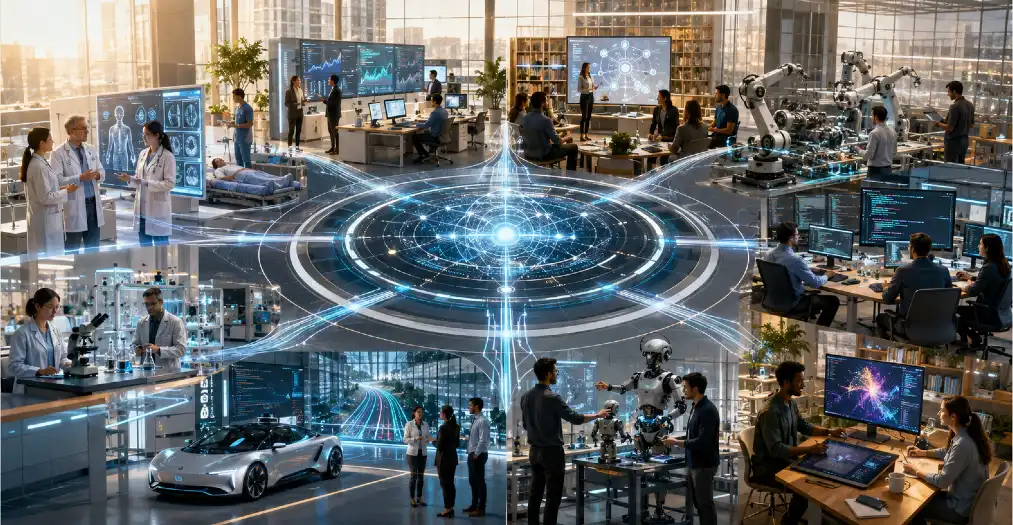
Every generation gets one technology that rewires how the economy works. For Baby Boomers, it was the personal computer. For Millennials, it was the smartphone. For the rest of us, it's happening right now - and it's bigger, faster, and stranger than either of those before it.
Walk into almost any boardroom in 2026 and you'll hear the same phrase repeated like a mantra: the AI Super Cycle. Not as a side project anymore, but as the central strategic question every company is trying to answer. Meanwhile, hundreds of billions of dollars are pouring into data centers, chips, and power grids at a pace that has genuinely startled people who've spent entire careers studying technology cycles.
This isn't a hype wave that will quietly deflate in eighteen months. It's what analysts and economists have started calling the AI Super Cycle - a sustained, multi-year period of technological, economic, and organizational transformation driven by artificial intelligence. And whether you're running a company, investing capital, building a career, or just trying to make sense of the headlines, understanding this cycle is no longer optional.
This piece breaks down what the AI Super Cycle actually is, why it's happening now, where the real opportunities and risks sit, and what businesses and individuals should be doing about it today.
Key Takeaways
- The AI Super Cycle refers to a multi-year, economy-wide transformation driven by generative AI, AI agents, and massive infrastructure investment - not a short-term hype cycle.
- Global AI infrastructure spending is on pace to reach the trillions of dollars this decade, with hyperscalers alone committing hundreds of billions annually.
- Enterprise AI adoption is nearly universal, but scaling AI to deliver real financial impact remains rare - most organizations are still in pilot mode.
- AI agents, enterprise automation, healthcare AI, and multimodal models are among the biggest trends reshaping industries in 2026.
- Real risks exist: energy consumption, workforce disruption, bias, regulation, and hallucinations all demand serious attention.
- Businesses that succeed will pair bold experimentation with strong governance, data discipline, and realistic ROI measurement.
What Is the AI Super Cycle?
A "super cycle" is a term economists borrowed from commodities markets, where it describes a prolonged period - often a decade or more - of above-trend demand, investment, and price growth driven by a structural shift in the economy rather than a temporary spike.
Applied to artificial intelligence, the AI Super Cycle describes something similar: a sustained wave of investment, adoption, and innovation that touches nearly every sector of the economy at once, rather than a narrow boom confined to one industry.
It helps to compare it with previous technology waves.
The internet revolution of the late 1990s and 2000s connected information. It changed how we communicate, shop, and consume media, but the underlying infrastructure - servers, browsers, bandwidth - took years to mature, and most companies didn't need to rebuild their operations around it immediately.
The smartphone revolution that followed did something different. It put computing in every pocket and created entirely new industries: app stores, ride-sharing, mobile-first commerce. It moved faster than the internet wave, but it was still primarily a consumer-facing shift.
The AI Super Cycle is different again, for one simple reason: it's not just changing what we can access. It's changing what work itself looks like. AI systems can now write code, analyze contracts, draft marketing campaigns, diagnose medical images, and increasingly act autonomously to complete multi-step tasks. That capability touches every department in every company, not just the consumer-facing parts of the economy.
Experts call it a super cycle because three things are happening simultaneously: unprecedented capital investment in physical infrastructure, rapid technical capability gains in the models themselves, and broad-based adoption across industries that don't typically move in sync. When infrastructure, capability, and adoption all accelerate together, you get a cycle that's longer and deeper than a typical tech trend.
Why the AI Super Cycle Is Happening Now
Technology historians will eventually point to a handful of converging factors that made the AI Super Cycle possible. None of them were sufficient on their own - it's the combination that matters.
Large language models crossed a usability threshold. For years, AI research produced impressive but narrow results. The breakthrough that triggered the current cycle was the emergence of large language models (LLMs) capable of general-purpose reasoning, writing, and problem-solving through natural language - no specialized training required to use them.
GPU advancements made training and inference economically viable. Specialized AI chips, led by Nvidia but increasingly contested by AMD, Broadcom, and custom silicon from hyperscalers, delivered the raw compute power needed to train ever-larger models and serve them to billions of users.
Cloud computing removed the barrier to entry. Because AWS, Azure, and Google Cloud already existed, companies didn't need to build data centers to experiment with AI. They could rent compute by the hour, dramatically lowering the cost of getting started.
Open-source AI accelerated the pace of innovation. Open-weight models gave startups, researchers, and enterprises the ability to build on top of state-of-the-art AI without paying licensing fees to a handful of labs, spreading capability far more widely than in previous tech cycles.
Enterprise adoption reached critical mass. According to McKinsey's most recent global AI survey, almost all survey respondents say their organizations are using AI, and many have begun to use AI agents, even though most are still in the early stages of scaling AI and capturing enterprise-level value.
Data availability exploded. Decades of digitized text, images, code, and transaction records gave model developers the raw material needed to train increasingly capable systems.
AI costs fell dramatically. The cost per unit of AI intelligence - measured in tokens processed or queries answered - has dropped sharply as competition between model providers intensified and inference got more efficient, making AI viable for use cases that would have been cost-prohibitive just two years ago.
Put these together, and you get a rare alignment: powerful technology, cheap distribution, falling costs, and genuine enterprise demand, all at once.
Major Trends Driving the AI Super Cycle
These ten trends represent the clearest, most measurable expressions of the AI Super Cycle at work today.
AI Agents
If 2023 and 2024 were about chatbots, 2025 and 2026 are about agents - AI systems that don't just answer questions but plan and execute multi-step tasks with limited human supervision. McKinsey's 2025 survey found that 23 percent of respondents report their organizations are scaling an agentic AI system somewhere in their enterprises, while an additional 39 percent say they have begun experimenting with AI agents. That said, use of agents is not yet widespread, and most of those who are scaling agents say they're only doing so in one or two functions. Agent adoption is currently concentrated in IT service management, research, and customer support - areas with clear, bounded workflows.
Enterprise AI
Enterprise AI is arguably the most visible face of the AI Super Cycle, and it has moved well past pilot projects at the biggest companies. Adoption is close to universal in name, but true transformation is not. 88% of organizations now use AI, yet McKinsey's research identifies a small group of "AI high performers" - roughly 6% of respondents - that report significant value and attribute more than 5% of EBIT to AI. The gap between using AI and profiting meaningfully from it remains the defining tension of enterprise adoption right now.
Automation
Robotic process automation is merging with generative AI to create a new category: intelligent automation that can handle unstructured tasks - reading a contract, summarizing a claim, routing a customer request - that traditional automation tools couldn't touch.
AI Infrastructure
This is where the capital behind the AI Super Cycle is flowing. Goldman Sachs estimates roughly $7.6 trillion of capital will be deployed between 2026 and 2031 across compute, data centers, and power to support the AI build-out. Gartner projects that worldwide AI spending will total $2.5 trillion in 2026, with AI infrastructure alone contributing roughly $401 billion of that total. Analysts at Morgan Stanley put the scale in even starker terms, estimating that nearly $3 trillion of AI-related infrastructure investment will flow through the global economy by 2028, with more than 80% of that spending still ahead.
Robotics
Physical AI is one of the newer fronts of the AI Super Cycle. Robots that combine large models with sensors and actuators are moving from research labs into warehouses, factories, and increasingly, homes. Humanoid robotics remains early-stage, but the underlying perception and planning models are advancing quickly because they share architecture with the same foundation models powering chatbots.
Healthcare AI
AI-assisted diagnostics, drug discovery acceleration, and clinical documentation tools are among the fastest-maturing applications, in part because the return on investment - faster diagnoses, reduced administrative burden - is easy to measure.
Financial AI
Banks and asset managers are deploying AI for fraud detection, credit underwriting, algorithmic research, and increasingly, client-facing advisory tools, while wrestling with strict regulatory requirements around explainability.
Cybersecurity
AI is a double-edged sword here: it's powering next-generation threat detection while simultaneously giving attackers new tools for phishing, deepfakes, and automated exploit discovery. Security teams are in an arms race that shows no signs of slowing.
Coding Assistants
AI-powered coding tools have become one of the clearest productivity wins of the entire AI Super Cycle. Developers routinely report meaningful time savings on boilerplate code, debugging, and documentation - freeing up time for architecture and problem-solving.
Multimodal AI
The newest wave of models can process and generate text, images, audio, and video within a single system. This is unlocking use cases from automated video editing to AI systems that can "see" a factory floor and flag anomalies in real time.
Industries Being Transformed
Few industries are sitting out the AI Super Cycle. Here's a snapshot of how ten major sectors are putting AI to work today.
| Industry | Primary AI Use Cases | Real-World Example |
|---|---|---|
| Healthcare | Diagnostics, drug discovery, clinical notes | AI-assisted radiology screening tools flagging anomalies for physician review |
| Finance | Fraud detection, underwriting, research | AI models scanning transaction patterns in real time to flag fraud |
| Manufacturing | Predictive maintenance, quality control | Computer vision systems catching defects on the production line |
| Retail | Personalization, inventory forecasting | Demand forecasting models reducing overstock and stockouts |
| Education | Personalized tutoring, administrative automation | AI tutors adapting pacing to individual student performance |
| Software | Coding assistants, testing, DevOps | AI pair programmers accelerating code review cycles |
| Transportation | Route optimization, autonomous systems | Fleet management platforms using AI for dynamic routing |
| Marketing | Content generation, campaign optimization | AI-generated ad variants tested at scale for performance |
| Agriculture | Crop monitoring, yield prediction | Satellite and drone imagery analyzed for early pest detection |
| Government | Citizen services, fraud detection, document processing | AI chatbots handling routine constituent inquiries |
A few patterns from the AI Super Cycle cut across all ten industries. First, the earliest wins tend to come from back-office and administrative work - the unglamorous processes that were always ripe for automation but too unstructured for older tools. Second, customer-facing AI deployments move more cautiously, because trust and accuracy matter more when the AI is interacting directly with the public. Third, regulated industries like healthcare, finance, and government are adopting AI more deliberately, prioritizing auditability over speed.
Opportunities Created by the AI Super Cycle
The upside of the AI Super Cycle is substantial for those who position themselves well.
Productivity gains are real, if uneven. Employees using AI tools for research, writing, and coding routinely report time savings on specific tasks. The challenge for most companies isn't finding productivity gains - it's translating those individual gains into organization-wide financial impact.
New business models are emerging. Usage-based pricing, AI-native software categories, and entirely new product lines - from AI copilots embedded in existing software to standalone agentic platforms - are creating market opportunities that didn't exist three years ago.
The startup ecosystem is thriving. Lower infrastructure costs and access to powerful foundation models mean small teams can build products that would have required entire engineering departments a decade ago. Venture funding has concentrated heavily around AI-native startups building applications, tooling, and infrastructure.
New jobs are being created even as others change. Roles like AI product manager, prompt engineer, AI governance specialist, and machine learning operations engineer barely existed five years ago and are now common job postings.
AI entrepreneurship is more accessible than in prior tech waves. Because foundational models are available via API or open weights, a founder no longer needs a research lab to build an AI-powered product - just a clear problem to solve and the discipline to build around it.
Investment opportunities span the entire value chain. From chipmakers and data center operators to power infrastructure providers and application-layer software companies, capital is flowing into every layer of the AI stack, not just the most visible names.
Innovation is compounding. Because AI tools themselves accelerate research and development - helping scientists analyze data faster, helping engineers prototype faster - each cycle of improvement tends to shorten the time to the next one.
Risks and Challenges
No honest account of the AI Super Cycle can ignore its costs and uncertainties. This is where balance matters most, and where readers deserve a clear-eyed look rather than a sales pitch.
Privacy. AI systems trained on and processing vast amounts of personal data raise legitimate concerns about how that data is collected, stored, and used - particularly as agentic systems gain the ability to take actions on a person's behalf.
Security. The same capabilities that make AI useful for cybersecurity defense also make it useful for attackers. Prompt injection, data poisoning, and AI-generated phishing are now standard items on every security team's risk register.
Bias. AI models trained on historical data can reproduce and even amplify existing biases in hiring, lending, and law enforcement contexts, making fairness testing and diverse training data essential rather than optional.
Regulation. Governments worldwide are still working out how to regulate AI without stifling innovation. The regulatory patchwork - different rules in the EU, US, and Asia - creates real compliance complexity for global companies.
Copyright. Ongoing legal disputes over whether training AI models on copyrighted material constitutes fair use remain unresolved in many jurisdictions, creating uncertainty for both AI developers and content creators.
Workforce disruption. McKinsey's own research on organizational readiness finds that leaders expect AI to change roles significantly over the next one to two years, with younger leaders notably more optimistic about AI taking on autonomous responsibilities than their senior counterparts. Change management, reskilling, and honest communication with employees matter as much as the technology itself.
AI hallucinations. Even the most advanced models still occasionally generate confident, plausible-sounding, and completely incorrect information - a risk that grows more consequential as AI is deployed in higher-stakes contexts like healthcare and finance.
Energy consumption. This is one of the most underappreciated risks of the cycle. The International Energy Agency projects global data center electricity consumption will more than double to around 945 terawatt-hours by 2030 - roughly equivalent to Japan's total electricity consumption today - and AI is the most important driver of this growth. In the United States specifically, data centers are set to account for nearly half of electricity demand growth between now and 2030, and by decade's end the country is projected to consume more electricity for data centers than for the production of aluminium, steel, cement, chemicals, and all other energy-intensive goods combined. That has direct implications for grid capacity, electricity prices, and climate targets.
Ethical concerns. Questions about accountability when AI systems make consequential decisions, the appropriate limits of AI autonomy, and how much human oversight is genuinely required remain unresolved - and will likely stay contested for years.
None of this means the AI Super Cycle's opportunity isn't real. It means that opportunity comes with genuine trade-offs that deserve clear-eyed attention rather than either blind enthusiasm or reflexive dismissal.
What Businesses Should Do Today
Given the scale of both the opportunity and the risk in the AI Super Cycle, here's practical guidance for leaders trying to navigate it responsibly.
-
Start small, but start. Pick a narrow, well-defined process with measurable outcomes rather than attempting an enterprise-wide AI transformation on day one.
-
Invest in AI literacy, not just AI tools. Employees who understand what AI can and can't do make better decisions about when to trust its output - and when to double-check it.
-
Train employees on responsible use. This includes knowing what data is appropriate to input into AI tools and understanding the limitations of AI-generated content.
-
Build governance before you scale. Governance is what separates companies that ride the AI Super Cycle safely from those that get burned by it. McKinsey's research on responsible AI found that organizations investing in governance and risk management achieve meaningfully higher maturity and realized value than those that don't - yet only about 30 percent of organizations reach a maturity level of three or higher in strategy, governance, and agentic AI controls.
-
Measure ROI honestly. Track well-defined KPIs from the start rather than relying on anecdotal enthusiasm. Organizations that do this consistently report stronger bottom-line impact from their AI investments.
-
Protect your data. AI systems are only as trustworthy as the data governance behind them. Strong data security and access controls aren't optional extras - they're prerequisites.
-
Choose the right tools for the job. Not every problem needs a custom-built agentic system. Sometimes a simple automation script or an off-the-shelf tool solves the problem faster and more reliably.
-
Redesign workflows, don't just bolt on AI. The organizations seeing the most value are the ones willing to rethink how work gets done, not just add an AI feature to an existing process.
The Future of the AI Super Cycle
Predicting exactly where the AI Super Cycle goes over the next five to ten years is a fool's errand - anyone who claims certainty here is overselling their confidence. But a few evidence-based trajectories seem reasonably likely.
Infrastructure spending will keep climbing before it plateaus. IDC projects global AI infrastructure spending will reach $487 billion in 2026 and exceed $1 trillion by 2029. That kind of capital commitment doesn't reverse overnight, but it will eventually moderate as the market shifts from build-out to optimization - much like the fiber-optic infrastructure built during the dot-com era eventually found its long-term use, even after the initial investment cycle cooled.
Agentic AI will mature from novelty to infrastructure. Just as cloud computing went from experimental to assumed default, AI agents handling multi-step workflows are likely to become standard business infrastructure within the next several years - though probably more slowly, and with more human oversight built in, than today's most bullish forecasts suggest.
Energy will become a genuine bottleneck. Power availability, not chip supply, may end up being the constraint that shapes where and how fast AI infrastructure can expand, pushing more investment toward grid modernization, nuclear power, and on-site generation.
Regulation will converge, slowly and unevenly. Expect continued fragmentation between major regulatory blocs in the near term, with gradual convergence around baseline safety and transparency standards as the technology matures and incidents inform policy.
The gap between AI leaders and laggards will widen before it narrows. Organizations that build genuine AI capability - not just AI usage - are likely to pull meaningfully ahead of competitors that treat AI as a bolt-on feature, at least until best practices become more standardized across industries.
Workforce transformation will be gradual, not sudden. History suggests that transformative technologies reshape job categories over years and decades, not months - even when the underlying capability arrives quickly.
Conclusion: Making Sense of the AI Super Cycle
The AI Super Cycle isn't a prediction about the future - it's a description of what's already happening. Trillions of dollars are being committed to infrastructure. Nearly every enterprise has some form of AI in production. New industries, business models, and job categories are emerging in real time.
But this cycle also comes with real costs: energy strain, workforce disruption, unresolved legal questions, and the ever-present risk of AI systems confidently getting things wrong. The organizations and individuals who navigate this moment well won't be the ones who chase every headline or panic at every risk. They'll be the ones who stay grounded - experimenting deliberately, measuring honestly, and building the governance and literacy needed to use AI responsibly as it keeps evolving.
The AI Super Cycle rewards curiosity paired with discipline. Staying informed isn't optional anymore - it's the baseline for staying relevant.
Frequently Asked Questions
What is the AI Super Cycle? The AI Super Cycle refers to a sustained, multi-year period of AI-driven investment, technological advancement, and enterprise adoption that's reshaping the global economy, similar in scale to previous technology waves like the internet and smartphone revolutions, but broader in its reach across industries.
How is the AI Super Cycle different from previous AI hype cycles? Earlier AI hype cycles were largely confined to research circles or narrow applications. The AI Super Cycle is defined by simultaneous acceleration across infrastructure investment, model capability, and enterprise adoption - a combination that hasn't occurred at this scale before.
How much is being invested in AI infrastructure? Estimates vary by source and time horizon, but major analysts including Goldman Sachs, Morgan Stanley, and Gartner project global AI-related infrastructure investment reaching into the trillions of dollars by the end of the decade, with hyperscalers alone committing hundreds of billions annually.
What industries are being most affected by AI right now? Software development, customer service, finance, healthcare, and marketing are seeing some of the earliest and most measurable AI impact, though the transformation is spreading into manufacturing, agriculture, and government services as well.
Are AI agents actually being used by businesses today? Yes, though adoption is still early. A meaningful share of enterprises report experimenting with AI agents, and a smaller but growing group is scaling them within specific business functions like IT and customer support.
What are the biggest risks of the AI Super Cycle? Key risks include rising energy consumption from data centers, workforce disruption, algorithmic bias, data privacy concerns, unresolved copyright questions, and the persistent challenge of AI hallucinations producing inaccurate information.
How much electricity do AI data centers use? Global data center electricity consumption is projected to more than double by 2030, driven largely by AI workloads, with implications for grid capacity, electricity costs, and climate goals in the regions where data centers are concentrated.
Will AI replace jobs during the AI Super Cycle? AI is expected to change job roles significantly rather than eliminate work altogether in most cases, with some tasks automated and new roles emerging around AI oversight, development, and governance. The pace and shape of this change will vary considerably by industry and role.
How should a business start adopting AI responsibly? Start with a narrow, well-defined use case with measurable outcomes, invest in employee AI literacy, establish clear governance and data protection practices, and track ROI honestly rather than relying on anecdotal impressions of success.
How long will the AI Super Cycle last? Most analysts expect the current investment and adoption phase to continue through at least the end of the decade, though the pace and shape of the cycle will likely shift as infrastructure build-out matures and the focus moves toward optimization and monetization.