
How to Build an Effective Data Governance Framework
A regional hospital network once discovered that three departments were tracking patient readmission rates using three different definitions of "readmission." None of the numbers matched. Leadership had spent months making decisions based on data nobody could actually trust.
This story repeats itself in nearly every industry. Marketing counts customers one way, finance counts them another way, and nobody agrees on which number is right. The root cause is rarely bad data. It's the absence of a structure to manage that data consistently.
That's exactly why more organizations are asking how to build an effective data governance framework instead of just buying another analytics tool. A governance framework gives you the rules, roles, and processes that make data trustworthy across the entire business. In this guide, you'll learn what a data governance framework actually is, why it matters, and the exact steps to build one that works in the real world, not just on paper.
Quick Answer: What Is a Data Governance Framework?
A data governance framework is a structured system of policies, roles, standards, and processes that defines how an organization manages, protects, and uses its data. It establishes who owns data, who can access it, how quality is measured, and how compliance is maintained. The goal is to make data accurate, secure, and usable across the entire organization.
What Is Data Governance?
Data governance is the practice of managing data as a business asset through defined policies, roles, and processes. Before going further, it helps to be precise about what data governance actually means, since the term gets used loosely. It answers basic but critical questions. Who owns this data? Who can change it? How do we know it's accurate? What happens when something goes wrong with it?
The purpose of data governance is simple even though the practice can get complex. It makes sure data is trustworthy, secure, and usable by the people who need it, without creating so much red tape that nobody wants to touch it. Good governance sits in the background, quietly making everything else in your data operation work better.
Data governance matters because bad data is expensive. Poor data quality leads to wrong decisions, wasted marketing spend, compliance fines, and lost customer trust. A single incorrect customer record can cascade into billing errors, failed deliveries, and frustrated support calls.
A few misconceptions get in the way of good governance programs. Some people think governance is only about compliance, when it's really about making data more useful for the business. Others think it's purely an IT project, when it actually requires business ownership to succeed. And plenty of teams believe governance means locking data down, when the real goal is making good data easier to find and trust.
What Is a Data Governance Framework?
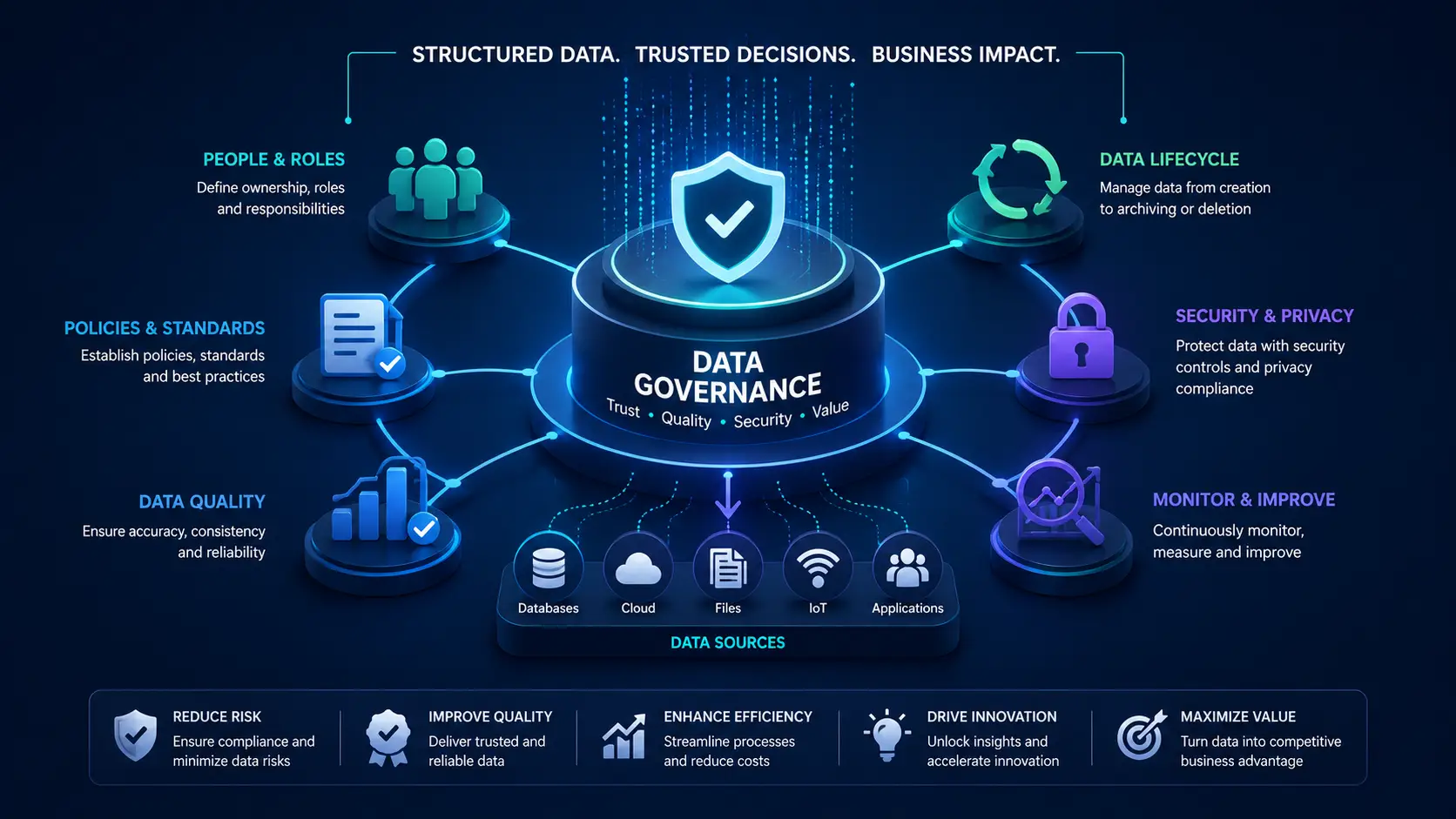
A data governance framework is the structured system that turns the concept of data governance into daily practice. It defines the policies, standards, roles, workflows, and tools an organization uses to manage its data consistently. Think of it as the operating manual for how data gets created, stored, protected, and used across the company.
The core objectives of a data governance framework are straightforward. It should establish clear ownership over data assets, set measurable standards for data quality, protect sensitive information, and support regulatory compliance. At the same time, it should make data easier to find and trust, not harder to access.
Every organization needs one, regardless of size or industry, because data touches every business decision. A small business tracking customer orders needs basic governance just as much as a global bank tracking financial transactions, even if the scale and formality look different.
It's worth understanding how governance differs from data management and analytics, since people often use these terms interchangeably. Data management is the actual execution of storing, moving, and processing data. Data governance is the rulebook that guides how that management happens. Analytics is what you do with the data once governance and management have made it trustworthy enough to use.
Why Data Governance Matters
A strong data governance strategy delivers value across nearly every part of the business. Here's where the impact shows up most clearly.
Better decision making. When leaders trust the numbers in front of them, they make faster, more confident decisions instead of second-guessing every report.
Improved data quality. Defined standards and ownership catch errors before they spread across systems and reports.
Regulatory compliance. Frameworks aligned with regulations like GDPR and HIPAA reduce data compliance risk and the odds of costly fines.
Data security. Clear access controls and classification reduce the chance of sensitive data ending up in the wrong hands, and they strengthen data privacy protections for customers and employees alike. For how governance, quality and security differ and overlap, see data governance vs data quality vs data security.
AI readiness. AI and machine learning models are only as good as the data that trains them, and governance is what makes that data trustworthy at scale.
Business intelligence. Consistent definitions and clean data mean BI dashboards actually reflect reality instead of three different versions of it. Even the best business intelligence (BI) tool only repeats whatever inconsistencies sit in the data beneath it. This holds wherever the data lives; see our comparison of a data warehouse vs data lake vs lakehouse.
Operational efficiency. Teams spend less time hunting for the right data or reconciling conflicting reports.
Customer trust. Customers notice when their data is handled carelessly. Strong governance protects the relationship, not just the data.
Reduced business risk. From financial reporting errors to data breaches, governance reduces the odds that a data problem turns into a business crisis.
Core Components of a Data Governance Framework
Every mature data governance framework rests on a set of core building blocks. Understanding each one helps you see how the pieces fit together.
Governance policies set the rules for how data should be handled, from classification to retention to access.
Data standards define consistent formats, definitions, and naming conventions so "customer" means the same thing in every system.
Data ownership assigns accountability for specific data domains to named individuals or teams, so decisions have a clear owner.
Data stewardship puts day-to-day responsibility for data quality and policy enforcement into the hands of stewards who work closely with the data.
Data quality management is about improving data quality across your organization by measuring and improving accuracy, completeness, consistency, and timeliness across your data assets.
Metadata management means documenting your data with metadata, meaning where it came from and what it means, so people can find and trust it.
Master Data Management (MDM) is the practice of building a single source of truth for core business entities like customers, products, and vendors, so every system references the same authoritative record.
Data catalog gives users a searchable inventory of available data assets, along with descriptions, owners, and usage guidance.
Data lineage tracks how data moves and transforms as it flows through systems, which is essential for troubleshooting and audits.
Security and access controls are how you go about protecting sensitive data with strong access controls, determining who can view, edit, or export specific data based on role and sensitivity.
Compliance management ensures data practices align with relevant regulations and internal policies.
Data lifecycle management governs how data is created, stored, archived, and eventually deleted.
Monitoring and auditing keeps the whole system honest by tracking policy adherence and flagging issues before they escalate.
How to Build an Effective Data Governance Framework
This is the part most guides skip over. Here's a practical, ten-step process for building a data governance framework that actually gets adopted.
Step 1: Define Business Objectives
Start with why, not with tools. Are you trying to reduce compliance risk, improve reporting accuracy, or prepare for an AI initiative? Clear objectives keep the program focused on business value instead of becoming a governance project for its own sake. A common mistake is jumping straight into policy writing before anyone agrees on what success looks like. For example, a retailer might define the objective as reducing duplicate customer records by 80 percent within a year.
Step 2: Secure Executive Sponsorship
Governance programs without executive backing tend to stall the moment they require someone to change how they work. A sponsor, ideally a Chief Data Officer or senior business leader, gives the program authority and budget. The biggest mistake here is treating sponsorship as a one-time approval instead of ongoing visible support. Best practice is to give the sponsor a regular seat at governance committee meetings, not just a kickoff appearance.
Step 3: Establish Governance Committees
A governance council made up of business and IT leaders makes the big decisions, while working groups handle domain-specific issues like data quality or security. This structure matters because governance decisions touch multiple departments, and someone needs the authority to break ties. A common mistake is making the committee too large to make timely decisions. Keep the core council small, usually eight to twelve people, and use working groups for detailed work.
Step 4: Assign Roles and Responsibilities
Every data domain needs a clear owner and steward. Without this, governance policies exist on paper but nobody enforces them in practice. The most frequent mistake is assigning stewardship as an unofficial side task with no time allocated for it. Document roles formally, and treat stewardship as a real part of someone's job, not an afterthought.
Step 5: Identify Critical Data Assets
You can't govern everything at once, so start with the data that matters most to the business, like customer records, financial data, or product data. Prioritizing critical data assets first delivers visible wins early and builds momentum. A common mistake is trying to govern every dataset in the organization simultaneously, which overwhelms the team and delays real progress. A manufacturing company might start with supplier and inventory data before expanding to HR records.
Step 6: Develop Governance Policies
Write policies for data classification, access, quality, retention, and privacy. Policies translate governance principles into rules people can actually follow. The biggest mistake is writing policies that are too vague to enforce or too rigid to work in practice. Involve the business units that will actually follow these policies before finalizing them, not after.
Step 7: Define Data Quality Standards
Set measurable definitions for accuracy, completeness, consistency, timeliness, and uniqueness for your priority data. Without defined standards, "good data quality" means something different to every team. A common mistake is setting standards that are never actually measured or reported on. Build quality checks into your pipelines so problems get flagged automatically instead of discovered months later in a report.
Step 8: Implement Metadata Management
Document what your data means, where it comes from, and how it's used, ideally through a data catalog. Metadata is what makes data findable and trustworthy instead of a mystery box nobody wants to touch. The common mistake is treating metadata documentation as a one-time project instead of an ongoing practice tied to every new data source. Start with your highest-priority datasets rather than trying to document everything at once.
Step 9: Deploy Governance Tools
Tools like data catalogs, quality monitoring platforms, and access management systems make governance scalable beyond spreadsheets and manual reviews. The mistake many organizations make is buying tools before defining the processes those tools are supposed to support. Select tools based on your actual governance requirements, not the other way around.
Step 10: Monitor, Measure, and Improve Continuously
Governance isn't a one-time rollout. Track your key metrics, review policy compliance, and adjust the framework as the business changes. The most common mistake is treating the initial launch as the finish line. Schedule regular governance reviews, quarterly at minimum, to keep the program aligned with evolving business needs.
Data Governance Roles and Responsibilities
Clear roles are what separate a governance framework that works from one that just sits in a document. Here's how responsibilities typically break down.
| Role | Primary Responsibility |
|---|---|
| Chief Data Officer | Sets overall data strategy, secures funding, and reports governance outcomes to executive leadership |
| Data Owners | Make final decisions about specific data domains, approve access requests, and are accountable for data quality in their area |
| Data Stewards | Handle day-to-day data quality issues, enforce standards, and act as the subject matter expert for their data domain |
| Data Custodians | Manage the technical storage, security, and infrastructure that houses the data |
| Compliance Teams | Ensure data practices meet regulatory requirements like GDPR and HIPAA, and manage audit readiness |
| IT Teams | Build and maintain the systems, pipelines, and tools that support governance processes |
| Business Users | Follow governance policies in daily work and flag data quality issues when they encounter them |
Data Governance Best Practices
Programs that succeed tend to follow a similar set of practices. Here are fifteen worth adopting.
- Start small with a pilot domain before scaling governance company-wide.
- Tie every governance initiative back to a specific business objective.
- Make data ownership explicit and document it formally.
- Involve business users early instead of designing policies in isolation.
- Automate data quality checks wherever possible instead of relying on manual review.
- Build a data catalog that people actually want to use, not just a compliance checkbox.
- Keep policies practical and enforceable rather than exhaustive and theoretical.
- Communicate governance wins regularly to maintain executive support.
- Train employees on why governance matters, not just what the rules are.
- Track data lineage for your most critical datasets from day one.
- Review and update policies at least annually as regulations and business needs change.
- Treat data stewardship as a real job function with allocated time.
- Use role-based access control instead of ad hoc permission grants.
- Measure governance success with clear, quantifiable metrics.
- Align your framework with a recognized model, like DAMA-DMBOK, rather than building entirely from scratch.
Common Challenges and How to Overcome Them
Even well-planned governance programs run into predictable obstacles. Here's how to address the most common ones. For a deeper look at the root causes, read why data governance programs fail.
Organizational resistance. Employees often see governance as extra work with no personal benefit. Solve this by showing how governance makes their jobs easier, like faster access to trustworthy data, rather than framing it purely as compliance.
Poor executive support. Without visible sponsorship, governance loses priority against other initiatives. Secure a specific executive sponsor and give them a defined role in program updates, not just a signature on the charter.
Low-quality data. Existing data problems can feel too big to tackle. Start with your most critical datasets and build quality improvement into ongoing workflows rather than attempting a one-time cleanup.
Siloed systems. Data scattered across disconnected systems makes consistent governance difficult. A data catalog and clear metadata standards help create visibility across silos even before systems are fully integrated.
Lack of ownership. When nobody is accountable, quality issues go unresolved indefinitely. Assign named data owners and stewards for every priority domain, and make that assignment official.
Legacy infrastructure. Older systems often lack the metadata and access controls modern data privacy and security requirements demand. Prioritize governance for new and high-value data first, and plan legacy system upgrades as a longer-term initiative.
Inadequate training. Policies fail when people don't understand them. Build simple, role-specific training rather than one generic session for the entire company.
Budget constraints. Governance can seem like a cost center with unclear ROI. Tie budget requests to measurable outcomes, like reduced compliance risk or fewer data quality incidents, to make the business case concrete.
Popular Data Governance Frameworks
Several established models can guide your governance program instead of forcing you to build everything from scratch.
DAMA-DMBOK organizes data management into eleven connected knowledge areas, with governance at the center of what's known as the DAMA Wheel. It's vendor-neutral and widely used as a foundational reference, making it a strong starting point for organizations building a governance program from the ground up.
DCAM, the Data Management Capability Assessment Model from the EDM Council, is a maturity assessment framework organized around components like governance, architecture, and data quality management. It's especially useful for organizations that want to benchmark their governance maturity against industry peers, particularly in financial services.
COBIT, developed by ISACA, is a broader IT governance framework rather than a data-specific one. It's the right choice when governance needs to integrate closely with IT risk management, security, and enterprise architecture decisions.
ISO 8000 is the international standard series for data quality, with a dedicated part covering data governance. It's most appropriate for organizations that need certifiable data quality standards, particularly in manufacturing, defense, and supply chain contexts.
ISO/IEC 38505 applies broader IT governance principles specifically to data governance at the board and executive level. It suits organizations that need governing bodies, not just operational teams, to understand their data governance responsibilities.
EDM Council Framework more broadly refers to the EDM Council's suite of data management and cloud data governance resources beyond DCAM alone. It's a strong fit for financial institutions navigating both data governance and regulatory data requirements simultaneously.
| Framework | Best For |
|---|---|
| DAMA-DMBOK | Organizations building a governance program from scratch |
| DCAM | Benchmarking governance maturity against industry peers |
| COBIT | Integrating data governance with broader IT governance |
| ISO 8000 | Certifiable data quality standards |
| ISO/IEC 38505 | Board-level and executive data governance oversight |
| EDM Council | Financial services and regulatory-heavy environments |
Top Data Governance Tools
Modern governance programs rely on software to scale beyond spreadsheets. Here's an overview of commonly used platforms.
Microsoft Purview provides Microsoft Purview's governance capabilities for data cataloging, classification, and compliance management, deeply integrated with the Microsoft ecosystem, including Microsoft Fabric and Microsoft 365.
Collibra is a dedicated data governance and catalog platform known for strong workflow automation and business glossary capabilities.
Informatica offers governance capabilities as part of a broader data management and integration suite, appealing to organizations already using Informatica for data pipelines.
Alation focuses heavily on data cataloging and collaborative data discovery, with strong adoption among data analyst and data science teams.
IBM Knowledge Catalog combines cataloging, quality, and governance capabilities within IBM's broader data and AI platform.
Talend, now part of Qlik, provides data integration alongside governance and quality features for organizations managing complex data pipelines.
Ataccama emphasizes automated data quality and master data management alongside governance, appealing to organizations prioritizing data quality automation.
| Tool | Core Strength | Best Fit |
|---|---|---|
| Microsoft Purview | Native integration with Microsoft data platforms | Organizations standardized on Azure and Fabric |
| Collibra | Governance workflow and business glossary | Enterprises needing strong policy workflow automation |
| Informatica | Integration plus governance in one suite | Teams already using Informatica for data pipelines |
| Alation | Data catalog and discovery | Analyst-heavy organizations prioritizing self-service |
| IBM Knowledge Catalog | Catalog plus AI governance | IBM-centric data and AI environments |
| Talend (Qlik) | Integration with governance features | Complex, multi-source data pipelines |
| Ataccama | Automated data quality and MDM | Organizations prioritizing data quality automation |
Real-World Data Governance Examples
Seeing governance in action across industries makes the concept easier to apply to your own organization.
Healthcare. Hospitals often struggle with inconsistent patient data across departments, risking both care quality and HIPAA compliance. A governance framework with clear data ownership and standardized definitions can reduce duplicate patient records and improve care coordination accuracy.
Banking. Financial institutions face strict regulatory reporting requirements alongside fraud risk. Governance programs built around frameworks like DCAM help banks maintain audit-ready data lineage and reduce reporting errors that could trigger regulatory penalties.
Retail. Retailers managing inventory across online and physical stores often deal with conflicting product data. Master data management paired with governance policies helps unify product catalogs, reducing stockouts and pricing errors.
Manufacturing. Supply chain data scattered across supplier systems creates inefficiencies and quality risks. ISO 8000-aligned governance helps standardize supplier and parts data, improving procurement accuracy and reducing costly errors.
Government. Public sector agencies handling citizen data face both privacy obligations and interoperability challenges across departments. Governance frameworks with strong access controls and metadata management support both compliance and better cross-agency collaboration.
SaaS. Software companies scaling quickly often accumulate inconsistent product usage and billing data across systems. Early governance investment in data ownership and quality standards prevents costly data cleanup projects as the company scales.
Key Metrics to Measure Success
Governance programs need measurable outcomes to prove their value and guide improvement. Track these KPIs regularly.
- Data quality score measures accuracy, completeness, and consistency across priority datasets.
- Policy compliance rate tracks how consistently teams follow governance policies.
- Metadata coverage shows what percentage of data assets have documented ownership and definitions.
- Data issue resolution time measures how quickly quality problems get identified and fixed.
- User adoption tracks how actively business users engage with governance tools like the data catalog.
- Audit success rate reflects how well the organization performs in compliance audits.
- Data accessibility measures how easily authorized users can find and access the data they need.
- Duplicate record reduction tracks progress in eliminating redundant customer, product, or vendor records.
Future Trends
Data governance is evolving quickly as AI adoption accelerates across industries. A few trends are worth watching closely.
AI-powered governance uses machine learning to automate classification, anomaly detection, and policy enforcement at a scale manual review can't match.
Automated metadata discovery reduces the manual burden of cataloging data by automatically scanning and tagging new data sources as they appear.
Data observability extends traditional monitoring by continuously tracking data health, freshness, and anomalies across pipelines in real time.
Privacy-first governance builds privacy protections into data architecture from the start, rather than treating compliance as an afterthought.
Data mesh decentralizes data ownership to domain teams while maintaining federated governance standards across the organization.
Responsible AI extends governance principles to AI models themselves, covering bias, explainability, and accountability alongside the training data.
Generative AI and governance raises new questions about how governance frameworks should manage prompts, model outputs, and AI-generated content.
Real-time governance shifts policy enforcement from periodic audits to continuous, automated checks as data moves through systems.
Frequently Asked Questions
What is a data governance framework? A data governance framework is a structured system of policies, roles, standards, and processes that defines how an organization manages, protects, and uses its data consistently across the business.
Why is data governance important? Data governance improves decision making, data quality, regulatory compliance, and security while reducing the business risk that comes from inconsistent or untrustworthy data.
How long does implementation take? The steps to implement data governance don't happen overnight. A focused pilot covering one data domain can launch in a few months. A mature, organization-wide framework typically takes one to two years to fully embed into daily operations.
Who owns data governance? Data governance is typically led by a Chief Data Officer or equivalent executive, with data ownership distributed across business leaders for specific data domains rather than centralized entirely in IT.
What are data governance policies? Data governance policies are formal rules covering how data should be classified, accessed, protected, retained, and used, designed to be specific enough to enforce consistently.
Which industries need data governance? Every industry benefits from data governance, but it's especially critical in healthcare, finance, government, and any regulated industry handling sensitive personal or financial data.
What tools support data governance? Common tools include Microsoft Purview, Collibra, Informatica, Alation, IBM Knowledge Catalog, Talend, and Ataccama, each offering some combination of cataloging, quality management, and policy enforcement.
What is the difference between governance and data management? Data governance defines the rules and accountability for how data should be handled. Data management is the actual execution of those rules through storing, moving, and processing data day to day.
What are the biggest implementation challenges? The most common challenges are organizational resistance, lack of executive support, poor existing data quality, and unclear ownership over data domains.
How much does data governance cost? Costs vary widely based on organization size and tool choices, ranging from a modest internal program using existing staff and spreadsheets to significant investment in enterprise governance platforms and dedicated staff.
Is data governance required for AI initiatives? Effective AI initiatives depend on governed, high-quality training data, so while it's not a formal legal requirement in most cases, weak governance significantly increases the risk of AI projects failing or producing biased results.
Can small businesses implement data governance? Yes. Small businesses can start with lightweight governance, like assigning clear data ownership and basic quality standards, without needing enterprise-scale tools or a dedicated governance team.
What is a data steward? A data steward is the person responsible for day-to-day data quality and policy enforcement within a specific data domain, acting as the subject matter expert and first point of contact for data issues.
How do you measure governance success? Governance success is measured through KPIs like data quality scores, policy compliance rates, metadata coverage, issue resolution time, and user adoption of governance tools.
What framework should organizations choose? The right framework depends on your goals, and it should shape your data governance roadmap rather than sit as a reference document on a shelf. DAMA-DMBOK works well as a general foundation, DCAM suits organizations wanting a maturity benchmark, and COBIT or ISO standards fit organizations needing tighter integration with IT governance or certifiable data quality standards.
How to start data governance if you're a beginner? You don't need a mature data estate to begin. If you can name your most critical data domain, identify a single executive sponsor, and commit to a small pilot, you have enough to start. Waiting for perfect conditions is one of the most common reasons governance programs never get off the ground. Many teams find it helpful to work from a simple data governance framework checklist covering objectives, sponsorship, committee structure, priority data, and initial policies before expanding further.
Conclusion
Building an effective data governance framework isn't a one-time project you finish and move past. It's an ongoing business capability that has to evolve alongside your data, your regulations, and your business goals. The organizations that get the most value treat governance as infrastructure, not a compliance checkbox.
The steps in this guide, from defining business objectives to continuous monitoring, work because they build governance around real business needs rather than abstract policy documents nobody reads. Start small, prove value on a priority data domain, and expand from there.
If you're just starting out, focus on aligning governance with enterprise strategy and your compliance requirements rather than treating governance as a separate initiative. Effective data governance ultimately isn't about controlling data. It's about making data something your organization can actually trust and use.
10 Key Takeaways:
- A data governance framework turns governance principles into daily, enforceable practice.
- Governance requires business ownership, not just an IT-led initiative, to succeed.
- Executive sponsorship is one of the strongest predictors of a governance program's success.
- Start with your most critical data assets rather than trying to govern everything at once.
- Data stewardship should be a real, allocated job responsibility, not an informal side task.
- Established frameworks like DAMA-DMBOK and DCAM save organizations from building governance from scratch.
- Tools should be selected after governance processes are defined, not before.
- Measurable KPIs like data quality score and policy compliance rate prove governance ROI.
- AI initiatives depend heavily on governed, high-quality data to succeed.
- Effective governance is an ongoing capability that evolves with the business, not a one-time project.