
Microsoft Fabric vs Traditional Data Governance Platforms: Key Differences, Benefits & Which One to Choose
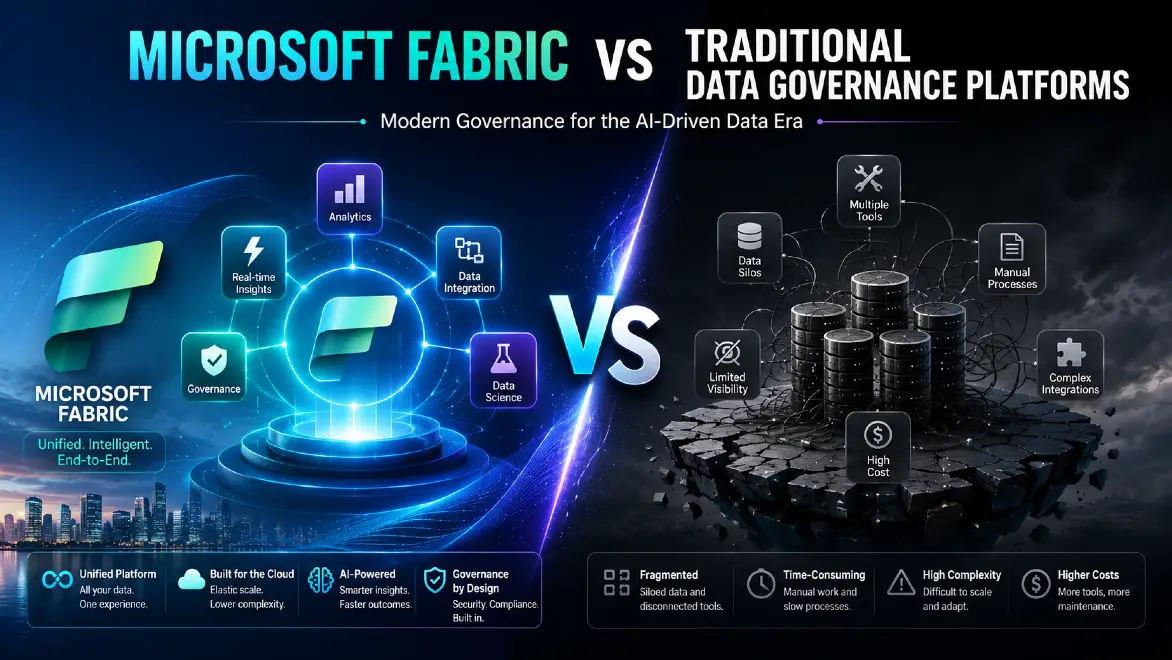
Enterprise data governance used to be simple to describe, even if it was hard to run. You bought a catalog tool, connected it to your warehouses, and asked a small army of stewards to tag everything by hand. That world is gone.
Today, data lives across lakehouses, SaaS applications, real-time streams, and half a dozen clouds at once. AI copilots need to query that data instantly. Regulators want proof that every byte is classified, tracked, and protected. And business leaders want answers in minutes, not quarters.
Microsoft's answer to this shift is Microsoft Fabric - a unified analytics and data platform that folds governance directly into the same environment where data is engineered, modeled, and analyzed. This is a fundamentally different approach from traditional data governance platforms like Collibra, Informatica, Alation, and IBM DataStage, which were built as separate layers sitting on top of your data estate.
This guide breaks down Microsoft Fabric vs traditional data governance platforms in detail - where each one wins, and how to decide which is right for your organization, or whether you need both.
What is Microsoft Fabric?
Microsoft Fabric is a unified, SaaS-based analytics platform that combines data engineering, data science, real-time intelligence, business intelligence, and data governance in one workspace, built on a single storage layer called OneLake. Instead of stitching together separate tools for ingestion, storage, modeling, and reporting, Fabric brings them under one roof with shared security and governance.
Fabric launched broadly in 2023 and has grown into Microsoft's flagship data platform, effectively merging what used to be Power BI, Azure Synapse Analytics, Azure Data Factory, and parts of Azure Data Lake into a single product experience, learn more about Microsoft Fabric.
Core components of Microsoft Fabric
- OneLake – A single, tenant-wide data lake built on Azure Data Lake Storage (ADLS) Gen2 that acts as the "OneDrive for data." Every workload in Fabric reads and writes to OneLake by default, which removes the need to copy data between systems.
- Data Engineering – Spark-based notebooks and pipelines for building and transforming data at scale, the same kind of workload compared across the 17 best data analysis tools VoidSyntax has reviewed.
- Data Factory – Low-code and pro-code data integration for ingesting data from hundreds of sources.
- Data Science – Built-in machine learning experimentation and model tracking using MLflow.
- Data Warehouse – A fully managed, SQL-based warehouse with native T-SQL support on top of open Delta Parquet files.
- Real-Time Intelligence – Native support for streaming data, event-driven pipelines, and time-series analytics.
- Power BI – Enterprise business intelligence and reporting, now natively integrated with Fabric datasets.
- Data Activator – No-code automation that triggers alerts and actions based on data conditions.
- Governance and Security – Built-in sensitivity labels, lineage tracking, and deep integration with Microsoft Purview for cataloging, classification, and compliance.
In short, Fabric isn't just a governance tool. It's an entire analytics ecosystem with governance woven into the fabric of the platform itself - which is exactly where the name comes from.
Definition Box Microsoft Fabric = OneLake (unified storage) + Data Engineering + Data Factory + Data Warehouse + Data Science + Real-Time Intelligence + Power BI + Governance, delivered as one SaaS product with a single security model.
What are Traditional Data Governance Platforms?
Traditional data governance platforms are standalone software products - such as Collibra, Informatica, Alation, IBM DataStage, Talend, SAP Master Data Governance, and Oracle Enterprise Data Management - that sit outside your data storage layer and connect to it to manage metadata, data quality, lineage, and stewardship.
These platforms were designed in an era when data warehouses, data lakes, and analytics tools were separate products from separate vendors. Governance had to live independently because there was no single platform to govern.
What traditional governance platforms typically provide
- Data Catalog – A searchable inventory of datasets, tables, and reports across the enterprise, often with business glossaries attached.
- Metadata Management – Automated and manual capture of technical, business, and operational metadata.
- Data Lineage – Visual maps showing how data moves and transforms from source to report.
- Data Quality – Rules-based profiling, validation, and cleansing engines.
- Stewardship Workflows – Formal approval chains where data stewards review, tag, and certify datasets.
- Policy Management – Centralized definition of data access, retention, and privacy policies.
- Compliance Reporting – Pre-built templates for regulations like GDPR, HIPAA, and CCPA.
Vendors in this space include:
- Collibra – Strong in business glossaries and stewardship workflows.
- Informatica – Deep metadata management and enterprise-grade data quality tools (Informatica CLAIRE, Axon).
- Alation – Known for its data catalog and search-driven discovery experience.
- IBM DataStage / IBM Knowledge Catalog – Enterprise ETL combined with governance for large IBM-centric environments.
- Talend – Open-source-friendly data integration with governance add-ons.
- SAP Master Data Governance – Purpose-built for SAP-centric master data domains.
These platforms are powerful, but they are fundamentally bolt-on systems. They connect to your Snowflake warehouse, your Oracle database, your Fabric lakehouse, and your on-prem SQL Server - and try to build a unified governance layer on top of all of it.
Definition Box Traditional Data Governance Platform = A vendor-neutral, standalone software layer that connects to multiple data sources to provide cataloging, lineage, quality, and stewardship - independent of where the data is stored or processed.
Microsoft Fabric Architecture
Fabric follows a "lake-centric, SaaS-first" architecture. Picture it as three layers stacked on top of one another:
-
Storage Layer - OneLake Every workspace, every workload, and every item in Fabric stores its data in OneLake using the open Delta Parquet format. There is no data movement between engines - a Spark notebook, a SQL warehouse, and a Power BI report can all read the exact same physical files.
-
Compute and Experience Layer On top of OneLake sit the Fabric workloads: Data Engineering (Spark), Data Warehouse (SQL engine), Data Science (ML), Real-Time Intelligence (KQL/streaming), and Power BI (semantic models and reports). Each workload is purpose-built but shares the same underlying data - so there's no ETL required just to move data from "the lake" to "the warehouse."
-
Governance and Security Layer Fabric applies OneSecurity, a unified permissions model, across every workload. Sensitivity labels from Microsoft Purview Information Protection flow automatically with the data. Lineage is captured natively as data moves through pipelines, notebooks, and reports - no manual mapping required. Microsoft Purview's Unified Catalog can scan Fabric items automatically because Fabric registers metadata as it's created.
Visual description for diagram: Imagine a large horizontal band labeled "OneLake" running across the bottom of the page. Above it, five vertical towers rise up - Data Engineering, Data Factory, Data Warehouse, Data Science, and Real-Time Intelligence - each drawing from the same OneLake band. Power BI sits at the top, consuming semantic models built from any of the towers. A translucent layer wraps around the entire diagram, labeled "Governance, Security & Compliance (Purview-integrated)," showing that governance isn't a separate box - it surrounds everything.
This is the single biggest architectural difference from traditional platforms: governance is not bolted on, it is baked in.
Traditional Governance Architecture
Traditional governance platforms follow a "hub-and-spoke, connector-based" architecture.
-
Data Sources (the spokes) Your data lives in many separate systems - SQL Server, Oracle, Snowflake, Salesforce, SAP, flat files, and possibly Fabric itself.
-
Governance Hub The governance platform (Collibra, Informatica, Alation, etc.) sits in the middle. It connects to each data source through pre-built connectors or APIs, pulling in metadata on a scheduled crawl.
-
Catalog, Lineage, and Quality Engine Metadata is normalized inside the governance platform's own repository. Lineage is often reconstructed by parsing SQL logs or ETL job definitions, rather than captured natively at the point of data movement.
-
Stewardship and Workflow Layer Human data stewards review, certify, and tag datasets inside the governance tool's own UI - separate from where analysts actually work with the data.
Visual description for diagram: Picture a central circle labeled "Governance Platform (e.g., Collibra / Informatica)." Multiple lines radiate outward to smaller boxes labeled SQL Server, Oracle, Snowflake, SAP, Salesforce, and Fabric/Data Lake. Each connection line is labeled "connector / scheduled crawl," signaling that metadata capture happens after the fact, not at the moment data is created.
This architecture is flexible - it can govern almost anything, from any vendor. But that flexibility comes at a cost: lineage and metadata are reconstructed, not native, and stewardship happens in a tool disconnected from the analyst's daily workflow.
Side-by-Side Comparison Table
| Dimension | Microsoft Fabric | Traditional Governance Platforms |
|---|---|---|
| Architecture | Unified SaaS platform, single storage layer (OneLake) | Hub-and-spoke, connects to many external sources |
| Deployment | Fully SaaS, no infrastructure to manage | SaaS or on-prem, often requires dedicated infra/admin team |
| Security Model | Unified OneSecurity across all workloads | Security defined per source system, mapped separately |
| Governance | Native, built-in, powered by Microsoft Purview | Bolt-on, connector-based, centralized in a separate tool |
| Metadata Management | Automatic capture at creation time | Captured via scheduled scans/crawls |
| Data Lineage | Native, automatic, end-to-end within Fabric | Reconstructed from logs, often partial across non-native sources |
| Data Catalog | Microsoft Purview Unified Catalog (deep Fabric integration) | Dedicated catalog module (often best-in-class for search/glossary) |
| Compliance | Built-in sensitivity labels, Purview compliance manager | Dedicated compliance and policy modules, highly configurable |
| Scalability | Auto-scales as a managed SaaS service | Scales with infrastructure investment (cloud or on-prem) |
| Cost Model | Capacity-based (Fabric SKUs, pay-as-you-go or reserved) | License-based, often per-user or per-connector, higher TCO |
| Licensing Complexity | Simplified, part of Microsoft 365/Azure ecosystem | Complex, multiple modules often licensed separately |
| AI Features | Copilot in Fabric, natural-language querying, AI-ready OneLake | AI features vary by vendor, often add-on modules |
| Automation | Data Activator, pipeline-triggered automation | Rules-based workflow automation, mature but siloed |
| Data Sharing | OneLake shortcuts, zero-copy sharing across workspaces | Data sharing depends on source system capabilities |
| Business Intelligence | Native Power BI integration | Requires separate BI tool integration |
| Analytics Depth | Deep - Spark, SQL, KQL, ML in one place | Governance-focused; analytics handled by separate tools |
| Ease of Use | Lower learning curve for Microsoft-ecosystem teams | Steeper learning curve, dedicated admin/steward roles needed |
| Maintenance | Managed by Microsoft (SaaS) | Requires internal platform administration |
| Integration | Best with Microsoft/Azure ecosystem, expanding connectors | Vendor-agnostic, strong multi-cloud/multi-vendor support |
| Migration Effort | Lower if already on Azure/Power BI | Depends on existing footprint, can be significant either way |
| Future Readiness | Rapid roadmap, Copilot and AI-first investments | Mature but slower-moving roadmaps, incremental AI additions |
Advantages of Microsoft Fabric
- Unified storage eliminates data duplication. OneLake means one copy of data serves every workload - no more copying data between a lake and a warehouse.
- Governance is automatic, not manual. Lineage and metadata are captured as data moves, reducing the burden on stewards.
- Single security model. Permissions set once in OneSecurity apply everywhere, reducing configuration drift.
- Deep Microsoft Purview integration for classification, sensitivity labeling, and compliance out of the box.
- Lower total cost of ownership for Microsoft-centric organizations, since Fabric consolidates several products into one capacity-based SKU.
- Faster time-to-insight. Analysts don't wait on ETL jobs to move data between systems before building reports.
- Native AI and Copilot integration for natural-language data exploration, code generation, and pipeline authoring.
- Simplified vendor management. One contract, one support channel, instead of five separate governance and analytics vendors.
- Built-in real-time analytics through Real-Time Intelligence, something most traditional governance platforms don't offer at all.
- Zero-copy data sharing across departments using OneLake shortcuts, avoiding duplicate storage costs.
- Scales automatically as a managed SaaS service - no capacity planning for governance infrastructure.
- Familiar tools for existing Microsoft shops. Power BI, Excel, and Teams integrations reduce training time.
- Open data format (Delta Parquet) prevents vendor lock-in at the storage level.
- Faster onboarding for new data sources compared to configuring connectors in a separate governance tool.
- Continuous roadmap investment. Microsoft ships new Fabric governance and AI capabilities on a near-monthly cadence.
- Reduced integration risk. Fewer moving parts means fewer points of failure across the data pipeline.
- Built-in collaboration. Workspaces support co-authoring across data engineers, analysts, and scientists in one place.
Advantages of Traditional Platforms
- Vendor-agnostic governance. These platforms can catalog and govern data across any cloud, any database, and any vendor - not just Microsoft's ecosystem.
- Mature, specialized catalog features. Tools like Alation and Collibra have spent over a decade refining business glossaries and search experiences.
- Deeper data quality engines. Informatica's data quality and CLAIRE AI have years of enterprise tuning behind them.
- Independent of any single cloud provider, which matters for multi-cloud or hybrid-cloud enterprises.
- Established compliance templates for specific regulated industries (finance, healthcare, government).
- Dedicated stewardship workflows built specifically for human review and certification processes.
- Long track record with large enterprises, meaning proven reference architectures and case studies.
- Strong master data management (MDM) capabilities, particularly SAP MDG and Informatica MDM.
- Granular policy configuration for complex, multi-jurisdictional compliance requirements.
- Broad connector ecosystems covering legacy mainframes, ERPs, and niche systems Fabric doesn't natively reach yet.
- Governance-first culture fit for organizations where governance and analytics teams are intentionally separate.
- Reduced platform risk from single-vendor concentration, since governance doesn't depend on one cloud vendor's uptime or roadmap.
Limitations of Microsoft Fabric
Fabric is powerful, but it isn't a universal fit.
- Best value requires a Microsoft-centric stack. Organizations heavily invested in AWS, Snowflake, or Google Cloud won't get the same seamless governance benefits.
- Newer product, evolving governance depth. Some advanced stewardship and workflow capabilities found in mature tools like Collibra are still maturing in Fabric/Purview.
- Capacity-based pricing can be unpredictable for organizations with spiky or unplanned workloads.
- Limited support for non-Microsoft data sources compared to the connector breadth of dedicated governance tools.
- Governance and analytics are tightly coupled, which some enterprises with strict separation-of-duties requirements may find restrictive.
- Organizational change management is required. Merging data engineering, BI, and governance teams into shared workspaces is a cultural shift, not just a technical one.
Limitations of Traditional Governance Platforms
- Higher total cost of ownership, with separate licenses for catalog, quality, lineage, and stewardship modules.
- Metadata and lineage are often reconstructed, not captured natively, which can introduce gaps or delays.
- Slower time-to-value. Implementations frequently take 6–18 months before stewards see full lineage coverage.
- Requires dedicated administration. Connector maintenance, crawl scheduling, and platform upgrades demand specialized staff.
- Disconnected from daily analytics work. Stewards work in a separate tool from the analysts and engineers actually using the data.
- Integration lag with new data platforms. Connectors for newer platforms like Fabric can trail behind the pace of product releases.
When Should You Choose Microsoft Fabric?
Choose Microsoft Fabric when:
- Your organization is already invested in Azure, Power BI, or Microsoft 365.
- You want to consolidate analytics and governance into fewer vendors and lower overall cost.
- Your teams need real-time analytics alongside traditional BI and data science.
- You're building a greenfield data platform and don't have years of legacy governance tooling to migrate.
- Speed to insight matters more than deep, multi-decade governance maturity.
- You want AI-assisted analytics (Copilot in Fabric) baked into daily workflows.
When Should You Stay with Traditional Platforms?
Stay with (or add) a traditional governance platform when:
- Your data estate is genuinely multi-cloud or multi-vendor, spanning AWS, GCP, on-prem mainframes, and SAP.
- You operate in a heavily regulated industry with complex, jurisdiction-specific compliance requirements that your existing tool already supports.
- You've already made a significant investment in Collibra, Informatica, or Alation, with mature stewardship workflows in place.
- Your governance and analytics teams are organizationally separate by design, for audit or separation-of-duties reasons.
- You need specialized master data management capabilities beyond what Fabric currently offers.
Practical reality: Many enterprises don't choose one or the other - they run Fabric for analytics and native governance, while keeping a traditional platform like Microsoft Purview alongside Collibra or Informatica for cross-cloud cataloging. Hybrid governance is increasingly common, not a compromise.
Migration Strategy
Moving toward Fabric - fully or partially - should follow a structured, low-risk path.
1. Assessment
Inventory current data sources, existing governance tooling, and compliance obligations. Identify which datasets are business-critical and which can migrate later.
2. Planning
Define target architecture: full Fabric adoption, hybrid governance, or phased rollout by business unit. Map data domains to OneLake structures (workspaces, lakehouses, warehouses).
3. Governance Design
Establish sensitivity labels, access policies, and stewardship roles before migrating data, not after. Align Purview classification taxonomy with existing business glossaries.
4. Security Configuration
Configure OneSecurity roles, row-level and column-level security, and integrate with Microsoft Entra ID for identity governance.
5. Rollout
Migrate in waves - start with a low-risk domain (e.g., a single business unit's reporting), validate governance and lineage capture, then expand.
6. Training
Train data engineers, analysts, and stewards on Fabric workspaces and Purview cataloging. Don't assume Power BI familiarity equals Fabric fluency.
7. Optimization
Monitor capacity usage, tune workload allocation, and refine governance policies based on real usage patterns after go-live.
Best Practices
Good Fabric governance starts before a single dataset moves. Define a clear data domain ownership model first, so everyone knows who's accountable for what. Apply sensitivity labels at the source rather than after data lands in a report, and integrate Microsoft Purview from day one instead of bolting it on later. Establish a data quality baseline before migration begins, so you have something to measure improvement against, and bring compliance and legal teams into governance design early rather than after launch. This mirrors a pattern that shows up across enterprise technology, not just data platforms - our guide to AI governance consulting makes a similar point: organizations that build oversight in from the start move faster later, not slower.
Architecture and workspace hygiene matter just as much as policy. Use OneLake shortcuts instead of duplicating data across workspaces, and standardize naming conventions before teams start spinning up their own. Set up row-level security centrally rather than configuring it per report, and enforce a workspace creation policy so sprawl doesn't creep in unnoticed. Monitor capacity continuously to right-size your Fabric SKUs, and test disaster recovery and backup procedures for every workspace well before you need them in a real incident.
Rollout discipline is where a lot of well-planned migrations quietly go sideways. Pilot with a single business unit before attempting an enterprise-wide rollout, and build a stewardship RACI matrix that spans both Fabric and any legacy tools you're keeping. Automate lineage validation checks after every pipeline deployment rather than reviewing lineage manually, and train stewards to work inside Fabric directly instead of only inside a separate catalog tool. Align business glossary terms between your legacy governance platform and Fabric or Purview so the same word means the same thing everywhere.
Governance doesn't stop at go-live. Document data retention policies inside Purview instead of in spreadsheets nobody maintains, and track governance KPIs on an ongoing basis - the percentage of datasets classified, lineage coverage, and policy violations are all worth watching. Review Microsoft's Well-Architected Framework guidance for data workloads periodically, and reassess your architecture at least once a year, since Fabric's roadmap moves quickly enough that last year's design decisions can go stale fast.
Common Mistakes
The most common mistake happens before migration even starts: moving data before governance policies are defined. A close second is treating Fabric adoption as a pure IT project with no business stakeholder involvement, which almost always produces a platform nobody outside IT trusts or understands. Teams also frequently ignore existing data quality issues instead of fixing them pre-migration, which just moves the same messy data into a shinier system. This is the same failure pattern behind most stalled technology rollouts - Look at why AI proof-of-concept projects never reach production found that most failures trace back to execution and planning gaps, not the technology itself, and Fabric migrations run into the same wall.
Technical missteps tend to show up next. Underestimating capacity needs leads to unexpected throttling right when the business needs the platform most. Allowing uncontrolled workspace creation across departments quietly builds sprawl that's painful to unwind later. Not integrating Microsoft Entra ID properly leads to access sprawl instead of the clean, unified security model Fabric is supposed to deliver. And duplicating data instead of using OneLake shortcuts inflates storage costs while defeating the entire point of a unified lake.
Rollout mistakes are just as costly. Skipping a pilot phase and attempting a "big bang" enterprise rollout raises risk dramatically, since problems surface everywhere at once instead of in one contained business unit. Failing to train stewards on the new governance workflow leaves people falling back on old habits. And assuming Power BI governance experience fully transfers to Fabric governance is a common but risky shortcut Fabric's governance model is broader and deeper than what most Power BI-only teams have worked with before.
Finally, governance breaks down when it's treated as a one-time project instead of an ongoing practice. Neglecting to map legacy business glossary terms to the new catalog leaves two versions of the truth living side by side. Overlooking compliance requirements specific to certain data domains creates blind spots regulators will eventually find. Failing to set up monitoring for lineage completeness means gaps go unnoticed until an audit surfaces them. And not budgeting for the organizational change management required is perhaps the most underestimated mistake of all - the technology is rarely the hard part; getting people to work differently is.
Real Enterprise Use Cases
Healthcare
A hospital network consolidates patient outcome data, insurance claims, and operational metrics into Fabric, applying Purview sensitivity labels to protect PHI under HIPAA while enabling real-time bed-capacity dashboards for administrators.
Finance
A regional bank uses Fabric's Real-Time Intelligence to monitor transaction anomalies for fraud detection, while Purview lineage provides auditors with a complete trail from raw transaction logs to regulatory reports.
Retail
A retail chain unifies point-of-sale, e-commerce, and inventory data in OneLake, eliminating nightly batch reconciliation between separate warehouse and reporting systems, and speeding up demand forecasting.
Manufacturing
A manufacturer streams IoT sensor data from factory floors into Fabric's Real-Time Intelligence workload, correlating equipment telemetry with quality-control data to reduce downtime.
Government
A government agency maintains strict data classification requirements across multiple departments, using Purview's sensitivity labels and access policies to enforce need-to-know access while preserving auditability.
Education
A university system consolidates student information, research data, and financial data into Fabric workspaces by department, using governance policies to separate FERPA-protected records from public research datasets.
Expert Recommendations
- Start with governance, not analytics. Organizations that define classification and access policy before migrating data see far fewer rework cycles.
- Don't discard existing governance investment overnight. If you have a mature Collibra or Informatica deployment, a hybrid model often delivers value faster than a full rip-and-replace.
- Treat OneLake as your single source of truth, and resist the temptation to keep shadow copies of data "just in case."
- Invest in steward training early. Fabric's governance model shifts more responsibility to the people creating data, not just the people cataloging it afterward.
- Align with recognized frameworks. Structuring your governance program around DAMA International's DMBOK, NIST's Cybersecurity Framework, and ISO 27001 principles gives your Fabric implementation a defensible, auditable foundation.
Future Trends
- AI-driven governance. Expect classification, lineage, and policy enforcement to become increasingly automated through AI, reducing manual steward workload.
- Microsoft Copilot expansion. Copilot in Fabric is moving from query assistance toward proactive governance recommendations and anomaly detection.
- Convergence of data fabric and data mesh principles. Enterprises are blending centralized platforms like Fabric with domain-oriented ownership models associated with data mesh.
- Real-time governance. As streaming analytics grows, governance tools must classify and secure data in motion, not just data at rest.
- Generative AI governance. As GenAI applications consume enterprise data, platforms will need to govern not just datasets, but the prompts, outputs, and model access built on top of them.
- Continued Fabric roadmap acceleration. Microsoft has signaled ongoing investment in deeper Purview integration, expanded connectors, and broader multi-cloud reach for OneLake.
Final Verdict
When it comes to Microsoft Fabric vs traditional data governance platforms, there's no universally "better" platform - there's a better fit for your organization's data footprint, regulatory environment, and existing investments.
Microsoft Fabric is the stronger choice for organizations that want unified analytics and governance in one platform, especially if you're already in the Microsoft ecosystem. It reduces complexity, speeds up time-to-insight, and bakes governance into daily workflows rather than treating it as a separate discipline.
Traditional data governance platforms remain the stronger choice for organizations with genuinely multi-cloud, multi-vendor data estates, deep existing investment in tools like Collibra or Informatica, or highly specialized master data management needs.
For many enterprises, the realistic answer is both - Fabric as the unified analytics and native governance layer for Microsoft-centric workloads, complemented by a traditional platform for cross-cloud cataloging where needed. The right architecture starts with a clear-eyed assessment of your data estate, not a preference for one vendor over another.
If your team needs help mapping this decision to your specific environment, Fabric and Azure consulting practice can help you design a governance architecture that fits your compliance requirements and existing infrastructure.
Frequently Asked Questions
1. What is Microsoft Fabric? Microsoft Fabric is a unified, SaaS-based analytics platform from Microsoft that combines data engineering, data warehousing, data science, real-time intelligence, and Power BI into one product, built on a shared storage layer called OneLake, with governance and security integrated throughout.
2. Is Microsoft Fabric a data governance platform? Not exactly. Fabric includes native governance capabilities - lineage, sensitivity labels, and deep Microsoft Purview integration - but it's primarily an analytics platform. Governance is a built-in feature of Fabric, not its sole purpose, unlike dedicated tools such as Collibra.
3. How is Microsoft Fabric different from traditional governance tools? Fabric captures metadata and lineage automatically as data moves through its own workloads, because governance is embedded in the platform. Traditional tools connect externally to your data sources and reconstruct lineage through scheduled scans, which is more flexible but less immediate.
4. Should enterprises migrate to Microsoft Fabric? Enterprises already using Azure and Power BI, or looking to consolidate analytics and governance tools, generally benefit from migrating. Organizations with complex multi-cloud estates or heavy investment in existing governance platforms should evaluate a hybrid approach instead of a full migration.
5. Who should use Microsoft Fabric? Fabric fits organizations in the Microsoft ecosystem - Azure customers, Power BI users, and teams wanting unified analytics and governance. It suits data engineers, BI professionals, and enterprises seeking faster time-to-insight with fewer vendor relationships to manage.
6. When should you choose traditional governance platforms? Choose a traditional platform when your data spans multiple clouds and vendors, when you need mature master data management, or when you've already built stewardship workflows in tools like Collibra or Informatica that are working well for your organization.
7. Can Microsoft Fabric replace Collibra? Fabric can replace some Collibra functions, particularly for Microsoft-centric data estates, through its native lineage and Purview integration. However, Collibra's mature business glossary and stewardship workflows remain stronger for complex, multi-vendor governance programs.
8. Does Microsoft Fabric include metadata management? Yes. Fabric automatically captures technical and operational metadata as data is created and transformed, and this metadata integrates with Microsoft Purview's Unified Catalog for business-level classification and search.
9. Is Microsoft Fabric replacing traditional data governance platforms? Fabric is replacing some traditional governance functions for organizations centered on Microsoft's ecosystem, but it isn't a universal replacement. Many enterprises run Fabric alongside a traditional platform for cross-cloud governance coverage.
10. How does Microsoft Fabric compare to Informatica? Informatica offers deeper, longer-established data quality and master data management capabilities across any cloud vendor. Fabric offers tighter native integration between analytics and governance but has less mature standalone data quality tooling.
11. How does Microsoft Fabric compare to Alation? Alation specializes in search-driven data discovery and cataloging across diverse data sources. Fabric's catalog capabilities, delivered through Purview, are deeply integrated with Fabric-native data but currently offer less catalog depth for non-Microsoft sources.
12. How does Microsoft Fabric compare to IBM DataStage? IBM DataStage focuses on enterprise ETL and governance within IBM-centric or mainframe-heavy environments. Fabric focuses on unified, cloud-native analytics and governance, making it a better fit for organizations modernizing away from legacy ETL architectures.
13. What is Microsoft Purview's role in Microsoft Fabric? Microsoft Purview provides the classification, cataloging, and compliance layer that powers Fabric's governance features. It scans Fabric items, applies sensitivity labels, and builds a searchable catalog across an organization's broader Microsoft data estate.
14. Is Microsoft Fabric secure enough for regulated industries? Yes, when configured correctly. Fabric supports row-level and column-level security, sensitivity labeling, and integrates with Microsoft Entra ID for identity governance, which regulated industries like healthcare and finance commonly rely on for compliance.
15. What is OneLake in Microsoft Fabric? OneLake is Fabric's single, unified data lake, built on Azure Data Lake Storage Gen2, where every Fabric workload stores and reads data. It eliminates the need to duplicate data across separate lakes and warehouses.
16. Does Microsoft Fabric support real-time data governance? Yes. Through Real-Time Intelligence, Fabric can classify, monitor, and govern streaming data as it arrives, which is a capability most traditional governance platforms have not fully matured for data in motion.
17. What does a typical Microsoft Fabric migration involve? A typical migration includes assessing current data sources, designing governance policies, configuring security in OneSecurity, migrating data in phased waves, training teams, and optimizing capacity and policies after go-live.
18. How much does Microsoft Fabric cost compared to traditional governance platforms? Fabric uses capacity-based pricing that often consolidates costs from multiple separate tools, generally lowering total cost of ownership for Microsoft-centric organizations. Traditional platforms typically involve separate licenses per module, which can raise overall costs.
19. Can Microsoft Fabric and traditional governance platforms work together? Yes. Many enterprises run Fabric for analytics and native governance while keeping a traditional platform connected for cross-cloud cataloging, creating a hybrid governance model that covers both Microsoft and non-Microsoft data sources.
20. What is the biggest difference between modern and traditional data governance? Modern data governance, as delivered through platforms like Fabric, is embedded directly into the data platform and captured automatically. Traditional governance is a separate layer added on top of existing systems, requiring manual configuration and periodic scanning to stay current.
21. What frameworks should guide a data governance strategy? Well-established frameworks like DAMA International's Data Management Body of Knowledge (DMBOK), the NIST Cybersecurity Framework, and ISO 27001 provide structured, auditable foundations for building a governance program, whether implemented in Fabric, a traditional platform, or both.