
Picture a mid-sized company six months into its AI adoption. Marketing is using an AI writing tool nobody in IT signed off on. Engineering has wired an AI coding assistant into the codebase. Customer support just launched a chatbot that can see order history and billing details. Someone in finance has been pasting spreadsheet data into a public AI chatbot to save time on reporting.
Each choice made sense on its own. Together, they add up to a company with no consistent answer to basic questions: which AI tools are actually approved, what data employees can share with them, who is responsible when a system gets something wrong, and what happens if a regulator asks how AI is being used. This is a common situation, not because anyone did anything reckless, but because AI adoption tends to outpace the structure meant to manage it. AI governance is how companies close that gap.
What Is AI Governance?
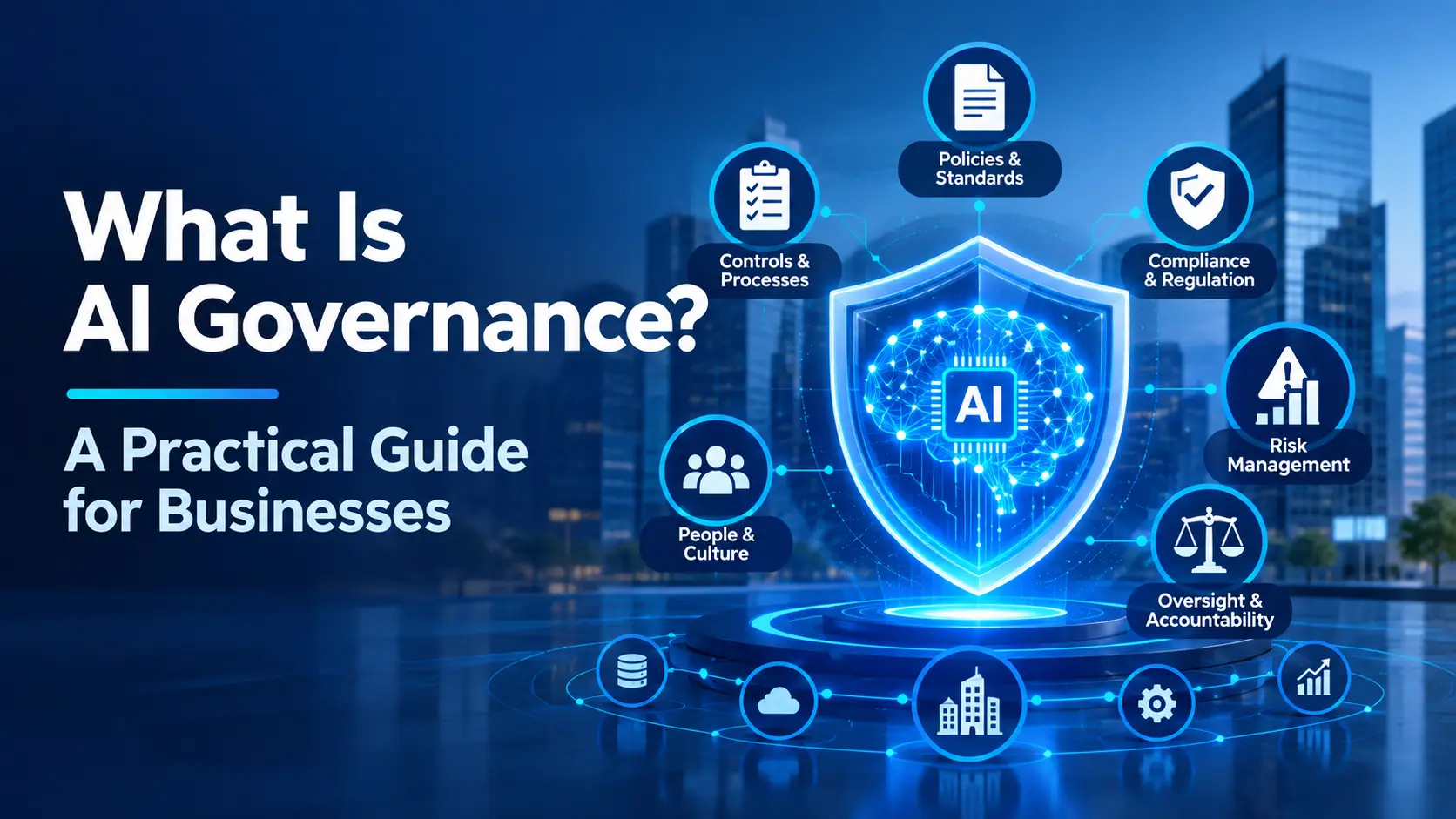
AI governance is the set of policies, roles, processes, and oversight mechanisms an organization uses to manage how AI is built, deployed, and used, so AI systems remain safe, compliant, accountable, and aligned with business goals. It applies to internally built models, purchased AI products, and AI features embedded in everyday software.
Governance isn't a single document or a one-time approval step. It's an ongoing set of decisions about who can introduce AI into the business, what checks happen before and after deployment, and who is accountable when something goes wrong.
It helps to separate three activities often blurred together. Building an AI system means developing or training a model. Only some organizations do this. Using an AI system means putting a tool, built in-house or purchased, to work on a real task, like drafting content or answering customer questions. Almost every business does this now, often through tools employees choose on their own. Governing an AI system means deciding, before and after use begins, whether it should happen, under what conditions, and with what accountability, regardless of who built the underlying model.
For example, a retail company that licenses a chatbot through a customer-service platform doesn't build the model, the vendor does. But it's still the retailer's job to decide what the chatbot can access, how its answers are reviewed, and who owns the outcome if it gives a customer bad information.
Why Is AI Governance Important for Businesses?
Governance exists to manage risks that are new in combination, even if few are entirely new on their own. Risk management is the most obvious driver: AI systems can produce incorrect outputs, reflect biases in their training data, or be manipulated through techniques like prompt injection. Governance gives a business a structured way to identify which use cases carry real risk and put proportionate controls around them before problems reach production.
Data privacy and security follow closely, since AI tools often process customer, employee, or proprietary data with no consistent check on what's appropriate to share. Accountability and transparency matter because AI decisions increasingly touch real people, from loan applications to support tickets; governance assigns clear ownership so a known person investigates problems rather than "the AI did it" going unresolved.
Regulatory compliance is harder to avoid as more jurisdictions introduce AI-specific rules, and governance builds the internal capability to respond as requirements arrive. Intellectual property, third-party risk, and reliability round things out: AI-generated content can raise IP questions, vendors can change terms with little warning, and models can quietly degrade in accuracy over time.
None of this makes governance a brake on adoption. Businesses with a working program often move faster, because they've already answered the recurring questions rather than relitigating them for every new tool.
What Does AI Governance Cover?
AI governance spans several connected areas. Most businesses won't build all of these out at once, but it helps to see the full picture before deciding where to start.
AI Strategy and Oversight
This is where leadership decides where AI fits into the business, and where it deliberately doesn't. It keeps individual teams from making conflicting bets on tools, use cases, or vendors.
AI Risk Management
Not every AI use case deserves the same scrutiny. This is the practice of identifying AI systems in use and assessing what could go wrong with each one, since a tool drafting internal meeting notes carries a very different risk profile than one approving credit applications.
Data Governance
This covers data quality, access, provenance, retention, and appropriate use. Businesses with a mature data governance framework already in place have a real head start here, since AI governance largely extends existing data controls rather than replacing them.
Privacy
Privacy governance focuses specifically on personal and sensitive information: what qualifies as personal data, what legal basis is needed to process it through an AI system, and how individual rights apply when AI is involved.
Security
AI systems introduce some security concerns that are specific to how they work, including prompt injection (malicious input tricking a model into ignoring its instructions), data leakage through outputs, unauthorized access, and vulnerabilities from connecting AI to other software. This doesn't need to turn every business into a security shop, but someone should be thinking about it before deployment, not after an incident.
Model and System Governance
This covers the practical lifecycle of the AI systems themselves: how a model or tool gets selected, tested before rollout, documented and version-tracked, and eventually retired once it's no longer fit for purpose.
Transparency and Explainability
Businesses increasingly need to be able to say where AI is being used and, to some degree, how it reaches its outputs. This matters for regulatory reasons in some cases, and for internal trust in every case.
Human Oversight
Certain AI outputs need a person to review, approve, or override them before they take effect, particularly in higher-stakes situations. Governance defines where that checkpoint is required and where it isn't.
Accountability
When an AI system produces a harmful or incorrect result, this is what determines who investigates it and who's responsible for the fix, rather than accountability defaulting to whoever happens to notice the problem first.
Monitoring and Auditing
Governance doesn't end at deployment. AI systems can drift in accuracy or behave differently as the business around them changes, and ongoing monitoring and periodic audits are what catch that before it becomes a bigger issue.
Third-Party AI Management
Most businesses use AI they didn't build, which means governance has to extend to vendors: what data they can access, how they handle it, and what happens if their service goes down or their terms change.
What Is an AI Governance Framework?
An AI governance framework is the organized structure a business uses to put the areas above into practice consistently, rather than handling every AI decision as a one-off. A working framework typically combines: a governance structure and clear roles and responsibilities; an AI inventory and risk classification method; written AI policies and an approval process for new systems; risk assessments, plus data, security, and privacy controls; documentation of key decisions; human oversight checkpoints; testing and validation before launch; ongoing monitoring, incident management, and auditing; and employee training and third-party vendor management.
Most organizations build these gradually, starting with whichever address their most pressing risks rather than trying to stand up all eighteen at once.
The AI Governance Lifecycle
Applying governance across the life of an individual AI system is more practical than treating it as an abstract program. An idea gets a known place to be proposed. Assessment evaluates risk, data sensitivity, and value. Development or selection documents the build or vendor choice against approved boundaries. Testing checks realistic scenarios and edge cases. Approval comes from a designated owner based on that testing, not by default.
Once deployed, oversight and monitoring are already in place, not added afterward. Monitoring tracks performance for drift, errors, or misuse. At defined intervals, review asks whether the risk profile or regulatory picture has changed. And when a system is no longer needed, retirement decommissions it deliberately, including any data it touched.
Who Is Responsible for AI Governance?
AI governance is often assumed to be an IT problem. It isn't, and treating it that way is a common reason programs stall. Board and executive leadership set risk appetite and back the program with real authority. CIOs and CTOs oversee infrastructure and system-level controls. Data teams, security, privacy and legal, and compliance and risk management each manage a piece of the underlying risk: data access, technical protections, applicable law, and the audit trail. Product and engineering teams are usually closest to day-to-day decisions. HR handles training and workplace policy. And business teams, the people actually using AI tools, ultimately determine whether policies mean anything in practice.
This is shared accountability: no single department can govern AI alone, because it touches data, security, legal exposure, product decisions, and frontline work at once.
How to Build an AI Governance Program
Step 1: Create an AI inventory. You can't govern what you don't know exists. Identify every AI system in use, including shadow AI, tools adopted informally without approval, which typically requires surveys and conversations with department leads since it won't show up in official records.
Step 2: Classify AI risks. A tool summarizing meeting notes is lower risk than one screening job applicants. Sorting use cases into tiers focuses limited oversight where it matters.
Step 3: Define AI governance policies. Address what employees actually run into: which tools are approved, what data can be shared, when human review is required, and how to report a problem.
Step 4: Assign ownership. Every AI system with meaningful impact needs a named owner, or problems tend to surface only after they've caused damage.
Step 5: Establish an approval process. New use cases need a defined evaluation path, ideally a fast one, so employees aren't tempted to bypass it.
Step 6: Establish data, privacy, and security controls. This turns policy decisions into technical reality: access controls, retention rules, and protections against AI-specific risks.
Step 7: Document important decisions. Recording why a system was approved and what risks were addressed makes accountability possible later, including for audits.
Step 8: Monitor AI systems. Approval isn't the finish line; systems can behave differently as data or usage patterns shift.
Step 9: Train employees. Cover what people are actually likely to encounter: which tools they can use, what not to share, and who to contact with concerns.
Step 10: Review and improve. Technology, use cases, and regulations keep changing, so the program needs a regular review cycle to stay relevant.
Businesses wanting outside help structuring this often start with AI governance consulting to shortcut some of the trial and error, particularly around risk classification and approval design. It also helps to connect governance to how AI actually gets used operationally; a clear AI workflow for business makes oversight points easier to build in from the start.
A Practical AI Governance Example
Consider a fictional mid-sized company launching an AI-powered customer-service chatbot. It's added to the AI inventory as soon as it's proposed, and the head of customer support is named as owner. Because it will access order and billing information directly with customers, it's classified as higher risk and gets fuller review: the data team confirms exactly what the vendor can access, legal checks whether new privacy disclosures are needed, and the team tests the chatbot against realistic and edge-case questions before launch. A clear rule is set that large refunds, account security, and complaints escalate automatically to a human agent.
With testing complete, a governance reviewer approves deployment and documents the reasoning. After launch, the team tracks escalation rates, ratings, and inaccurate answers. When the chatbot gives a wrong answer about a return policy in month two, the incident process logs it, identifies the cause, corrects the logic, and follows up with affected customers. This is illustrative, not a real case study, but it shows how the pieces fit together in practice.
AI Governance vs AI Compliance
These terms get used interchangeably, but aren't the same. See AI governance vs AI compliance for a deeper comparison.
| Area | AI Governance | AI Compliance |
|---|---|---|
| Primary purpose | Ensure AI is developed and used responsibly, aligned with business goals | Ensure AI meets specific legal or regulatory requirements |
| Scope | Broad: strategy, risk, data, security, oversight, accountability | Narrower: defined laws and mandated obligations |
| Focus | Ongoing decision-making and organizational structure | Meeting external requirements |
| Trigger | Business need to manage AI responsibly | Existence of a specific legal obligation |
| Responsibility | Shared across leadership, product, data, security, legal, business | Typically led by legal, compliance, risk |
| Example | Deciding which AI tools are approved and monitored internally | Meeting EU AI Act documentation requirements |
Compliance is a piece of governance, not a separate track. A business can meet every applicable law and still have weak governance if it has no visibility into which AI tools employees are using. Governance is the broader discipline compliance sits inside.
AI Governance vs AI Ethics
AI ethics asks whether a system's outputs are fair and free from harmful bias, a values question. Responsible AI is the broader practice of applying those principles in how AI is actually built and used, like testing for bias or building in safeguards. AI governance is the organizational machinery that makes that happen consistently rather than depending on individual good intentions. AI compliance is the subset focused on specific legal requirements.
Say a hiring tool is found scoring candidates from a particular university unfairly low due to a training data quirk. Ethics identifies the outcome as wrong. Responsible AI practices, like bias testing, should have caught it earlier. Governance defines who's accountable for investigating, fixing, and preventing a repeat, whether or not any law required it.
AI Governance and AI Agents
AI agents raise the stakes because they don't just generate content, they take actions: booking tasks, sending emails, querying databases, triggering workflows, often with limited direct review of each step.
That autonomy raises new questions: what systems can the agent access and why, what data can it read or write, how narrowly are its permissions scoped, and which decisions require human approval first. Monitoring matters more with agents, not less, because their actions compound: a chatbot's wrong answer affects one conversation, while an agent with the wrong permissions can take a chain of actions before anyone notices, which makes audit trails a practical necessity. Agent-to-agent handoffs add another layer, and governance needs to account for how errors might propagate between them. This is moving fast, and businesses exploring AI agents for business intelligence should expect requirements to keep evolving.
Common AI Governance Challenges
Rapid adoption outpaces oversight; the fix is prioritizing governance for the highest-risk use cases first. Shadow AI shows up because official approval is often slower than people will wait for; regular inventory checks and a genuinely fast approval path help. Lack of ownership leaves systems unmonitored; assigning an owner at approval time closes the gap. Limited internal expertise can be offset with external consulting or established frameworks. Changing regulations are easier to track by anchoring to a few authoritative sources rather than every piece of commentary. Third-party dependencies put risk outside direct control, which strong contracts and periodic reviews help manage. Employee resistance eases when policies are framed around what people can safely do, not just what they can't.
Excessive bureaucracy deserves its own mention: if approving a new AI tool takes weeks and a dozen sign-offs, employees will quietly route around it, recreating the shadow AI problem the process was meant to solve. Proportionate governance that's actually followed beats heavy governance that isn't.
AI Governance Best Practices
Start with an inventory, since nothing else works without knowing what AI is in use. Use risk-based governance so effort matches actual exposure. Assign clear ownership, since unassigned accountability tends not to exist in practice. Keep policies understandable, since ones that need a legal background to interpret won't be followed. Involve multiple departments, since governance built by one function misses risks visible to others.
Document important decisions so reasoning can be reconstructed later. Monitor continuously, since systems that pass review at launch can still drift. Evaluate third-party vendors, since buying an AI product doesn't transfer away responsibility for its use. Train employees in practical, tool-specific terms, and test systems before deployment, since catching failures in testing is far cheaper than in production. Establish incident response procedures, and review governance regularly, since a program left alone eventually stops matching how the business actually uses AI.
How to Measure AI Governance Effectiveness
Useful indicators include the percentage of AI systems inventoried and risk-assessed, the percentage with an assigned owner, training completion rates, policy compliance rates, incident counts (and how many remain unresolved), and how long approvals take.
It's worth being direct about a common trap: measuring governance by the number of policies written is close to meaningless. A business can have a thick policy binder and still have no real oversight if those policies aren't followed or checked. The metrics that matter track actual behavior, not documentation volume.
Effectiveness also connects to business value, not just risk avoidance. A business that can confidently answer "is this system safe to scale" moves faster on AI investments that are working, which is worth tracking alongside how to measure AI ROI, since governance data and ROI data tell a more complete story together.
AI Governance Regulations and Standards
It's worth being precise about what's a law, a standard, or voluntary guidance, since businesses sometimes treat all three as equally mandatory.
The EU AI Act is a binding regulation taking a risk-based approach, with stricter requirements for higher-risk AI systems and a small set of prohibited uses. Its timeline has shifted since adoption: several core high-risk obligations originally set for August 2026 have moved later (December 2027 for many use-based high-risk systems, August 2028 for AI in certain regulated products), following amendments adopted in 2026. Because these dates continue to move, check the European Commission's own page rather than a secondhand summary: digital-strategy.ec.europa.eu/en/policies/regulatory-framework-ai.
The NIST AI Risk Management Framework, from the U.S. National Institute of Standards and Technology, is voluntary, organized around four functions: Govern, Map, Measure, and Manage. Many U.S. businesses use it as a practical foundation for internal governance without any legal obligation to do so: nist.gov/itl/ai-risk-management-framework.
ISO/IEC 42001 is an international standard for AI management systems, similar in structure to ISO 27001 for information security. Organizations can pursue formal certification to demonstrate a mature program to customers and partners: iso.org/standard/81230.html.
The OECD AI Principles are high-level, internationally agreed principles for trustworthy AI, not enforceable law but influential in shaping national AI policy: oecd.ai/en/ai-principles.
Keep the categories distinct: the EU AI Act is binding law. NIST's framework and the OECD principles are voluntary guidance. ISO/IEC 42001 is a certifiable standard a business chooses to pursue. An internal AI policy is neither law nor a public standard, it's an operating decision. This isn't legal advice, and requirements vary by jurisdiction and industry; businesses with specific compliance questions should consult qualified legal counsel.
Third-Party AI and Vendor Governance
Most businesses rely on AI they didn't build, whether a SaaS product with AI features, a standalone API, or a licensed model. It's tempting to assume buying rather than building shifts the governance burden onto the vendor. It doesn't, entirely.
Vendor governance means understanding how a provider handles data, whether it's used to train their models, how long it's retained, and whether subprocessors touch it too, along with what access the vendor's AI has into your environment and what happens to reliability if the vendor has an outage. Contracts should spell out incident notification obligations and, ideally, an exit strategy. Purchasing an AI product transfers operational work to the vendor, but not the organization's responsibility for how it's used or what happens when it fails.
AI Governance for Small Businesses
A lightweight, genuinely useful approach doesn't require a dedicated risk team: list the AI tools currently in use, even informally adopted ones; identify where sensitive data might flow into any of them; write a short, plain-language set of usage rules; assign one person, even part-time, as the point of contact; take a closer look at higher-risk use cases specifically; give employees a short, practical training session rather than a lengthy document; and revisit it periodically, since a small business's AI use tends to change quickly.
The Future of AI Governance
Governance is shifting away from static policy documents toward continuous oversight, largely because AI itself is becoming more continuous and less like a tool someone deliberately opens. Generative AI embedded in everyday software, agents taking multistep actions, enterprise copilots, AI coding tools touching production code, and multimodal systems all make one-time approval less workable.
The likely direction is governance closer to real time: automated monitoring flagging anomalies as they happen, risk classification updating as usage changes, and audit trails generated continuously rather than reconstructed after the fact. Agentic workflows in particular are likely to push businesses toward stronger default permissions and more granular logging, since after-the-fact review isn't fast enough for systems acting autonomously. Specific predictions are risky given the pace of change, but governance built as a once-a-year checkbox exercise is a poor fit for how AI is actually deployed today.
Frequently Asked Questions
What is AI governance in simple terms?
It's how a business manages AI responsibly: the policies, roles, and processes used to decide which AI tools are allowed, how they're monitored, who owns them, and what happens when something goes wrong. It covers AI a business builds and AI it buys.
Why do businesses need AI governance?
Without it, AI adoption happens unevenly, with different teams making independent decisions about tools and data with no consistent oversight. Governance reduces data exposure, security, and compliance risk, while giving the business more confidence to scale AI rather than reacting to problems after they occur.
What are the main components of AI governance?
An AI inventory, risk classification, policies, an approval process, data and security controls, documentation, human oversight, testing, monitoring, incident management, auditing, employee training, and vendor management. Not every business needs all of this fully built immediately.
What is an AI governance framework?
The organized structure that puts governance into practice: defined roles, policies, risk assessment methods, approval processes, and monitoring combined into a repeatable system, rather than AI decisions handled as disconnected one-offs.
Who is responsible for AI governance?
It's shared, not solely an IT function. It typically involves leadership, IT, data, security, privacy, legal, compliance, product and engineering teams, HR, and the employees using AI day to day, each managing a different piece of the risk.
What is the difference between AI governance and AI compliance?
Compliance means meeting specific legal or regulatory requirements. Governance is the broader discipline of managing AI responsibly, which includes compliance but also covers internal risk management, oversight, and accountability beyond what any law requires.
How do you implement AI governance?
Start with an AI inventory, risk classification, practical policies, assigned ownership, and an approval process for new systems, then add data and security controls, documentation, ongoing monitoring, and employee training, revisited periodically.
What are the biggest AI governance challenges?
Adoption outpacing oversight, shadow AI, unclear ownership, limited internal expertise, and governance so slow that employees route around it entirely. Proportionate, risk-based governance holds up better than heavy uniform processes.
Is AI governance required by law?
Parts of it overlap with binding requirements, such as the EU AI Act for businesses operating in or serving the EU. Much of it, however, is voluntary practice rather than legal mandate. Businesses with specific compliance questions should consult legal counsel familiar with their jurisdiction.
How can businesses measure AI governance?
The percentage of AI systems inventoried and risk-assessed, how many have an assigned owner, training completion rates, policy compliance rates, incident counts and resolution, and approval times. The number of policies written isn't meaningful on its own; what matters is whether the program changes behavior and outcomes.
Conclusion
AI governance isn't about building a large bureaucracy before a business is allowed to use AI. It's about closing the gap between how fast AI gets adopted and how well a business actually understands and controls that adoption. The starting point is the same regardless of company size: know what AI is in use, understand where the real risks are, assign clear ownership, put basic policies and data protections in place, keep watching systems after launch, and make sure employees understand what's expected of them. None of these needs to be perfect on day one, but it needs to start somewhere.
As AI moves further into agentic tools that take real actions rather than just generating text, the businesses in the best position won't necessarily be the ones with the thickest policy documents. They'll be the ones that built governance into how AI actually gets used, continuously, rather than writing it down once and revisiting it only when a regulator or customer asks.