
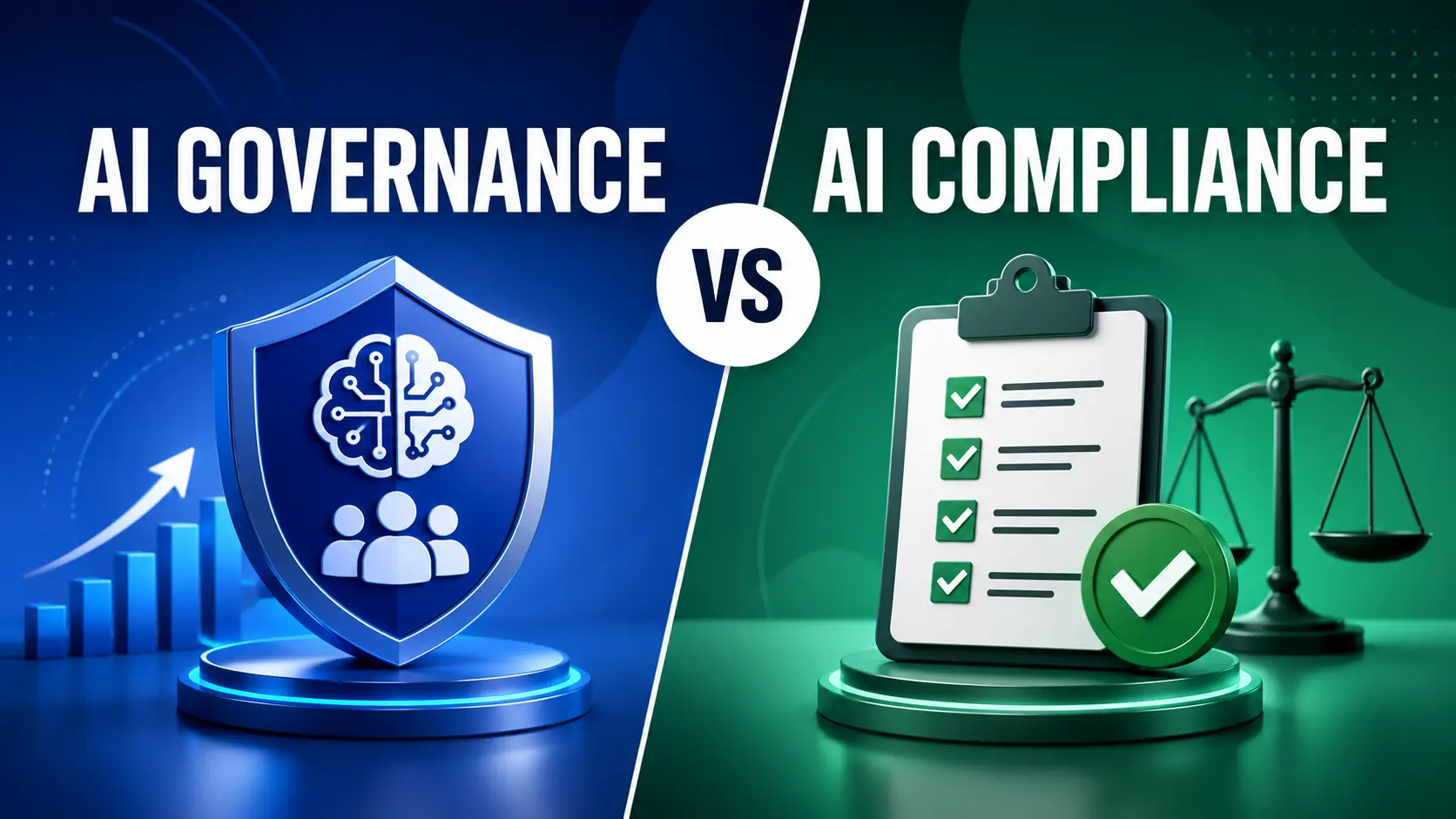
AI governance is the full system an organization uses to manage AI responsibly: strategy, ownership, risk management, oversight, and lifecycle controls. AI compliance is narrower. It means meeting the specific laws, regulations, standards, and contractual obligations that apply to a given AI system. Compliance is a required output of governance, not a substitute for it. An organization can pass an audit and still have no real governance in place, and that gap is where most AI failures actually happen.
That distinction sounds simple, but it gets misapplied constantly. Legal teams get handed "AI governance" as a project and treat it like a compliance checklist. Compliance officers get asked to "own AI risk" without the authority to set policy or stop a risky deployment. Neither setup works. A sound AI governance strategy treats responsible AI as an operating discipline, and compliance as one of the things that discipline has to produce evidence for. This article explains that relationship using current frameworks, current regulatory timelines, and a real operational example.
Quick Answer: AI Governance vs AI Compliance
| AI Governance | AI Compliance | |
|---|---|---|
| What it is | The organizational system for managing AI responsibly | The act of meeting applicable rules and requirements |
| Core question | "How should we manage this system?" | "Are we meeting what's required?" |
| Scope | Strategy, risk, oversight, ethics, lifecycle | Laws, regulations, standards, contracts |
| Driven by | Organizational values, risk appetite, business goals | External rules and internal policy requirements |
| Time horizon | Ongoing, continuous | Often tied to specific deadlines and audit cycles |
Governance sets the direction and the guardrails. Compliance proves the organization is staying inside them. You need both, and neither one covers the other's job completely.
What Is AI Governance?
AI governance is the set of policies, roles, processes, and controls an organization uses to manage AI systems responsibly across their entire lifecycle, from the decision to build or buy a system through deployment, monitoring, modification, and eventual retirement.
It's an operating discipline, not a document. A governance program typically includes:
- AI policies that define acceptable use, prohibited use cases, and approval requirements
- Accountability structures that name who owns a given AI system and who can approve or halt its deployment
- Roles and responsibilities spanning executives, technical teams, legal, and business units
- AI risk management processes for identifying, assessing, and mitigating risks before and after launch
- Model oversight covering performance, accuracy, and behavior over time
- Data governance for the inputs a model is trained or fine-tuned on, and the data it processes in production
- Ethical considerations, including fairness and the potential for discriminatory outcomes
- Transparency and explainability, meaning people affected by an AI decision can get a meaningful account of how it was reached
- Human oversight, so a person can review, override, or stop a system when something goes wrong
- Security and privacy controls specific to how AI systems handle sensitive data
- Monitoring and incident management for detecting and responding to problems after deployment
- Third-party AI risk, since most organizations use AI built by vendors, not built in-house
- Documentation that captures what a system does, how it was tested, and how decisions about it were made
Governance applies across the full AI lifecycle. That's a key point people miss: it doesn't end at deployment. A model that performed well at launch can drift as data patterns change, as usage expands into new contexts, or as the underlying vendor model gets updated without notice. Governance is what catches that.
Many organizations find it easier to formalize this through AI governance consulting, particularly when internal teams lack bandwidth to build the program from scratch. That work usually starts with the data layer, since a data governance framework is what most AI governance programs end up depending on for accurate inputs and traceable decisions.
What Is AI Compliance?
AI compliance means demonstrating that a specific AI system meets the laws, regulations, industry standards, contractual terms, and internal policies that apply to it. It's narrower and more concrete than governance, and it's usually tied to a specific external requirement with a specific deadline or audit cycle.
Compliance work typically covers:
- Laws and regulations that apply based on jurisdiction, sector, or system type
- Standards an organization has adopted or been asked to certify against
- Contractual obligations, including AI-related terms customers or partners require
- Internal policies that function like binding requirements even without an external regulator
- Documentation and evidence proving a requirement was actually met, not just written down
- Audits and assessments, internal or third-party
- Controls that enforce a requirement operationally, not just on paper
- Reporting, both to regulators and to internal stakeholders like a board or risk committee
- Ongoing monitoring to confirm compliance holds after the initial assessment, not only at the moment of sign-off
The compliance question is narrow and checkable: are we meeting the requirements that apply to this system, right now, and can we prove it? The governance question is broader and ongoing: how should we manage this system responsibly, on a continuous basis, regardless of what any single regulation says? Compliance is largely externally defined. Governance is internally owned, even when it's shaped by external pressure.
AI Governance vs AI Compliance: Key Differences
| Dimension | AI Governance | AI Compliance |
|---|---|---|
| Definition | Organization-wide system for managing AI responsibly | Meeting specific applicable requirements |
| Primary objective | Responsible, consistent, well-managed use of AI | Demonstrated adherence to laws, regulations, and standards |
| Scope | Strategy, ethics, risk, oversight, lifecycle, culture | Specific legal, regulatory, and contractual obligations |
| Focus | How AI should be managed | Whether requirements are being met |
| Accountability | Distributed across leadership, risk, legal, and technical teams | Usually anchored in legal, compliance, or risk functions |
| Risk management | Broad: operational, ethical, reputational, strategic, legal | Focused on regulatory and legal risk exposure |
| Policies | Sets the policies | Enforces and evidences adherence to them |
| Regulations | Considers regulation as one input among several | Directly driven by regulatory text |
| Standards | May adopt standards voluntarily to strengthen the program | May be required to certify against a standard contractually |
| Audits | Uses audit findings to improve the broader system | Produces the evidence audits require |
| Documentation | Documents decisions, rationale, and oversight structure | Documents proof of specific requirement adherence |
| Monitoring | Continuous oversight of system behavior and risk | Periodic verification against defined requirements |
| Decision-making | Owns whether and how to deploy a system at all | Confirms a decision already made meets legal requirements |
| Business responsibility | Shared organizational responsibility | Typically owned by legal, compliance, or risk teams |
| Typical stakeholders | Board, executives, risk, legal, product, engineering, data science | Legal, compliance, audit, privacy office |
| Outcome | A well-managed AI program that can adapt as risk and regulation evolve | A demonstrable record of meeting applicable requirements |
Are AI Governance and AI Compliance the Same Thing?
No. They're closely related, but AI compliance is generally one component of a broader AI governance program, not a synonym for it.
A useful way to think about it: governance is the management system, and compliance is one of the requirements that system has to satisfy and prove it satisfied.
A company can have strong compliance documentation for a specific regulation and still lack a coherent governance program if nobody owns the AI system day-to-day, nobody is watching for model drift, and there's no process for deciding whether a new AI use case should be approved in the first place.
The reverse also happens. A company can have a genuinely strong governance culture, clear ownership, active monitoring, thoughtful risk reviews, and still fall short on a specific compliance requirement because a new regulation took effect and the paperwork hasn't caught up yet. Good governance makes closing that gap faster and less chaotic, but it doesn't make the gap disappear on its own.
How AI Governance and Compliance Work Together
The two functions connect through a repeatable lifecycle rather than operating as separate tracks:
Identify → Assess → Govern → Control → Document → Monitor → Audit → Improve
- Identify the AI systems in use or planned, including shadow AI tools employees have adopted informally.
- Assess the risk level, intended use, data sensitivity, and regulatory exposure of each system.
- Govern by assigning ownership, setting policy, and deciding whether and how the system should proceed.
- Control by implementing the technical and procedural safeguards the governance decision calls for.
- Document the system, its risk assessment, its controls, and the decisions made about it.
- Monitor performance, drift, incidents, and changing risk conditions after deployment.
- Audit against applicable regulations, standards, and internal policy to confirm requirements are met.
- Improve the program based on what monitoring and audits reveal, then repeat the cycle.
Compliance sits inside steps 3 through 7. It doesn't replace the cycle; it's the evidence-producing part of it. Governance is the system that makes sure the cycle actually runs, repeatedly, across every AI system the organization touches, not just the ones a regulator happens to be asking about this quarter.
Real-World Example: AI Hiring System
Consider a mid-sized company deploying an AI system to screen resumes and rank job candidates. This is one of the clearest ways to see governance and compliance operating side by side, because employment decisions carry both organizational risk and direct legal exposure.
Governance questions the company needs to answer:
- Should the company use this system at all, given the risk of biased outcomes in hiring?
- What specific risks does it create, and are they acceptable given the business benefit?
- Who owns this system: HR, IT, a dedicated AI team, or some combination?
- Who has the authority to approve deployment, and who can pause it if something looks wrong?
- How will the company monitor for bias in candidate outcomes over time, not just at launch?
- What human oversight is required before a rejection or advancement decision is finalized?
- How often will the system be reviewed, and what triggers an off-cycle review?
- What happens operationally if the model starts producing skewed or problematic results?
Compliance questions the company needs to answer:
- Which laws apply: employment law, state or local AI hiring disclosure rules, privacy law, or sector-specific requirements?
- Are required disclosures being given to candidates about the use of automated decision-making?
- Are documentation requirements being met, such as records of testing or bias audits where locally required?
- Are privacy obligations for candidate data being satisfied, including data retention and consent where applicable?
- Can the company produce evidence of compliance if a regulator or candidate challenges the process?
- Are required assessments, such as periodic bias audits mandated in some jurisdictions, actually being conducted and retained?
Notice the difference in character. The governance questions are about judgment, ownership, and ongoing management. The compliance questions are about whether a specific, checkable requirement has been satisfied. A company could answer every compliance question correctly and still have a poorly governed hiring system if nobody is actually watching outcomes after launch.
AI Governance Frameworks and Standards
NIST AI Risk Management Framework
The NIST AI Risk Management Framework (AI RMF), published by the U.S. National Institute of Standards and Technology in January 2023, is voluntary guidance designed to help organizations manage risks related to AI throughout the system lifecycle. It's built around four core functions: Govern, Map, Measure, and Manage. It does not certify anything and no regulator requires its use, but it has become a widely referenced common vocabulary for structuring an AI risk program.
NIST has continued expanding this ecosystem. In July 2024, it released the Generative AI Profile (NIST AI 600-1), which addresses risks specific to generative AI and large language models, including confabulation (AI-generated false information presented as fact), data privacy exposure, and information integrity. NIST has since published an agentic AI profile addressing risks tied to autonomous AI agents, and in early 2026 launched an AI Agent Standards Initiative and a concept note for a Trustworthy AI Profile for critical infrastructure. NIST also maintains crosswalk documents mapping the AI RMF to other frameworks, including ISO/IEC 42001 and the EU AI Act, which makes it useful for organizations trying to align multiple obligations without duplicating work.
ISO/IEC 42001
ISO/IEC 42001, published in 2023, is the first international, certifiable management system standard specifically for AI. It defines requirements for establishing, implementing, maintaining, and continually improving an AI management system (AIMS), an organization's structured set of policies, processes, and controls for governing how AI systems are designed, developed, deployed, and used.
Certification against ISO/IEC 42001 is voluntary and is carried out by accredited third-party certification bodies, not by ISO itself. It follows the same plan-do-check-act structure used in other ISO management system standards like ISO 9001 and ISO/IEC 27001, which makes it easier for organizations that already run those systems to integrate AI governance into existing management processes rather than building something entirely separate.
Organizations sometimes pursue certification to demonstrate commitment to responsible AI practices to customers, regulators, and partners, and a number of major technology vendors have already achieved it.
EU AI Act
The EU AI Act (Regulation (EU) 2024/1689) is the first comprehensive legal framework for AI adopted by a major regulatory body, and unlike NIST's framework or ISO/IEC 42001, it is legally binding within its scope, which makes it primarily a compliance matter rather than a voluntary governance framework, even though it strongly shapes how organizations structure their governance programs.
The Act entered into force in August 2024 with a phased implementation schedule. Prohibitions on certain AI practices and AI literacy obligations took effect first, followed by rules for general-purpose AI models. The regulatory picture shifted meaningfully in 2026: the EU's "Digital Omnibus on AI," adopted through political agreement in May 2026 and entering into force in July 2026, deferred the compliance deadline for standalone high-risk systems under Annex III (covering areas like employment, biometrics, education, and critical infrastructure) from August 2, 2026 to December 2, 2027. High-risk systems embedded in regulated products, such as medical devices, now face an August 2028 deadline. Core transparency obligations under Article 50, covering disclosures for AI chatbots and synthetic media, remain on the original August 2026 timeline. Because these dates depend on adopted legislative text, organizations should verify current status through the European Commission's AI Act page or EUR-Lex rather than relying on any single secondary source.
AI Compliance Regulations Businesses Need to Understand
AI compliance is not a single universal checklist, and treating it that way is one of the more common mistakes organizations make. Requirements vary based on jurisdiction, industry, the specific AI system involved, its risk level, the type of data it processes, its intended use, and any contractual obligations tied to customers or partners.
Relevant regulatory areas include:
- The EU AI Act, for organizations offering AI systems in the EU market or affecting people located there, regardless of where the company is headquartered.
- GDPR, which applies to AI systems processing personal data of EU residents, particularly around automated decision-making, data minimization, and the right to an explanation for certain automated decisions.
- Sector-specific rules, such as financial services regulations governing algorithmic decision-making, or healthcare regulations governing AI used in clinical or diagnostic contexts.
- Consumer protection requirements, which in the U.S. are actively enforced by the FTC against deceptive or unfair AI-related practices, even without an AI-specific statute.
- Privacy requirements at the state or national level that apply to AI systems processing personal information, independent of any AI-specific law.
- Employment regulations, particularly where AI is used in hiring, promotion, or performance evaluation decisions.
- Cybersecurity requirements, which increasingly extend to how AI systems are secured, tested, and monitored for adversarial risk.
It's worth being precise here: not every law relevant to AI is an "AI law." A privacy statute, an employment regulation, or a consumer protection rule can all apply directly to an AI system without ever mentioning artificial intelligence by name. Organizations that only track laws with "AI" in the title tend to miss a meaningful share of what actually applies to them.
AI Governance Framework vs AI Compliance Framework
These terms get used loosely, and the overlap causes real confusion, so it's worth separating them clearly.
- An AI governance framework is a structured approach an organization uses to manage AI responsibly across the full lifecycle: strategy, ownership, risk, oversight, and continuous improvement. It's internally defined, even when informed by external guidance.
- An AI compliance framework is a structured approach to meeting specific external and internal requirements: laws, regulations, standards, and contracts, along with the evidence needed to prove adherence.
- An AI risk management framework, like the NIST AI RMF, is a methodology for identifying, assessing, and managing AI-related risks. It supports both governance and compliance but is not itself either one.
- An AI management system, the concept behind ISO/IEC 42001, is a certifiable, formalized version of a governance framework, built around documented policies, processes, and continual improvement.
In practice, mature organizations use a risk management framework like the NIST AI RMF to structure how they think about risk, adopt or reference a management system standard like ISO/IEC 42001 to formalize their governance program, and maintain a separate but connected compliance framework to track and evidence adherence to whatever laws and contracts actually apply to them. None of these four things is interchangeable with the others, even though they're built to work together.
Who Is Responsible for AI Governance and Compliance?
AI governance should never sit with a single department, and it's a mistake many organizations make early on, especially handing the whole thing to legal or compliance and assuming it's covered.
The board and executive leadership set risk appetite, approve major AI investments, and are ultimately accountable for how the organization manages AI risk at a strategic level.
A Chief AI Officer, where the role exists, typically coordinates AI strategy and governance across business units, though this role is still relatively new and its scope varies significantly by organization.
The CIO and CTO own the technical infrastructure AI systems run on and often lead decisions about which AI tools and platforms the organization adopts.
The CISO addresses the security dimension: how AI systems are protected, how they might be exploited, and how AI itself might introduce new attack surfaces.
Legal teams interpret how existing and emerging law applies to specific AI use cases and advise on contractual AI provisions.
Compliance teams track applicable regulations, manage audit evidence, and confirm requirements are actually being met on an ongoing basis.
Risk teams assess and prioritize AI-related risks alongside the organization's broader risk portfolio.
Data governance teams manage the data AI systems are trained on and process, since data quality and data rights issues are often where AI risk originates.
Product teams, data scientists, and developers make day-to-day decisions that directly shape how a system behaves, which means governance policies only work if these teams understand and follow them.
Internal audit independently verifies that governance and compliance controls are actually functioning as designed, not just documented.
Concentrating AI governance entirely within legal or compliance functions tends to produce a program that's strong on paperwork and weak on actual system oversight, because the people closest to how a model behaves in production aren't part of the accountability structure.
What Happens Without AI Governance?
Organizations without a functioning AI governance program tend to run into a predictable set of problems, usually gradually rather than all at once.
Inconsistent AI adoption develops as different teams evaluate and deploy AI tools using different standards, or no standards at all.
Unclear accountability means that when something goes wrong with an AI system, no one is quite sure who's responsible for fixing it or who approved it in the first place.
Unmanaged AI risks accumulate because there's no structured process for identifying them before deployment or tracking them afterward.
Shadow AI spreads as employees adopt AI tools independently, often without any visibility into what data those tools are processing.
Weak documentation makes it difficult to reconstruct why a decision was made or how a system was tested, which becomes a serious problem during an audit or an incident review.
Poor vendor oversight allows third-party AI tools to operate with minimal scrutiny after initial approval, even as the underlying model or its behavior changes.
Privacy and security issues surface when AI systems handle sensitive data without controls calibrated to that sensitivity.
Inconsistent monitoring means model drift or degraded performance can go unnoticed for extended periods.
Difficulty demonstrating compliance follows naturally from all of the above, since compliance evidence is much harder to produce retroactively than to maintain continuously.
None of this requires a dramatic AI failure to become a real cost. It shows up as slower decision-making, duplicated vendor evaluations, inconsistent customer commitments, and a compliance function that's constantly scrambling to reconstruct information that should have been tracked from the start. It's the same underlying pattern behind why so many AI proof-of-concept projects never reach production: the technology usually isn't the blocker, the surrounding management discipline is. That gap tends to widen as adoption accelerates, which is part of why AI risk is becoming harder to contain as the current super-cycle plays out.
Can a Company Be Compliant but Poorly Governed?
Yes, and this is one of the more important things to understand about the relationship between these two functions, because it's counterintuitive. An organization can technically satisfy specific regulatory requirements while still having weak overall AI management.
Here's what that looks like in practice:
Compliance paperwork exists, but nobody actually owns the model. A risk assessment was completed and filed. No one is watching how the system performs six months later.
Required documentation exists, but the systems described in it aren't being monitored. The paper trail is accurate at the moment it was created and stale almost immediately after.
Policies exist, but employees don't follow them. A well-written AI use policy sitting in a shared drive doesn't change behavior if there's no enforcement mechanism or training behind it.
An audit is passed, but AI risks aren't continuously assessed. Passing an audit confirms a point-in-time snapshot. It says nothing about whether the organization is tracking new risks that emerge afterward.
Vendors are approved, but their models aren't monitored after deployment. Initial vendor due diligence gets completed, then the vendor updates their underlying model, and nobody at the client organization notices or reassesses.
This is the gap that causes real problems, because it's invisible from the outside. A company in this position can show a regulator a clean compliance file and still be genuinely exposed to operational, reputational, and financial risk, because the underlying management discipline that's supposed to keep pace with a changing system simply isn't there. Compliance answers "did we meet the requirement," not "are we actually managing this well." Those are different questions, and an organization needs governance to answer the second one honestly.
How to Build an AI Governance and Compliance Program
Building both functions together, rather than sequentially, tends to produce a program that's more durable and less duplicative. A practical sequence for a mid-sized organization:
- Create an AI inventory. Catalog every AI system in use or development, including tools adopted informally by individual teams. This is the foundation everything else depends on.
- Classify AI use cases by risk. Not every system needs the same level of scrutiny; a customer-facing hiring tool carries different stakes than an internal document summarizer.
- Identify applicable regulations and standards. Map each system against the laws, industry rules, and contractual obligations that actually apply to it, based on jurisdiction, sector, and data type.
- Establish AI governance policies. Define acceptable use, approval workflows, and escalation paths before problems arise, not after.
- Assign clear ownership. Every AI system needs a named owner accountable for its ongoing management, not just its initial approval.
- Conduct AI risk assessments. Evaluate each system for bias, security, privacy, accuracy, and operational risk before deployment and at defined intervals afterward.
- Establish controls. Translate governance decisions into actual technical and procedural safeguards.
- Document AI systems thoroughly. Capture what a system does, how it was tested, and the reasoning behind key decisions, in a form that would hold up under audit.
- Evaluate vendors carefully. Third-party AI tools need the same rigor as internally built systems, plus ongoing reassessment as vendor models change.
- Establish human oversight. Define where a person must review or approve an AI-driven outcome, particularly for higher-stakes decisions.
- Monitor AI systems continuously. Track performance, drift, and incidents after deployment, not just at launch.
- Conduct periodic reviews. Revisit risk classifications and controls on a set schedule, and whenever a system changes materially.
- Maintain evidence for audits. Keep documentation current on an ongoing basis so compliance evidence doesn't require a scramble every time it's needed.
- Update policies as regulations and systems change. Treat the program as a living system, not a one-time project.
AI Governance and Compliance Checklist
- Complete AI inventory covering all systems, including shadow AI
- Named owner assigned to every AI system
- Risk classification completed for each use case
- Applicable laws, regulations, and standards mapped per system
- Data privacy requirements identified and addressed
- Security controls in place for AI-specific risks
- Documentation maintained and kept current
- Transparency and disclosure requirements met where applicable
- Human oversight defined for higher-risk decisions
- Vendor and third-party AI risk assessed, including post-deployment monitoring
- Ongoing monitoring in place for performance and drift
- Incident response process defined for AI-related failures
- Audit evidence maintained continuously, not assembled reactively
- Employee training delivered on AI policies and acceptable use
Common AI Governance and Compliance Mistakes
"AI governance and AI compliance are the same thing." They're related but not equivalent. Compliance is one component of governance, focused on meeting specific external and internal requirements. Governance is the broader system that manages AI responsibly overall, including areas no regulation currently addresses.
"If we're compliant, our AI is automatically well governed." Compliance confirms a specific requirement was met at a specific point in time. It doesn't confirm ongoing oversight, accountability, or risk management are actually functioning day to day, which is why compliant-but-poorly-governed organizations are common.
"AI governance is only for large enterprises." Smaller organizations often have less capacity to absorb the fallout from an ungoverned AI failure, not more. A lightweight governance program scaled to organizational size is more valuable at a smaller company, not less.
"AI governance is only about ethics." Ethics is one dimension of governance, but the discipline also covers operational risk, legal exposure, security, financial risk, privacy, and reputational risk. Reducing governance to an ethics conversation understates its practical business function.
"Compliance only matters after an AI system is deployed." Compliance considerations, particularly around data privacy, disclosure requirements, and risk classification, need to be addressed before deployment. Retrofitting compliance onto an already-live system is significantly harder and riskier than building it in from the start.
Comparison With Traditional IT Governance
AI governance builds on the same foundational principles as traditional IT governance: accountability, risk management, documentation, and oversight. But AI introduces challenges conventional IT governance wasn't designed to handle.
Traditional software behaves deterministically: the same input produces the same output every time, and testing can verify that behavior with reasonable confidence. AI systems, particularly generative and agentic ones, produce probabilistic outputs, meaning the same input can produce different results, which complicates testing, validation, and quality assurance in ways traditional IT governance frameworks don't anticipate.
Model behavior and training data introduce risk sources that don't exist in conventional software. A model's outputs are shaped by data it was trained on, often data the deploying organization never directly reviewed, particularly with third-party foundation models.
Bias can emerge from training data or model design in ways that are difficult to detect through standard software testing, requiring specialized evaluation methods.
Explainability is harder with AI than with traditional software. A conventional application's logic can typically be traced step by step; a machine learning model's decision path often can't be, especially with more complex architectures.
Model drift means an AI system's performance and behavior can change over time as real-world data patterns shift, even without any code change, which is a risk category traditional IT governance rarely has to account for.
Generative AI raises additional concerns around accuracy, fabricated outputs, and content risk that don't have a direct equivalent in conventional software governance.
Autonomous AI agents, systems that can plan and execute multi-step actions on their own rather than just responding to a single prompt, introduce oversight challenges around authorization, monitoring, and containment that go well beyond what traditional access control models were built for.
Third-party foundation models mean many organizations are governing systems they didn't build and don't fully control, which shifts a significant part of governance toward vendor oversight rather than internal engineering review.
None of this makes traditional IT governance irrelevant. Access controls, change management, and security practices still apply directly to AI systems. AI governance extends that foundation to address risks specific to how these systems learn, behave, and change.
Frequently Asked Questions
What is the difference between AI governance and AI compliance? AI governance is the broader organizational system for managing AI responsibly, covering strategy, accountability, risk management, and oversight across the AI lifecycle. AI compliance is the narrower practice of meeting specific applicable laws, regulations, standards, and contractual obligations. Compliance is one component of a governance program, not a replacement for it.
Is AI governance the same as AI compliance? No. They're closely connected but distinct. An organization can be compliant with specific regulations while still lacking strong overall governance, and a strong governance program still needs a dedicated compliance function to track and evidence adherence to specific external requirements.
What is an AI governance framework? An AI governance framework is a structured approach an organization uses to manage AI systems responsibly across their full lifecycle, including policies, accountability structures, risk management processes, and oversight mechanisms. It's internally owned, even when shaped by external standards or regulatory expectations.
What is an AI compliance framework? An AI compliance framework is a structured approach to identifying, meeting, and evidencing adherence to the specific laws, regulations, standards, and contractual obligations that apply to an organization's AI systems.
Is AI governance mandatory? No specific law mandates "AI governance" as a standalone requirement in most jurisdictions, though regulations like the EU AI Act effectively require governance-like practices, such as risk assessment and human oversight, for certain high-risk systems. Frameworks like the NIST AI RMF and standards like ISO/IEC 42001 are voluntary.
Is AI compliance mandatory? Yes, where a specific law, regulation, or contract applies. Compliance obligations aren't optional once they apply to an organization's AI systems, though the specific requirements vary significantly by jurisdiction, sector, and system type.
How does the EU AI Act affect AI governance? The EU AI Act is a binding legal framework, primarily a compliance matter, but it strongly influences how organizations structure their governance programs by requiring practices like risk classification, human oversight, and documentation for high-risk systems. Following the 2026 Digital Omnibus amendments, most standalone high-risk system obligations under Annex III now apply from December 2, 2027, while transparency obligations under Article 50 remain on the original August 2026 timeline.
How does NIST AI RMF relate to AI governance? The NIST AI RMF is a voluntary risk management framework organizations can use to structure their AI governance program. It provides a common methodology, built around the functions of Govern, Map, Measure, and Manage, but it isn't itself a governance program and doesn't certify anything.
Is ISO 42001 an AI compliance standard? ISO/IEC 42001 is a certifiable management system standard for AI governance, not a compliance regulation. Certification is voluntary and demonstrates that an organization has a structured AI management system in place. It can support compliance efforts, but it isn't a legal requirement.
Who is responsible for AI governance? Responsibility is distributed across the board, executive leadership, legal, compliance, risk, IT and security leadership, data governance teams, and the product and engineering teams building or deploying AI systems. It shouldn't sit exclusively with any single department, particularly not legal or compliance alone.
Why do companies need AI governance? Without governance, organizations tend to face inconsistent AI adoption, unclear accountability, unmanaged risk, weak documentation, and difficulty demonstrating compliance when it's needed. Governance provides the structure that makes AI use consistent, accountable, and manageable as systems and regulations change.
Can a company be compliant without having good AI governance? Yes. A company can meet specific regulatory requirements at a given point in time while still lacking the ongoing ownership, monitoring, and risk management that make AI use genuinely well-managed. This gap is common and often invisible until an incident exposes it.
How do AI governance and risk management differ? AI risk management is a core component of AI governance, focused specifically on identifying, assessing, and mitigating risks. Governance is the broader system that includes risk management alongside policy-setting, accountability structures, oversight, and lifecycle management.
How can a company start an AI governance program? Start with an AI inventory to understand what systems are actually in use, then classify use cases by risk, assign ownership, and build policies and controls proportional to that risk. Reference an established framework like the NIST AI RMF for structure, and consider ISO/IEC 42001 as a target if third-party certification adds value for your customers or industry.
Final Verdict
AI governance is the broader system for managing AI responsibly. AI compliance focuses on meeting the specific requirements that apply to an organization and its AI systems. They overlap heavily, but they answer different questions: governance asks how a system should be managed, compliance asks whether specific requirements have been met.
Mature organizations need both, and treating either one as sufficient on its own tends to produce the exact gaps this article has walked through: compliant paperwork attached to unmanaged systems, or well-intentioned governance principles with no mechanism to prove they're actually being followed. The regulatory landscape, particularly around the EU AI Act, NIST's evolving guidance, and ISO/IEC 42001 adoption, will keep shifting through 2026 and beyond. A governance program built to adapt as that landscape changes will always outperform one built to satisfy a single regulation's current text, because the next regulation is already being drafted.