
Data Warehouse vs Data Lake vs Data Lakehouse: Key Differences Explained
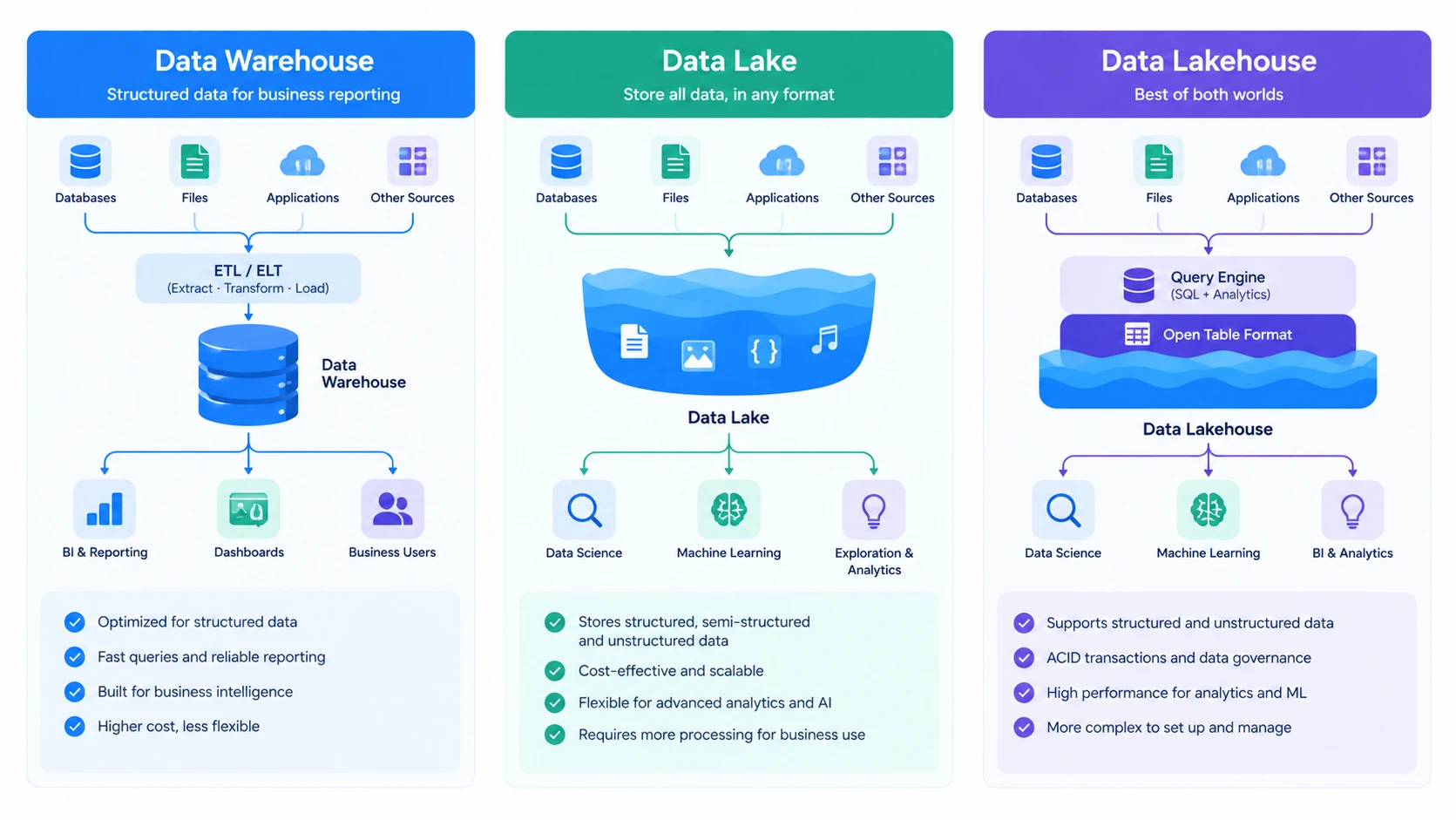
Quick Answer: Data Warehouse vs Data Lake vs Data Lakehouse
A data warehouse, a data lake and a data lakehouse are three ways to store data for analysis. The core difference is how much structure the data has before it is stored and what the system is optimized for.
- Data warehouse: stores cleaned, structured data in a central repository built for analytics and business intelligence. AWS describes it as "a central repository of preprocessed data for analytics and business intelligence" (AWS).
- Data lake: stores large volumes of raw data in any format. IBM defines it as "a repository designed to store large volumes of raw data, typically using low-cost cloud object storage" (IBM).
- Data lakehouse: combines the two. IBM calls it "a modern data platform that combines the low-cost, flexible data storage of a data lake with the high-performance analytics and data management capabilities of a data warehouse" (IBM).
Our editorial summary: choose a warehouse when your work is mostly structured reporting, a lake when you need cheap storage for raw and varied data, and a lakehouse when you want both in one platform. The three can also be combined. This guide explains each option, compares them side by side, shows how a real platform (Microsoft Fabric) splits lakehouse and warehouse, and gives a checklist for choosing.
Introduction
The phrase "data warehouse vs data lake" comes up whenever a team starts planning where its analytics data should live. The question matters because the choice affects cost, speed, who can use the data and how much cleanup work happens before and after it is stored.
The picture has also changed. A third option, the data lakehouse, has joined the comparison, so it is no longer a two-way choice. This article keeps to what the vendors' own documentation and research say, and flags where the choice depends on your situation.
If you are new to the surrounding ideas, our guide to what business intelligence is explains where warehouses and lakes fit in a BI system.
What Is a Data Warehouse?
A data warehouse collects data from many sources and stores it in a structured form for analysis. IBM defines it as something that "aggregates data from various sources into a central data store optimized for querying and analysis." It contrasts a warehouse with an ordinary database: a database mainly supports fast transaction processing for specific applications, while a warehouse integrates large volumes of data from many sources and prepares it for analytical queries and business intelligence (IBM).
Key characteristics, based on the AWS and IBM descriptions:
- Structured data. Warehouses hold structured, relational data.
- Schema defined up front. AWS says a warehouse schema is "often designed prior to implementation." IBM calls this approach schema-on-write: structure is enforced before data enters.
- Prepared data. Data is cleaned, validated and normalized before storage, usually through ETL (extract, transform, load).
- A "single source of truth." IBM says the centralized, cleansed repository supports self-service analytics and consistent reporting (IBM).
Strengths: fast, reliable queries on structured data; consistent definitions; well suited to dashboards and reports.
Limits: less flexible for raw, unstructured or rapidly changing data; changes to the model can take planning.
What Is a Data Lake?
A data lake stores data in its original form, first and processes it later. AWS describes it as "a central repository for raw data and unstructured data. You can store data first and process it later" (AWS). IBM adds that lakes use schema-on-read: structure is applied only when the data is accessed, not when it is stored (IBM).
Key characteristics:
- Any data type. Structured, semi-structured and unstructured data, including free text and images.
- Low-cost storage. IBM notes lakes typically use low-cost cloud object storage.
- Schema on read. The same raw files can serve different analyses.
- ELT instead of ETL. AWS notes data lakes use an ELT approach, loading first and transforming later.
Strengths: flexibility, scale and low storage cost; a good fit for data science and machine learning work that needs raw data.
Limits: lower performance optimization for analytics than a warehouse, and a governance risk. IBM warns that without strong governance a lake can deteriorate into a data swamp, where data becomes hard to find or trust because it lacks metadata, structure and oversight. It recommends "strong data governance, data quality and data security practices from day one" (IBM).
What Is a Data Lakehouse?
A data lakehouse tries to give you both worlds. IBM defines it as "a modern data platform that combines the low-cost, flexible data storage of a data lake with the high-performance analytics and data management capabilities of a data warehouse." The point, IBM explains, is to avoid the trade-off where lakes are cheap and flexible but lack built-in analytics tools, while warehouses perform well but are less flexible (IBM).
How lakehouses work: open table formats
Lakehouses typically rely on open table formats, which add a metadata layer that organizes raw data files into logical, database-like tables. IBM names three:
- Apache Hudi, designed for incremental data processing.
- Apache Iceberg, optimized for very large analytic tables.
- Delta Lake, developed by Databricks and open-sourced in 2019.
These layers enable capabilities such as ACID transactions, time travel and schema evolution (IBM).
Where the idea came from
The lakehouse was argued for in a 2021 research paper by Michael Armbrust, Ali Ghodsi, Reynold Xin and Matei Zaharia at the CIDR conference. The paper argues that the data warehouse architecture will be replaced by a "lakehouse" built on open, direct-access data formats such as Apache Parquet, with first-class support for machine learning and data science. It lists problems with warehouses that lakehouses aim to address: data staleness, reliability, total cost of ownership, data lock-in and limited use-case support (CIDR 2021 paper). That is an argument made by the architecture's proponents, so it is best read as a design thesis, not a neutral finding.
Strengths (per IBM): unified data management that reduces silos; cost-effective storage at scale; support for BI, analytics and AI/ML workloads; centralized metadata catalogs; and the option to avoid vendor lock-in through open formats.
Limits: it is a newer, more complex architecture that depends on the maturity of the table formats and tooling you choose, and it still needs governance.
What About a Data Mart?
A data mart often appears in the same comparisons. AWS describes it as "a data warehouse that serves the needs of a specific business unit, like a company's finance, marketing, or sales department." It is smaller and focused on a single subject area, usually built from pre-processed data (AWS).
Data Warehouse vs Data Lake vs Lakehouse: Side-by-Side Comparison
| Data warehouse | Data lake | Data lakehouse | |
|---|---|---|---|
| Data types | Structured | Structured, semi-structured and unstructured | All types, with table structure layered on |
| Schema | Defined before loading (schema-on-write) | Applied when reading (schema-on-read) | Table formats add schema and transactions over lake storage |
| Processing | ETL | ELT, store first and transform later | Supports both, depending on design |
| Storage cost and flexibility | Optimized for performance, less flexible | Low-cost and flexible | Aims for lake-like cost and flexibility |
| Analytics performance | Strong for structured queries | Lower without extra layers | Aims for warehouse-like performance |
| Typical users | Business analysts, BI teams | Data engineers, data scientists | Both groups |
| Main risk | Rigidity, cost of change | Data swamp without governance | Complexity and tooling maturity |
| Best for | Reporting, dashboards, dimensional modeling | Raw storage, data science, ML | Combined BI and data science workloads |
Sources: IBM warehouse, IBM lake, IBM lakehouse and AWS. The "best for" row is editorial summary.
Data Warehouse vs Data Lake: The Key Differences
Structure: before or after storage
The biggest difference is when structure is applied. A warehouse enforces it on the way in, so the data you query is already clean and consistent. A lake applies it on the way out, so you can store anything now and decide how to interpret it later. IBM frames this as schema-on-write versus schema-on-read.
Flexibility versus reliability
Lakes accept raw data, giving greater flexibility but lower performance optimization, per IBM. Warehouses clean and prepare data before ingestion for immediate analytics use (IBM). That makes warehouses the more predictable choice for reporting and lakes the more open-ended choice for exploration.
Who uses them
AWS lists business analysts, data scientists and developers as warehouse users, and a wider mix that includes data engineers for lakes.
Cost
AWS says lakes offer "more flexibility at a lower cost," while warehouses handle structured relational data efficiently. In a data lake vs data warehouse cost comparison, the real answer depends on data volume, query patterns and the vendor, so treat this as a general tendency, not a rule.
Data Warehouse vs Lakehouse
A lakehouse can look like a warehouse with a more flexible storage layer. The differences to weigh:
- Data variety. A warehouse is for structured data; a lakehouse also handles unstructured data in the same platform.
- Workloads. A lakehouse is designed to support BI, analytics and AI/ML together, per IBM.
- Openness. Lakehouses built on open table formats can reduce lock-in, which the CIDR paper lists as a key motivation.
- Maturity. Warehouses are an established technology with a long track record; lakehouse tooling is newer.
If your needs are mainly structured reporting and your team is SQL-first, a warehouse may be all you need.
Data Lake vs Lakehouse
A lakehouse can be seen as a lake with added structure and management:
- Table structure and transactions. Open table formats give lake data ACID transactions, time travel and schema evolution, which raw lakes lack.
- Governance. Centralized metadata catalogs help prevent the data swamp problem that IBM warns about.
- Performance for analysts. A lakehouse aims to make lake data queryable with warehouse-like performance.
If you already run a lake and struggle with reliability or reporting, adding a table format layer is the lakehouse path.
A Real Example: Microsoft Fabric's Lakehouse and Warehouse
Microsoft Fabric offers both a lakehouse and a warehouse, which makes it a useful concrete comparison. According to Microsoft Learn:
| Fabric lakehouse | Fabric warehouse | |
|---|---|---|
| Primary development tool | Apache Spark (Python, Scala, SQL, R) | T-SQL |
| Data types | Structured and unstructured | Structured |
| Multi-table transactions | No | Yes |
| Best for | Data engineering, data science, medallion architectures | BI reporting, dimensional modeling, SQL-first teams |
Microsoft says both share the same SQL engine and store data in Delta format on OneLake, and that you can use both in the same workspace, for example landing and transforming data in a lakehouse with Spark and exposing curated datasets to a warehouse for SQL reporting. A Fabric lakehouse also gets an automatically generated SQL analytics endpoint, which lets analysts query Delta tables with T-SQL in a read-only way (Microsoft Learn).
The example shows one pattern: use the lake side for raw and engineered data and the warehouse side for curated, reporting-ready data. For the broader platform, see our explainer on Microsoft Fabric.
When to Use Each
These suggestions are editorial guidance based on the descriptions above.
Choose a data warehouse when:
- Most of your data is structured and your main need is reporting and dashboards.
- Your team works mainly in SQL.
- Consistent, trusted numbers matter more than raw flexibility.
Choose a data lake when:
- You need to store large amounts of raw or varied data cheaply.
- Data scientists or engineers need access to unprocessed data.
- You are prepared to invest in governance so it does not become a swamp.
Choose a data lakehouse when:
- You want BI and data science on the same data without copying it between systems.
- You value open formats and want to limit lock-in.
- You have the engineering capacity for a newer architecture.
Use a combination when different teams have different needs. One option is a lake for raw data with a warehouse or lakehouse layer for curated analytics.
How They Fit Together in a BI Setup
In practice these are layers more often than rivals. The sketch below is an illustration of a common pattern, not a recommendation for any specific company.
- Raw data lands first. Exports from operational systems, logs and files are stored in a lake (or the lake side of a lakehouse) in their original form, so nothing is lost.
- Data is cleaned and shaped. Engineers transform the raw data, fixing types, removing duplicates and applying business rules. This is the ETL or ELT step described by AWS (AWS).
- Curated tables are published. Cleaned, agreed-upon tables go into a warehouse or a curated lakehouse layer, with consistent definitions for metrics such as revenue or active customers.
- BI tools read the curated layer. Dashboards and reports connect to those tables, so every team sees the same numbers.
- Data scientists work upstream. They can use the raw and lightly processed data for modeling, without disturbing the reporting layer.
Microsoft's lakehouse documentation describes a similar split when it says you can land and transform data in a lakehouse with Spark, then expose curated datasets to a warehouse for SQL reporting (Microsoft Learn). The layers serve different jobs: storing everything, preparing it, and presenting trusted answers.
Questions to ask when planning the layers
- Which datasets need to be raw and kept for the long term?
- Which tables must be curated and consistent for reporting?
- Who owns each layer, and who can change it?
- How will changes be tested before they reach dashboards?
- What is the plan for sensitive data in each layer?
Governance and Data Quality Matter More Than the Label
Whichever you choose, the same problem appears: data is only useful if people can find it, trust it and use it safely. IBM's warning about data swamps applies beyond lakes. Without metadata, ownership and quality rules, any repository becomes hard to rely on.
Practical basics:
- Define owners for key datasets.
- Document what each table or file contains and where it came from.
- Set access rules so sensitive data is protected.
- Monitor data quality and fix problems at the source.
Our guide to building a data governance framework covers these practices in detail, and our comparison of Microsoft Fabric vs traditional data governance platforms looks at how one platform approaches governance.
Common Mistakes
- Treating a lake as free storage with no plan. Without governance, it risks becoming a data swamp.
- Choosing a lakehouse because it is new. Pick it because you have mixed workloads, not because of the label.
- Copying data between systems unnecessarily. Duplicates drift apart and cause conflicting numbers.
- Ignoring who will use the data. Analysts and data scientists need different interfaces and guarantees.
- Skipping definitions. Agree on what key metrics mean before building anything.
- Assuming one architecture fits forever. Needs change, so design so you can evolve.
How to Choose: A Short Checklist
- What data do you have? Mostly structured, or a mix of formats?
- Who will use it? Analysts, engineers, data scientists, or all three?
- What workloads matter? Reporting, machine learning, or both?
- How much engineering capacity do you have? A lakehouse typically needs more.
- How important is avoiding lock-in? Open table formats are the usual answer.
- What governance exists today? Fix this before adding volume.
Frequently Asked Questions
What is the difference between a data warehouse and a data lake? The difference between a data warehouse and a data lake comes down to structure: a data warehouse stores cleaned, structured data prepared for analytics, with the schema defined before loading. A data lake stores raw data in any format and applies structure when the data is read (IBM).
What is a data lakehouse? A platform that combines a data lake's low-cost, flexible storage with a data warehouse's analytics performance and data management, according to IBM (IBM).
Is a data lakehouse better than a data warehouse? Not in every case. A lakehouse suits mixed BI and data science workloads and open formats, while a warehouse is a mature, simple choice for structured reporting.
Do I need both a data warehouse and a data lake? Many organizations use both, with the lake holding raw data and the warehouse holding curated data for reporting. A lakehouse tries to serve both roles in one platform.
What is a data swamp? A data lake that has become hard to use because data lacks metadata, structure and governance, so quality data is hard to find (IBM).
What is a data mart? A smaller data warehouse serving a specific business unit such as finance, marketing or sales (AWS).
What is the difference between ETL and ELT? ETL transforms data before loading it into the target, while ELT loads first and transforms afterward. AWS says ELT has become more popular with cloud infrastructure (AWS).
What open table formats do lakehouses use? IBM names Apache Hudi, Apache Iceberg and Delta Lake, which add ACID transactions, time travel and schema evolution to lake data (IBM).
How does Microsoft Fabric handle this? Fabric offers both a lakehouse (Spark-based, structured and unstructured data) and a warehouse (T-SQL, structured data) that share a SQL engine and store Delta data on OneLake (Microsoft Learn).
Which is cheaper, a data lake or a data warehouse? AWS says lakes offer more flexibility at a lower cost, but real costs depend on your data volume, usage and vendor, so model your own scenario.
Conclusion
The data warehouse, data lake and data lakehouse are answers to different needs. Warehouses give you clean, consistent, fast structured analytics. Lakes give you cheap, flexible storage for raw and varied data. Lakehouses try to combine the two so that BI and data science can share one platform and one copy of the data.
The best choice depends on your data, your users and your engineering capacity, and many teams end up with a mix. Whatever you pick, governance and data quality decide whether the data is actually useful. If you want the bigger picture, start with what business intelligence is, then look at how Microsoft Fabric puts lakehouse and warehouse side by side.
Sources
- IBM, What is a data warehouse?, What is a data lake? and What is a data lakehouse?
- AWS, The difference between a data warehouse, data lake and data mart and What is ETL?
- Armbrust, Ghodsi, Xin and Zaharia, Lakehouse: A New Generation of Open Platforms that Unify Data Warehousing and Advanced Analytics (CIDR 2021; summarized from its abstract as reported in search results)
- Microsoft Learn, What is a lakehouse? (Microsoft Fabric)