
Data Governance vs Data Quality vs Data Security: Key Differences
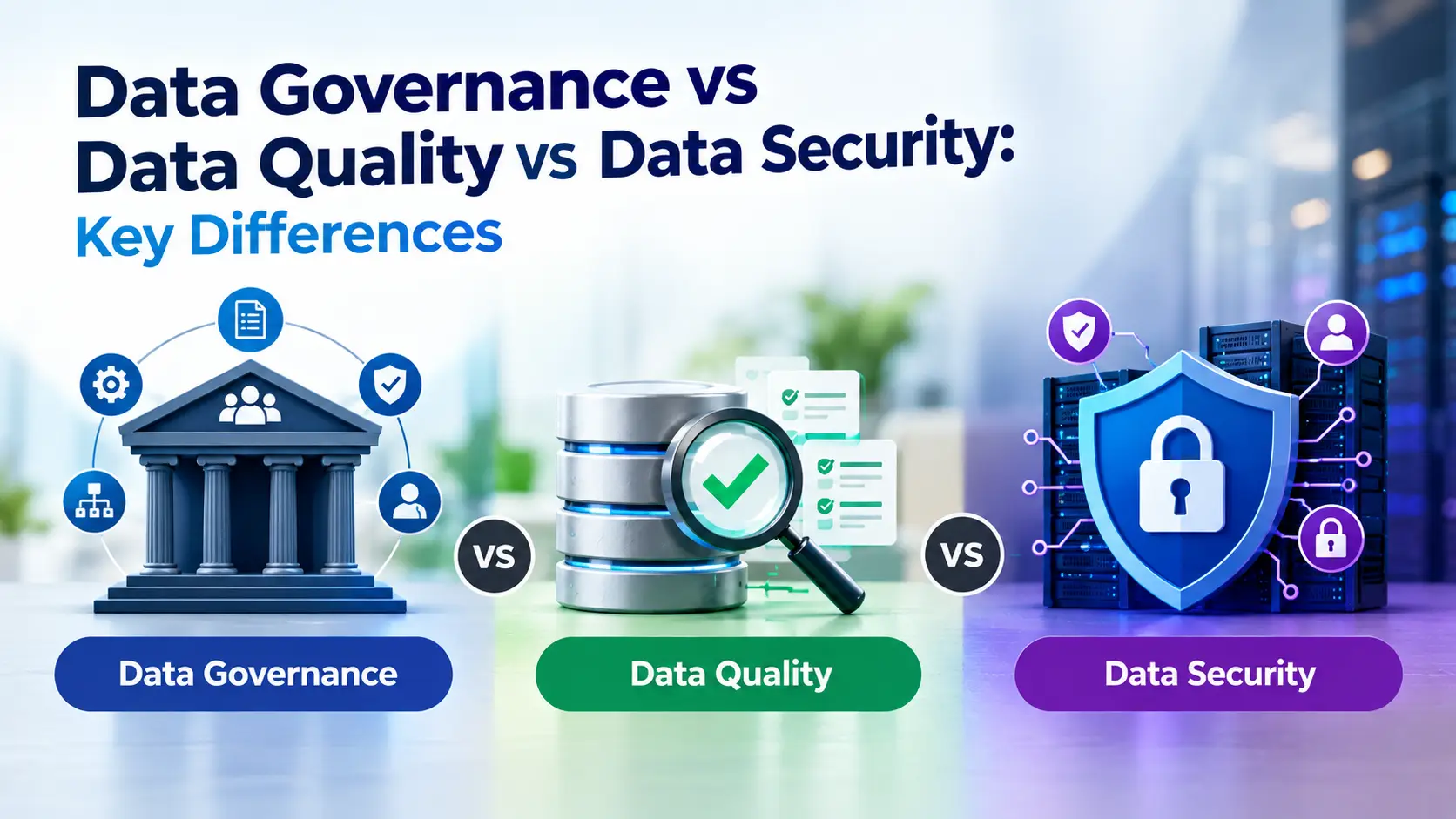
Quick Answer: Data Governance vs Data Quality vs Data Security
These three terms are related but they are not the same thing:
- Data governance is the set of roles, rules and decisions that determine who owns data, who can use it and how it must be handled.
- Data quality is how well the data fits its purpose: accurate, complete, consistent, valid, unique and timely.
- Data security is the protection of data from unauthorized access, corruption or theft.
A simple way to remember it: governance sets the rules, quality asks "can we trust this data?", and security asks "is this data protected?" Governance is the umbrella. Quality and security are two of the things it directs.
| Data governance | Data quality | Data security | |
|---|---|---|---|
| Main question | Who is responsible, and what are the rules? | Is the data fit to use? | Is the data protected? |
| Focus | Ownership, policy, accountability | Accuracy, completeness, consistency | Confidentiality, integrity, availability |
| Typical owner | Data governance council, data owners | Data stewards, data engineers | Security team, CISO |
| Typical outputs | Policies, roles, glossary, standards | Quality scores, cleansing rules, monitoring | Access controls, encryption, monitoring |
| Failure looks like | Nobody knows who owns a dataset | Two reports show different revenue | A breach, or an employee seeing data they shouldn't |
Definitions
Data governance. IBM describes data governance as "the data management discipline that focuses on the quality, security and availability of an organization's data." Notice that quality and security are both inside that definition. Our data governance framework guide covers how to build the full program.
Data quality. IBM defines data quality as a measure of "how well a dataset meets criteria for accuracy, completeness, validity, consistency, uniqueness, timeliness and fitness for purpose."
Data security. IBM describes data security as "the practice of protecting digital information from unauthorized access, corruption or theft throughout its lifecycle."
Introduction
People mix these three terms up constantly, and the confusion has a cost. A company that thinks it has governance because it bought a security tool will find that nobody owns its customer data. A company that runs a data quality project without governance will clean the same errors again next year. A company that governs and cleans its data but ignores security will eventually have a clean, well-documented dataset in the wrong hands.
This guide explains what each discipline covers, where they overlap, who is responsible for each, and how to decide where to start. It uses published definitions from IBM, NIST and Microsoft so you can check the terms against recognized sources.
What Is Data Governance?
Data governance is about decisions and accountability. It answers questions such as:
- Who owns the customer dataset?
- Who is allowed to change it, and who is allowed to see it?
- What does "active customer" mean, and who decides?
- What happens when two teams disagree?
In practice it is made up of policies, standards, a business glossary, defined roles and a way to resolve disputes. Microsoft describes one common structure in its Purview documentation: a central data office sets rules and policies, data owners register assets and manage access, data stewards look after quality, the glossary and lineage, and data consumers find and request what they need (Microsoft Learn).
Governance doesn't clean data or encrypt it. It decides who is responsible for doing so and to what standard. That's why it is so often described as the framework that holds the other two together.
If governance programs interest you, it is worth reading why so many of them stall in our guide to why data governance programs fail.
What Is Data Quality?
Data quality is about whether data is good enough for the job it is being used for. IBM lists six common dimensions:
- Completeness: how much of the expected data is actually present.
- Uniqueness: how many duplicate records exist.
- Validity: whether data follows the required format and business rules.
- Timeliness: whether data is available when it's needed.
- Accuracy: whether it is correct against an agreed source of truth.
- Consistency: whether records agree across datasets and systems.
Bad data quality is common and expensive. A study published in Harvard Business Review by Tadhg Nagle, Thomas Redman and David Sammon found that on average 47% of newly created data records contained at least one critical error, and only 3% of the quality scores were acceptable. The sample was small and focused on Irish companies, so read it as a warning, not a universal average (HBR). IBM also cites a Gartner report estimating that poor data quality costs organizations an average of USD 12.9 million a year.
Quality work includes profiling data, setting rules, cleansing and deduplicating records, monitoring for problems, and fixing them where the data is created. It matters for every report, and it matters even more for AI: IBM puts it as "garbage in, garbage out," meaning poor input data produces unreliable predictions.
What Is Data Security?
Data security is about protection. NIST's FIPS 199 frames security around three goals, usually called the CIA triad:
- Confidentiality: only authorized people can see the data.
- Integrity: the data isn't improperly changed or destroyed.
- Availability: authorized people can reach the data when they need it.
IBM lists the core techniques as encryption, access control built on the principle of least privilege, data masking, and backup and recovery. The threats it names include ransomware and malware, phishing, insider threats, misconfiguration and human error, and weak authentication.
The stakes are high. According to IBM's Cost of a Data Breach Report 2026, the global average cost of a breach is USD 4.99 million, a 12% increase over the previous year. That figure is an average, and individual breaches vary widely by industry and region.
Security is also separate from privacy. IBM draws the line this way: security protects information with technical controls, while privacy governs how organizations collect, store and use that data in line with rules like GDPR and CCPA.
Key Differences Between the Three
Purpose
Governance aims for accountability and consistency. Quality aims for trustworthy, usable data. Security aims for protection. A dataset can succeed at one and fail at the others: perfectly accurate customer records with no owner and loose permissions would pass on quality and fail on governance and security.
Who does the work
- Governance is led by a council or data office with business and IT leaders, with data owners accountable for specific domains.
- Quality is carried out daily by data stewards, analysts and data engineers.
- Security is handled by information security teams, often led by a chief information security officer, with IT operations.
What they produce
Governance produces policies, definitions and role assignments. Quality produces measurements, cleansing rules and monitoring. Security produces access controls, encryption, detection and incident response.
How you measure success
| Discipline | Example measures |
|---|---|
| Governance | Share of critical datasets with a named owner, policy exceptions, time to approve data access |
| Quality | Error rate on critical fields, duplicate rate, completeness, timeliness |
| Security | Number of incidents, time to detect and respond, share of sensitive data classified and protected |
Where They Overlap
The three disciplines share a lot of ground, which is why they get confused.
- Access control is a governance decision (who should have access) enforced by a security control (the permission itself).
- Classification labels data by sensitivity. Governance defines the labels, and security uses them to decide which protection to apply.
- Lineage shows where data came from and how it changed. It helps quality teams trace an error to its source, helps governance with accountability, and helps security understand where sensitive data travels.
- Integrity appears in both quality (is the data correct?) and security (has it been tampered with?).
- Compliance draws on all three. Regulations such as GDPR and HIPAA need defined ownership, accurate records and protected data.
Microsoft's product design reflects this. Its Purview platform groups data security, data governance and data compliance as separate solution areas under one portal, with shared capabilities such as classifiers and sensitivity labels used across them (Microsoft Learn). Vendors bundle them, but the underlying jobs remain different.
An Example: One Customer Record, Three Questions
This is a hypothetical example to show how the three apply to the same data.
A retailer holds a customer record containing a name, email, address and purchase history.
- Governance asks: Who owns customer data? Who approved the marketing team's access? How long should it be kept? What does "active customer" mean?
- Quality asks: Is the email valid? Is the address complete? Is this person recorded twice under slightly different spellings?
- Security asks: Is the record encrypted? Is access limited to people who need it? Would we notice if someone downloaded all of it?
If any one of these is missing, the record becomes a problem: unowned and ungoverned, unreliable, or exposed.
How They Work Together
Think of governance as the operating model, with quality and security as two of its main workstreams.
- Governance sets the rules. It names owners, defines standards and decides how much quality is required and how sensitive each dataset is.
- Quality makes the data trustworthy. It measures against those standards and fixes problems at the source.
- Security protects the data. It applies controls in proportion to the sensitivity that governance assigned.
- Governance reviews the results. It reads quality scores and security incidents and adjusts the rules.
This loop is why combining them in one program works better than running three separate projects. For how this feeds into reporting and analytics, see the role of governance in data analytics and digital transformation.
Which One Should You Start With?
You rarely need to pick only one, but the order of attention can differ.
| Your situation | Start with |
|---|---|
| Reports and dashboards disagree, and nobody can say which is right | Governance (definitions and ownership), then quality |
| Reports are mostly consistent but contain obvious errors and duplicates | Data quality |
| You hold sensitive or regulated data and have weak access controls | Data security, with a minimum of governance to classify the data |
| A regulator, auditor or customer has asked how you manage data | All three, starting with governance to show accountability |
| You're preparing to deploy AI on company data | Quality and governance first, with security for any sensitive training data |
If you're unsure, begin with a small governance structure: name owners for your most important data, then use that structure to direct quality and security work.
Tools for Each Area
Different tools serve each discipline, though many platforms cover more than one.
- Governance: data catalogs, business glossaries and policy management, such as the Purview Unified Catalog and Data Map or tools from other vendors.
- Quality: profiling, validation and monitoring tools, either standalone or built into data platforms.
- Security: encryption, identity and access management, data loss prevention and monitoring.
A tool supports a discipline and does not replace it. For a comparison of governance platforms, see Microsoft Fabric vs traditional data governance platforms.
Where AI Fits In
AI raises the stakes for all three. Models trained on poor-quality data produce poor results, which is a quality issue. Models that can reach sensitive data create new exposure, which is a security issue. And deciding which data an AI system may use, and who is accountable for its outputs, is a governance issue.
IBM's 2026 breach report highlights this last point, recommending dynamic, identity-based access controls and auditability for AI agents. For the governance side, see our guide to what AI governance is.
Common Mistakes
- Treating them as the same thing. Buying a security tool doesn't give you governance, and a quality project doesn't give you security.
- Treating governance as only a security or compliance exercise. Governance also covers meaning, ownership and usability.
- Cleaning data without fixing the cause. If errors are created at the source, they return.
- Locking data down so tightly that nobody can use it. Good governance balances protection and access.
- Running three disconnected projects. Different teams duplicate effort and contradict each other.
- Skipping the baseline. Without current quality scores or an inventory of sensitive data, you can't show improvement.
- Forgetting privacy. Security protects data, but privacy rules decide what you may collect and do with it.
Frequently Asked Questions
What is the difference between data governance and data security? Data governance decides who owns data and how it may be used. Data security applies technical protections, such as encryption and access controls, to keep the data safe. Governance sets the policy and security enforces much of it.
What is the difference between data governance and data quality? Governance defines the roles, rules and standards. Data quality measures and improves how well the data meets those standards. Governance says what "good" means and who is responsible, and quality work gets the data there.
Is data quality part of data governance? Yes, in most frameworks. IBM's definition lists quality as one of the things governance focuses on. Quality management is one of the core components of a governance program.
Is data security part of data governance? Security is usually treated as a close partner. Governance defines access rules and classifies data, and the security team implements the technical controls. Some organizations place them within the same program, and others keep them separate with clear hand-offs.
What are the six dimensions of data quality? IBM lists completeness, uniqueness, validity, timeliness, accuracy and consistency. Some frameworks add or rename dimensions, so agree on your own list.
What is the CIA triad? Confidentiality, integrity and availability: the three goals that data security aims to protect. NIST's FIPS 199 uses them to categorize systems by potential impact.
Is data privacy the same as data security? No. Security protects data from unauthorized access with technical controls. Privacy covers how personal data is collected, used and shared under rules like GDPR and CCPA. You need security to deliver privacy, but privacy involves legal and ethical choices as well.
Who is responsible for data quality? Business data owners are accountable for quality in their area, and data stewards, analysts and engineers do much of the day-to-day work. A central team can set standards and provide tooling.
Which should a small business start with? Start with the basics of all three on your most important data: name an owner, check the quality of the key fields, and secure access with strong authentication and least-privilege permissions. You don't need an enterprise platform to begin.
Can you have good data quality without governance? Briefly, yes, for a single project. Over time, quality decays without owners and standards, because the same errors keep being created. Governance is what makes quality last.
Can you have governance without security? Not in any meaningful way. A governance program that classifies data and sets access rules needs security controls to enforce them.
Do I need separate tools for each? Not always. Some platforms combine catalog, quality and security features. Decide on your roles and rules first, then choose tools that fit.
Conclusion
Data governance, data quality and data security are three views of the same asset. Governance makes people accountable, quality makes data trustworthy and security keeps it protected. Weakness in one undermines the others, so treating them as a connected set works better than treating them as rivals.
Key takeaways
- Governance is the umbrella: roles, rules and decisions.
- Quality asks whether data is fit for use, across dimensions like accuracy and completeness.
- Security protects confidentiality, integrity and availability.
- They overlap on access, classification, lineage and compliance.
- Start with named owners for your most important data, then direct quality and security work through them.
- Measure each separately so you can see where the gaps are.
Next step: pick your most important dataset, then write down its owner, its current error rate and who has access to it. Any blank answer shows where to start.