
Financial Data Quality Management: Framework, Challenges, and Best Practices
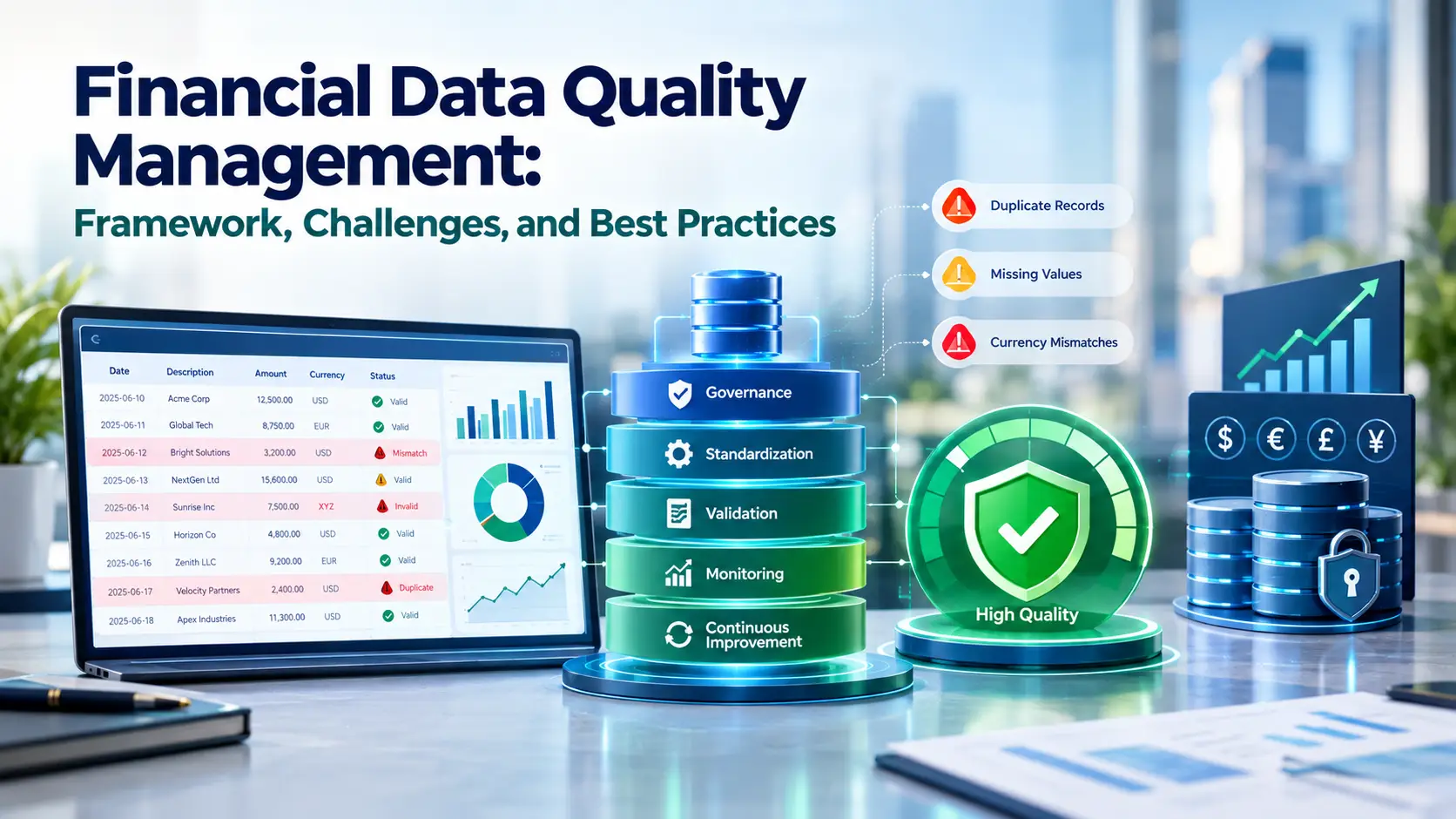
A bank's month-end close is running late. The general ledger says one number, the sub-ledger says another, and the difference is small enough to look harmless. Two analysts spend a day tracing it. A batch of transactions was loaded twice after a system retry, and a handful of accounts carry a currency code the reporting layer does not recognize. Nothing was hacked and no one made a dramatic mistake. A few ordinary records were wrong, and nobody had a rule that would catch them before they reached the report.
That is the everyday reality financial data quality management is meant to prevent. Financial data quality management is the set of rules, processes, roles and tools an organization uses to keep its financial data accurate, complete, consistent and timely. The goal is data that reports, risk models, regulatory filings and decisions can rely on. This guide explains how it works, how to measure it, and how to build a framework that holds up in practice.
What Is Financial Data Quality Management?
Financial data quality management is the ongoing practice of defining what good financial data looks like and checking data against those standards. Whatever fails gets fixed, and monitoring keeps the same problems from returning.
Three ideas sit inside that definition:
- Financial data covers transactions, balances, customer and counterparty records, pricing, positions, ledger entries and invoices. It also includes the reference data that describes them, such as currency codes and the chart of accounts.
- Data quality is how well that data fits its intended use. Data can be perfectly formatted and still be wrong for a particular purpose, which is why quality is always judged against a use.
- Data quality management is the discipline that turns quality from a hope into a routine: requirements, rules, checks, ownership, metrics and remediation.
Put together, the first gives you the subject, the second gives you the standard, and the third gives you the process that keeps the subject at the standard.
It helps to separate this from broader financial data management, which also covers storage, architecture, security and integration. Quality management is the part concerned with whether the data is actually right.
Why Financial Data Quality Matters
Finance is unusually unforgiving about data. Numbers get summed, compared, audited and sent to regulators, so a small defect rarely stays small.
Reporting is the first casualty, because financial data accuracy and integrity underpin every figure in it. A duplicated batch or a misclassified account flows straight into management accounts and external statements. By the time anyone notices, the figure may already have informed a decision. Poor financial reporting data quality also drags out the close. When source systems disagree, finance teams spend the period chasing differences instead of analyzing results, and the work is manual and easy to get wrong.
Regulators care too. Banks and other regulated firms must be able to produce accurate, traceable data on demand. The Basel Committee's BCBS 239 principles for risk data aggregation and risk reporting exist because supervisors found that some banks could not aggregate risk exposures quickly or reliably. Whether a specific rule applies to you depends on your jurisdiction and institution type, so confirm that with your compliance team.
Risk management depends on inputs. Credit, market and liquidity models are only as good as the data behind them. A missing counterparty identifier can hide concentration risk, and a stale price can misstate a position.
Customers feel it as well. Wrong addresses, duplicated customer records and mismatched account details lead to failed payments, misdirected statements and extra service calls. This is why banking data quality is usually a board-level concern, not just an IT one.
Then there is trust. Once executives learn that two reports disagree, they start doubting all of them, and rebuilding that confidence takes far longer than preventing the problem. Most of the damage comes from steady, low-level friction: extra checking, extra reconciling, and decisions delayed because nobody is sure which number is right.
Common Financial Data Quality Problems
Most issues in financial data fall into eight groups. Knowing them helps you write rules that target real failures instead of generic ones.
Duplicate records
The same customer, trade or invoice exists more than once. This often happens when systems retry a failed load, when customers are onboarded through separate channels, or when mergers combine databases. A duplicated payment file can overstate expenses or trigger a double payment.
Missing or incomplete data
Required fields are blank: no tax identifier, no counterparty, no cost center. Incomplete records break downstream joins, weaken anti-money-laundering screening and leave gaps in regulatory reports.
Incorrect values
The field is filled in, but the value is wrong. A transposed digit in an amount, a wrong interest rate, or a transaction posted to the wrong account all fall here. These are the hardest to spot because the record looks normal.
Inconsistent formats
One system stores dates as day-month-year, another as month-day-year. One uses "USD", another "US$". Aggregating across systems then produces errors or silently drops rows.
Outdated data
Exchange rates, credit ratings, customer addresses and beneficial ownership details all change. Using last quarter's rate for today's valuation is a timeliness failure even when the number was once correct.
Data integrity problems
Relationships between records break. A transaction points to an account that no longer exists, or a child record has no parent. Referential integrity constraints in databases catch some of these, but data copied between systems often escapes them.
Reconciliation mismatches
Totals in one system do not match totals in another. The ledger and the payments platform disagree on the day's volume. Mismatches are usually a symptom of one of the other problems on this list.
Data lineage gaps
Nobody can say where a figure came from or what transformations touched it. Without lineage, investigating an error means interviewing people instead of following a trail, and auditors will ask for that trail.
Key Dimensions of Financial Data Quality
Data quality dimensions are the categories used to describe and measure quality. Different frameworks list different dimensions, and DAMA's data management body of knowledge is a common reference point. The seven below are the ones finance teams use most.
| Dimension | What it means | Financial example | Why it matters |
|---|---|---|---|
| Accuracy | Data reflects the real-world value | A loan balance matches the amount actually owed | Wrong values distort reports and decisions |
| Completeness | All required data is present | Every trade has a counterparty and settlement date | Gaps break reports and screening |
| Consistency | Data agrees across systems and formats | Customer name and currency match in the CRM and the ledger | Inconsistency causes reconciliation breaks |
| Timeliness | Data is available and current when needed | Closing rates are loaded before end-of-day valuation | Stale data produces outdated figures |
| Validity | Data follows defined formats and allowed values | Currency is a valid ISO 4217 code | Invalid values fail processing |
| Uniqueness | Each entity appears once | One customer, one customer ID | Duplicates inflate totals and confuse records |
| Integrity | Relationships between records hold | Every posting links to an existing account | Broken links make data untraceable |
Accuracy is the dimension people mention first and measure last, because proving a value is correct usually means comparing it with an outside source. Validity, completeness and uniqueness are easier to automate, so most programs start there. Consistency and reliability tend to follow once the same checks run across several systems.
Financial Data Quality Management Framework
A financial data quality framework is the structure that connects requirements, rules, checks, ownership and improvement. The steps below work in most organizations, whether you are a bank, an insurer or the finance function of a mid-sized company.
-
Define data quality requirements. Ask what each report or process needs. Regulatory capital reports, monthly management accounts and customer statements each have different tolerances for error and delay. Write requirements in terms the business agrees with, such as "99.5% of trades carry a valid counterparty ID before end-of-day".
-
Identify critical financial data. You cannot police everything equally. Pick the data elements that feed regulatory reporting, financial statements, risk models and customer-facing outputs. Start with those.
-
Establish data quality rules. Turn each requirement into a testable rule, covered in the next section. A rule that cannot be tested is a wish.
-
Profile and assess the data. Run profiling against real data to see null rates, value distributions, format variations and duplicates. Profiling often shows that the real problems differ from what people assumed.
-
Validate data. Financial data validation means applying the rules where data enters or moves: at source systems, during loading, and before reporting. Catching an error at entry costs far less than finding it at month-end.
-
Cleanse and standardize. Financial data cleansing means fixing failures by correcting values, merging duplicates, standardizing formats and enriching missing fields. Document each fix so corrections are traceable.
-
Monitor continuously. Financial data quality monitoring means running checks on a schedule or on every load, and alert the right owner when thresholds are breached. A one-off cleanup decays quickly if nothing watches the data afterward.
-
Investigate and resolve issues. Find the root cause, not just the bad record. If the same defect keeps appearing, the fix belongs in the source system or process.
-
Track quality metrics. Publish a small set of measures over time, so leaders can see whether quality is improving.
-
Improve processes continuously. Feed lessons back into system design, onboarding procedures and training. Review rules regularly, because products, systems and regulations change.
The most common failure is jumping to step 6 before completing steps 1 and 2. Cleaning data nobody has defined standards for just creates a cleaner version of the same uncertainty.
Data Quality Rules for Financial Data
A data quality rule is a testable statement about what valid data looks like. Rules are how requirements become automated checks. Good rules are specific, owned by someone, and tied to a business consequence.
Examples common in financial data:
- Uniqueness: Each account ID must appear only once in the account master.
- Range: A transaction amount cannot be negative unless the transaction type explicitly allows it, such as a refund or reversal.
- Validity: Currency must be an approved code, for example one defined in ISO 4217.
- Completeness: Required fields such as account number, transaction date and counterparty cannot be empty.
- Format: Dates must follow the accepted format, and postings cannot be dated in the future beyond the allowed settlement window.
- Duplicates: Customer records should not share the same tax or national identifier.
- Reconciliation: Transactions in the payments system must reconcile with the appropriate ledger within an agreed tolerance.
- Referential: Every journal line must reference a valid account in the chart of accounts.
Start with rules that catch frequent, costly errors instead of trying to write hundreds at once. Each rule should say what happens on failure: reject the record, quarantine it, flag it for review, or just log it.
Metrics and KPIs for Measuring Data Quality
Metrics show whether quality is improving and where to focus. Keep the list short enough that people actually read it.
| Metric | What it measures |
|---|---|
| Accuracy rate | Share of records whose values match a trusted reference |
| Completeness rate | Share of required fields that are populated |
| Duplicate rate | Share of records that are duplicates of another |
| Error rate | Share of records failing one or more rules |
| Validity rate | Share of values conforming to formats and allowed lists |
| Timeliness | Share of data delivered before its deadline |
| Reconciliation rate | Share of items matched across systems without manual work |
| Issue resolution time | Average time from detecting an issue to closing it |
Two habits make these useful. First, measure by data domain, such as customers, accounts, transactions and reference data, because an overall average hides the weak spot. Second, track trends over time and tie them to impact. A fall in the reconciliation rate matters more when it is linked to extra days at month-end.
Targets should reflect risk. The tolerance for errors in regulatory capital data is not the same as for a marketing contact list.
The End-to-End Data Quality Process
The framework describes what to put in place. This process describes the repeating cycle that runs once it exists.
- Discover. Find where critical financial data is created, stored and used, including spreadsheets and shadow systems that rarely appear in architecture diagrams.
- Profile. Measure the current state of the data to establish a baseline.
- Define rules. Agree on what good looks like for each critical element, with business and technical owners signing off.
- Validate. Run the rules against incoming and stored data.
- Cleanse. Correct, standardize, deduplicate and enrich records that fail.
- Monitor. Schedule recurring checks and alert on threshold breaches.
- Remediate. Route issues to owners, fix root causes and verify the fix.
- Report. Share scorecards with data owners and leadership.
- Improve. Adjust rules, processes and systems based on what the reports show, then begin again.
It is a loop, not a line. Each pass should find fewer repeat problems because root causes were addressed.
Data Governance and Financial Data Quality
People often use data governance and data quality as if they were the same thing. They are related but different, and finance programs work best when both exist.
Financial data governance sets the framework. It decides who owns which data, what the policies and standards are, who may access it, and who is accountable when something goes wrong. Data quality management measures and improves the actual condition of the data inside that framework. Financial data management is the broader umbrella that includes both, along with architecture, integration and security.
The governance elements that matter most for quality are:
- Data ownership: A named business owner is accountable for each critical data domain, such as customer, account or general ledger.
- Data stewardship: Stewards handle day-to-day quality work, such as reviewing exceptions and maintaining definitions.
- Policies and standards: Written rules for naming, formats, retention and acceptable quality thresholds.
- Metadata: Shared business definitions so "active customer" or "net revenue" means one thing everywhere.
- Data lineage: A traceable path from source to report, so errors can be located and explained.
- Accountability: Clear escalation when thresholds are missed, and consequences that people take seriously.
- Access controls: Limits on who can create or change data, which prevents some quality problems before they begin.
Our guides on building a data governance framework and why data governance programs fail cover the organizational side in more depth.
Data Quality Tools and Technologies for Finance Teams
No single product covers every need. Think in categories and match them to your gaps.
- Data quality platforms profile data, apply rules, score quality and manage exceptions. They are the core of most programs.
- Data catalogs document what data exists, who owns it and how it is defined. They support stewardship and lineage.
- Data observability tools watch pipelines for freshness, volume and schema changes, and flag anomalies as they happen.
- ETL and ELT validation adds checks inside the pipelines that move data, so bad records are stopped or quarantined during loading.
- Database constraints such as primary keys, foreign keys, not-null and check constraints enforce basic validity and integrity at the source.
- Reconciliation systems match records between systems, such as ledger to sub-ledger or bank statements to cash records, and highlight breaks.
- Master data management creates a single trusted version of core entities like customers, products and accounts.
- A business intelligence (BI) tool can surface quality scorecards and let users see reports alongside the quality of the data feeding them. If you are choosing one, see our comparison of business intelligence tools.
- Automated monitoring and alerting ties all of the above together so owners hear about issues quickly.
- AI-assisted checks add pattern detection on top of explicit rules, covered below.
Platforms such as Microsoft Fabric bundle several of these capabilities, while dedicated tools go deeper in particular areas. Verify current capabilities in each vendor's official documentation before deciding, since features change often.
Choose tools after you have defined rules, owners and metrics. Buying software first usually produces an expensive dashboard nobody acts on.
How AI Can Improve Financial Data Quality
Rule-based validation checks data against conditions a person wrote in advance. It is precise, explainable and good at known problems. Its weakness is that someone has to anticipate each problem.
AI-assisted quality management adds methods that can learn patterns from data, which helps with problems nobody wrote a rule for. In practice, the useful applications are:
- Anomaly detection. Models learn what normal looks like for a field or a feed. They flag values that deviate, such as a sudden spike in refunds or a drop in daily transaction counts.
- Duplicate detection. Fuzzy and probabilistic matching finds records that refer to the same entity despite spelling differences, abbreviations or typos.
- Classification. Models suggest categories for uncategorized transactions or map free-text descriptions to standard codes.
- Automated validation. Models can suggest candidate rules based on observed patterns, for a person to review and approve.
- Pattern recognition. Recurring error patterns across systems can point to a shared root cause.
- Data matching. Matching counterparties or transactions across sources helps reconciliation, particularly when identifiers are missing.
- Issue prioritization. Ranking issues by likely business impact helps small teams focus.
- Monitoring. Continuous checks catch drift that scheduled reviews miss.
- Natural-language investigation. Analysts can ask questions about data issues in plain language instead of writing queries, which speeds up triage. Our article on AI agents for business intelligence shows how this works in an analytics setting.
A few cautions apply. AI methods produce probabilities, not guarantees, and results vary with the data and the model. In finance, flagged items still need human review, and any model used in a regulated process needs documentation, testing and oversight. That is where AI governance comes in. Treat AI as an addition to rules, not a replacement for them.
Best Practices for Financial Data Quality
- Start with critical financial data. Begin where errors cost the most: regulatory reports, financial statements and risk inputs.
- Define measurable quality standards. "Good data" means nothing until it is a number with a threshold.
- Assign data ownership. Every critical data element should have a named owner who answers for it.
- Automate validation. Manual spot checks do not scale and tend to stop when people get busy.
- Monitor continuously. Check on every load or on a fixed schedule, not only before reporting deadlines.
- Track data lineage. Know where numbers come from so errors can be traced quickly and audits go faster.
- Build quality checks into pipelines. Validate at ingestion and at each major transformation instead of waiting for the final report.
- Prioritize issues by business impact. Fix the problem affecting regulatory filings before the one affecting a rarely used field.
- Measure quality over time. A trend line shows whether effort is working and justifies continued investment.
- Treat data quality as ongoing. Systems, products and regulations change, so rules and monitoring must change too.
A Worked Example: Fixing a Loan Portfolio Mismatch
The following scenario is illustrative, not a report about a specific company.
Problem: A mid-sized lender notices that monthly loan portfolio reports differ between the credit risk team and the finance team. The difference is small but recurring, and each month-end close takes two extra days to explain it.
Root cause: Investigation shows two issues. Loans migrated from an acquired lender carry an older product code that the risk system does not map, so they fall into an "unclassified" bucket. Separately, some customers have two records because they applied through different channels, so exposure is split across IDs.
Data quality rules: The team defines four rules: every loan must have a product code from the approved list, and each customer must have one master ID. Outstanding balances in the loan system must reconcile with the general ledger within an agreed tolerance. Exposure must be aggregated at the master customer level.
Detection: Profiling quantifies how many loans carry unmapped codes and how many customers share matching names, dates of birth and identifiers. Validation checks are added to the nightly load, and the reconciliation report runs automatically.
Remediation: The team maps the legacy product codes and merges confirmed duplicate customers through a steward-reviewed process. It also fixes the onboarding form so the second channel checks for an existing customer first.
Monitoring: A scorecard tracks unmapped code count, duplicate rate and reconciliation rate. Alerts go to the named data owner when any measure passes its threshold.
Result: Reports from both teams now start from the same customer and product definitions, so differences become exceptions to investigate rather than a monthly argument. Because the fix reached the onboarding process, new duplicates stop at the source. The team can also show an auditor how each number was derived.
Data Quality Management vs Data Governance
| Area | Financial Data Quality Management | Data Governance |
|---|---|---|
| Primary focus | Data quality | Data ownership and control |
| Goal | Accurate, complete, consistent data | Responsible data management |
| Main activities | Validation, profiling, cleansing, monitoring | Policies, ownership, standards, accountability |
| Relationship | Operational quality discipline | Governance framework |
Governance decides who is responsible and what the standards are. Quality management checks whether the data meets those standards and fixes it when it does not. Either one alone falls short: governance without quality measurement produces policies nobody can verify, and quality work without governance produces fixes nobody owns. For a wider comparison that also covers security, read data governance vs data quality vs data security.
Financial Data Quality Challenges and How to Address Them
Legacy systems
Older platforms often lack validation and export data in awkward formats. Add checks at the point where data leaves them, and plan gradual replacement for the worst offenders.
Fragmented data sources
Financial data spreads across ledgers, trading systems, CRMs and spreadsheets. Build a central view of critical data and a shared set of rules, supported by a sound data warehouse or lakehouse design.
Inconsistent definitions
Two departments may define "revenue" or "customer" differently. Resolve this in a business glossary with a named owner for each term.
Large data volumes
Manual review cannot keep up. Automate checks and sample intelligently where full validation is too costly.
Real-time data
Streaming payments and market data leave little time for correction. Place lightweight validation at ingestion and run deeper checks asynchronously.
Manual processes
Rekeying and spreadsheet adjustments introduce errors. Replace the most error-prone manual steps first and log any remaining adjustments.
Unclear ownership
When nobody owns a field, nobody fixes it. Assign owners and make quality part of their goals.
Regulatory requirements
Rules differ by jurisdiction and change over time. Maintain a mapping between regulatory obligations and the data elements and controls that support them, and review it with compliance regularly.
Data silos
Teams guard their own data and build private fixes. Shared standards, a data catalog and executive sponsorship help break this pattern.
Changing business rules
New products and policy changes make old rules obsolete. Version your rules and review them on a schedule.
Frequently Asked Questions
What is financial data quality management? Financial data quality management is the practice of defining quality standards for financial data, testing data against them, correcting problems and monitoring over time. It means reports, risk analysis and decisions rely on accurate, complete, consistent and timely data.
Why is data quality important in finance? Financial data feeds statements, regulatory filings, risk models and customer transactions. Errors spread quickly, causing misreporting, reconciliation delays, compliance problems and poor decisions. Reliable data also reduces rework and builds trust in the numbers among executives, auditors and regulators.
What are the dimensions of financial data quality? Commonly cited dimensions are accuracy, completeness, consistency, timeliness, validity, uniqueness and integrity. Different frameworks use slightly different lists, but these seven cover most practical needs in banking, accounting and financial reporting.
How do banks ensure data quality? Banks combine governance and technical controls: named data owners, written standards, validation rules at entry and during loading, automated reconciliation, lineage tracking, quality scorecards and issue management. Supervisory expectations such as BCBS 239 push large banks toward stronger risk data aggregation.
What are financial data quality metrics? They are measures of how well data meets its standards. Typical examples include accuracy rate, completeness rate, duplicate rate, error rate, validity rate, timeliness, reconciliation rate and the average time to resolve data quality issues.
What is the difference between data quality and data governance? Data governance sets ownership, policies, standards and accountability for data. Data quality management measures and improves the condition of the data against those standards. Governance is the framework, and quality management is the operational discipline that works inside it.
How can AI improve financial data quality? AI can detect anomalies, find fuzzy duplicates, classify transactions, suggest validation rules and prioritize issues. It complements rule-based checks by catching patterns nobody anticipated, but its outputs are probabilistic and still need human review in regulated processes.
Conclusion
Financial data quality management comes down to a handful of decisions. Define what good data means for the processes that matter most. Write rules that can be tested. Give every critical data set a named owner. Measure the results, and fix root causes so problems stop returning.
Governance supplies the ownership and standards, tooling supplies the automation, and AI can widen coverage once the basics are in place. None of it works without people who treat the numbers as their responsibility.
Financial data quality is not a one-time cleanup project. It is an ongoing management discipline that combines rules, processes, ownership, technology, and continuous monitoring.