
Internet of Things Examples: Devices, Applications, and Use Cases
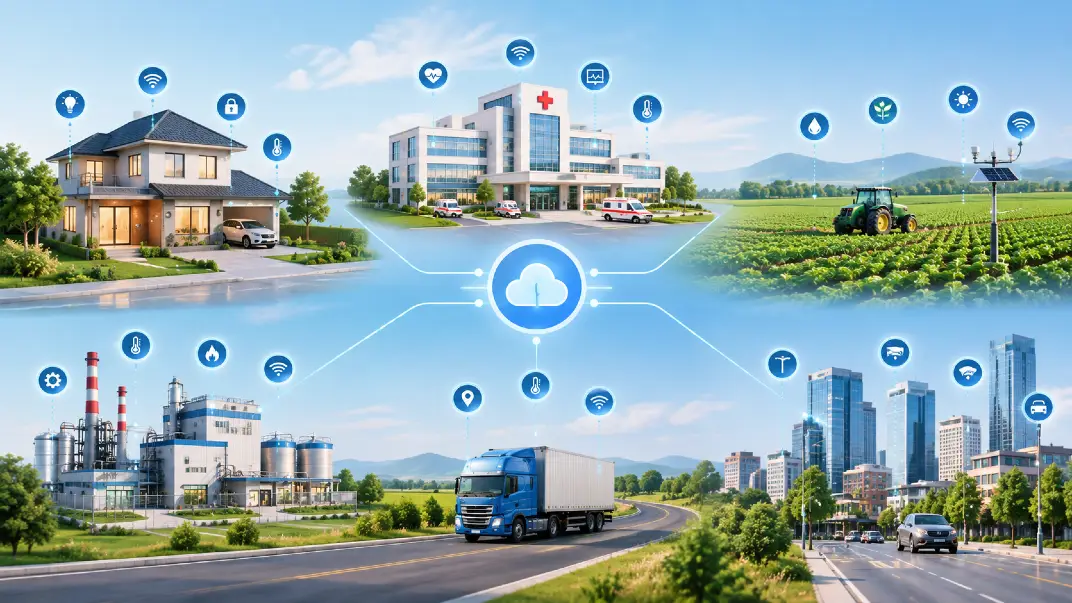
Internet of things examples include smart thermostats, fitness wearables, connected vehicles, smart electricity meters, soil moisture sensors, and vibration sensors on factory machines. Each follows the same chain: a physical device senses or controls something, sends data over a network, and software turns that data into an alert, a report, or an automatic action.
A list of gadgets does not explain that chain. This guide separates the device, the application, and the use case, then walks through 25 real-world IoT examples across eight industries, along with plain-language answers to the examples of IoT and examples of Internet of Things questions people ask most.
What Is the Internet of Things?
The Internet of Things (IoT) is a network of physical objects that can sense their surroundings, exchange data, and sometimes act on it. The ITU-T's standards definition describes a global infrastructure that connects physical and virtual things through interoperable communication technologies.
A typical deployment combines six parts:
- Sensors measure conditions such as temperature, motion, vibration, or location.
- Actuators cause a physical change, such as opening a valve, locking a door, or switching a relay. A sensor observes. An actuator acts.
- Connectivity carries data over Wi-Fi, Bluetooth, cellular, LoRaWAN, or a wired link.
- Data processing happens on the device, near it, or in the cloud.
- Applications show results to people or feed rules.
- Automation closes the loop by sending a command back.
Putting a device online is not the same as building an IoT solution. NIST notes that many IoT devices interact with the physical world in ways conventional IT devices do not, and many cannot be accessed, managed, or monitored the same way. A connected sensor whose readings nobody uses is only a connected sensor. IoT earns its place when the data changes a decision.
How Does IoT Work?
The core flow is device → sensor → connectivity → data processing → decision → action.
- Sensing. A sensor converts a physical condition into a signal. A microcontroller turns it into a reading.
- Connectivity. The device sends the reading directly or through a gateway. A gateway translates between the protocols used by devices and those used by communication networks.
- Processing. Edge computing handles quick decisions near the device and can keep working through short outages. Cloud processing stores history and runs heavier analysis.
- Decision. A threshold, rule, model, or person decides what the reading means. NIST calls this logic a decision trigger, a conditional if-then expression whose output can control actuators.
- Action. An actuator moves, or a notification reaches a person.
IoT devices do not always talk to the public internet. ITU-T material notes that devices may connect directly, through gateways, or within local ad hoc networks. NIST's SP 800-183 treats IoT as one kind of network of things, specifically one whose things are tethered to the internet, and notes that a local network with no internet link can also be one. In practice, many sensors reach a hub over Bluetooth, Zigbee, or a private wireless network, and only the hub or gateway reaches the internet.
IoT Devices vs Applications vs Use Cases
These five terms get mixed up constantly, and most IoT devices examples people search for are really asking about one of the five rows below. Here is how they differ, using one running example.
| Term | What it means | Temperature-sensor example |
|---|---|---|
| IoT device | A physical object with sensing or actuation plus a way to communicate | A wireless temperature sensor |
| IoT system | Devices, network, processing, storage, and management working together | Sensors, gateway, cloud service, alert rules |
| IoT platform | Software that connects and manages devices, ingests and routes data, and exposes APIs | A cloud service such as AWS IoT Core, or a self-hosted broker and database |
| IoT application | Software that turns device data into something people act on | A dashboard with alerts and reports |
| IoT use case | The business or human problem being solved | Cold-chain temperature monitoring |
The same hardware can serve several use cases. Move that sensor from a delivery truck into a server room and the device barely changes. The application may change a little, and the use case becomes data-center environmental monitoring. Getting the order right avoids a common mistake: buying devices before defining the problem.
These are working definitions for this article. Standards bodies define devices, gateways, and networks precisely, but "application" and "use case" are used loosely, and some vendors treat them as synonyms. Here, the application is the software, and the use case is the problem.
Internet of Things Examples: 25 Real-World Examples
The examples below are grouped by industry. Established deployments are separated from emerging ones, and this is the same set of real world IoT examples people usually mean when they ask for IoT examples in real life.
Smart Homes
IoT examples in smart homes are the ones most people meet first, since smart homes are where IoT examples in daily life usually start.
1. Smart thermostats. Temperature sensors, and sometimes occupancy sensors, report to a cloud service over Wi-Fi. The thermostat follows schedules and switches heating or cooling through a relay, which is the actuator. The use case is comfort and energy control. Savings depend on the home and the settings.
2. Smart lighting. Bulbs, switches, and motion sensors connect over Wi-Fi, Zigbee, or Thread. An app or hub sends dim and switch commands and reacts to motion events. The use case is lighting that follows schedules or occupancy, which reduces wasted lighting.
3. Smart locks and security cameras. Locks report their state and access events. Cameras send video and motion alerts. Owners get remote visibility. These devices are attractive targets, so security guidance is to configure them securely, disable unused features, use a strong unique password, and enable automatic updates.
4. Connected appliances. Refrigerators, washers, and ovens report cycle status and fault codes and accept app commands. The use cases are remote monitoring and diagnostics. Many features are app-control conveniences rather than data-driven automation.
Healthcare
IoT examples in healthcare tend to center on data that a clinician, not just the wearer, needs to see.
5. Wearables. Smartwatches and bands use optical heart-rate sensors and accelerometers, usually syncing by Bluetooth to a phone and then to the cloud. FDA notes that digital health technologies range from general wellness uses to medical device uses, so the same wrist device can carry both. Benefit: continuous trend data. Limitation: accuracy and regulatory status vary by feature.
6. Remote patient monitoring. Home blood pressure cuffs, pulse oximeters, and glucose meters send readings through Bluetooth, a hub, or cellular to a clinician dashboard. FDA lists remote patient monitoring among functions that use wireless links such as Wi-Fi, Bluetooth, and cellular. Benefit: visibility between clinic visits. Limitation: it depends on patient engagement and reliable connectivity.
7. Connected medical equipment. Infusion pumps and patient monitors on hospital networks report status and receive configuration. The use cases are central monitoring and maintenance. Because these devices can affect patients directly, security and safety are design requirements, not extras.
8. Vaccine storage monitoring. CDC recommends a digital data logger that records at least every 30 minutes, using a buffered probe that tracks vaccine temperature more closely than a standard thermometer, which tends to reflect air temperature. A standalone logger is only a device. Add remote alerts and a dashboard and it becomes an IoT system. Benefit: temperature excursions are caught and documented.
Agriculture
IoT examples in agriculture mostly turn field conditions that used to require a manual check into a live reading.
9. Smart irrigation. Soil moisture sensors and weather data feed a rule that opens or closes valves. Research reviews describe sensor data enabling targeted interventions such as optimized irrigation. Limitation: field trials report calibration drift and occasional data interruptions, and large fields with varied soil need many sensors.
10. Crop and environment monitoring. Field stations measure air temperature, humidity, leaf wetness, and soil conditions, often sending small messages over low-power long-range networks such as LoRaWAN. The use case is frost and disease-pressure alerts. Reviews flag poor connectivity in remote farmland as a recurring obstacle.
11. Livestock monitoring. Ear tags and collars carry accelerometers or GPS. Software flags unusual activity or location. The use cases are earlier attention to sick animals and finding strays. Alerts need a per-herd baseline and tuning before they are trustworthy.
Manufacturing
Industrial IoT examples and IoT examples in manufacturing usually start with one machine or one line, not a whole plant.
12. Predictive maintenance. Vibration, temperature, and current sensors on motors and pumps feed software that compares readings with a baseline. Unlike preventive maintenance, which follows a fixed calendar, it schedules work when the data shows wear. Benefit: fewer surprise stoppages. It does not require AI; simple thresholds often work, provided the baseline is sound.
13. Machine and production monitoring. Data from PLCs and sensors shows machine states, cycle counts, and stoppage reasons on a dashboard. The use case is tracking availability and output. Older machines may need retrofit gateways to expose their data.
14. Smart factory cells. Connected machines, robots, and quality sensors coordinate work orders and adjust settings. Benefit: less manual data entry and faster response to quality drift. Coordinating a whole plant is much harder than monitoring one machine, so many sites start with a single line.
15. Asset and tool tracking. Bluetooth tags, RFID, or GPS trackers on tools, pallets, and equipment let readers and gateways locate them. The use case is reducing loss and search time. Indoor accuracy depends heavily on the technology chosen.
Transportation and Logistics
IoT examples in transportation span everything from a single delivery van to a whole national vehicle-to-infrastructure network.
16. Connected vehicles. Established: telematics units report location, diagnostics, and update status. Emerging: vehicle-to-everything (V2X), where vehicles, roadside equipment, and pedestrians' devices exchange speed, position, and other data. USDOT says pilot deployments have shown safety, mobility, and efficiency benefits, but V2X depends on interoperability across manufacturers and jurisdictions.
17. Fleet tracking. GPS and cellular trackers, plus engine data, feed dispatch software. The use cases are routing, arrival estimates, and maintenance scheduling. Driver privacy policies matter here.
18. Cold-chain monitoring in transit. Temperature sensors, sometimes with door or shock sensors, ride in trailers, containers, or shipment boxes and upload through cellular, satellite, or gateways. Alerts fire when readings leave range. The benefit is intervening before spoilage and documenting conditions. Loggers that only store data until someone downloads them are data loggers, not live IoT.
19. Smart parking. In-ground sensors, ceiling sensors, or cameras detect whether a space is occupied. Signs and apps show availability. Benefit: less circling for drivers and occupancy data for operators. Sensor upkeep and coverage are the practical limits.
Retail
IoT examples in retail mostly aim at the same problem: knowing what is actually on the shelf without a person counting it.
20. RFID inventory tracking. Tagged items are counted by fixed or handheld readers without scanning each barcode. The use case is faster, more accurate stock counts. Tag cost and interference from metal or liquids are the trade-offs.
21. Smart shelves and electronic shelf labels. Shelf-edge labels update prices from a central system. Some shelves add weight sensors or cameras to detect low stock, which is more specialized. Benefit: fewer manual label changes and consistent prices.
Energy and Utilities
22. Smart meters. In 2022, US utilities had about 119 million advanced meters, roughly 72% of electric meters. EIA defines them as meters that record use at least hourly and give data to both utility and customer at least daily, and many support two-way communication. The use case is billing and usage visibility based on interval data.
23. Smart-grid equipment monitoring. Sensors and controllers on feeders, transformers, and switches report load, voltage, and faults to utility control systems. Benefit: faster fault location. "Smart grid" blends newer IoT devices with older SCADA control systems, and both need careful security because the infrastructure is critical.
Smart Cities
24. Smart waste bins. Fill-level sensors report to routing software so collection follows need rather than a fixed schedule. Benefit: fewer unnecessary pickups. Sensor fouling and battery life are the maintenance issues.
25. Environmental monitoring. Air-quality, noise, and water-level sensors feed public dashboards or warnings. The use cases are pollution episodes and flood alerts. Low-cost sensors need calibration and checking against reference monitors before their data is trusted.
IoT Examples by Industry
| Industry | IoT devices | Application | Example use case |
|---|---|---|---|
| Smart homes | Thermostats, locks, cameras | Home app and hub | Away-mode energy control |
| Healthcare | Wearables, home monitors, pumps | Clinician dashboard | Chronic condition follow-up |
| Agriculture | Soil sensors, weather stations, valves | Irrigation controller | Water only where needed |
| Manufacturing | Vibration sensors, PLC gateways | Condition monitoring | Repair before failure |
| Transportation | Telematics units, GPS trackers | Fleet management software | Route and maintenance planning |
| Retail | RFID tags, readers, shelf labels | Inventory system | Faster stock counts |
| Energy | Smart meters, grid sensors | Metering and grid control systems | Interval-based billing, fault location |
| Smart cities | Bin sensors, air-quality sensors | City operations dashboard | Need-based waste collection |
IoT Use Cases in Business
IoT applications in business tend to follow one pattern: problem → IoT solution → data → action → outcome. The outcomes below are possibilities, not guarantees, and ROI figures are deliberately omitted.
| Use case | Problem | IoT solution | Data | Action | Possible outcome |
|---|---|---|---|---|---|
| Predictive maintenance | Unplanned pump failures | Vibration and temperature sensors | Trend vs baseline | Schedule repair when readings drift | Fewer surprise stoppages |
| Asset tracking | Lost tools and pallets | Bluetooth or RFID tags with readers | Location, last-seen time | Locate item, flag missing | Less search time and loss |
| Remote monitoring | Unstaffed sites | Sensors and cellular gateway | Status, alarms | Dispatch only on alarm | Fewer routine visits |
| Inventory management | Inaccurate counts | RFID or weight sensors | Stock levels | Trigger replenishment | Better stock accuracy |
| Fleet management | Late or idle vehicles | GPS and telematics | Location, engine data | Reroute, schedule service | Better vehicle use |
| Energy management | Unclear where energy goes | Sub-meters and sensors | Load by area | Shift or fix wasteful loads | Visibility and less waste |
| Cold-chain monitoring | Spoiled temperature-sensitive goods | Temperature sensors | Temperature, door events | Alert and reroute | Fewer losses, better records |
| Building management | Comfort vs energy cost | Occupancy, temperature, air sensors | Occupancy, CO2 | Adjust HVAC | Comfort with less waste |
| Production monitoring | No visibility into a line | Machine connectors | Cycle counts, downtime | Address stoppages | Clearer view of bottlenecks |
IoT Applications vs IoT Use Cases
One application can support many use cases, and one use case can need several applications.
- A fleet management application can serve route optimization, driver coaching, maintenance scheduling, and stolen-vehicle recovery.
- A condition-monitoring dashboard can serve bearing-fault detection on a factory floor and filter-change reminders in a building.
- A smart home app can serve away-mode energy control, water-leak alerts, and door notifications.
Naming the application tells you what software exists. Naming the use case tells you why anyone should pay for it.
Benefits of IoT
IoT can deliver these benefits when the sensors are accurate, the connectivity is dependable, and the organization changes how it works:
- Real-time visibility into equipment, inventory, and environments.
- Faster alerts when a reading leaves its normal range.
- Remote monitoring that reduces routine site visits.
- Automation of repetitive adjustments, such as watering or lighting.
- Resource management, including water and energy. GAO's agriculture assessment cites possible reductions in chemical and nutrient runoff.
- Predictive maintenance that schedules work by condition.
- Better decisions, since good data analytics turns measured data into something a person can act on, rather than an estimate.
None of this is automatic. Data that nobody reviews, or alerts that nobody acts on, produce cost without benefit.
Challenges of IoT
- Security. Connected devices expand the attack surface. NIST frames IoT risk management around device security, data security, and individual privacy.
- Privacy. Cameras, wearables, and location trackers collect personal data.
- Interoperability. Devices from different vendors often speak different protocols.
- Connectivity. Remote sites and dense buildings both cause dropouts.
- Data management. Ownership, retention, quality, and storage need rules, the same ground covered by data governance practices more broadly.
- Lifecycle management. NIST notes that some IoT devices cannot be patched or upgraded, which leaves known flaws in place.
- Cost. GAO lists high up-front acquisition costs as a barrier in precision agriculture.
A Practical Security Checklist
- Authentication: unique credentials per device (a password manager makes this practical at scale), no default passwords, multifactor sign-in for accounts.
- Firmware updates: confirm the vendor supports secure updates and for how long.
- Network security: put IoT devices on a separate network segment and disable unused services.
- Vulnerability management: keep an inventory, so you know what to patch.
- Decommissioning: wipe stored credentials and data, and remove the device from platforms and accounts.
NIST's IR 8259A defines baseline device capabilities such as identity, secure update, and data protection. Regulation is tightening. Under the EU Cyber Resilience Act, since September 11, 2026, manufacturers must report actively exploited vulnerabilities and severe incidents, with an early warning within 24 hours and a full notification within 72. Most other obligations apply from December 11, 2027.
IoT vs Smart Devices
A smart device has computing and connectivity, often with app control. An IoT system also moves data between devices, a platform, and applications to support decisions or automation. The terms overlap without being interchangeable. A Bluetooth speaker controlled by a phone is a smart device, but it may not be part of a wider IoT system. A smart thermostat that reports to a cloud service, follows occupancy rules, and feeds a utility program is both. Marketing tends to blur this further, since "smart" and "AI" labels get applied loosely to products that may do neither.
IoT vs AI
IoT connects, senses, monitors, and acts in the physical world. AI analyzes data, finds patterns, predicts, classifies, or generates information. They work well together: sensors supply the data, and a model might run anomaly detection and automated decisions on top of it, or an AI agent might plan a multi-step response to what the sensors report. But IoT does not require AI. A thermostat rule and a temperature alarm are IoT with no AI involved. And AI does not require IoT. A chatbot senses nothing physical.
Internet of Things applications are the layer most of these examples have in common: whatever the device, something still has to turn its readings into a dashboard, an alert, or a report a person can act on.
What Technologies Power IoT?
- Sensors and actuators: measure and act.
- Microcontrollers: small chips that run device firmware.
- Connectivity: Wi-Fi, Bluetooth, cellular, LoRaWAN, and wired links.
- Gateways: bridge local devices to wider networks.
- Edge computing: processes data near the source.
- Cloud and databases: store and analyze history.
- APIs: let other software use the data.
- Analytics and AI: find patterns, where used.
- Device management: provisioning, monitoring, and updates.
- Security: identity, encryption, and access control.
A common messaging protocol here is MQTT, a lightweight publish/subscribe transport for connecting remote devices with a small code footprint and minimal bandwidth. It is one option among several.
Real-World IoT Architecture Example
Take a temperature sensor in a refrigerated trailer, following the flow sensor → gateway → network → edge or cloud processing → IoT platform → dashboard or alert → action:
- Temperature sensor. Reads the cargo compartment and sends readings over a short-range radio.
- Gateway. Collects readings from several sensors, translates protocols, and buffers data when coverage drops.
- Network. Cellular carries the data to the platform.
- Edge or cloud processing. The gateway may raise an instant local alarm, while the cloud stores history and compares trips.
- IoT platform. Manages device identity, receives messages, and routes them to the right applications.
- Dashboard or alert. Shows current conditions and notifies dispatch when the temperature leaves range. This is usually where general-purpose dashboards and analytics tools enter the picture, turning raw messages into something a person can read at a glance.
- Action. A driver checks the refrigeration unit, or a rule reroutes the shipment.
This maps onto NIST's SP 800-183 building blocks, which define a sensor, an aggregator, a communication channel, an external utility such as a cloud service, and a decision trigger. Here the sensor is the temperature probe, the gateway acts as the aggregator, the network is the communication channel, the platform and dashboard are external utilities, and the alert rule is the decision trigger.
Future of IoT
These are directions worth watching, not forecasts:
- Edge computing. More processing near devices is a design trend where latency or connectivity matters.
- AI-enabled IoT. Models running on or near devices for anomaly detection and classification.
- Digital twins. Software models fed by live sensor data, mainly in industry.
- Industrial IoT. Continued adoption in stages, starting from single machines or lines.
- Connected transportation. V2X is still developing, with interoperability across manufacturers and regions as a stated requirement.
- Smart infrastructure. Metering, grid, and city sensing keep expanding, as smart meter numbers show.
- Low-power connectivity. Networks such as LoRaWAN, NB-IoT, and LTE-M target battery-powered sensors.
- IoT security. NIST published IR 8259 Revision 1, foundational activities for IoT product manufacturers, in April 2026, and EU reporting duties are now in force.
6. Featured Snippet Answers
- What are examples of the Internet of Things? Smart thermostats, fitness wearables, connected vehicles, smart electricity meters, soil moisture sensors, and vibration sensors on factory machines. Each senses or controls something and sends data to software that acts on it.
- What are 5 examples of IoT devices? Smart thermostats, smart lights, security cameras, smartwatches, and fleet GPS trackers.
- What is an IoT device? A physical object with sensing or actuation plus communication, such as a wireless temperature sensor. It may connect directly or through a gateway.
- What are IoT applications? Software that turns IoT data into something people act on, such as a fleet dashboard, a condition-monitoring screen, or a smart home app.
- What are IoT use cases? The problems IoT solves, such as cold-chain monitoring, predictive maintenance, asset tracking, and energy management.
- IoT vs AI? IoT senses and acts in the physical world. AI analyzes data and finds patterns. They can work together, but IoT does not need AI.
7. FAQs
What are examples of the Internet of Things? Smart thermostats, wearables, connected vehicles, smart meters, agricultural sensors, and machine monitors are common ones. The full list of 25 above covers eight industries.
What are 5 examples of IoT devices? Smart thermostats, smart lighting, security cameras, smartwatches, and GPS fleet trackers. These are the everyday devices that ranking pages repeat most.
What are IoT devices? Physical objects that sense or act and can communicate. Some connect to the internet directly, while others reach it through a gateway.
Where is IoT used in real life? In homes, hospitals, farms, factories, delivery fleets, shops, utilities, and city services.
What are IoT applications? The software layer that presents device data and lets people or rules act on it, such as dashboards and control apps.
What are IoT use cases? The business or human problems solved, such as spotting equipment wear early or keeping shipments cold.
Is a smartphone an IoT device? Sources disagree. Some treat a phone as an IoT device because it has sensors and connectivity. Others reserve the term for objects that are not general-purpose computers. A phone is more often the gateway or controller for other IoT devices.
Is a smartwatch an IoT device? Usually yes. It has sensors, connects by Bluetooth or Wi-Fi, and sends data to a phone and cloud service. Its regulatory status depends on the feature, as FDA separates wellness from medical uses.
What is the difference between IoT and AI? IoT gathers data from and acts on the physical world. AI analyzes data. Each can exist without the other.
What is the difference between an IoT device and an IoT application? The device is hardware that senses or acts. The application is software that turns its data into something a person can use.
What are the disadvantages of IoT? Security and privacy risk, interoperability problems, connectivity gaps, data management effort, device lifecycle upkeep, and hardware costs.