
Why "AI" Is Everywhere (And Why It Shouldn't Cost You Extra)
Last December, I stood in an electronics shop staring at an "AI-enhanced" smart toothbrush that cost four times more than the standard version from the same brand. When I asked what made it different, the salesman explained it "learns your brushing style."
"And then what?" I asked.
"It shows you on the app," he said.
I bought the cheaper one.
Quick answer: Most "AI-powered" products fall into one of three buckets — real AI doing something genuinely hard, an old feature that got rebranded, or pure theater dressed up with buzzwords. You can usually tell which one you're looking at by asking a single question: can the company describe what it does without saying "AI"? If not, you're paying for a sticker.
That moment in the toothbrush aisle pretty much sums up where we are right now. Walk through any store or scroll any app marketplace, and you'll see "AI-powered" slapped onto toothbrushes, mattresses, water bottles, refrigerators, washing machines, browsers, project management tools, photo apps — even bird feeders. Sometimes that label means something real. Often, it's decoration on a product that does exactly what the non-AI version already did.
The problem is that decoration is currently worth hundreds of dollars in markup, and there's no reliable way to know which side of that line you're on until you understand what's happening under the hood. This guide shows you how to check for yourself.
Why Companies Keep Betting on the "AI" Label
Here's what matters: people pay more for products when "AI" shows up in the description, even when the underlying product is unchanged. A 2025 Capgemini survey found the share of shoppers willing to pay a 1–5% premium for AI-branded, personalized shopping experiences rose to 38%, though willingness to pay a larger premium (5%+) has been trending down as buyers get more familiar with the term. In short: the AI premium is real, but it's shrinking as people get better at spotting the difference between substance and sticker — which is exactly the skill this guide is trying to build.
Part of why the label works so well is that "AI" has no legal definition. It's not like "organic" or "certified," which come with actual standards and oversight bodies. Nobody is checking whether a product's "AI" is real or theater. Companies can attach the label to almost anything: a thermostat running a single rule ("if temperature exceeds 75°F, turn on AC") gets marketed as AI-powered, and technically nobody's lying.
It sticks because most shoppers don't yet know what to look for — which is a solvable problem.
This isn't a conspiracy, just ordinary marketing. "Eco-friendly" had its moment. "Smart" dominated a whole decade. Right now "AI-powered" is the reigning champion, and it's doing real work on your wallet.
The Three Kinds of "AI" Products
Most products labeled AI-powered fall into one of three categories. Figure out which one you're looking at, and you've solved most of the puzzle.
1. Real AI — doing something genuinely difficult
These products use machine learning to do something that would be hard or impossible without it.
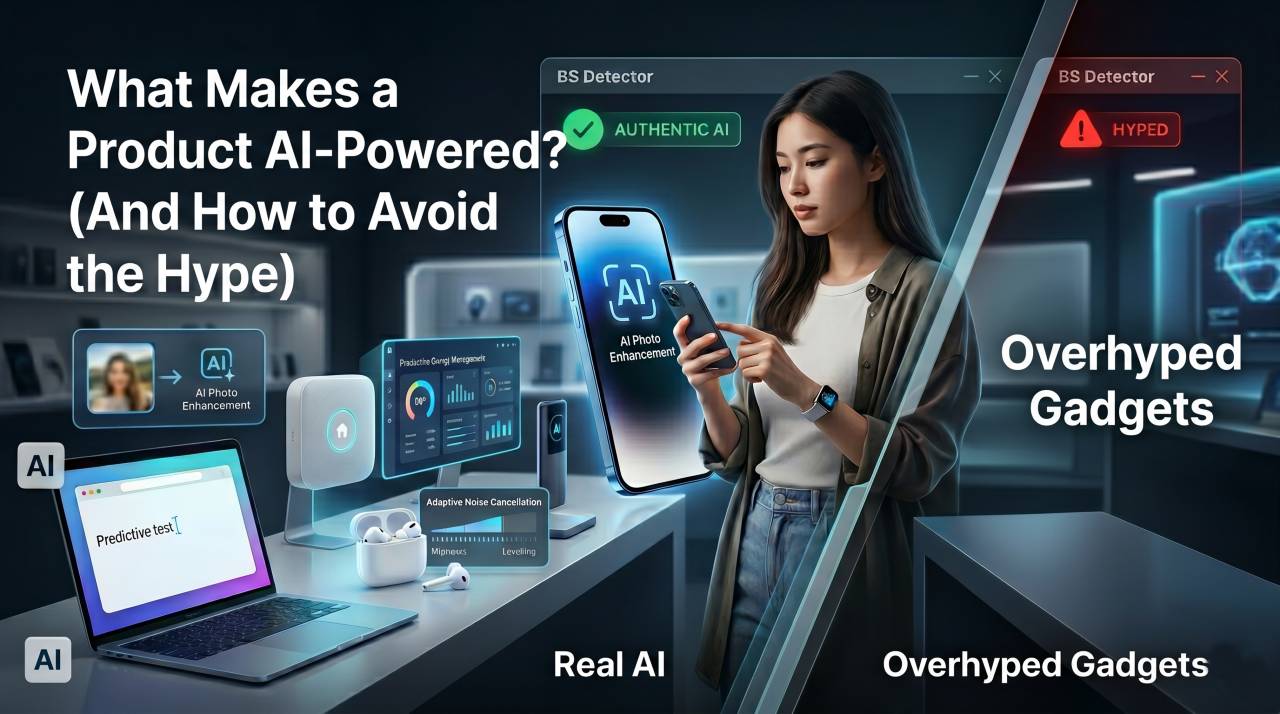
Examples: live noise cancellation that strips out a barking dog mid-call, photo editing that removes objects and convincingly fills in the background, voice transcription that punctuates and capitalizes correctly on its own, translation software that handles idioms rather than word-for-word swaps, and music recommendations that noticeably improve the longer you use the service.
How to test for it: If the feature vanished overnight, would you miss it within a week? Can you name one specific thing it does that the basic version can't? If yes to both, it's real AI.
2. Rebrand — old tech in a new label
The feature already existed; the company just started calling it AI because the trend got too loud to ignore.
Gmail's spam filtering has run on machine learning since the early 2000s. When Gmail's marketing started calling it "AI-powered email," that was technically true and quietly misleading at the same time. The same story applies to Netflix recommendations, phone autocorrect, automatic braking, and camera autofocus — all genuinely useful, none of them new.
The cost here isn't the feature. It's paying a premium for a label on something that was already in the box.
3. Theater — basic rules in a costume
This is where companies get creative. The "AI" either does what a simple if-then rule could already do, or isn't doing much of anything.
- A "smart" toothbrush announcing "you brushed for 90 seconds" has a timer.
- A "smart" water bottle reminding you to drink has a clock.
- A fridge that "uses AI to track groceries" has a camera and a barcode database.
The features themselves might be fine — the "AI" framing is what costs extra.
The 5-Question Checklist: Is This Product Actually AI?
Run this before buying anything labeled AI-powered. In practice, failing two or more of these is a strong signal to walk away.
1. Can the company describe it without saying "AI"?
A real feature holds up in plain language: "It detects faces in your photos and blurs them automatically before you share to social media." A theater feature collapses without the buzzword: "It uses cutting-edge AI to enhance your experience" — enhance it how? If the marketing copy falls apart when you remove the letters A and I, there's nothing underneath.
2. Could this have been built in 1995 with basic rules?
A thermostat that turns off when you leave home is a geofence rule from the late '90s. A washing machine that "detects load size" is probably a weight sensor. A toothbrush that "learns your brushing style" is almost certainly a timer, an accelerometer, and a nice-looking graph. None of these are bad products — they're just not new, and the AI premium on them is unearned.
3. Does the AI version measurably outperform the basic version?
This is the cleanest test, and most reviews skip it. Find someone who's used both versions for a few weeks and ask directly: did the AI version save time, catch a mistake, or do something the regular model couldn't? If they can't name a specific moment it won out, the premium is paying for the brand name, not the technology.
4. Is this one feature, or the whole product?
Strong AI features usually live alongside other solid capabilities — a good notes app adding AI summarization is a real upgrade. An "AI notes app" that's mediocre at actual note-taking is a chatbot wearing a notebook costume.
5. Where does the AI run, and what happens offline?
Some excellent AI runs on-device (Apple's transcription, Pixel's photo editing). Some excellent AI runs in the cloud (ChatGPT, DeepL). But theater AI sometimes runs nowhere in particular — it's a server-side rule that disappears the moment the company shuts a service down or pulls it from your subscription tier. Ask directly where the processing happens. If the company can't or won't answer, that silence is the answer.
Where the AI Label Is Actually Worth Paying For
These are categories where the premium is earned and the feature measurably improves your day-to-day use:
Computational photography on smartphones. Night mode, object removal, best-shot selection from a burst, real-time HDR — genuinely difficult without machine learning, largely functional offline, and noticeably better than the pre-AI equivalent. If your phone is three or four years old, the upgrade alone gets you the real benefit.
Voice transcription and translation. Otter, Whisper-based apps, Apple's built-in transcription, and offline modes in Google Translate are dramatically better than they were five years ago. If you sit in meetings, conduct interviews, or travel across language barriers regularly, this category pays for itself.
Noise cancellation on calls. Krisp and its built-in equivalents in Zoom, Teams, and Google Meet remove background noise — barking dogs, keyboard clicks, lawn mowers — rather than just turning the volume down. A real quality-of-life upgrade for remote work.
Smart compose and writing assistance. Gmail's Smart Compose, inline suggestions in Word, and autocomplete in modern code editors save real time on repetitive text or boilerplate. Not groundbreaking, but consistently useful.
Photo editing for non-professionals. Generative fill, automatic background removal, and magic editors compress what used to take a skilled retoucher thirty minutes into ten seconds. The AI is doing the heavy lifting here, not you — that's the actual product.
Where the AI Label Is Mostly Marketing
Keep this list in mind before you're tempted:
- AI kitchen appliances (toasters, air fryers, "smart" grocery-tracking fridges)
- AI toothbrushes (still timers with better apps)
- AI fitness wearables (usually averaging your heart rate and calling it coaching)
- AI mattresses (comfort is personal — a mattress can't "learn" that)
- AI ovens that "decide" cooking times
- SaaS tools with a bolted-on chatbot nobody touches after week two
- Wellness gadgets generally
- Any product described mainly with adjectives ("intelligent," "smart," "adaptive") rather than verbs describing what it actually does
None of this is permanent — the smart oven of 2030 might genuinely out-cook you. Right now, in these aisles, you're mostly paying for marketing, not innovation.
The 30-Second Store Test
Standing in front of a tempting product? Try this:
- Pull up the product page on your phone.
- Search the page for "AI" and "machine learning."
- Read every sentence those words appear in.
- Try to finish this sentence: "The AI does ___________."
- If you can't fill that blank with something specific, it's theater. Skip it.
Already bought it? Give it 30 days. Can you point to one specific way the AI made your life better — something you'd actually miss if it disappeared? If not, return it while you still can. The base model probably does the job.
Frequently Asked Questions
How can I tell if a product's AI is real or just marketing? Ask whether the company can describe the feature without using the word "AI." If the description falls apart without the buzzword, there's likely nothing underneath it.
Is "AI-powered" a regulated or legally defined term? No. Unlike "organic" or "certified," there's no legal standard or oversight body for the term "AI," so companies can apply it to almost any feature, including simple rule-based automation.
Which AI features are actually worth paying for in 2026? Computational photography, voice transcription and translation, real-time noise cancellation on calls, smart-compose writing tools, and consumer photo editing (generative fill, background removal) are the categories with the clearest, measurable benefits.
Which AI-labeled products are mostly hype? AI toothbrushes, kitchen appliances, fitness wearables, mattresses, and most SaaS tools with a bolted-on chatbot tend to offer little beyond what a basic sensor or rule already did.
What Happens Next
The "AI-powered" sticker boom will likely fade the way "smart" eventually did. Products with real AI will keep the feature, quietly drop the label, and just be good products. Products using AI as marketing will migrate to whatever term comes next — my bet is "agentic," which is already overheating in B2B software.
In the meantime, the most valuable consumer skill is reading past the label to the product underneath. A good toothbrush cleans your teeth. A good fridge keeps food cold. A good mattress is comfortable. If the AI version doesn't do that base job measurably better than the cheap one, the letters A and I aren't worth the price difference.
That salesman in December was honest when I pushed back. The fancy toothbrush, he admitted, was "basically the same toothbrush."
Worth remembering the next time you see the sticker.