
Windsurf Success Story: How AI Coding Became a New Category
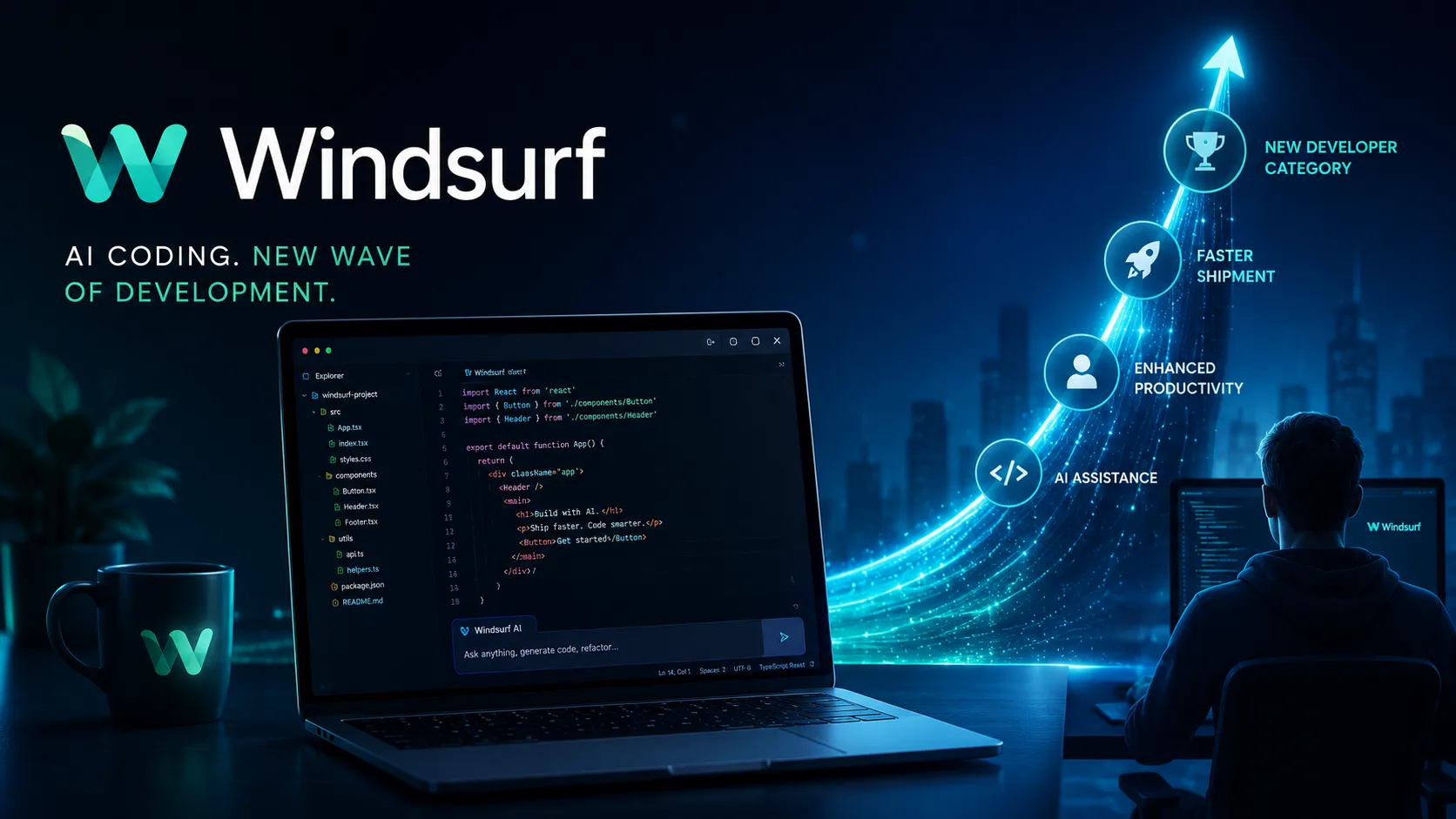
Windsurf's story is not simply about building another AI coding assistant. It is about recognizing, earlier than most, that developers wanted AI inside the development environment itself. Not just AI that suggests the next line of code. AI with enough context and enough freedom to do real engineering work.
That single insight turned a small AI infrastructure startup called Exafunction into Codeium, then into Windsurf. It also turned Windsurf into one of the most closely contested AI coding assets of 2025. Told start to finish, this is the Windsurf AI success story that explains why Windsurf AI coding became a strategic target for OpenAI, Google, and Cognition in the same summer. In July 2025, Google paid about $2.4 billion in license fees while hiring Windsurf's CEO, co-founder, and selected research and development staff. Google did not acquire Windsurf itself. Three days later, Cognition announced a deal to acquire the remaining Windsurf business, including its IDE, IP, brand, employees, and customer base. In June 2026, Cognition renamed the former Windsurf desktop editor Devin Desktop.
Why did an AI code editor become worth fighting over at that scale? Because Windsurf proved something the rest of the software industry was still debating. The editor itself, not just the model behind it, was becoming the real battleground for AI-native software development.
Quick answer: Windsurf was an AI coding startup, originally named Codeium, that built an agentic IDE around the Cascade coding agent. It reached $82 million in ARR and more than 350 enterprise customers by the time Cognition announced its acquisition in July 2025. Google did not buy the company. Instead, Google hired Windsurf's CEO, co-founder, and selected R&D staff and agreed to pay about $2.4 billion in license fees for certain technology under nonexclusive terms. Cognition then announced the acquisition of the remaining Windsurf business. As of June 2, 2026, the former Windsurf desktop editor is called Devin Desktop.
What Is Windsurf?
The Windsurf company built an AI-native code editor. It was a fork of Visual Studio Code that let developers write software alongside an AI agent called Cascade. Instead of just completing a line of code, Cascade could read a whole codebase, plan changes across many files, run terminal commands, and carry out tasks described in plain English.
The company behind it started in 2021 as Exafunction. It pivoted to AI coding as Codeium in 2022. In November 2024 it launched the standalone Windsurf Editor, which it called the first agentic IDE. In April 2025, it renamed the whole company Windsurf. Three months after that, Windsurf ceased operating as an independent company after the July 2025 transactions. Google hired its top leadership. Cognition acquired what remained.
Here is the fast version, for anyone who wants the shape of the story before the detail:
| Period | Milestone | Significance |
|---|---|---|
| 2021 | Founded as Exafunction by Varun Mohan and Douglas Chen | Started in GPU virtualization, not AI coding |
| 2022 | Pivoted to AI code completion, renamed Codeium | Entered the AI coding assistant market as a free Copilot alternative |
| Jan 2024 | $65M Series B at a $500M valuation | Kleiner Perkins-led round, signaling investor interest in code AI |
| Aug 2024 | $150M Series C at a $1.25B valuation | General Catalyst-led round; company reaches unicorn status |
| Nov 2024 | Launches the Windsurf Editor | First standalone agentic IDE built around the Cascade agent |
| Apr 2025 | Company renames itself Windsurf | Signals the shift from plugin-based assistant to full IDE company |
| May-Jul 2025 | OpenAI agrees to acquire Windsurf for a reported $3B | Deal collapses over Microsoft IP-sharing rights in July 2025 |
| Jul 11, 2025 | Google pays about $2.4B to hire Windsurf's CEO, co-founder, and about 40 staff, plus a technology license | Not an acquisition; Google took no equity or control |
| Jul 14, 2025 | Cognition acquires the remaining Windsurf business | Cognition gets the IDE, brand, IP, remaining workforce, $82M ARR, and 350+ enterprise customers |
| 2025-2026 | Cognition integrates Windsurf's IDE with Devin | Windsurf 2.0 (Apr 2026) added Devin as a cloud agent and Agent Command Center; the desktop product became Devin Desktop in June 2026 |
| Sep 2026 | Cognition Series E | More than $2B raised at a $48B valuation; Cognition says run-rate revenue reached nearly $900M |
| Jun 2, 2026 | Former Windsurf desktop editor becomes Devin Desktop | Cognition makes the Agent Command Center the default surface while retaining the full IDE; existing plans, settings, and extensions carry over |
The rest of this article walks through how that timeline came together, and what it says about where AI-native software development is headed.
The Codeium Story: How Windsurf Started
For readers who only know the company by its later name, the connection is simple. Windsurf and Codeium are the same company at two different stages. What follows is effectively the Codeium success story: the founding, funding, and early growth that happened before the Windsurf brand, or the AI-native IDE it became known for, existed at all.
Windsurf's roots are in a company that had nothing to do with code editors. Varun Mohan and Douglas Chen, both MIT graduates, founded a startup in 2021 called Exafunction. It focused on GPU virtualization and infrastructure for machine learning workloads. Chen had previously worked at Meta, building software tools for VR headsets like the Oculus Quest. Mohan had been a tech lead at Nuro, the autonomous delivery startup. That GPU infrastructure business raised roughly $20 million. But the founders decided the market was too narrow to build a large company around. So they pivoted toward a very different product: a free, AI-powered coding assistant that would compete directly with GitHub Copilot. The founders' backgrounds and the early decisions behind that pivot are covered in more detail in our Windsurf founders story.
That pivot became Codeium. The pitch was simple and aggressive: give developers an AI autocomplete tool that was fast, accurate, and free, at a time when Copilot charged a monthly fee. It worked. By January 2024, Codeium raised a $65 million Series B led by Kleiner Perkins, with Greenoaks and General Catalyst joining in. The company said its platform was already used by more than 300,000 developers. Those developers worked at organizations ranging from startups to Fortune 500 companies. The round carried a reported $500 million valuation.
Momentum did not slow down. Eight months later, in August 2024, Codeium closed a $150 million Series C led by General Catalyst, worth $1.25 billion, making it a unicorn. At the time, co-founder and CEO Varun Mohan told TechCrunch that Codeium had barely touched the earlier Series B funding. He framed the new capital as fuel for larger strategic bets. By this point, the company had grown its active developer base to more than 700,000 users, according to industry trackers, though exact counts vary by source.
Total disclosed funding before the 2025 transactions reached roughly $243 million to $245 million, according to Sacra and other funding trackers. Kleiner Perkins, General Catalyst, and Greenoaks were the anchor investors. None of that figure includes the 2025 deals with Google or Cognition. Those deals were structured very differently from a normal funding round, a distinction that matters later in this story.
The strategic logic of starting with free code completion was sound. Rather than pitching enterprises on an unproven AI product, Codeium built a large base of individual developer users first. It converted that adoption into enterprise contracts only once trust and daily habit were established. That sequencing, product-led growth before enterprise sales, became a defining feature of how the company scaled.
Why AI Coding Was Ready for a New Category
To understand why Windsurf mattered, it helps to separate three distinct eras of developer tooling.
Traditional developer tools are the software that has defined programming for decades. Code editors, compilers, debuggers, version control systems like Git, and continuous integration pipelines all fall into this group. These tools help developers write and manage code. But they have no independent understanding of what the code is supposed to do.
AI coding assistants layer a language model on top of that traditional stack. Autocomplete tools like the early GitHub Copilot, or the original Codeium, suggest the next line, function, or block of code based on context. They explain code, help debug errors, and draft documentation. But the developer stays fully in charge of every action. The AI reacts to what the human is already doing.
AI-native coding environments go further. They understand a whole repository, not just the open file. They accept natural-language instructions instead of requiring the developer to type code themselves. They can plan and carry out changes across many files, run terminal commands, write and run tests, and check their own output before handing work back to a human for review. For a deeper look at where the line sits between a reactive assistant and a really autonomous agent, see AI coding assistants vs. AI coding agents.
That third category is where Windsurf placed its bet. The underlying shift can be summed up in one line: the market was moving from "AI helps me write code" toward "AI helps me complete software engineering tasks." Autocomplete assists a task the developer is already doing. An agentic IDE can be handed a task and asked to carry it out on its own.
This distinction is not cosmetic. It changes what a coding tool needs to do well. An autocomplete engine mainly needs a fast, accurate model. An agentic IDE needs more. It needs a way to index and understand a large codebase. It needs a permission system, so an autonomous agent does not make unsafe changes. It needs a way to run and observe code as it executes. And it needs an interface that lets a human stay in control while handing off real chunks of work. Windsurf's Cascade agent, and the "Flows" concept the company used to describe it, was built to blend those reactive and autonomous modes rather than force a choice between them. The broader shift this reflects, software that can act rather than just suggest, is covered in more general terms in AI agents explained.
From Codeium to Windsurf: The Rise of the Agentic IDE
The Windsurf Editor launched on November 13, 2024. The company called it the first agentic IDE. It was designed to fuse the collaborative style of a copilot with the independence of an autonomous agent into something the company called a "flow." At the center of the product was Cascade. Cascade combined deep codebase understanding, a suite of developer tools, and real-time awareness of what the developer was doing, all indexed through a proprietary context system.
For the first several months, Windsurf was the company's flagship product, while Codeium stayed the corporate and brand name. The original plugin-based autocomplete tools were eventually renamed Windsurf Plugins to keep things consistent. Then, in April 2025, the company completed the transition and renamed itself Windsurf entirely. In its own announcement, the company explained the logic plainly: most users already knew the company as Windsurf rather than Codeium. Codeium had felt like the right name at the start of the journey. But Windsurf better reflected where the company believed it was headed: a combination of human and machine that should feel effortless.
That renaming was a strategic statement as much as a marketing decision. It told the market, investors, and rivals that the company no longer saw itself primarily as a code-completion vendor. It saw itself as an IDE company, competing for a much bigger and more strategically important piece of the developer's daily workflow.
How Windsurf's AI-Native IDE Worked
Analyzing Windsurf's product strategy means separating two things that are easy to mix up: the AI model, and the AI coding product built around it.
A model provides raw intelligence. It understands language, reasons about problems, and generates text or code. But a model alone cannot see a developer's repository. It cannot run a test suite. It cannot remember what happened three steps ago in a task. It cannot respect an organization's security policies. An AI coding product supplies all of that surrounding infrastructure. That includes the interface a developer interacts with, the context system that feeds the model relevant code, and the tools the AI can call, such as a terminal, a file editor, or a test runner. It also includes the permissions that decide what the AI is allowed to touch, integrations with services like GitHub, the overall developer experience, and the reach needed to get the product in front of millions of programmers.
Windsurf's strategy rested on owning that second layer. The company built its own base models early on. That gave it more control over cost and speed than rivals who simply resold access to OpenAI or Anthropic models. It also integrated premium third-party models, like Anthropic's Claude, as options inside the product. That kind of model-blending gives developers access to several underlying models through one product, rather than locking them to a single provider. It is the same problem that infrastructure companies like the one profiled in the OpenRouter success story have built whole businesses around. By owning the IDE itself, rather than shipping only a plugin, Windsurf controlled the full experience. That meant how code was indexed, how AI suggestions were displayed, how multi-file edits were reviewed, and how much autonomy the AI had for a given task.
This is the same reason a browser mattered more than any single website. It is the same reason owning the operating system mattered more than any individual application. Whoever controls the environment where the work happens has leverage that a feature bolted onto someone else's environment does not.
Windsurf Business Model: How the Company Made Money
Windsurf's monetization followed a familiar product-led growth pattern common among developer tools. Enterprise expansion layered on top as the product matured.
At the individual level, the company offered a free tier. It historically covered base-model code completion and limited use of Cascade's agentic features. Paid individual and Pro plans, priced around $15 a month during the Codeium and early Windsurf period, unlocked higher usage limits and access to premium models such as Claude and GPT-4-class systems. Team and enterprise plans added centralized billing and administrative controls. As the product matured, those plans also added features aimed at security-conscious organizations, like single sign-on and audit logging.
It is worth separating the historical Windsurf business model from what exists today. After Cognition's acquisition and the rebrand to Devin Desktop in June 2026, pricing and packaging changed. As of mid-2026, reporting describes a free tier with unlimited Tab completions. There is a $20-a-month Pro plan that includes access to Devin's cloud agent, a $200-a-month Max plan, and Teams pricing built around an $80 base fee plus $40 per full seat. Enterprise pricing is custom and includes compliance features such as SOC 2 Type II certification and a self-hosted inference option for regulated industries. Existing Windsurf subscribers kept their original pricing after the rebrand, according to product coverage. But the packaging itself now reflects Cognition's broader Devin strategy, not Windsurf's original standalone plan.
Windsurf Revenue and Growth
Windsurf ARR is the single most cited financial figure in this story. It is also the most frequently misused. Different figures describing Windsurf's business often get mixed up in casual coverage, so this is the section where precision matters most. Here are the terms worth defining before the numbers.
ARR, or annual recurring revenue, is a run-rate metric. It takes a company's current recurring revenue, such as monthly subscription revenue, and multiplies it out to an annual figure. ARR is a useful signal of momentum. But it is not the same as GAAP revenue, which is actual recognized revenue reported under formal accounting standards over a defined period. A company can have high ARR and still report lower recognized revenue in a given quarter, especially if it is growing fast. That is because ARR reflects the run rate at a single point in time, not revenue already earned.
With that distinction in place, here is what is reliably known. When Cognition announced its acquisition of Windsurf on July 14, 2025, the company stated in its own blog post that Windsurf carried $82 million in ARR. TechCrunch confirmed the same details the same day. Enterprise ARR was doubling quarter over quarter. The user base included more than 350 enterprise customers and hundreds of thousands of daily active users. These are Cognition's own disclosed figures at the moment of acquisition, not third-party estimates.
There is some inconsistency in earlier reporting on Windsurf's ARR. TechCrunch said in April 2025 that Windsurf's ARR had at one point reached $100 million. That figure does not line up cleanly with the $82 million disclosed at the July acquisition. It underscores how quickly a run-rate number can move, whether from momentum or from setbacks tied to the acquisition uncertainty itself. Separately, a February 2025 funding report put the company's ARR at around $40 million, at a time when investors were putting the company's worth near $3 billion. That implies a revenue multiple of roughly 70 times, a striking figure even by the standards of high-growth AI startups.
The honest takeaway is this: Windsurf's revenue moved quickly and unevenly through 2025. Different snapshots from different months will not match precisely. The most authoritative figure, because it comes directly from the acquiring company's own announcement, is the $82 million ARR reported at the July 2025 acquisition close.
Windsurf Funding and Valuation
The Windsurf valuation arc, from $500 million to $1.25 billion in a single year, is one of the clearest signals of investor conviction in this story. Windsurf's funding history is easier to document than its revenue, because most rounds were publicly announced with disclosed terms.
| Round | Date | Amount | Valuation | Lead Investor(s) |
|---|---|---|---|---|
| Early funding (as Exafunction/Codeium) | 2021-2023 | Approx. $20-93M combined | Undisclosed | Various, like Founders Fund |
| Series B | January 2024 | $65M | $500M | Kleiner Perkins, with Greenoaks and General Catalyst |
| Series C | August 2024 | $150M | $1.25B | General Catalyst, with Kleiner Perkins and Greenoaks |
| Reported new round (did not close) | February 2025 | Undisclosed | Reportedly near $2.85B-$3B | Reportedly led by Kleiner Perkins |
| Total disclosed funding before 2025 transactions | — | Approximately $243M-$245M | — | — |
That last row matters. The company's total funding before the 2025 upheaval was in the low hundreds of millions of dollars. That is a fraction of the multibillion-dollar figures later tied to the Google and Cognition transactions. Those later numbers were not funding rounds. Google's was an acquihire-and-license deal. Cognition's was an acquisition of undisclosed value. Mixing up "total funding raised" with "deal value" is one of the most common errors in casual coverage of this story. It is worth keeping the categories separate. Funding is capital a company raised by selling equity. Valuation is what investors believed the company was worth at a point in time. Acquisition or licensing value is what a specific buyer agreed to pay for a specific set of assets, people, or rights.
The reported February 2025 talks, worth an estimated $2.85 billion to $3 billion, never closed as a funding round. Instead, that momentum fed directly into acquisition interest from OpenAI just months later.
Why Investors Bet on Windsurf
Several factors, some verifiable and some more interpretive, help explain why investors valued Windsurf so aggressively.
Verified, factual drivers:
- Rapid user growth, from roughly 300,000 developers in early 2024 to more than 700,000 by late 2024, according to funding-round disclosures and trackers.
- A jump from a $500 million valuation in January 2024 to $1.25 billion just seven months later, reflecting genuine investor conviction rather than a slow markup.
- The launch of a really new product category, the agentic IDE, in November 2024, which coincided with a broader industry shift toward autonomous coding agents.
- Strong enterprise traction, with the company reporting more than 350 enterprise customers by mid-2025.
Analyst interpretation, not disclosed fact: Beyond the numbers, analysts and investors were likely betting on a few structural advantages. Developer tools with daily, habitual usage tend to be sticky once adopted. Owning the IDE gives a company a natural home for future AI agents as they get more capable. Usage data generated inside a coding environment could, in principle, improve future models and product decisions. And AI labs and platform companies would eventually want to own, rather than simply integrate with, the environment where their models get used. These are reasonable explanations for the intensity of acquisition interest that followed. But they are analysis, not statements Windsurf, Google, or Cognition made about their own motivations. Enterprise buyers evaluating tools like this are increasingly expected to justify the spend in concrete terms.
The OpenAI Windsurf Deal: What Happened?
In the first half of 2025, OpenAI entered discussions to acquire Windsurf outright. CNBC said in April 2025 that the two companies were in talks for a deal that would value Windsurf at around $3 billion. The companies later entered a period of exclusivity to finalize the acquisition. Had it closed, this would have been OpenAI's largest acquisition to date. It would have given OpenAI a direct foothold in the AI-native IDE market, competing head-on with Microsoft's GitHub Copilot.
The deal never closed. Bloomberg was among the first to report that the exclusivity period expired without a completed transaction. Reporting from many outlets points to the same underlying cause: OpenAI's close partnership with Microsoft. According to accounts of the negotiations, Windsurf grew concerned about Microsoft's existing agreements with OpenAI. Microsoft owns GitHub Copilot, a direct competitor to Windsurf, and those agreements could give Microsoft a claim on intellectual property flowing through any OpenAI acquisition. OpenAI reportedly pushed for a carve-out to protect Windsurf's technology from Microsoft's reach. Microsoft declined to amend its standing agreements, and the deal lapsed.
It is worth being precise here: OpenAI did not acquire Windsurf. Reporting describes an agreement that was reached and then collapsed before closing, not a completed transaction that was later reversed. Some secondary sources describe this loosely as "OpenAI acquired Codeium." That is not accurate and should not be repeated as settled fact.
Google's $2.4 Billion Windsurf Deal Explained
The Windsurf Google deal is the part of this story most often described incorrectly, so it is worth walking through in order. Within hours of the OpenAI deal falling apart, Google moved. On July 11, 2025, Google announced it had reached an agreement to bring on Windsurf's CEO Varun Mohan, co-founder Douglas Chen, and a small group of the company's research and development staff, roughly 40 people. They would join Google's DeepMind division. The transferred team would focus on agentic coding work for Google's Gemini project. As part of the same arrangement, Google agreed to pay approximately $2.4 billion, structured as licensing fees and compensation, for a nonexclusive license to certain Windsurf technology.
The structure of this deal is the single most misunderstood detail in the whole Windsurf story, so it is worth stating clearly: Google did not acquire Windsurf. Google took no equity stake and no controlling interest in the company. It paid to hire specific individuals and to license specific technology on a nonexclusive basis. Windsurf remained free to license the same technology to others. Most of the remaining Windsurf workforce stayed with the company; Reuters reported that most of roughly 250 employees remained, while Google hired the senior leaders and selected R&D staff. Cognition subsequently acquired the remaining Windsurf business.
Industry coverage described this as a form of "reverse acquihire." It mirrored a pattern other large technology companies had used earlier in 2025: bringing in AI talent while avoiding the antitrust review a full acquisition would typically trigger. Reuters reported that the deal structure could still draw regulatory scrutiny, given its resemblance to more conventional acquisitions, even without a formal change of control.
Why Cognition Acquired Windsurf
The Windsurf Cognition deal was announced three days after the Google announcement, on July 14, 2025. This is where the story resolves into a single acquirer. Cognition, the company behind the autonomous coding agent Devin, announced it had signed a definitive agreement to acquire the remainder of Windsurf. Cognition's own blog post, written by CEO Scott Wu, spelled out exactly what the company was getting. That included the Windsurf IDE, now with full access to the latest Claude models. It included Windsurf's intellectual property, like its trademark and brand. It included $82 million of ARR, with enterprise ARR doubling quarter over quarter. And it included a user base of more than 350 enterprise customers and hundreds of thousands of daily active users.
Cognition did not disclose the price it paid. That is worth repeating, because it is one of the more commonly misreported facts about this story. There is no reliable, sourced figure for what Cognition paid to acquire Windsurf. Reports and estimates describing a specific dollar acquisition price for the Cognition deal should be treated with skepticism unless they cite Cognition directly, because Cognition itself has not disclosed one.
What Cognition described clearly was the strategic logic. It framed the deal internally as a major unlock for its broader mission of building the future of software engineering. Cognition had a powerful autonomous agent, but no consumer-scale reach or IDE presence. Windsurf had exactly that. It was a product used daily by hundreds of thousands of developers and already sold into more than 350 enterprise accounts. But it had just lost its founding leadership team to Google. The fit was almost too clean. Many outlets described the whole sequence as one of the most compressed and dramatic acquisition sagas the AI industry had seen. That sequence ran from OpenAI's deal collapsing, to Google's rapid counter-move, to Cognition's acquisition closing within roughly 72 hours.
Jeff Wang, Windsurf's former head of business, had been named interim CEO after Mohan and Chen departed for Google. He captured the whiplash of the period in a public post at the time. He described the preceding three days as the wildest stretch of his career. He said he was relieved the team had landed with a company that shared its focus on shipping real engineering work rather than demos.
Windsurf 2.0 and the Integration With Devin
Cognition did not fold Windsurf into Devin right away. In the months after the acquisition, the company kept Windsurf operating as a distinct product while it worked on deeper integration. That integration arrived in stages.
In April 2026, Cognition released what it called Windsurf 2.0. It natively embedded Devin as a cloud-based agent inside the Windsurf IDE. The workflow let a developer work locally in Windsurf's own agent, Cascade, then hand off a task to Devin with a single click. Devin would then carry out the work on Cognition's own infrastructure. It could keep running tests, opening pull requests, and performing quality checks even after the developer had moved on to something else. Devin access was bundled automatically into Windsurf's self-serve Pro, Max, and Teams plans. Enterprise customers needed administrator opt-in.
Then, on June 2, 2026, Cognition introduced Devin Desktop, describing it as the next generation of Windsurf. The Agent Command Center became the default surface, while the full IDE remained available and backwards-compatible with the Windsurf editor. Existing plans, pricing, extensions, settings, and workflows carried over through the over-the-air update. Cognition also moved away from Cascade toward Devin Local, while adding support for the Agent Client Protocol so compatible third-party agents could run inside the desktop environment.
The most important part of this rebrand was not the name change itself. It was the architecture underneath it. Devin Desktop shipped with support for the Agent Client Protocol, an open standard. It lets many AI coding agents, like Anthropic's Claude Agent and OpenAI's Codex, run inside the same editor alongside Cognition's own models. All of it is coordinated through what the company calls an Agent Command Center. In effect, Cognition turned the former Windsurf product from an editor with one built-in assistant into something different: a management layer for several AI agents working in parallel, no matter which company built the underlying model.
Windsurf vs Cursor vs GitHub Copilot
The competitive landscape around Windsurf illustrates a broader point about the AI coding market. Several different companies have built large businesses by focusing on different points in the same workflow.
GitHub Copilot, built by Microsoft-owned GitHub with underlying OpenAI models, took an assistant-first strategy. It lives inside existing editors that developers already use, rather than asking them to switch tools. It leans on GitHub's existing reach across hundreds of millions of developer accounts.
Cursor, built by Anysphere, took an IDE-first strategy similar to Windsurf's. It forked Visual Studio Code and built deep agentic features on top of it. By 2026, industry reporting put Cursor's ARR at roughly $500 million. The company closed a $2.3 billion Series D in November 2025, worth $29.3 billion, making it larger by revenue than Windsurf ever reported as an independent company. Cursor's own path to that scale is covered in the Cursor AI success story.
Windsurf, and later Devin Desktop, pursued a similar IDE-first approach. But it increasingly positioned itself around agent orchestration, letting many AI agents, not just one house model, operate inside a single environment.
Devin, Cognition's original product, took an agent-first strategy. Rather than living inside an editor at all, it operated as an autonomous, cloud-based software engineer. It could take on a task and work independently, checking in with humans mainly for review.
Claude Code, Anthropic's own agentic coding tool, takes a terminal-first, command-line approach. It is aimed at developers who want an agent that operates alongside their existing editor and tools rather than replacing the IDE itself. A full side-by-side of these approaches is available in Claude Code vs. Cursor vs. GitHub Copilot. A broader comparison of the wider field appears in best AI coding assistants compared.
Why Windsurf Was More Valuable Than Just Its Revenue
Windsurf's $82 million in ARR at the time of acquisition was a real and respectable number for a company of its age. But it does not, by itself, explain a $2.4 billion talent-and-licensing deal from Google, or the urgency Cognition placed on closing its own acquisition within days. Several sources of value beyond the headline revenue figure help explain the intensity of interest.
Developer reach. An IDE occupies a developer's screen for hours every working day. That kind of daily, habitual presence is hard and expensive to build from nothing. It gives whoever owns the IDE a natural way to reach developers with new AI capabilities as they are released.
Enterprise relationships. More than 350 enterprise customers, with enterprise ARR reportedly doubling quarter over quarter at the time of acquisition, represent recurring revenue relationships. Those relationships are typically far stickier, and far more expensive to replace, than individual subscriptions.
Workflow data, described carefully. AI-native development environments generate rich signals about how developers actually work. That includes what kinds of edits they make, where AI suggestions succeed or fail, how developers correct an agent's output, and what kinds of tasks get delegated versus done by hand. This kind of interaction data can, in principle, be valuable for improving future coding models and products. It is worth being explicit here: neither Windsurf, Google, nor Cognition has published specific claims about how this data was or was not used after the transactions. This point should be understood as a plausible source of strategic value, not a confirmed fact about any company's data practices.
Product surface for agents. As AI agents get more capable, they need somewhere to operate. They need a place to see code, run commands, and show their work to a human reviewer. An established IDE already provides that surface, which is one reason Cognition chose to keep and build on Windsurf's editor rather than only expanding Devin's cloud-only product.
The interface between human and agent. Perhaps the most durable point of value is the least tangible. An IDE that has already earned developer trust can become the primary interface through which a human works with one or more AI agents. It is where they decide what to hand off, what to review, and what to do by hand. That interface layer, not the underlying model, is what a buyer like Google or Cognition was ultimately paying to influence.
What Made Windsurf Successful?
Several factors, taken together, explain how Windsurf grew as quickly as it did. Here they are, split into what is documented and what is reasonable analysis built on top of that documentation.
Documented: the company built a free product first, reaching hundreds of thousands of developers before asking most of them to pay anything. It shipped a really new product category, the standalone agentic IDE, months before most rivals had a comparable offering. It trained its own base models rather than depending entirely on third-party API access, giving it more control over cost and speed. And it converted a meaningful share of that individual developer base into paying enterprise accounts, reaching more than 350 enterprise customers within roughly a year of the Windsurf Editor's launch.
Analytical: the sequencing of free product, then paid individual plans, then enterprise contracts, mirrors a well-established pattern in developer tools generally, sometimes called product-led growth or bottom-up growth. Rather than a sales team convincing an engineering leader to adopt a new tool top-down, individual developers adopt a free or cheap product on their own. They build habits around it, and eventually pull their employer's procurement process along behind them. Windsurf's growth pattern is consistent with that model, though the company's own public statements did not frame it in exactly these terms.
What Windsurf's Story Teaches AI Startups
Lesson 1: The interface can be as important as the model. Windsurf never claimed to have the best underlying AI model in the market. It integrated third-party models like Claude alongside its own. What it built instead was the surrounding product experience: the context system, the workflow, the permissions, that made a model useful for real engineering work. That interface layer proved valuable enough on its own to justify billions of dollars in combined transaction value.
Lesson 2: Developer reach is extremely valuable. Becoming part of a developer's daily workflow, rather than a tool they open occasionally, created real stickiness. Both Google and Cognition were willing to pay heavily to access it, whether through talent and licensing or outright acquisition.
Lesson 3: AI can create really new software categories. Windsurf's move from code completion to a full agentic IDE shows how AI changed the role of the code editor itself. It went from a passive space where a human wrote every character, to an active workspace where a human and an AI agent share the work.
Lesson 4: Enterprise adoption changes the economics. The jump from individual subscriptions to more than 350 enterprise accounts, with enterprise ARR reportedly doubling quarter over quarter, materially changed the quality and durability of Windsurf's revenue. Cognition called this out specifically as a core reason for the acquisition.
Lesson 5: Strategic value can exceed standalone revenue. Windsurf's $82 million in ARR, while respectable, would not on its own justify a $2.4 billion talent deal from Google under any normal revenue multiple. The value larger companies saw included talent, intellectual property, an existing customer base, a working product, and a strategic position in a market both companies considered critical. None of that shows up cleanly in an ARR figure.
What Could Go Wrong With the AI Coding Business Model?
A complete account of Windsurf's story has to include the parts that did not go smoothly, and the structural risks the broader AI coding category still faces.
Intense, well-funded competition. Cursor's roughly $500 million ARR, worth $29.3 billion by 2026, shows that Windsurf, even at its peak, was not close to the largest player in its own category. GitHub Copilot benefits from Microsoft's existing developer reach at a scale few rivals can match.
Dependence on foundation models built by others. Even companies that train their own base models, as Codeium did early on, generally still need access to frontier models like Claude or GPT-class systems. That is true if they want to stay competitive on the hardest coding tasks. It creates an ongoing dependency on a small number of AI labs.
High inference costs. Running agentic AI systems that read whole codebases, execute multi-step plans, and check their own output is computationally expensive. Pricing has to balance affordability for individual developers against the real cost of running these systems. That tension is visible in Cognition's own pricing changes, which cut Devin's price from $500 to $20 a month while adding usage-based compute charges.
Rapidly changing technology. The pace of change in this category has been unusually fast, even by software industry standards. A product praised as category-defining in November 2024 had its own core agent, Cascade, declared legacy technology by mid-2026, less than two years later.
Talent retention and strategic uncertainty. Windsurf's own story is a case study in how quickly a company's leadership and independence can change. Employees who joined Windsurf as an independent, venture-backed company found themselves, within a single week in July 2025, split between a new employer at Google and a different acquiring company at Cognition. It was an outcome no one at the company could have fully planned for.
Success does not guarantee independence. Perhaps the clearest lesson from Windsurf's trajectory is this: strong product-market fit and fast growth are not enough on their own to stay an independent company. That is especially true in a market this capital-intensive and strategically contested. Windsurf built a really successful product and still did not survive as a standalone business past its fourth year.
What Happened to Windsurf After the Cognition Acquisition?
In the immediate aftermath of the July 2025 acquisition, Cognition kept Windsurf operating largely as it had been. The IDE kept developing while Cognition's separate team kept building Devin. Over the following months, the two products moved closer together. Combined enterprise ARR across Devin and Windsurf grew more than 30 percent in the seven weeks after the acquisition closed, according to Cognition's own disclosures.
The clearest sign of full integration came in 2026. Windsurf 2.0, released in April 2026, brought Devin directly into the editor as a cloud agent available to all paid subscribers. Then, on June 2, 2026, Cognition retired the Windsurf name altogether. It renamed the product as Devin Desktop. It folded that product into a broader family that includes Devin Cloud, for longer-running autonomous tasks, and an Agent Command Center for coordinating many agents at once.
By September 2026, the post-acquisition story had moved materially beyond the May snapshot. Cognition announced more than $2 billion in Series E funding at a $48 billion valuation on September 8, 2026. Cognition said its annualized run-rate revenue had grown from $492 million in May to nearly $900 million by September. On September 25, Cognition announced that it had crossed $1 billion in annualized revenue run rate. These are company-reported run-rate figures for Cognition, not Windsurf-specific revenue and not audited GAAP revenue.
The Future of AI Coding
Some trends in this category are already established fact, not speculation. AI coding agents can now carry out multi-step engineering tasks with real autonomy. Many companies have built agent orchestration layers, like Cognition's Agent Command Center, that let several different AI agents work inside the same environment. Open standards like the Agent Client Protocol are emerging specifically to let agents from different companies work together inside a shared editor, rather than locking developers into a single vendor's model.
Other directions remain really uncertain and should be treated as possibilities, not inevitabilities. It is plausible, but not guaranteed, that asynchronous coding becomes the default way meaningful engineering work gets delegated to AI. That is where a developer assigns a task and checks back later, rather than watching the AI work in real time. It is plausible that automated testing, AI-driven code review, and AI-assisted debugging become standard expectations rather than differentiating features. It is plausible that enterprise AI engineering, where large organizations run fleets of coding agents across their whole codebase, becomes a distinct and large market of its own. None of these outcomes is certain. This category has moved fast over just the past two years: from code completion, to a standalone agentic IDE, to a full acquisition saga, to integration inside a broader multi-agent platform. That speed alone is a reason for caution about firm predictions.
Windsurf's Most Important Strategic Insight
The most important thing Windsurf demonstrated was not a specific feature or model capability. It was this: the development environment itself, not just the AI generating code within it, could become the primary interface where humans and AI agents work together. That interface was valuable enough to fight over, independent of the underlying model's quality.
That pattern has a few useful, if imperfect, historical parallels. Spreadsheets did not just make arithmetic faster. They changed how financial analysis was structured and who could perform it, by giving a general-purpose grid the ability to model relationships between numbers. Web browsers did not just display pages. They became the interface through which an enormous share of computing happened, no matter which company built the underlying website or service. Cloud platforms did not just rent out servers. They became the operating layer that determined how businesses built and scaled software. Software-as-a-service did not just move software online. It changed who controlled updates, pricing, and the customer relationship.
The comparison should not be overstated. Windsurf is a single company in a young and still-consolidating category, not a foundational platform shift on the scale of the browser or the cloud. But the underlying pattern holds: owning the interface layer where work actually happens can matter as much as owning the intelligence underneath it. That is the same pattern that made those earlier shifts significant. It is also the clearest lens for understanding why an $82 million ARR company became the subject of a multibillion-dollar, three-way corporate scramble in the summer of 2025.
As an AI coding startup, Windsurf's path stands out even in a fast-moving industry. It went from a free autocomplete tool to a $2.4 billion talent deal, and then a same-week acquisition. It is one of the fastest and strangest arcs any AI developer tools company has gone through. It is worth having the direct answers to the most common questions in one place.
What Is Windsurf Called Now?
As of October 1, 2026, the Windsurf desktop editor has been repositioned as Devin Desktop, Cognition's agent-management-oriented development environment. Cognition introduced Devin Desktop on June 2, 2026, building it on the Windsurf IDE foundation and making the Agent Command Center the default surface. The full IDE remains part of the product, and existing Windsurf plans, pricing, extensions, settings, and workflows were carried over.
The broader Cognition business has also grown substantially since the Windsurf acquisition. Cognition announced more than $2 billion in Series E funding at a $48 billion valuation in September 2026, and later announced that it had crossed $1 billion in annualized revenue run rate. Those figures describe Cognition as a whole rather than Windsurf as a standalone business, so they should not be presented as Windsurf revenue or valuation.
Is Windsurf Still Available in 2026?
As of October 2026, the former Windsurf desktop editor continues under the Devin Desktop name. Cognition introduced Devin Desktop on June 2, 2026, using the Windsurf IDE foundation and making the Agent Command Center the default surface. The full IDE remains part of the product, while existing Windsurf plans, pricing, extensions, settings, and workflows were carried over.
For readers searching specifically for Windsurf, the important distinction is that the Windsurf name now refers primarily to the product's history and technology lineage, while Devin Desktop is the current product name under Cognition.
Frequently Asked Questions
What is Windsurf? Windsurf was an AI coding IDE, built as a fork of Visual Studio Code, that let developers delegate coding tasks to an AI agent called Cascade. Cascade could understand a full codebase and make multi-file changes. As of June 2026, the product has been renamed Devin Desktop under owner Cognition.
Who founded Windsurf? Windsurf was founded by Varun Mohan and Douglas Chen in 2021, originally as a GPU virtualization company called Exafunction, before pivoting to AI coding as Codeium in 2022.
Was Windsurf originally called Codeium? Yes. The company operated as Codeium from 2022 until April 2025, when it renamed itself Windsurf following the success of its Windsurf Editor, launched in November 2024.
How much revenue did Windsurf make? Cognition disclosed that Windsurf had reached $82 million in annual recurring revenue (ARR) at the time of its July 2025 acquisition. This is a run-rate figure, not audited GAAP revenue.
What was Windsurf's ARR? $82 million, according to Cognition's own July 14, 2025 acquisition announcement, with enterprise ARR reported as doubling quarter over quarter.
How much funding did Windsurf raise? Roughly $243 million to $245 million in total disclosed venture funding before the 2025 transactions, led by investors like Kleiner Perkins, General Catalyst, and Greenoaks.
What was Windsurf's valuation? Its last confirmed, closed venture round was the August 2024 Series C, which valued Codeium at $1.25 billion post-money. A later financing was reportedly being discussed at a $2.85 billion valuation in February 2025, but that round did not close.
Did Google buy Windsurf? No. Google paid about $2.4 billion in license fees while hiring Windsurf CEO Varun Mohan, co-founder Douglas Chen, and selected R&D staff for Google DeepMind. The technology license was nonexclusive, and Google did not acquire Windsurf itself.
Did OpenAI buy Windsurf? No. OpenAI agreed to acquire Windsurf for a reported approximately $3 billion in 2025. The deal collapsed in July 2025 before closing, reportedly over intellectual property terms tied to Microsoft's agreements with OpenAI.
Who owns Windsurf now? Cognition, the maker of the AI coding agent Devin, acquired the remaining Windsurf business, brand, IP, and employees on July 14, 2025. The product was renamed Devin Desktop in June 2026.
Why did Cognition acquire Windsurf? The Windsurf acquisition gave Cognition an AI-native IDE, plus a brand and intellectual property. It also gave Cognition a way to reach both developers and enterprise buyers at scale, roughly 350 enterprise customers and hundreds of thousands of daily active users. Cognition planned to combine all of that with Devin's autonomous coding capabilities.
How is Windsurf related to Devin? Windsurf and Devin are both products under Cognition. Windsurf 2.0, released in April 2026, added Devin as a cloud agent inside the editor. On June 2, 2026, Cognition introduced Devin Desktop as the next generation of Windsurf, with the Agent Command Center as its main surface.
What made Windsurf successful? A combination of things. Free, developer-led product adoption. An early and genuine shift to a standalone agentic IDE ahead of most rivals. Ownership of its own base models alongside third-party model access. And a fast conversion of individual users into enterprise contracts.
How does Windsurf compare with Cursor? Both are agentic, VS Code-based IDEs. Cursor grew into the larger business by reported ARR, reaching roughly $500 million by 2026 versus Windsurf's $82 million at acquisition. Cursor was also worth more on its own, at $29.3 billion. Windsurf differentiated on deep codebase context through Cascade and, later, on multi-agent orchestration through Cognition.
Why did AI coding become a new software category? Because AI moved from assisting a task a developer was already doing, like autocomplete, to being able to independently plan and carry out meaningful chunks of engineering work. That shift required new kinds of tools, interfaces, and permission systems that traditional IDEs and simple assistants were not built to provide.
What can startups learn from Windsurf? That the interface and workflow around an AI model can be as strategically valuable as the model itself. That developer and enterprise reach add up over time. And that even a really successful product in a hot category is not guaranteed to stay independent when the underlying technology, and the interest of much larger rivals, are moving this fast.
Conclusion
As an AI developer tools company, Windsurf's significance goes beyond its funding history or its acquisition price, both of which remain only partially disclosed. Its larger significance is that it helped prove, in a real and commercially tested way, that AI could become a core interface for software development. Not simply a feature that generates code inside a tool a human still fully controls.
The emerging category that Windsurf helped define is not really about AI autocomplete anymore. It is about the combination of developers, AI assistants, and increasingly autonomous AI agents. All of them work inside a shared development environment that has to manage context, permissions, and trust between human and machine. Windsurf did not survive as an independent company past its fourth year. It was absorbed in pieces by Google and then Cognition within the same week, and its name did not survive past its second year as a standalone brand. But the product category it helped establish, the AI-native IDE built around agentic collaboration rather than passive suggestion, outlasted the company that built it. By mid-2026, that category had become the organizing principle for how one of the AI industry's most highly valued coding companies chose to build its whole platform.