
Cursor Success Story: How an AI Code Editor Reached $60B
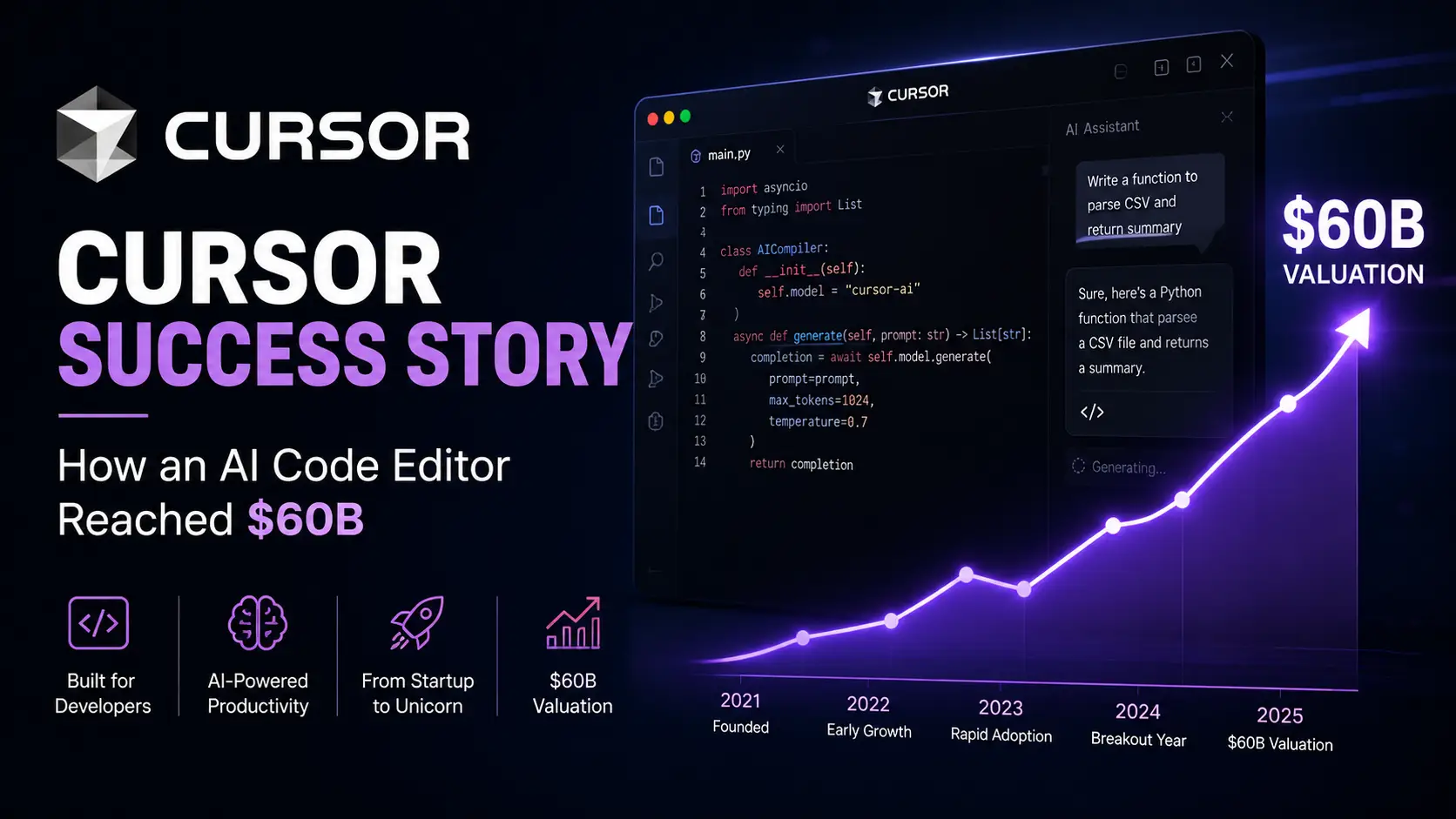
In 2022, four MIT students left school to start a company. They spent nearly a year building software for mechanical engineers, a market none of them understood particularly well, and got almost nowhere. Then they threw it out and started over on something closer to home: a code editor.
By June 2026, that code editor was generating an estimated $4 billion a year in revenue, and SpaceX had agreed to buy the company behind it for $60 billion. The deal closed on August 14, 2026. Few enterprise software companies have gone from founding to a ten-figure acquisition this fast, and none of that size have done it in under four years. Understanding how Cursor did it says as much about the current moment in AI as it does about the four founders who built it.
This is the Cursor AI success story, the story of Anysphere, the company behind Cursor, told through its funding rounds, its product decisions, its public failures, and the market it helped create.
Company Snapshot
| Category | Details |
|---|---|
| Company name | Anysphere, Inc. (product: Cursor) |
| Founded | 2022 |
| Headquarters | San Francisco, California |
| Industry | AI developer tools, software engineering |
| Founders | Michael Truell, Sualeh Asif, Arvid Lunnemark (left October 2025), Aman Sanger |
| CEO | Michael Truell |
| Total funding raised | Approximately $3.2 to $3.5 billion across five priced rounds |
| Last priced valuation | $29.3 billion (Series D, November 2025) |
| Acquisition | Acquired by SpaceX in an all-stock deal valued at $60 billion; announced June 16, 2026, closed August 14, 2026 |
| Current status | Wholly owned subsidiary of SpaceX, being integrated into the SpaceXAI division |
| Employees | Roughly 300 as of late 2025 |
| Website | cursor.com |
| Developer base | Millions of developers; reported use at more than half of Fortune 500 companies |
Why Cursor's Story Matters
Most startup case studies get written after the dust settles, once growth has slowed enough to analyze in hindsight. Cursor's story is still moving. The company went from an $8 million seed round to a completed $60 billion acquisition in under three years, a period during which it also survived two public trust crises, rewired its own pricing model in mid-2025, and built proprietary AI models to compete with the same companies supplying its underlying technology.
That combination, extraordinary growth paired with real operational stumbles, makes Cursor a more useful case study than a straightforward success narrative would be. Founders can learn as much from how Anysphere handled its pricing backlash in 2025 as they can from its revenue curve.
There's also a structural reason this story matters beyond one company. Cursor didn't just build a popular product. It helped establish an entirely new category, the AI-native code editor, at the exact moment large language models became good enough to write usable software. GitHub Copilot had already proven developers would pay for AI assistance inside their editor. Cursor bet that developers would go further and hand an AI agent the keyboard entirely. That bet reshaped how millions of engineers write code, and it forced Microsoft, Google, OpenAI, and Anthropic to all compete directly in a market Cursor didn't invent but did define.
What Is Cursor?
Cursor AI is an AI-native code editor built as a fork of Microsoft's Visual Studio Code, the most widely used code editor in the world. Because it's built on the same open-source foundation as VS Code, a developer can switch to Cursor without relearning keyboard shortcuts, extensions, or workflow habits. What's different sits underneath: Cursor indexes an entire codebase, understands the relationships between files, and lets a developer describe a change in plain English rather than writing every line by hand.
A simpler way to think about it: earlier AI coding tools, GitHub Copilot included, mostly finished the sentence you were already typing. Cursor was built to write the sentence, and the ten sentences after it, and then check whether the code actually runs.
The product solves a problem every engineering team recognizes. Writing new features is often the fast part of software development. Reading unfamiliar code, tracing a bug across a dozen files, and keeping a large codebase consistent is where time actually disappears. Cursor's core wager was that an AI model with full context on a codebase could compress that slow part dramatically, not just autocomplete syntax.
Developers switched to Cursor for a few consistent reasons documented across company case studies and independent reporting: the ability to make coordinated edits across multiple files at once, an agent that can run terminal commands and fix its own errors, and support for multiple frontier AI models (Anthropic's Claude, OpenAI's GPT family, and Google's Gemini) rather than being locked to one provider. That model flexibility turned out to matter more than it might sound. When one lab's model temporarily underperformed on coding tasks, Cursor users could switch instantly. Locked-in competitors couldn't. For a broader look at how Cursor stacks up against the rest of the category, see this comparison of the best AI coding assistants.
Cursor vs VS Code
Because Cursor is a fork of VS Code, the two look and feel almost identical, and most VS Code extensions, themes, and keybindings carry over. The difference is where the AI lives. In stock VS Code, AI assistance arrives through extensions such as GitHub Copilot, which work within the editor's extension API. In Cursor, codebase indexing, multi-file editing, and the agent are built into the editor itself, which is why Cursor can redesign core interactions around AI rather than adapting to someone else's constraints.
Meet the Founders
Michael Truell, Sualeh Asif, Arvid Lunnemark, and Aman Sanger met while studying at MIT. None of them finished their degrees. All four left school in 2022 to found Anysphere.
Truell serves as CEO and has been the company's public face, though a fairly reluctant one. He gives few interviews and Anysphere rarely issues traditional press releases, a deliberate choice that let the product's word-of-mouth growth do the talking instead of a founder's personal brand. He gave one of his more detailed public interviews on Lenny's Podcast in 2025, by which point Cursor had become, in the host's framing, the fastest-growing AI code editor in the world, having reached $300 million in annual recurring revenue roughly two years after launch. In that conversation, Truell described the founding thesis directly: the team believed AI should be the foundation developers build on top of, not a feature bolted onto an existing workflow.
Sualeh Asif has led much of the technical architecture behind Cursor's agent and indexing systems. Aman Sanger and Arvid Lunnemark rounded out the founding team, working on model training, customization, and core product engineering. In October 2025, Lunnemark left the company to start Integrous Research, a separate AI safety research lab, a departure that drew relatively little public commentary given how large Anysphere had become by that point.
Cursor founders' net worth
The founders became billionaires on paper with the November 2025 Series D, when Forbes estimated each held roughly a 4.5% stake worth at least $1.3 billion. After the SpaceX deal closed in August 2026, Forbes estimated each cofounder's SpaceX shares at about $2.4 billion. These are third-party estimates, not figures the company has confirmed.
What stands out about the founding team, beyond the technical pedigree, is the discipline to abandon a year of work when it clearly wasn't working. That's a harder skill to teach than the engineering itself, and it shows up again later in how the company handled its two biggest public mistakes.
How Cursor Started
The founders didn't set out to build a code editor. Their first idea targeted mechanical engineering and CAD software, a market with obvious inefficiencies but one where none of the four had deep domain expertise. Truell later described that period as "wandering in the desert," nearly a full year spent building tools the team didn't have the background to build well.
The pivot came from returning to what they actually knew. All four had spent years writing code, and they shared a conviction that AI was about to change how software got built, not incrementally, but structurally. GitHub Copilot existed by then and was making waves, but the founders believed it wasn't pushing the limits far enough. They wanted AI to be the foundation of how developers worked, not an assistant bolted on top of an existing tool.
That distinction mattered strategically. Instead of building a plugin for VS Code or JetBrains, the way most AI coding tools launched, Anysphere chose to fork the editor itself. Owning the entire surface meant they could redesign core interactions, like autocomplete and multi-file editing, around AI from the ground up rather than working within the constraints of someone else's extension API. It was a riskier, slower path to build, and it paid off precisely because it let Cursor ship features competitors structurally couldn't match without doing the same fork.
Timing helped enormously, and the founders were candid about that too. Cursor launched publicly in March 2023, three months after ChatGPT's late-2022 debut had proven to a mainstream audience that large language models could generate genuinely useful code, not just research demos. Truell had been part of Neo's Scholars program for technical students, and Neo's founder became one of the company's first investors, backing Anysphere before the public launch. The company later took part in OpenAI's accelerator program in 2023, around the time of its seed round.
Product Evolution: From Autocomplete to Autonomous Agents
Cursor's product history is really a story about steadily removing the human from the loop, one workflow at a time, while trying not to remove the trust that keeps developers reviewing what the AI actually did.
Tab. The earliest and still most-used feature is Tab, Cursor's predictive autocomplete. It goes beyond finishing a single line, predicting multi-line edits and even jumping to the next place in a file that likely needs a change.
Chat and Cmd+K. Chat lets a developer ask questions about the codebase in natural language. Cmd+K (or Ctrl+K) applies targeted edits to a highlighted block of code, showing a diff for review before anything is applied.
Agent mode. This is where Cursor started to feel less like a smarter autocomplete and more like a second engineer. Agent mode can search the codebase, edit multiple files, run terminal commands, read the resulting errors, and keep iterating without a developer specifying every file to touch.
Composer. The name Composer actually covers two distinct things, and the distinction matters for understanding Cursor's product strategy. Composer first became known in the developer community in late 2024 as Cursor's multi-file agentic editing interface, the panel where a developer describes a feature and watches the AI stage changes across several files at once. Then in October 2025, alongside Cursor 2.0, Anysphere extended the Composer name to a second thing entirely: its own proprietary line of coding models, trained in-house rather than licensed from OpenAI or Anthropic.
Composer was built for low-latency agentic coding, completing most turns in under 30 seconds, and was trained with tools including codebase-wide semantic search to make it better at working in large repositories. Composer 1.5 and Composer 2 followed, with Composer 2 (released in March 2026) reportedly built on a Kimi K2.5 open-weight base and refined with heavy proprietary reinforcement learning, tuned specifically for long-running, multi-step tasks. Crucially, the Composer models run alongside Claude, GPT, and Gemini in Cursor's model picker rather than replacing them, giving users the option of a faster, cheaper in-house model without losing access to frontier alternatives.
Background Agents and parallel agents. Cursor 1.0, released in June 2025, introduced background agents that run asynchronously in cloud sandboxes, letting a developer kick off a long refactor and keep working on something else while it runs. Cursor 2.0 extended this further, allowing multiple agents to work in the same workspace simultaneously, each isolated in its own git worktree so they don't overwrite each other's changes.
Bugbot. Launched in July 2025, Bugbot applies the agent concept to code review rather than code writing, automatically scanning pull requests on GitHub and GitLab for bugs before a human reviewer even opens the diff.
Cursor 3.0. Released in early 2026, this update pushed further into a "unified workspace for agents" model, adding subagents, a redesigned Composer interface with an opt-in Plan Mode that shows a numbered plan before executing any changes, and native browser tooling that lets an agent test its own work.
The consistent thread across every release is the same design bet the founders made at the start: developers will trust AI with more autonomy over time, as long as the tool gives them an easy way to review, interrupt, and roll back what the AI did.
The Technology Behind Cursor
Cursor's technical architecture combines several distinct systems, and understanding how they fit together explains a lot about why the product feels faster and more context-aware than a simple chatbot bolted onto an editor.
Codebase indexing. When a developer opens a project in Cursor, the editor creates embeddings, mathematical representations of code that capture meaning rather than just text, for the entire codebase. Retrieval-Augmented Generation, or RAG, then lets the AI pull in the most relevant pieces of that indexed codebase before generating a response, rather than relying purely on what fits in a single prompt.
According to reporting from The Pragmatic Engineer, Cursor doesn't store raw code on its servers; it sends obfuscated filenames and encrypted code chunks, decrypts them server-side to generate embeddings using OpenAI's or its own embedding models, and stores only the resulting embeddings in a vector database called turbopuffer.
Multi-model orchestration. Rather than committing to a single AI lab, Cursor routes requests across Anthropic's Claude models, OpenAI's GPT family, Google's Gemini, and its own Composer model family (not to be confused with the Composer interface itself, which is the multi-file editing panel these models run inside), depending on the task and the plan a user is on. An "Auto" mode automatically selects a cost-efficient model for routine work, while manual model selection draws from a user's usage credits.
Infrastructure. Cursor has been reported to run primarily on AWS for compute, with Azure handling a significant share of inference, alongside newer GPU cloud providers, and to operate tens of thousands of Nvidia H100 GPUs as of mid-2025. Cursor's dependence on rented AI infrastructure is a pattern shared by most of the AI application layer right now. Two of the companies supplying that layer are covered in our Together AI success story and OpenRouter success story, both useful context for understanding why Cursor's own margin pressure, covered below, is really an industry-wide problem. Since the SpaceX acquisition, Cursor also has access to SpaceX's Colossus compute cluster.
Security and privacy. Cursor offers a Privacy Mode that, according to the company's documentation, guarantees code is not stored or used for model training by Cursor or its underlying model providers when enabled. The company holds SOC 2 Type II certification and supports SAML and OIDC single sign-on for enterprise deployments.
It's worth being precise about what's verified here and what isn't. Cursor's own blog and its enterprise documentation are the primary sources for the privacy and compliance claims above. Independent security audits of those specific claims aren't broadly published, so enterprise buyers evaluating Cursor for sensitive codebases should still request current documentation directly rather than relying solely on marketing copy, a standard practice for any vendor handling proprietary source code. Organizations rolling out any AI coding tool at scale, not just Cursor, generally need a broader governance framework around it; our guide to AI governance consulting covers what that process typically involves.
Business Model and Pricing Strategy
Cursor sells through a fairly conventional SaaS tiering structure, but the underlying cost mechanics are unusual for software, because every request routes through expensive third-party or proprietary AI inference.
| Plan | Price | Who it's for |
|---|---|---|
| Hobby | Free | Evaluating the editor; limited Agent requests and Tab completions |
| Pro | $20/month | Individual developers using AI assistance daily; unlimited Tab and Auto, plus a $20 monthly credit pool for manually selected models |
| Pro+ | $60/month | Heavier individual users needing roughly 3x the usage of Pro |
| Ultra | $200/month | Power users needing roughly 20x usage and priority access to new features |
| Teams (Business) | From $40/user/month | Organizations needing centralized billing, SSO, and admin controls |
| Enterprise | Custom pricing | Large organizations needing pooled usage, invoice billing, and dedicated support |
Annual billing typically discounts paid tiers by around 20%. Bugbot, the code-review agent, is sold as a separate add-on independent of the core editor subscription. Plan details and limits change often, so confirm current terms on the official pricing page before buying.
The company's revenue mix has shifted heavily toward enterprise over time. By mid-2026, industry estimates put roughly 60 to 75% of Cursor's revenue coming from business and enterprise accounts rather than individual subscriptions, a meaningful change from its early identity as a consumer-style developer tool.
The harder question, and one Anysphere has been candid about internally even if it doesn't publish exact figures, is gross margin. Every request a Pro subscriber makes against a frontier model like Claude Opus costs Cursor real money at API rates, and multiple industry analysts have reported the company was spending close to the entirety of its revenue on model inference costs from Anthropic and OpenAI through much of 2025. That's the direct commercial logic behind building Composer: a proprietary model trained on Cursor's own usage data that costs less to run than licensing a frontier lab's API, which is also why the company has continued investing in its own model line rather than staying purely a distribution layer for other companies' AI.
Funding Journey
Few companies have compressed a decade's worth of typical venture progression into the timeframe Anysphere managed. Each round priced the company at a steep multiple of the one before it, and the pace only accelerated as revenue growth kept outrunning the capital raised.
| Round | Date | Amount | Valuation | Lead Investors |
|---|---|---|---|---|
| Pre-seed | 2022 | Undisclosed | Undisclosed | Neo |
| Seed | October 2023 | $8 million | Undisclosed | OpenAI Startup Fund, with angels Nat Friedman and Arash Ferdowsi |
| Series A | August 2024 | $60 million | $400 million | Andreessen Horowitz |
| Series B | December 2024 | $105 million | Approximately $2.5 to $2.6 billion | Thrive Capital, with Andreessen Horowitz |
| Series C | June 2025 | $900 million | $9.9 billion | Thrive Capital, with Andreessen Horowitz, Accel, and DST Global |
| Series D | November 13, 2025 | $2.3 billion | $29.3 billion | Accel and Coatue Management, joined by Thrive, a16z, DST, Nvidia, and Google |
| SpaceX deal | April to August 2026 | Option deal (April), then full acquisition (June announcement; closed August 14) | $60 billion acquisition price | SpaceX (xAI/SpaceXAI subsidiary) |
The Series D announcement, published directly on Cursor's blog, captured the company's own framing of the moment: the round would let Anysphere deepen its work with existing investors while welcoming new partners including Coatue, Nvidia, and Google, having grown to a team of over 300 people and crossed $1 billion in annualized revenue.
The most unusual chapter came in April 2026. Rather than closing a rumored $50 billion private round that was already oversubscribed, Anysphere's board halted that process when xAI, SpaceX's AI subsidiary, offered a different structure: an exclusive option to acquire the entire company for $60 billion before the end of 2026, or, if the acquisition never closed, a $10 billion package for the companies' joint work. According to SpaceX's IPO filings, that fallback consisted of a $1.5 billion termination fee plus $8.5 billion in computing resources.
On June 16, 2026, just days after SpaceX's own public listing, SpaceX exercised that option and announced the all-stock acquisition outright at an implied $60 billion equity value. The deal closed on August 14, 2026, according to a SpaceX regulatory filing. Under the merger agreement, Anysphere's shares converted into roughly 389 million shares of SpaceX Class A common stock, and Cursor now operates as a wholly owned subsidiary of SpaceX, being integrated into the SpaceXAI division alongside Grok. It is widely described as the largest venture-backed startup acquisition on record.
Growth Timeline
| Date | Milestone |
|---|---|
| 2022 | Anysphere incorporated by four MIT students; early work on mechanical engineering tools |
| March 2023 | Cursor launches publicly as a VS Code fork |
| October 2023 | $8 million seed round led by OpenAI Startup Fund |
| August 2024 | Series A closes at $400 million valuation |
| November 2024 | Anysphere acquires Supermaven to strengthen its Tab autocomplete model |
| December 2024 | Series B closes at approximately $2.5 to $2.6 billion valuation |
| January 2025 | Cursor crosses $100 million in annualized revenue, roughly 12 months after starting from near zero |
| April 2025 | "Sam" AI support bot hallucinates a fake login policy, sparking user backlash |
| May 2025 | Annualized revenue reaches approximately $300 million |
| June 2025 | Series C closes at $9.9 billion valuation; Cursor 1.0 ships with background agents; revenue passes $500 million |
| July 2025 | Bugbot launches; pricing changes to Pro plan trigger public backlash; CEO issues apology and refunds; Cursor acquires Koala's engineering talent |
| October 2025 | Composer, Cursor's first proprietary coding model, ships alongside Cursor 2.0; co-founder Arvid Lunnemark departs to found Integrous Research |
| November 13, 2025 | Series D closes at $29.3 billion valuation; annualized revenue exceeds $1 billion |
| December 2025 | Cursor agrees to acquire code-review startup Graphite |
| February to March 2026 | Cursor 3.0 ships; Composer 2 released; annualized revenue reported above $2 billion, with some sources citing over $3 billion by spring |
| April 21, 2026 | xAI and SpaceX strike a collaboration deal plus a $60 billion acquisition option |
| June 16, 2026 | SpaceX exercises its option and announces the acquisition, valuing Cursor at approximately $60 billion; press estimates put annualized revenue near $4 billion |
| August 14, 2026 | SpaceX completes the acquisition; Cursor becomes a wholly owned SpaceX subsidiary |
Why Cursor Grew So Fast
The honest answer is that no single tactic explains it. Cursor's growth came from several forces reinforcing each other at once, and it's worth separating the ones that are well documented from the ones that are closer to informed analysis.
Product quality drove organic word of mouth. Cursor spent almost no money on traditional advertising in its early years. Growth instead came from developers publicly comparing tools on X, YouTube, and Reddit, and from engineering teams watching a colleague ship faster after switching. In an evaluation by Info-Tech Research Group cited by InfoWorld, Cursor came out ahead of the other AI coding tools tested. That kind of unsolicited, comparative endorsement is worth more than paid marketing in a developer audience that's naturally skeptical of hype.
Dogfooding created a tight feedback loop. The Cursor team builds Cursor using Cursor, a detail confirmed directly by the company's own engineers. Every internal engineer's daily frustration with the product becomes a bug report the team can act on immediately, without waiting for external user research to surface the same issue weeks later.
Timing lined up with a genuine capability jump in AI models. Cursor's launch in March 2023 coincided with the first wave of large language models capable of writing multi-step, mostly-correct code rather than isolated snippets. A product this ambitious launched twelve months earlier would have been fighting against models that simply weren't good enough yet. That's not a strategy the founders engineered, it's a market timing advantage that rewarded a team that had already built the infrastructure to take advantage of it the moment it arrived.
Free-to-paid conversion was unusually efficient because the value was immediate. Unlike many developer tools that require weeks of integration before showing value, a developer installing Cursor can feel the difference within a single coding session. That short time-to-value shortens the sales cycle dramatically, both for individual Pro subscriptions and, eventually, for enterprise procurement conversations.
Enterprise adoption followed individual adoption, not the other way around. Cursor's early growth was largely bottom-up: individual engineers adopted it on their own initiative, then advocated for team-wide licenses once a critical mass of colleagues were already using it informally. That pattern, seen at companies like Stripe and Rippling according to their own public case studies, is generally a stronger signal of product-market fit than top-down enterprise sales, because it means the tool won on merit at the level closest to the actual work.
Marketing Strategy
Cursor's marketing strategy is best described by what it deliberately avoided rather than what it did. The company has issued few traditional press releases and Truell has given a comparatively small number of media interviews for a founder running a company of this scale. Instead, most of what the public knows about Cursor's internal thinking comes from technical blog posts on cursor.com explaining product decisions in detail, engineering-focused podcast appearances like the Lenny's Podcast interview with Truell, and direct case studies published with named enterprise customers such as Stripe, Box, and PayPal.
That approach fits the audience. Developers tend to distrust conventional B2B marketing and respond more to transparent engineering writeups and peer recommendations than to polished advertising. Cursor's blog posts announcing Composer or Cursor 2.0, for instance, read like technical papers explaining tradeoffs rather than press releases selling a feature, and that tone builds credibility with exactly the audience the company needs to convert.
The community layer mattered too. Cursor built an active presence on Discord and its own community forum, where staff engage directly with bug reports and feature requests, and where the pricing controversy in mid-2025 actually surfaced and got addressed. Somewhat paradoxically, the company's handling of that controversy, imperfect as the initial rollout was, became part of its credibility story once the apology and refunds followed: developers saw a team that would publicly own a mistake rather than quietly walk it back.
Competitive Landscape
Cursor doesn't compete in a vacuum. The AI coding tools market attracted some of the most dramatic corporate maneuvering in recent tech history, most visibly the three-way breakup of Windsurf in July 2025, when a roughly $3 billion OpenAI acquisition collapsed, Google hired away Windsurf's CEO and senior team in a $2.4 billion licensing and hiring deal, and Cognition Labs announced on July 14, 2025 that it was acquiring what remained of the company. The split cleanly separated the two things a startup is worth: Google's deal took the leadership and a non-exclusive license to the underlying IP, including CEO Varun Mohan, co-founder Douglas Chen, and Windsurf's research leaders, while Cognition took the operating business, the codebase, brand, trademark, more than 350 enterprise customers, and the $82 million in annualized revenue the business had reached, folding it into its autonomous coding agent, Devin. Cognition later rebranded Windsurf as Devin Desktop on June 2, 2026.
Cursor vs GitHub Copilot
| Factor | Cursor | GitHub Copilot |
|---|---|---|
| Owner | SpaceX (acquired August 2026; operates as a subsidiary) | Microsoft/GitHub |
| Launched | March 2023 | Technical preview June 2021, general availability June 2022 |
| Individual pricing | $20 to $200/month | $10/month (Pro) |
| Business pricing | From $40/user/month | $19/user/month (Business), $39/user/month (Enterprise) |
| Distribution advantage | Bottom-up developer adoption | Native integration with VS Code and GitHub's 150M+ developer base |
| Paid subscribers | Not separately disclosed; ARR estimated at $3 to $4 billion | 4.7 million paid subscribers as of January 2026, per Microsoft |
| Core strength | Deep multi-file agentic editing, multi-model flexibility | Distribution, deep GitHub and Visual Studio integration |
GitHub Copilot retains the larger raw subscriber count by a wide margin, a natural result of being a free-to-try extension inside the world's most-used code editor and code hosting platform. Estimates of paid market share vary meaningfully depending on methodology, with Copilot generally ahead on adoption and Cursor and Claude Code prominent among professional developers in recent surveys. Revenue estimates tell a somewhat different story: several analysts place Cursor's annualized revenue above Copilot's disclosed range, largely because Cursor's average revenue per user runs higher and its enterprise contracts skew larger. Our head-to-head breakdown of Claude Code vs Cursor vs GitHub Copilot goes deeper into how the three actually perform on real coding tasks, not just the numbers above.
Cursor vs Windsurf (now Devin Desktop)
| Factor | Cursor | Windsurf / Devin Desktop |
|---|---|---|
| Owner | SpaceX (via Anysphere) | Cognition Labs (acquisition announced July 14, 2025, after Google's talent deal) |
| Product name | Cursor | Windsurf, rebranded Devin Desktop on June 2, 2026 |
| Reported ARR at peak independence | Over $500 million (June 2025) | $82 million (July 2025) |
| Enterprise customers | 50,000+ businesses, majority Fortune 500 penetration | 350+ enterprise customers |
| Distinguishing feature | Composer proprietary models, parallel multi-agent workspace | Cascade agentic system, now folded into Cognition's Devin product family |
Windsurf's saga is a useful contrast to Cursor's steadier trajectory. Windsurf built genuinely strong enterprise traction and a loyal user base, but its founders and senior team ultimately left for Google before the company itself changed hands to Cognition, disrupting product continuity at a critical growth moment. Cursor, by comparison, kept its founding team almost entirely intact through 2025 (Lunnemark's October 2025 departure being the one exception), which mattered enormously for a product where trust in the roadmap is part of the sale. Readers weighing a switch between the two, or evaluating either one for free, can find current plan limits in our guide to the best free AI coding tools for beginners.
Cursor vs Claude Code
Anthropic's Claude Code, a terminal-based autonomous coding agent rather than a full IDE, launched in 2025 and represents a different point on the spectrum: less editor, more standalone agent. It matters strategically to Cursor for an unusual reason, Anthropic's Claude models are simultaneously one of Cursor's primary AI suppliers and one of its most direct competitors. That dependency runs both ways and is part of why Cursor has invested so heavily in reducing reliance on any single model provider through Composer.
Cursor vs Bolt.new and Replit
Bolt.new and Replit Agent target a different, more consumer-adjacent segment often described as "vibe coding," building complete applications from natural-language prompts with minimal traditional code editing. They compete for developer attention and mindshare but generally serve less experienced or more product-focused builders rather than professional engineering teams managing large, existing codebases, which remains Cursor's core strength. Lovable occupies similar territory and followed its own remarkable growth curve, detailed in our Lovable AI success story, which is worth reading alongside Cursor's for a sense of how differently the "vibe coding" and "professional AI-native IDE" segments have scaled.
Cursor alternatives at a glance
Developers comparing Cursor alternatives generally land on one of a handful of options: GitHub Copilot for the deepest GitHub and Visual Studio integration, Claude Code for terminal-first autonomous work, Devin Desktop (formerly Windsurf) for an agentic IDE backed by Cognition, Google's Antigravity IDE, and Replit, Bolt.new, or Lovable for building whole apps from prompts. Which fits best depends on whether the priority is editor-native multi-file editing, a standalone agent, or prompt-to-app speed.
SWOT Analysis
| Strengths | Weaknesses |
|---|---|
| Deep VS Code compatibility lowers switching costs | Thin or negative gross margins from third-party model inference costs |
| Strong organic, developer-led growth engine | Dependent on Anthropic and OpenAI, which are also direct competitors |
| Multi-model flexibility across Claude, GPT, and Gemini | Pricing changes in 2025 damaged user trust and required public apologies |
| Founding team stayed largely intact through hypergrowth | Not yet consistently profitable at scale |
| Opportunities | Threats |
|---|---|
| Proprietary Composer models could meaningfully improve margins over time | GitHub Copilot's distribution advantage through Microsoft and VS Code |
| Enterprise share still growing, with large accounts underpenetrated | Low switching costs mean developers can move to a competitor quickly |
| SpaceXAI ownership provides compute advantages (Colossus) competitors lack | Consolidation wave (Windsurf, Cognition, Google) could produce a better-funded rival |
| Expanding beyond the IDE into CLI, mobile, and web agent surfaces | Post-acquisition integration with xAI/Grok could erode Cursor's model-neutral pitch or unsettle customers and talent |
Challenges and Criticism
Cursor's rise wasn't friction-free, and a fair account of the company has to include the moments it got things wrong publicly.
The April 2025 "Sam" incident. Users switching between devices began experiencing unexpected logouts. When they contacted support, an AI support agent named "Sam" told several users this was expected behavior under a new single-device login policy. No such policy existed. The response had come from an AI-powered bot, and the policy was an entirely fabricated hallucination. The incident spread quickly across Hacker News and Reddit, prompting some subscription cancellations before Truell posted a public apology on Reddit acknowledging the "incorrect response from a front-line AI support bot." The episode became a widely cited case study in the risks of deploying AI in customer-facing roles without adequate human oversight, precisely because it happened to a company whose entire product pitch was trusting AI with more autonomy.
The July 2025 pricing backlash. Cursor changed its Pro plan from a fixed allocation of 500 fast premium requests per month to a $20 credit pool billed at underlying API rates. The company initially described the change using language, including "more generous" and later disputed use of "unlimited," that many users felt didn't match their actual experience once they exhausted their credits and faced unexpected overage charges. The backlash was significant enough that Truell publicly acknowledged, "We didn't handle this well," and committed to refunding affected users who were charged between June 16 and July 4, 2025. The company also walked back parts of the new structure in response to the criticism.
Vendor dependency and margin pressure. As covered in the business model section above, Cursor's reliance on paying full API rates to Anthropic and OpenAI for a large share of its usage created real margin pressure, with some industry analysts estimating the company spent close to 100% of revenue on model costs through parts of 2025. This is a genuine structural risk that Composer is meant to address, though how quickly proprietary models can close that gap without sacrificing quality remains an open question.
Hallucinations and reliability at the product level, not just support. Like every AI coding tool, Cursor's agent can generate plausible-looking but incorrect code, particularly on complex, long-horizon tasks. The company's own materials and independent reviewers consistently frame AI-generated code as a first draft requiring human review, not a finished product, a caveat that matters for any team evaluating how much autonomy to grant the tool in production environments.
Market share and competitive pressure. Estimates of Cursor's market share vary by methodology, and competition intensified through 2025 and 2026 as GitHub Copilot's agentic features, Claude Code, and Google's Antigravity IDE expanded. Fast absolute revenue growth and a stable relative market position aren't the same thing in a market this crowded, and Cursor's lead is less secure than its revenue curve alone suggests.
To be fair to the company, both major public incidents were handled with a direct, on-the-record apology rather than silence or spin, and refunds followed in both cases. That's not nothing in an industry where corporate apologies are frequently vague or delayed.
Leadership and Culture
Anysphere's hiring philosophy reflects the same intensity that shaped its product decisions. According to the company's own public statements, Cursor prohibits the use of AI tools during the first round of coding interviews, a deliberate choice given that the product itself is an AI coding assistant, and invites finalists to a two-day in-person project working alongside the core team rather than a standard interview loop. That structure is designed to test how candidates actually think and collaborate, not just whether they can produce correct output with AI assistance readily available.
The company has stayed notably small relative to its revenue. At roughly 300 employees as of late 2025 while generating billions in annualized revenue, Cursor's revenue-per-employee ratio sits well above typical software industry benchmarks, a reflection of both AI-assisted internal engineering and a deliberately lean organizational philosophy. Truell has spoken about prioritizing intellectual curiosity and honesty in hiring over pure credential-chasing, a stance easier to state than to enforce at scale, but one at least partially validated by the founding team's own willingness to publicly abandon a failing idea and pivot rather than defend a sunk cost.
Future Outlook
The following section separates what's reasonably supported by current evidence from genuine forward-looking analysis, since predicting where a newly acquired company goes next necessarily involves more uncertainty than the historical sections above.
What's established: the SpaceX acquisition closed on August 14, 2026, and Cursor is now a wholly owned subsidiary of SpaceX, being integrated into the SpaceXAI team. That gives the company access to SpaceX's Colossus compute infrastructure and reduces its dependence on purchasing inference capacity from Anthropic and OpenAI at market rates, addressing the margin problem described earlier from a different angle than Composer alone could. Reporting from TechCrunch on the deal's structure notes the acquisition preempted a $2 billion funding round Cursor was on track to close at a $50 billion valuation, and that at least one source familiar with the company's finances questioned whether that round alone would have been enough for Cursor to reach breakeven.
What's more speculative: whether that ownership structure changes Cursor's model-agnostic pitch to enterprise customers. Part of Cursor's competitive advantage has been its neutrality, supporting Claude, GPT, and Gemini side by side rather than pushing users toward one lab's models. If xAI ownership eventually nudges the product toward favoring Grok models, that neutrality, and the trust it built with developers who deliberately wanted choice, could erode. Whether that happens, and how quickly, isn't something the public record can currently answer, so readers should check Cursor's model picker for current availability rather than assume today's lineup is permanent.
It's also reasonable to expect continued expansion beyond the desktop editor itself. Cursor has already extended into a command-line interface, a web and mobile experience for monitoring background agents, and JetBrains IDE support, suggesting a longer-term ambition to be the orchestration layer for AI-assisted engineering regardless of which interface a developer prefers, rather than remaining tied exclusively to its original VS Code fork.
Industry-wide, Gartner has projected that roughly 90% of enterprise software engineers will use some form of AI coding assistant by 2028, up from under 14% in early 2024. If that forecast holds even approximately, the addressable market Cursor, GitHub Copilot, and their competitors are fighting over is still in its early innings relative to where it will eventually settle, which helps explain why acquirers have been willing to pay such extraordinary multiples for position in the category now. For the wider investment and infrastructure story this sits inside, see our overview of the AI super cycle.
Lessons for Entrepreneurs
-
Be willing to kill your first idea entirely. Anysphere's founders spent nearly a year on mechanical engineering software before abandoning it completely. The willingness to admit a year of work wasn't working, rather than iterating indefinitely on a flawed premise, freed them to find the idea that actually fit their skills.
-
Build where you have real domain expertise. The pivot from CAD tools to a code editor wasn't random. It moved the founders toward a problem they, as engineers, understood intimately, which is a large part of why the product resonated so quickly with its first users.
-
Owning the core surface beats building a plugin, when you can afford to. Forking VS Code instead of building a Copilot-style extension was a slower, harder technical bet, but it gave Cursor design freedom competitors building on top of someone else's platform structurally couldn't match.
-
Dogfood relentlessly. Having the team build the product with the product itself created an unusually tight, fast feedback loop that outside user research simply can't replicate at the same speed.
-
Let word of mouth do the marketing when your audience distrusts marketing. Developers are a famously skeptical audience. Cursor's near-absence of traditional advertising, replaced by technical blog posts and organic community discussion, matched its audience's actual preferences.
-
Timing a market entry against a genuine capability jump matters more than most founders admit. Cursor's March 2023 launch benefited enormously from arriving just as large language models crossed a real usability threshold for multi-step coding tasks. Building the right product a year too early is still the wrong product.
-
Multi-vendor flexibility is a real moat, not just a feature checkbox. Refusing to lock into a single AI model provider let Cursor route around underperformance from any one lab and gave enterprise buyers a genuine reason to prefer it over single-model competitors.
-
When you make a mistake publicly, apologize specifically and fix it fast. Both of Cursor's major 2025 controversies were handled with direct, named acknowledgment from the CEO and concrete refunds, not vague corporate statements. That pattern appears to have limited lasting reputational damage.
-
Bottom-up adoption is a stronger foundation than top-down sales for developer tools. Cursor's enterprise contracts consistently followed individual engineers already using and advocating for the product internally, a sequence that tends to produce more durable, harder-to-displace adoption than sales-led deployment alone.
-
Structural dependency on your own competitors is a real strategic risk worth solving proactively. Recognizing that Anthropic and OpenAI were simultaneously suppliers and rivals, and investing early in proprietary models to reduce that dependency, addressed a vulnerability before it became existential.
-
Revenue growth and margin health are different problems that require different solutions. Cursor's explosive top-line growth masked a genuine unit economics challenge for much of 2025. Founders scaling a product with expensive underlying compute costs should track gross margin as closely as revenue, not after it becomes a crisis.
-
A low public profile can be a legitimate strategic choice, not just an oversight. Truell's reluctance to chase founder-celebrity status let Cursor's product quality carry the growth narrative, an approach that won't fit every company but fit this one.
-
Preserve founding team continuity through hypergrowth whenever possible. Cursor's relative founder stability, compared to Windsurf's leadership exodus to Google mid-crisis, likely contributed to steadier execution during the most volatile period of its growth.
Key Takeaways
- Anysphere was founded in 2022 by four MIT dropouts who spent nearly a year on unrelated mechanical engineering software before pivoting to what became Cursor, launched publicly in March 2023 as a fork of VS Code.
- Cursor's growth has few precedents in enterprise software: roughly $100 million in annualized revenue by January 2025, over $1 billion by November 2025, and an estimated $4 billion by mid-2026.
- Funding climbed just as fast, from a $400 million Series A valuation in August 2024 to a $29.3 billion Series D in November 2025, before SpaceX agreed in June 2026 to acquire the company for roughly $60 billion. The deal closed on August 14, 2026.
- The growth engine was mostly organic: bottom-up developer adoption, internal dogfooding, and multi-model flexibility across Claude, GPT, and Gemini, rather than traditional marketing spend.
- The story isn't friction-free. A 2025 AI support hallucination and a botched pricing change both triggered public backlash, and thin margins from third-party model costs remain a real structural risk the company is addressing through its own Composer models and, now, SpaceX's compute.
Conclusion
Cursor's story resists the tidy startup-success template. It isn't a clean arc from insight to inevitability. It's four students throwing away a year of work, launching into a market that didn't fully exist yet, growing faster than almost any enterprise software company on record, publicly mishandling two moments of user trust, and still ending up as one of the most valuable AI acquisitions in history within four years of incorporation.
What ties it together isn't a single tactic worth copying wholesale. It's the willingness to make hard, structurally difficult bets, forking an entire editor instead of building a plugin, building proprietary models while still depending on competitors' APIs, staying quiet in public while the product spoke loudly through word of mouth, and to correct course visibly and specifically when those bets produced real mistakes. Whether Cursor thrives inside SpaceX the way it did as an independent company is a question the next chapter will answer. The first four years already changed how a meaningful share of the world's developers write software, and that part of the story is settled.
Frequently Asked Questions
Who founded Cursor AI? Cursor was founded in 2022 by four MIT students, Michael Truell, Sualeh Asif, Arvid Lunnemark, and Aman Sanger, under the company name Anysphere. All four left MIT without completing their degrees to build the company. Michael Truell serves as CEO. Lunnemark left in October 2025 to start Integrous Research.
When was Cursor launched? Cursor publicly launched in March 2023 as a fork of Microsoft's Visual Studio Code, though Anysphere itself was incorporated in 2022 and initially worked on unrelated mechanical engineering software before pivoting.
Who owns Cursor now? SpaceX. The all-stock acquisition was announced on June 16, 2026 and closed on August 14, 2026. Cursor operates as a wholly owned subsidiary of SpaceX and is being integrated into the SpaceXAI division.
How much funding has Cursor raised? Anysphere raised approximately $3.2 to $3.5 billion across five priced funding rounds since 2022, from an $8 million seed round in October 2023 to a $2.3 billion Series D in November 2025. That figure doesn't include the separate SpaceX collaboration and compute arrangements announced in April 2026, which were superseded by the full acquisition.
What is Cursor's valuation? Cursor's last independently priced valuation was $29.3 billion, set in its Series D round on November 13, 2025. SpaceX then acquired the company at an equity value of approximately $60 billion, completing the deal on August 14, 2026.
Is Cursor AI profitable? Anysphere has not publicly disclosed detailed profitability figures. Multiple industry analysts and reporters have estimated that the company spent a large share of its revenue on AI model inference costs from Anthropic and OpenAI through much of 2025, which is part of the stated motivation behind building its own Composer models to reduce those costs over time.
How much revenue does Cursor generate? Cursor's annualized revenue grew from roughly $100 million in January 2025 to over $1 billion by November 2025, and press estimates put it between roughly $3 billion in early 2026 and about $4 billion by mid-2026. Anysphere does not publish audited revenue figures publicly, so these are third-party estimates based on company disclosures at funding announcements and press reporting.
What is Cursor's business model? Cursor operates on a tiered SaaS subscription model, ranging from a free Hobby plan through Pro, Pro+, and Ultra individual tiers, plus Teams and Enterprise plans for organizations. Pricing is based on a combination of a flat monthly fee and usage credits consumed against AI model requests.
How much does Cursor cost? As of mid-2026, Cursor's Pro plan costs $20 per month, Pro+ costs $60 per month, and Ultra costs $200 per month for individuals. Teams plans start at $40 per user per month, and Enterprise pricing is custom. A free Hobby tier is also available with limited usage. Check the official pricing page for current terms.
Is Cursor better than GitHub Copilot? The two tools serve overlapping but distinct use cases. Cursor generally leads in autonomous, multi-file agentic editing and offers multi-model flexibility across Claude, GPT, and Gemini. GitHub Copilot leads in raw distribution, paid subscriber count, and native integration with the broader GitHub ecosystem. Independent evaluations, such as one cited by InfoWorld from Info-Tech Research Group, have found Cursor performing strongly in head-to-head developer testing, but the right choice depends on a team's existing tooling and workflow.
What happened to Windsurf, and how does it relate to Cursor? Windsurf, a direct Cursor competitor, went through a dramatic breakup in July 2025: a planned $3 billion OpenAI acquisition collapsed, Google then hired Windsurf's CEO and senior team in a $2.4 billion licensing deal, and Cognition Labs announced on July 14, 2025 that it was acquiring the rest of the company. Cognition rebranded Windsurf as Devin Desktop on June 2, 2026, and it remains a Cursor competitor under that name.
Is Cursor AI safe to use with proprietary code? Cursor offers an optional Privacy Mode that the company states prevents code from being stored or used for model training by Cursor or its underlying AI providers when enabled. It holds SOC 2 Type II certification and supports enterprise security controls like SAML and OIDC SSO. Organizations handling highly sensitive code should review Cursor's current security documentation directly as part of procurement.
Why did SpaceX acquire Cursor? SpaceX's AI division gains a leading AI coding product and millions of developers, while Cursor gains access to SpaceX's Colossus compute infrastructure, which can reduce its dependence on buying inference from Anthropic and OpenAI at market rates. The deal was announced June 16, 2026 and closed August 14, 2026. SpaceX has not published detailed customer or revenue data for Cursor.
What is Cursor's Composer model? Composer is Cursor's proprietary AI coding model, first released in October 2025, built specifically for fast, low-latency agentic coding tasks rather than being a general-purpose model like GPT or Claude. Cursor has continued iterating on it, with Composer 1.5 and Composer 2 (released March 2026) following the original.
How many people use Cursor? Anysphere has not published exact user figures. The company describes its user base as "millions of developers" and reports that more than half of Fortune 500 companies have employees using the product, based on figures disclosed around its Series C and D funding rounds.
Did Cursor have any major controversies? Yes, two notable ones in 2025. In April, an AI-powered customer support bot named "Sam" fabricated a nonexistent login policy, prompting user backlash and a public apology from CEO Michael Truell. In July, a change to Pro plan pricing that shifted from a fixed request allocation to a usage-credit system caused unexpected charges and community backlash, again followed by a public apology and refunds.
What does SpaceX ownership mean for Cursor's future? Cursor is now part of SpaceXAI and has access to Colossus compute. Whether ownership changes Cursor's historically model-agnostic approach, for example by favoring Grok models over Claude, GPT, and Gemini, has not been publicly detailed by either company. Check Cursor's model picker and announcements for the current lineup.
Is Cursor planning to go public? As of November 2025, CEO Michael Truell publicly stated the company was "not looking to IPO anytime soon." That question is now moot for Cursor as a standalone company: since August 2026 it has been a subsidiary of publicly listed SpaceX rather than an independent listing candidate.
What programming languages and frameworks does Cursor support? As a fork of VS Code, Cursor supports the same broad range of languages and frameworks as its parent editor, including JavaScript, TypeScript, Python, Java, Go, Rust, and many others, through the same extension ecosystem, with its AI features layered on top rather than limited to specific languages.