
Lovable AI Success Story: How an AI App Builder Reached Millions of Users
Executive Summary
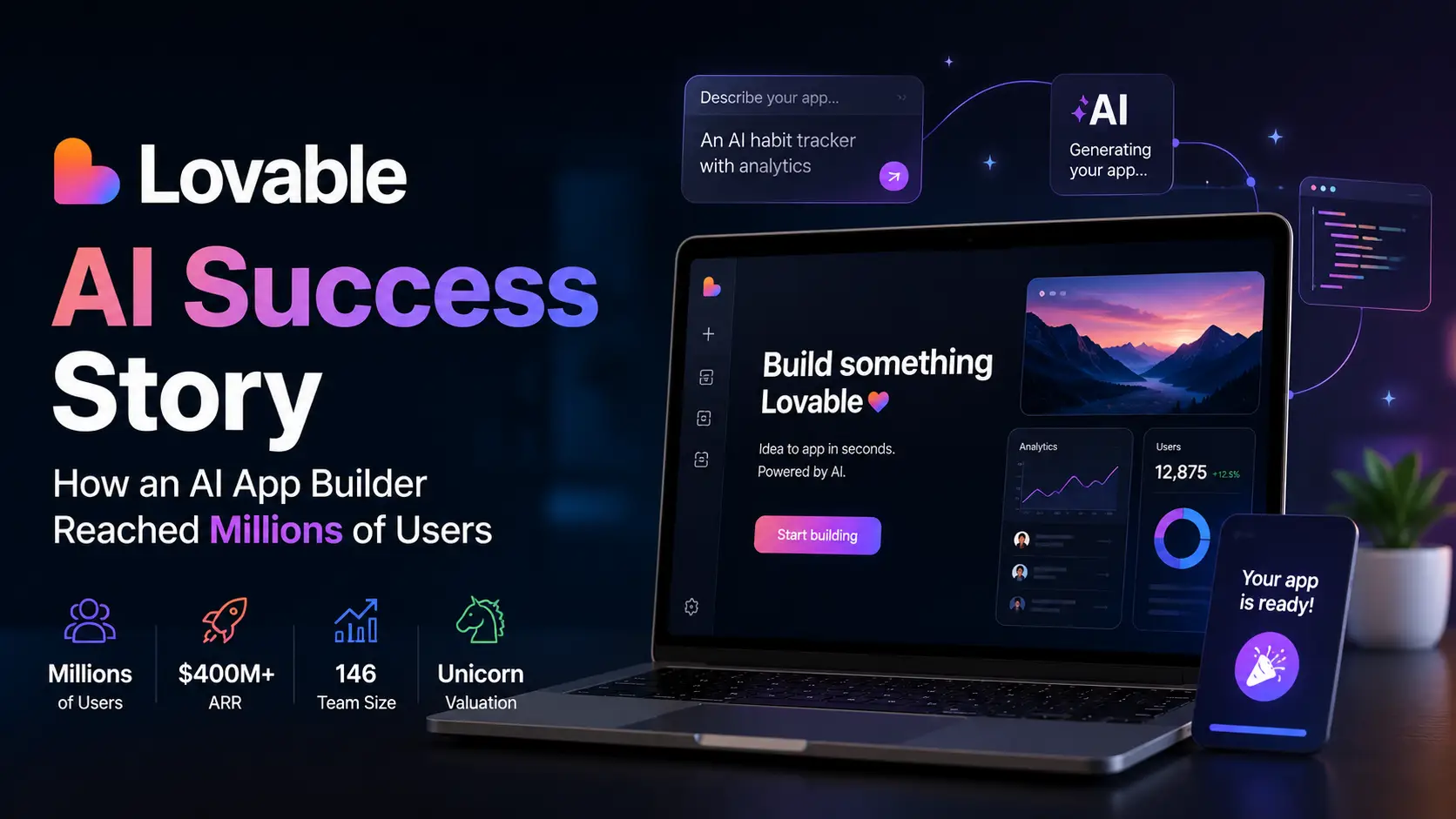
Lovable is a Stockholm-based startup that lets people build working software by describing it in plain English. No coding required. It started as a weekend side project on GitHub in mid-2023, failed twice as a commercial product in 2024, and then, after a rebrand and a rebuilt go-to-market strategy, became what Forbes called the fastest-growing software startup in history.
By February 2026, Lovable had crossed $400 million in annual recurring revenue with a team of just 146 people, according to TechCrunch. It had raised more than $550 million across four funding rounds, most recently a $330 million Series B in December 2025 that valued the company at $6.6 billion. Investors include Accel, CapitalG (Alphabet's growth fund), Menlo Ventures, Nvidia's NVentures, Salesforce Ventures, and Databricks Ventures. In April 2026, TIME named Lovable to its list of the 100 most influential companies in the world.
That's the highlight reel. The fuller story includes two failed product launches, a Stockholm founder who turned down pressure to relocate to Silicon Valley, and a string of security incidents that have made Lovable a case study in both what AI-generated software can do and where it can go wrong.
Company Snapshot
| Attribute | Detail |
|---|---|
| Founded | November 2023, Stockholm, Sweden (as Lovable AB; product rebranded "Lovable" in December 2024) |
| Headquarters | Stockholm, Sweden |
| Industry | AI software development, "vibe coding," no-code/low-code app building |
| Founders | Anton Osika (CEO), Fabian Hedin (CTO) |
| Total Funding | Approximately $552.5 million across four rounds (some trackers list slightly different totals due to how individual rounds are aggregated) |
| Latest Valuation | $6.6 billion (Series B, December 2025) |
| Employees | Approximately 146 (as of February 2026) |
| Revenue | $400 million ARR (February 2026) |
| Users | More than 8 million registered users (as reported in 2026 coverage) |
| Website | lovable.dev |
Why Lovable's Story Is Worth Studying
Most startup case studies get written after the ending is known, which makes the founders' decisions look inevitable in hindsight. Lovable's story doesn't have an ending yet, and that's exactly what makes it useful right now. This is a company that failed at the thing it eventually became famous for, not once but twice, before anyone outside Stockholm had heard of it.
There's also a broader story here about where AI value gets captured. For two years, the loudest debate in AI was about which lab had the best model. Lovable didn't build a model. It built the layer on top of other people's models, orchestrating OpenAI, Anthropic, and Google's systems into something a non-programmer could actually use. That's a bet on product and distribution over research, and so far it's paying off at a scale that surprised even its own investors.
And then there's the part most coverage skips: the security failures. A platform built to let non-coders ship real software has had at least three publicly documented incidents where AI-generated backends exposed user data. That tension, between radical accessibility and the guardrails that accessibility requires, is not unique to Lovable. It's the central unsolved problem of the entire "vibe coding" category, and Lovable is the company furthest along in having to answer for it in public.
Key Takeaways
- Lovable grew from a weekend open-source project to $400 million in annual recurring revenue in roughly two years, reaching that milestone with only 146 employees.
- The company failed twice under its original name, GPT Engineer App, before a December 2024 rebrand as Lovable succeeded.
- Lovable has raised more than $550 million, with its valuation climbing from $1.8 billion in July 2025 to $6.6 billion just five months later in December 2025.
- Its backend runs on Supabase, its frontend on React, Tailwind, and Vite, and its AI layer orchestrates multiple large language models from OpenAI, Anthropic, and Google rather than relying on one.
- Three separate, publicly documented security incidents (May 2025, February 2026, and April 2026) exposed user data from apps built on the platform, highlighting the core risk of letting non-technical users ship production software.
- CEO Anton Osika deliberately kept the company headquartered in Stockholm rather than relocating to Silicon Valley, betting that Sweden's talent pool from Spotify, Klarna, and King gave Lovable an edge investors initially doubted.
What Is Lovable AI?
Lovable is an AI platform that turns a written description into a working application. A user types something like "build me a booking system for a yoga studio with login and payments," and Lovable generates the frontend, wires up a database, sets up authentication, and gives you a live preview within seconds. This category of product has picked up the informal name "vibe coding," a term popularized by former Tesla and OpenAI researcher Andrej Karpathy to describe building software by conversing with AI rather than writing code line by line.
Under the hood, Lovable produces real, editable code: React and TypeScript on the frontend, styled with Tailwind CSS, backed by a Postgres database through Supabase for authentication, storage, and serverless functions. Users can export that code to GitHub, hand it to a professional developer, or keep iterating entirely through chat. That distinction matters.
Lovable isn't a black box that outputs a hosted app you can never leave. It's closer to an AI engineer sitting next to you, typing the code, while you describe what you want in plain language.
The people using it split roughly into two camps. The first is Osika's original target: what he calls "the 99% of the population who don't know how to code," meaning founders, product managers, designers, and marketers who have an idea but no engineering team. The second, which grew larger than Lovable initially expected, is professional developers who use it to scaffold projects fast and then move into a code editor like Cursor for the harder engineering work.
By late 2025, more than half of Fortune 500 companies reportedly had at least some team using Lovable somewhere in their organization, and named enterprise customers now include Uber, Zendesk, Klarna, and McKinsey, according to TIME's 2026 profile of the company.
The Founders
Anton Osika, CEO
Anton Osika studied physics at KTH Royal Institute of Technology in Stockholm and worked at CERN, the particle physics laboratory in Switzerland, before moving into startups. He was the first technical hire at investment firm Ampfield Aktiebolag, then the founding engineer at Sana, a Stockholm AI company building enterprise learning software. In 2020, he became co-founder and CTO of Depict, a Y Combinator-backed startup building AI-powered product recommendations for e-commerce sites, which went on to raise roughly $20 million from Initialized Capital, Tiger Global, EQT Ventures, and Y Combinator itself.
It was at Depict, in June 2023, that Osika built GPT Engineer as a weekend side project. He'd noticed that GPT-4, released just months earlier, could write individual functions well but had never been pushed to generate an entire codebase from a single natural-language description. He posted the command-line tool to GitHub almost on a whim. Within days it was trending worldwide. Within weeks it had tens of thousands of stars, on its way to what would become one of the fastest-growing repositories in GitHub's history.
Fabian Hedin, CTO
Fabian Hedin is, by most accounts, one of the youngest people to co-found a company now valued in the billions. Before Lovable, he had sold a startup he built in high school and worked on the communication interface technology used by physicist Stephen Hawking. He joined Depict as a front-end engineering lead in February 2022, reporting to Osika, and left in January 2023 to strike out on his own.
The two reconnected that summer under almost accidental circumstances. As Hedin has recounted in interviews, Osika called him early one Saturday morning, a few days after posting GPT Engineer, and asked him to go for a walk. Hedin didn't know what GPT Engineer was yet, since the project was only days old, but the implications were obvious to both of them almost immediately: if AI could generate an entire codebase from a sentence, the barrier between having an idea and shipping software could effectively disappear. That walk led, eventually, to a company now valued at $6.6 billion.
Shared Vision
Both founders describe Lovable's mission in nearly identical language: give the roughly 99% of people who can't write code the same power that professional software engineers have always had. Osika has framed this less as a tools company and more as an attempt to build what he calls "the last piece of software," a platform capable enough that it removes the need for most other development tools entirely. Whether that framing survives contact with enterprise reality is one of the more interesting open questions in the company's future, and we'll come back to it later.
The Startup Idea: From Side Project to Company
The idea for Lovable didn't arrive as a clean insight in a pitch deck. It arrived as an accident that revealed a market. GPT Engineer's viral spread proved something Osika suspected but couldn't have tested any other way: there was enormous pent-up demand for AI that could write whole applications, not just autocomplete a function. The open-source tool amassed a waitlist of roughly 27,000 people asking for an easier, non-technical way to use it, since the original CLI still required comfort with a terminal.
The market gap was specific. Existing AI coding tools in 2023, including GitHub Copilot, were built for people who already knew how to code; they accelerated developers rather than replacing the need for one. Meanwhile, no-code platforms like Bubble and Webflow let non-technical users build things visually, but they hit a ceiling fast once an idea needed real backend logic, a database, or custom business rules. Osika and Hedin saw a gap between those two worlds: an AI that could write genuinely production-capable code, but accessed the way a no-coder would want to access it, through conversation rather than a visual canvas or a terminal.
Timing mattered enormously here. GPT-4's release in March 2023 had, for the first time, made multi-file, structurally coherent code generation plausible rather than a research curiosity. Osika and Hedin founded Lovable AB in Stockholm in November 2023, just months after that shift in what was technically possible, positioning them early relative to competitors who would enter the same "AI app builder" category over the following two years, including Bolt.new, Replit's agent product, and Vercel's v0.
Early Challenges: Two Failed Launches
Here's the part most coverage of Lovable glosses over: the company failed publicly, twice, before it worked.
In the spring and again in the summer of 2024, Osika and Hedin launched a commercialized, web-based version of GPT Engineer called GPT Engineer App, at gptengineer.app. Neither launch achieved meaningful traction. In a candid internal post-mortem that Osika later shared, the team attributed the failures to three specific mistakes: they built based on assumptions that were never properly validated with users, the brand felt gimmicky rather than credible, and the timing didn't line up with how the broader AI coding market was actually moving at that moment. Users who tried the early product tended to underestimate what it could do, since the tool still felt more like an experimental toy than something you'd trust with a real project.
This is a useful corrective to how unicorn stories usually get told. Lovable did not stumble into product-market fit. It found product-market fit through two expensive, public misses, then rebuilt its brand, its onboarding, and its core capability set before trying a third time.
The team funded that iteration with a modest $7.5 million pre-seed round (also reported as roughly €6.8 million) closed on October 7, 2024, led by Hummingbird Ventures and byFounders, alongside angel investors including several early operators from DeepMind and Creandum co-founder Stefan Lindeberg. That capital, and not a bigger war chest, is what bought the runway for a third attempt.
The fixes that eventually worked were concrete rather than cosmetic. The team rebranded from GPT Engineer App to Lovable in December 2024, which gave the product a warmer, less technical-sounding identity that matched its non-technical target audience. They added deeper integration with Supabase, which meant users could get a real, functioning database and authentication system without leaving the chat interface. And they leaned harder into a go-to-market motion built around Product Hunt, developer communities, and short, highly shareable demo videos rather than paid acquisition. The third launch hit the front pages of both Product Hunt and Hacker News on the same day, something the first two attempts never came close to achieving.
Product Evolution: A Timeline of Major Releases
| Date | Milestone |
|---|---|
| June 2023 | Anton Osika open-sources GPT Engineer, a command-line tool that generates full codebases from natural-language prompts. It becomes one of the fastest-growing repositories in GitHub history. |
| November 2023 | Osika and Fabian Hedin officially co-found Lovable AB in Stockholm. |
| Spring and summer 2024 | Two commercial launches under the name GPT Engineer App fail to gain meaningful traction. |
| October 7, 2024 | Company closes a $7.5 million pre-seed round led by Hummingbird Ventures and byFounders. |
| December 2024 | Product is rebranded from GPT Engineer App to Lovable and opened to a wider audience. The relaunch tops Product Hunt and Hacker News. |
| February 2025 | Lovable closes a $15 million pre-Series A round led by Creandum. At the time, the company reports roughly 500,000 users, 30,000 paying customers, and around $17 million in annualized revenue. |
| April 2025 | Lovable ships a full code editor, giving professional developers direct access and control over generated code, expanding its audience beyond non-technical founders. |
| July 17, 2025 | Lovable raises a $200 million Series A led by Accel at a $1.8 billion valuation, at the time Sweden's largest-ever Series A round. The company crosses $100 million in ARR around this period, roughly eight months after its relaunch. |
| November 2025 | Annual recurring revenue reaches $200 million. The company reports nearing 8 million users and says more than half of Fortune 500 companies use its tools in some capacity. |
| December 18, 2025 | Lovable raises a $330 million Series B co-led by CapitalG (Alphabet's growth fund) and Menlo Ventures, at a $6.6 billion valuation, more than tripling its valuation from five months earlier. |
| January 2026 | Annual recurring revenue reaches $300 million. |
| February 2026 | Lovable ships "Lovable 2.0," adding Workspaces, real-time multiplayer editing, and a Dev Mode for deeper code control. ARR crosses $400 million, with the company adding $100 million in a single month while employing roughly 146 people. |
| March 2026 | Lovable runs a "free day" promotion; more than 500,000 projects are built or updated on the platform in 24 hours. |
| April 2026 | Lovable launches a mobile app. Separately, security researchers disclose a platform-level vulnerability affecting projects created before November 2025. |
| April 30, 2026 | TIME names Lovable to its TIME100 Most Influential Companies list. |
| May 2026 | Lovable rolls out "Skills," a reusable agent-instruction format built on Anthropic's specification, and introduces parallel subagents capable of exploring a codebase independently. Lovable also announces a partnership with Semrush integrating search intelligence into the building experience. |
A few patterns jump out of that timeline. The gap between "failed launch" and "fastest-growing software startup ever" was less than 18 months. And the pace of fundraising accelerated dramatically once revenue did: it took roughly 14 months to go from pre-seed to Series A, and only five months to go from Series A to Series B.
Technology Behind Lovable
Lovable's technical architecture is less about a single breakthrough model and more about orchestration. According to founder statements reported by TechCrunch, the platform routes requests across multiple large language models, drawing on OpenAI, Anthropic, and Google Gemini, rather than betting on a single provider. Osika has described this multi-model approach as deliberate: it lets Lovable "hop between AI models for the best and cheapest" option for a given task, which matters enormously for gross margins when your core product literally runs on someone else's expensive inference.
On the output side, Lovable generates React and TypeScript for the frontend, styled with Tailwind CSS and built on Vite, a modern build tool. For the backend, it relies on Supabase, an open-source Firebase alternative that provides a Postgres database, authentication, file storage, and serverless edge functions, all without the user needing to provision or manage any of that infrastructure directly. Code changes sync bidirectionally with GitHub, meaning a user (or a developer they eventually hire) can pull the real repository, edit it locally in a tool like Cursor or Claude Code, and push changes back into Lovable's interface.
The platform's own hosting layer, called Lovable Cloud, bundles compute, database, and AI usage into the same credit system that powers the chat interface itself, so a user doesn't need a separate Vercel or AWS account to get an app live on the internet. Integrations have expanded steadily: Stripe for payments, Resend for transactional email, Replicate for AI model access, Figma import for design handoff, and, more recently, Firecrawl for web data extraction (integrated in December 2025) and Semrush for SEO and search intelligence (announced in 2026).
On the enterprise side, Lovable has added SOC 2-relevant governance controls, SSO, audit logging, and, following its security controversies, a partnership with application security firm Aikido to bring automated penetration testing into the platform.
It's worth being direct about what isn't independently verifiable here. Lovable has not published a detailed technical architecture paper, and specifics like exact model routing logic, infrastructure cost per generated app, or internal reliability benchmarks are not publicly disclosed. What's described above reflects founder statements to press outlets like TechCrunch and Forbes, cross-referenced against Lovable's own product documentation and the technical breakdowns produced by third-party security researchers who have examined the platform's generated code.
Business Model: How Lovable Makes Money
Lovable runs on a freemium, credit-based subscription model, confirmed directly on the company's official pricing page (lovable.dev/pricing) and corroborated by multiple independent pricing trackers as of mid-2026.
A credit is the unit that meters usage. Sending a message to the AI to build or edit an app consumes credits, with simple requests like a styling tweak costing a fraction of a credit and complex requests like wiring up authentication costing more. The same credit pool also covers Lovable Cloud hosting and any AI features a user builds directly into their own app, which is a meaningfully different model from competitors like Cursor or Bolt that charge flat per-seat subscriptions regardless of how much you actually use the AI in a given month.
| Plan | Price | What It Includes |
|---|---|---|
| Free | $0/month | 5 daily build credits (capped at 30/month), a small monthly Cloud credit grant, unlimited collaborators, public projects on lovable.app subdomains |
| Pro | Around $25/month (roughly $21/month billed annually) | 100 monthly credits plus daily bonus grants, private projects, custom domains |
| Business | Around $50/month | Same credit structure as Pro at a higher price point, adding SSO, data-training opt-out, design templates, and per-user credit limits for teams |
| Enterprise | Custom, quote-based | SCIM provisioning, audit logs, dedicated support, custom connectors, and negotiated volume credit pricing |
Lovable also offers a student discount of up to 50% off the Pro plan for verified students. Because pricing tiers, credit allocations, and promotional offers change fairly often in this category, readers evaluating Lovable for a real project should confirm current terms directly on lovable.dev/pricing rather than relying on any single article, including this one.
The company doesn't publicly break out revenue by plan type, so it's not possible to say precisely what share of its $400 million ARR comes from self-serve subscriptions versus enterprise contracts. What is publicly known is that the mix has shifted meaningfully toward larger organizations over time.
Fortune 500 usage, the launch of enterprise-specific governance features, and the composition of Lovable's Series B investor base (which includes the venture arms of Salesforce, Databricks, Atlassian, and HubSpot, all enterprise software companies with an obvious interest in where Lovable ends up embedded) all point toward enterprise deals becoming a larger part of the revenue story going forward, even if individual builders and small teams remain the visible face of the product.
Funding Journey
| Date | Round | Lead Investors | Amount | Valuation |
|---|---|---|---|---|
| October 7, 2024 | Pre-seed | Hummingbird Ventures, byFounders | $7.5 million | Not disclosed |
| February 2025 | Pre-Series A / Seed | Creandum | $15 million | Not disclosed |
| July 17, 2025 | Series A | Accel | $200 million | $1.8 billion |
| December 18, 2025 | Series B | CapitalG, Menlo Ventures (Anthology fund) | $330 million | $6.6 billion |
Total disclosed funding across these four rounds is approximately $552.5 million. A handful of data aggregators list somewhat different totals, generally because of how they classify or timestamp individual tranches; readers should treat any total funding figure for a fast-moving private company as an approximation rather than an audited number.
Why the pre-seed round mattered: $7.5 million is a modest sum by later Lovable standards, but it funded the exact pivot, from failed GPT Engineer App to successful Lovable, that made everything after it possible. Lead investor Hummingbird Ventures had backed Osika since before Lovable existed as a company, having met him in May 2023, which meant the round came with conviction rather than just capital.
Why the Series A mattered: $200 million was, at the time, the largest Series A round in Swedish history, and it came only eight months after Lovable's successful relaunch. Accel partner Ben Fletcher framed the thesis around addressable market rather than technology: "Lovable is for the 99% of folks that have not had access to this ability to build before." The round also validated Osika's contrarian bet to keep the company in Stockholm rather than relocate to the Bay Area, a decision several investors had reportedly pushed him to reconsider.
Why the Series B mattered: Tripling a valuation in five months is rare even by the standards of the current AI funding cycle. What stands out about this round isn't just the size, it's the investor list. CapitalG is Alphabet's growth-stage fund, NVentures is Nvidia's, and Salesforce Ventures, Databricks Ventures, Atlassian Ventures, and HubSpot Ventures all represent strategic bets by major enterprise software incumbents. That's a signal that large technology companies see Lovable less as a scrappy startup to ignore and more as infrastructure worth having a stake in, whether as a partner, a future acquirer, or simply a company whose growth trajectory they want visibility into.
For context, competitor Cursor (built by Anysphere) raised $2.3 billion in November 2025 at a $29.3 billion valuation, more than four times Lovable's Series B valuation just one month later. That gap reflects Cursor's larger revenue base at the time (reportedly crossing $1 billion in annualized revenue by early 2026) and its deeper penetration among professional developers, a different and, for now, larger market than Lovable's non-technical target audience.
Growth Timeline
| Period | Revenue (ARR) | Users / Usage | Team Size |
|---|---|---|---|
| February 2025 | Approximately $17 million | ~500,000 users, 30,000 paying customers, 25,000 new projects/day | ~15 people |
| July 2025 | ~$100 million | Growing rapidly; specific user count not disclosed at this point | ~45 people |
| November 2025 | $200 million | Nearing 8 million users; 6 million+ daily visits to Lovable-built sites (200 million+ monthly); over 50% of Fortune 500 companies using the platform | Not disclosed |
| January 2026 | $300 million | Not disclosed | Not disclosed |
| February 2026 | $400 million (adding $100 million in a single month) | 200,000+ new projects built per day on average | ~146 people |
| March 2026 | Not disclosed | 500,000+ projects built or updated during a single "free day" promotion | Not disclosed |
| Mid-2026 | Not disclosed | 8 million+ registered users (per multiple 2026 industry trackers) | Not disclosed |
The revenue-per-employee math is the number that gets circulated most in startup circles, and it's worth sitting with. At $400 million ARR and roughly 146 employees, Lovable was generating close to $2.7 million in annual recurring revenue per employee in February 2026, a figure that dwarfs almost any comparable stage in traditional SaaS history. That efficiency is a direct product of the business model: Lovable doesn't need a large sales team when growth comes primarily from self-serve signups and word of mouth, and it doesn't need a large support organization when the product is, by design, meant to be usable without hand-holding.
Marketing Strategy: How Lovable Grew Without a Traditional Marketing Budget
Lovable's growth engine long predates the company itself. GPT Engineer's viral spread on GitHub in mid-2023 built an initial audience of tens of thousands of developers and a 27,000-person waitlist before Lovable, the commercial product, even existed. That's an unusually strong starting position: most startups spend their first funding round trying to manufacture the kind of organic distribution Lovable inherited from an open-source side project.
Once the company launched under the Lovable name, its go-to-market strategy leaned on a few consistent tactics rather than paid acquisition:
- Founder-led visibility. Osika became a regular, visible presence on X and LinkedIn, sharing metrics milestones (user counts, revenue numbers, funding news) in near real time, which built both credibility and a sense of momentum that outside observers could track publicly.
- Shareable product demos. Because watching an app get built in 30 seconds from a plain-English prompt is inherently visual and surprising, short demo videos performed well on TikTok, X, and YouTube without requiring a traditional content marketing operation.
- Community and co-marketing. Lovable ran joint content and hackathons with venture firms like a16z and Northzone, and produced joint technical content with partners like Supabase, Replicate, and Resend, borrowing credibility from more established developer-facing brands.
- Distribution-first platform launches. Both the successful Lovable relaunch in December 2024 and later feature releases were timed around Product Hunt and Hacker News, platforms with an audience that overlaps heavily with early AI tool adopters.
- User-generated proof. Individual builder stories, like a first-time non-coder building a working marketplace startup in ten days, or a solo founder building a job-search platform in a weekend, became organic case studies that spread through founder and indie hacker communities on their own.
None of this is exotic. What made it work was consistency and product quality reinforcing each other: the demos were shareable because the product genuinely did what it showed, and the community engagement worked because early users were retained and vocal rather than churning quietly.
Competitive Landscape
Lovable operates inside a crowded and fast-moving category that includes dedicated AI app builders, AI-native code editors, and cloud IDEs with AI agents bolted on. The lines between these categories blur constantly, and several serious competitors have themselves raised nine or ten-figure rounds over the past year.
- Bolt.new, built by StackBlitz, runs on in-browser WebContainers technology, which lets code execute instantly without any server spin-up. It supports a wider range of frameworks than Lovable and has its own bundled cloud hosting, but reviewers consistently describe its backend output as rougher and more bug-prone than Lovable's.
- Cursor, built by Anysphere, is an AI-native fork of VS Code aimed squarely at professional developers rather than non-coders. It reportedly crossed $2 billion in annualized revenue and one million paying subscribers by early 2026, and is used inside a reported 64% of Fortune 500 companies, according to industry coverage. Cursor and Lovable increasingly function as complementary tools in the same workflow: many builders prototype in Lovable, then export to Cursor for complex debugging and custom backend logic.
- Replit, originally a browser-based coding education tool, has evolved into a full AI agent platform with roughly 35 million users, according to third-party comparisons, the largest raw user base of any tool in this category. It supports over 50 programming languages and includes built-in hosting and a database, but its interface leans more toward a genuine development environment than a beginner-friendly builder.
- v0, built by Vercel, specializes in generating polished React and Next.js components rather than complete applications, and integrates tightly with Vercel's own hosting. It's a strong fit for teams already inside the Vercel ecosystem but a weaker starting point for someone with no development background at all.
- Firebase Studio, Google's entrant into the category, connects AI-assisted app generation directly to Google's Firebase backend infrastructure, positioning it as an alternative path for teams already standardized on Google Cloud.
- Base44, an Israeli AI app builder, was acquired by Wix for a reported $80 million in June 2025, an early sign of established software companies moving to acquire rather than out-build competitors in this space.
Competitor Comparison Table
| Tool | Primary Audience | Backend Approach | Entry Price | Notable Strength |
|---|---|---|---|---|
| Lovable | Non-coders, founders, PMs, plus developers who prototype fast | Supabase (Postgres, auth, storage) | ~$25/month (Pro) | Full-stack completeness; GitHub sync; cleanest generated code per multiple independent reviews |
| Bolt.new | Developers and technical prototypers | Built-in Bolt Cloud (recently added) | ~$20/month | In-browser instant execution via WebContainers; broad framework support |
| Cursor | Professional developers | N/A (code editor, not app builder) | $20/month (Pro) | Deep codebase awareness; multi-model access; largest developer revenue base in category |
| Replit | Learners, hobbyists, and technical builders | Built-in Postgres and hosting | ~$20/month (Core) | Broadest language support; largest total user base; strongest all-in-one dev environment |
| v0 (Vercel) | Developers already on Vercel/Next.js | Vercel-native, developer-provisioned | ~$20/month (Premium) | Highest-polish UI component generation |
| Firebase Studio | Teams standardized on Google Cloud | Firebase (Firestore, Auth) | Usage-based via Google Cloud | Deep native integration with Google's cloud ecosystem |
Pricing across this category changes frequently and is often usage-metered rather than flat, so treat the figures above as a snapshot rather than a permanent reference; always check each vendor's current pricing page before budgeting.
SWOT Analysis
| Strengths | Weaknesses |
|---|---|
| Extremely high revenue-per-employee efficiency; strong product-market fit evidenced by organic, founder-led growth; genuine full-stack output (not just UI mockups); code portability through GitHub sync reduces lock-in fear | Heavy dependence on third-party LLM providers for its core product; recurring, publicly documented security failures in AI-generated backends; premium pricing relative to some developer-focused competitors when usage scales |
| Opportunities | Threats |
| Enterprise expansion, evidenced by strategic investment from Salesforce, Databricks, Atlassian, and HubSpot's venture arms; deeper integrations (Notion, Linear, Jira, Miro) planned with Series B capital; large underserved market of non-technical builders | Intensifying competition from well-funded rivals (Cursor at $29.3B valuation, Replit's continued scale); foundation model providers (OpenAI, Google, Anthropic) could build competing app-generation features directly into their own products; continued security incidents could erode enterprise trust just as enterprise adoption is accelerating |
Challenges and Criticism
Lovable's growth numbers are genuinely remarkable, but a fair account of the company has to include what hasn't gone well, because the pattern is consistent rather than a one-off mistake.
The core security problem. In May 2025, a security researcher at rival Replit, Matt Palmer, published findings after scanning 1,645 Lovable-built applications featured on the platform's own showcase. He found that 170 of them had broken Supabase Row-Level Security policies, exposing user names, email addresses, financial information, and API keys to anyone who knew where to look. Semafor covered the story under the memorable headline "the hottest new vibe coding startup Lovable is a sitting duck for hackers." The vulnerability was later assigned a formal designation, CVE-2025-48757, in the National Vulnerabilities Database.
Lovable's public response drew its own criticism. Osika initially clashed publicly with Replit's CEO Amjad Masad on X rather than focusing solely on remediation, and the "security scanner" Lovable rolled out afterward was criticized by Palmer for checking only whether a security policy existed, not whether it was actually configured correctly, which he argued gave users a false sense of protection.
A second, more targeted incident followed in February 2026. Independent researcher Taimur Khan found 16 vulnerabilities, six of them critical, in a single Lovable-hosted application used by universities including UC Berkeley and UC Davis to manage exam questions and student grades. The flaw stemmed from inverted authentication logic that granted full access to anonymous users while blocking legitimate authenticated ones, exposing more than 18,000 user records, including thousands of student accounts.
Lovable's response emphasized that some of the vulnerable code hadn't been generated by Lovable and that the database wasn't hosted on Lovable's own infrastructure, a defense Khan pushed back on directly, arguing that featuring an app to 100,000 viewers on Lovable's own Discover page comes with some responsibility regardless of where the code originated.
A third, platform-wide incident emerged in April 2026. This one was structurally different from the first two, which involved individual apps with misconfigured security policies. The April disclosure described a platform-level authorization flaw that exposed source code, database credentials, and AI chat histories across every project created before November 2025, regardless of how carefully an individual user had configured their own app. Lovable's initial public response, that the exposed data reflected "intentional behaviour" and that its documentation had simply been unclear, was widely criticized before the company issued a more direct partial apology.
The broader context matters here, and it isn't unique to Lovable. Multiple independent studies cited across security research in 2025 and 2026 estimate that somewhere between 40% and 62% of AI-generated code contains at least one security vulnerability. Every "vibe coding" platform generating backend logic faces some version of this problem, because the AI models writing the code aren't yet able to reason reliably about how that code will ultimately be attacked.
Lovable has responded by partnering with application security firm Aikido to bring automated penetration testing into the platform, but as of this writing, the tension between "anyone can build production software in minutes" and "production software needs security review" remains fundamentally unresolved industry-wide.
Other, less dramatic challenges are worth naming too. Compute costs for running multiple frontier LLMs at scale are substantial, and Osika has acknowledged Lovable likely has among the largest AI inference spend of any European startup, which puts real pressure on gross margins even as revenue scales.
The company's own pricing pages and independent reviewers both note that its credit-based billing can be unpredictable for users doing heavy iteration or debugging, a common complaint across the entire vibe-coding category rather than something specific to Lovable. And as the company moves further into enterprise sales, it will need governance, compliance, and support capabilities that a 146-person team, however efficient, may need to grow meaningfully to deliver at scale.
Leadership and Culture
Public information about Lovable's internal culture is thinner than its funding and revenue data, and it would be inaccurate to claim detailed insight into day-to-day operations that the company hasn't disclosed. What is publicly documented paints a picture of a deliberately lean, execution-focused organization.
Osika has been explicit in interviews about resisting investor pressure to relocate the company to Silicon Valley, telling an audience at the Slush conference in Helsinki in November 2025 that keeping Lovable in Stockholm let him tap into talent shaped by Sweden's earlier generation of global tech successes, including Spotify, Klarna, and King (maker of Candy Crush). "The average ambition level in Europe is much lower than the U.S., but if we can ignite we have more of the raw fuel to build a generational company," Osika told Forbes in 2025.
The team's growth has been unusually gradual relative to its revenue curve: roughly 15 people at the time of the Series A discussions in early 2025, growing to about 45 by the Series A close in July 2025, and reaching approximately 146 by February 2026, even as revenue grew more than twentyfold over a comparable period. Both Osika and Hedin, along with Anton Osika's KTH background, have been recognized within Sweden's tech ecosystem: in 2025 the two founders received the KTH Innovation Award, funded partly through donations from Spotify founder Daniel Ek.
Future Roadmap
Everything in this section reflects publicly stated company plans, founder commentary, and outside analyst speculation, not confirmed future fact. Startups routinely miss self-stated targets, and readers should treat forward-looking statements accordingly.
Lovable has said it intends to use Series B capital to deepen integrations with workplace tools including Notion, Linear, Jira, and Miro, and to build out infrastructure that helps users move projects from prototype to genuine production scale, an area where the company has faced its sharpest criticism to date.
Product releases through the first half of 2026, including Lovable 2.0's Workspaces and Dev Mode, a native mobile app, "Skills" (a reusable agent-instruction format built on a specification originally developed by Anthropic), and parallel subagents capable of exploring a codebase independently, all point toward a platform positioning itself as a more autonomous, more collaborative development environment rather than a single-player prompt box.
Some industry commentary has referenced an internal goal for Lovable to reach $1 billion in annual recurring revenue by mid-2026, though this figure comes from secondary industry analysis rather than a confirmed company statement, and should be read as an aggressive aspiration rather than guidance investors should treat as fact. Given that Lovable added $100 million in ARR in February 2026 alone, the underlying growth rate makes such a target at least mathematically plausible, though sustaining that pace through deeper enterprise sales cycles, which typically move slower than self-serve signups, is a meaningfully different challenge than the one Lovable has solved so far.
Analysts also widely expect continued consolidation in the vibe-coding category over the next 18 to 24 months, following the pattern already set by Wix's acquisition of Base44 and Google's high-profile hiring of Windsurf's founding team. Whether Lovable ends up as an acquirer, a target, or a long-term independent public company is genuinely unknown, and any confident prediction here would be speculation rather than reporting.
Lessons for Entrepreneurs
-
A failed launch is data, not a verdict. Lovable's first two attempts under the GPT Engineer App name didn't work, and the founders treated that as specific, correctable feedback (wrong assumptions, wrong brand, wrong timing) rather than evidence the whole idea was broken.
-
Open source can be the cheapest distribution channel you'll ever have. GPT Engineer's viral spread on GitHub built a 27,000-person waitlist before Lovable existed as a commercial product, effectively front-loading years of organic marketing.
-
Timing a technology shift matters more than being first. Osika built GPT Engineer within months of GPT-4's release, when multi-file code generation had just become plausible. Being early to a capability inflection point mattered more than being the first company in the category.
-
Don't confuse a gimmicky brand for a differentiated one. The founders explicitly cited their original brand feeling "gimmicky" as a reason the first two launches failed. Renaming to something warmer and more accessible (Lovable, versus the more technical GPT Engineer App) was a deliberate, not cosmetic, fix.
-
Geography is a choice, not a constraint. Osika resisted real investor pressure to move to Silicon Valley and instead built a thesis around Stockholm's existing talent pool from Spotify, Klarna, and King. A founder's location decision is a strategic bet, not a default.
-
Multi-vendor dependency can be a moat, not just a risk. By orchestrating multiple LLM providers rather than committing to one, Lovable protects its margins and product quality against any single model provider's pricing changes or performance regressions.
-
Revenue velocity attracts capital faster than almost anything else. Lovable went from Series A to a tripled valuation in five months, largely because ARR itself tripled over a similar window. Investors chase proof, not just narrative.
-
Strategic investors are a signal worth reading. When Salesforce Ventures, Databricks Ventures, Atlassian Ventures, and HubSpot Ventures all buy into the same round, that tells you which incumbents see you as infrastructure worth having a stake in, which is useful information for negotiating partnerships later.
-
Product accessibility and security are not automatically compatible, and pretending otherwise is a liability. Lovable's biggest reputational hits came from treating its core promise (anyone can ship production software) as separate from the responsibility that promise implies. Removing a technical barrier doesn't remove the underlying technical risk; it just moves who's exposed to it.
-
Founder visibility is a real growth lever, used carefully. Osika's consistent, public sharing of metrics and milestones on X and LinkedIn built momentum and trust, but it also puts a founder's public statements under scrutiny during a crisis, as seen in the public exchanges around the May 2025 security disclosure.
-
Revenue per employee is a more honest efficiency signal than headcount growth. Lovable's roughly $2.7 million ARR per employee in February 2026 reflects a genuinely different cost structure than most SaaS companies at a comparable revenue stage, and it's a metric worth tracking deliberately rather than treating headcount growth as an automatic sign of health.
-
A crowded market isn't a reason to avoid entering it, if your entry point is genuinely different. Lovable entered a category that already included Bolt.new, Replit, and eventually Cursor and v0, and still became the fastest-growing company among them by focusing specifically on non-technical users rather than trying to serve everyone at once.
-
Criticism handled defensively costs more than the original mistake. Across all three of Lovable's security incidents, the sharpest public backlash followed the company's initial response (deflecting blame, minimizing the issue) rather than the vulnerability itself. How a company responds in the first 48 hours of a crisis often shapes the story more than the incident does.
Expert Opinion
Lovable's rise is real, well-documented, and genuinely unusual in its speed. It's also easy to overstate what it proves. The company benefited from near-perfect timing (building on GPT-4 just after it made whole-codebase generation plausible), a founder with credible technical pedigree and an existing network from a prior YC startup, and a viral open-source project that functioned as years of free marketing compressed into a few months. Not every founder gets that combination, and treating Lovable's trajectory as a repeatable playbook rather than a specific set of advantages would be a mistake.
What genuinely does generalize is the discipline the founders showed after the lucky part happened. Two failed commercial launches is not a story anyone tells in a pitch deck, but it's the part of Lovable's history that actually explains the success that followed. The team diagnosed specific, addressable failures rather than pivoting blindly or giving up, and the fix (a brand change, a deeper integration, a sharper go-to-market motion) was targeted rather than a wholesale reinvention.
The unresolved question, and the one worth watching most closely, is whether Lovable's security track record catches up with its growth rate before its growth rate slows down for other reasons. Three publicly documented incidents in roughly twelve months, each somewhat more structurally serious than the last, is not a pattern that resolves itself through better PR. It resolves through architecture, defaults, and possibly slower feature velocity in favor of more review, which is a genuinely difficult trade-off for a company whose entire value proposition has been speed. How Lovable navigates that trade-off over the next year will likely say more about its long-term durability than any single funding round.
Conclusion
Lovable's story so far is a genuinely unusual one: a side project that wasn't supposed to become a company, two commercial failures that came before the success, and then a revenue curve that outpaced almost anything comparable in software history. It reached $400 million in annual recurring revenue with a team smaller than a single floor of most enterprise software companies, and it did it while staying headquartered in a city that, until recently, most global investors wouldn't have named as a serious AI hub.
None of that erases the parts of the story that are still unresolved. A platform built to let anyone ship software has had to answer, publicly and repeatedly, for what happens when that software isn't secure. Whether Lovable becomes the company that solved accessible software development responsibly, or a cautionary tale about what happens when growth outpaces guardrails, is a question this article can't answer, because the story isn't finished. What can be said with confidence is that Lovable has already changed the competitive landscape for an entire category of AI tools, and its next eighteen months will likely tell us more about the future of "vibe coding" than its first two years did.
Frequently Asked Questions
Who founded Lovable AI? Lovable was founded by Anton Osika (CEO) and Fabian Hedin (CTO) in Stockholm, Sweden, in November 2023. Osika previously worked at CERN and co-founded the Y Combinator startup Depict, where he later built GPT Engineer, the open-source project that became Lovable's foundation.
When was Lovable founded? Lovable AB was founded in November 2023. The product itself launched commercially under the name GPT Engineer App in 2024, then was rebranded to Lovable in December 2024 following two unsuccessful earlier launches.
How does Lovable AI make money? Lovable uses a freemium, credit-based subscription model with four tiers: a free plan, a Pro plan around $25 per month, a Business plan around $50 per month, and custom-quoted Enterprise pricing. Credits meter usage across app building, cloud hosting, and AI features, rather than charging a flat fee regardless of usage.
What is Lovable's valuation? Lovable was valued at $6.6 billion following its $330 million Series B funding round in December 2025, up from a $1.8 billion valuation just five months earlier at its Series A in July 2025.
How much funding has Lovable raised? Lovable has raised approximately $552.5 million across four funding rounds: a $7.5 million pre-seed round (October 2024), a $15 million pre-Series A round (February 2025), a $200 million Series A (July 2025), and a $330 million Series B (December 2025).
What is Lovable's revenue? Lovable reported crossing $400 million in annual recurring revenue in February 2026, having added $100 million of that in a single month. Revenue climbed from roughly $17 million in February 2025 to $100 million by mid-2025, then to $200 million in November 2025 and $300 million in January 2026.
How many employees does Lovable have? Lovable had approximately 146 employees as of February 2026, up from roughly 15 employees in early 2025 and 45 at the time of its Series A close in July 2025.
How many users does Lovable have? Lovable reported nearing 8 million users by November 2025, and multiple industry sources place registered users above 8 million by mid-2026. The company has said its platform supports more than 200,000 new projects per day on average.
What technology does Lovable use? Lovable generates frontend code in React, TypeScript, and Tailwind CSS, built on Vite, and uses Supabase for backend services including its Postgres database, authentication, and file storage. It orchestrates multiple large language models from providers including OpenAI, Anthropic, and Google rather than relying on a single AI model.
Is Lovable AI free to use? Yes. Lovable offers a free plan with 5 daily build credits, capped at 30 per month, along with unlimited collaborators and public project hosting. Paid plans unlock private projects, custom domains, and significantly higher credit allowances.
What is Lovable vs Bolt? Both let users describe an app in plain English and generate working code, but they differ in backend approach and audience. Lovable integrates tightly with Supabase and is generally considered to produce cleaner, more production-ready code by independent reviewers, while Bolt (built on StackBlitz's WebContainers technology) offers broader framework support and faster initial code execution, with a steeper learning curve for non-technical users.
What is Lovable vs Cursor? Lovable and Cursor serve different primary audiences. Lovable is built for non-technical founders and fast prototyping through natural-language chat, generating complete full-stack applications. Cursor is an AI-native code editor built for professional developers who are already comfortable working directly in code, offering deeper codebase awareness and multi-file editing. Many builders use both, prototyping in Lovable and moving to Cursor for complex debugging.
What is Lovable vs Replit? Replit is a broader cloud development environment with the largest user base of the three (around 35 million users, per third-party comparisons), supporting over 50 programming languages and functioning more like a full IDE than a beginner-focused builder. Lovable is more narrowly focused on non-technical users building web applications quickly, with a more polished, guided onboarding experience.
Has Lovable had any security incidents? Yes. Lovable has had at least three publicly documented security incidents: a May 2025 disclosure that 170 of 1,645 scanned Lovable-built apps had broken database security policies exposing user data (CVE-2025-48757), a February 2026 incident involving a single EdTech app that exposed roughly 18,000 user records due to inverted authentication logic, and an April 2026 platform-wide vulnerability affecting projects created before November 2025.
Who are Lovable's main competitors? Lovable's main competitors include Bolt.new (built by StackBlitz), Cursor (built by Anysphere), Replit, v0 (built by Vercel), and Firebase Studio (built by Google), along with newer entrants like Base44, which Wix acquired for a reported $80 million in 2025.
Is Lovable profitable? Lovable has not publicly disclosed profitability figures. Its revenue-per-employee ratio, roughly $2.7 million in ARR per employee as of February 2026, suggests a highly efficient cost structure, but gross margins are affected by substantial ongoing spending on third-party AI model inference, and the company has not confirmed whether it is net profitable.
What companies use Lovable? According to TIME's 2026 profile of the company, Lovable's customers include Uber, Zendesk, Klarna, and McKinsey. The company has also reported that more than half of Fortune 500 companies use its tools in some capacity as of late 2025.
Where is Lovable headquartered? Lovable is headquartered in Stockholm, Sweden. Founder Anton Osika has spoken publicly about deliberately keeping the company there rather than relocating to Silicon Valley, citing Sweden's existing tech talent pool from companies like Spotify, Klarna, and King.
What does "vibe coding" mean? Vibe coding refers to building software by describing what you want in natural language and letting an AI model generate the code, rather than writing it manually. The term was popularized by AI researcher Andrej Karpathy and has since become the informal name for the category of tools that includes Lovable, Bolt.new, Replit's agent product, and others.