
The Windsurf Founders Story: From GPU Infrastructure to AI Coding
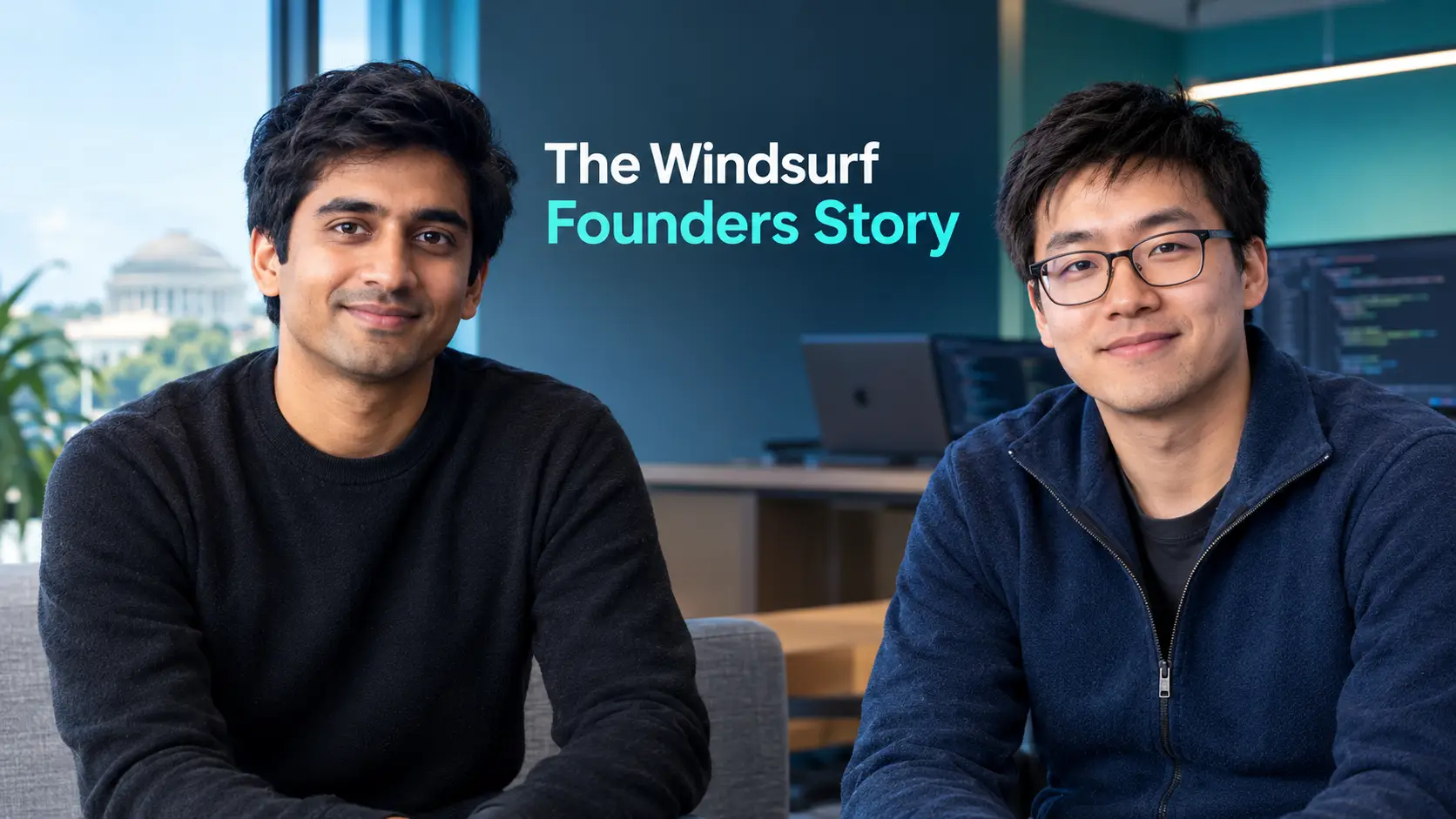
Who founded Windsurf? Varun Mohan and Douglas Chen, both MIT graduates, founded the company in 2021. It did not start as an AI coding tool. It started as Exafunction, a GPU infrastructure business, before the founders pivoted it into Codeium and later renamed it Windsurf.
Most people who have heard of Windsurf know it as one of the AI coding tools that got fought over by OpenAI, Google, and Cognition in a single chaotic week in July 2025. Fewer people know that the company spent its first year doing something almost unrelated to code editors at all. The more interesting question is not how fast Windsurf grew. It's why two infrastructure engineers walked away from a working business to build something else entirely, and why they kept making similarly aggressive bets after that.
Who Are Varun Mohan and Douglas Chen?
The Exafunction founders and the Codeium founders are the same two people: Varun Mohan and Douglas Chen, the pair who eventually founded Windsurf under a third name.
Varun Mohan grew up in Sunnyvale, California, the child of Indian immigrant parents, and attended The Harker School in San Jose before enrolling at MIT to study electrical engineering and computer science. According to his own later interviews, he graduated in 2017 and joined Nuro, the autonomous-vehicle startup, where he became a tech lead managing large-scale deep learning infrastructure for self-driving systems. That job put him directly in charge of the unglamorous but expensive problem of keeping GPU clusters running efficiently for AI workloads, a problem that would define his next company.
Douglas Chen is also an MIT graduate. Before Windsurf, he worked at Meta, building software tools for VR headsets including the Oculus Quest. That work gave him a different kind of systems experience: shipping consumer-facing software under hardware constraints, rather than managing backend infrastructure at scale.
Their backgrounds were complementary rather than identical. Mohan's experience was in the infrastructure layer that makes large AI workloads run at all. Chen's was in building software that had to work reliably on a device in someone's hands. Both experiences turned out to matter once they started a company together.
How They Met, and What They Did Before Windsurf
According to Contrary Research's business breakdown of the company, Mohan and Chen first met in middle school and later ended up as classmates at MIT. Kleiner Perkins, which later became one of Windsurf's investors, has separately noted that its own partner met the two founders at MIT and bonded with them over a shared background in competitive mathematics.
The point of this backstory isn't romance. It's that Mohan and Chen weren't two strangers who met at a hackathon and decided AI was hot. They had a long-standing working relationship by the time they started a company, and neither of them arrived at AI coding as a first career move. Mohan had spent years running deep learning infrastructure at Nuro. Chen had spent years shipping production software at Meta. When they eventually built an AI coding tool, they were doing it with real experience in how large software and AI systems actually run, not as newcomers chasing a trend.
The First Company Was Exafunction
In 2021, Mohan and Chen founded Exafunction, a GPU virtualization software company. Kleiner Perkins describes Exafunction plainly as exactly that: a company built to solve GPU utilization problems, not an AI coding startup in disguise.
The problem Exafunction targeted is a real and expensive one. GPUs, the specialized chips that make modern machine learning possible, are costly and often sit idle or underused, because most software wasn't written to share them efficiently across multiple jobs. Exafunction's pitch was to virtualize that hardware: let companies run their machine learning workloads without being tightly coupled to specific physical GPUs, similar in spirit to how cloud computing decoupled software from specific physical servers years earlier. According to the company's Series A announcement, the original goal was to optimize machine learning workloads by virtualizing GPUs, so customers did not have to manage GPU allocation by hand.
By most accounts, Exafunction was working. It had real customer traction and had raised a seed and Series A round, reportedly totaling around $20 million, led by investors including Greenoaks. This wasn't a failing startup casting around for a new idea. It was a functioning infrastructure business.
The Decision That Changed Everything: The Pivot
This is the part of the story that separates Windsurf's founders from a lot of infrastructure founders who stayed in their lane. Kleiner Perkins's own account says that despite Exafunction's "early, impressive customer traction," the team "quickly realized the potential of generative models," and decided, directly following their Series A, to redirect their own infrastructure toward building a full-stack AI-powered coding platform instead.
Several secondary accounts describe this as an abrupt, deliberate decision rather than a slow drift. One retelling of the moment, drawing on Mohan's later public comments, describes him and Chen taking a walk one weekend and returning to tell the team that the existing business was being shut down in favor of the new direction. That specific framing comes from a single secondary source and should be read as one account of the moment rather than an independently confirmed sequence of events. What's better documented is the underlying logic: as generative AI models improved rapidly through 2021 and into 2022, the founders concluded that the bigger opportunity wasn't in optimizing the infrastructure underneath AI models, but in using that infrastructure to build an application people would actually use directly.
The shift can be summarized simply: GPU infrastructure experience became AI infrastructure expertise, which became the foundation for an AI-powered developer tool. Nothing in the available reporting suggests the founders "predicted" the generative AI boom in advance. What the record shows is that they were positioned, by their own prior work, to notice the shift early and had the technical background to act on it fast.
From Exafunction to Codeium: The Free-First Bet
The pivoted company became Codeium, and its first product, a beta AI code-completion extension for existing IDEs, launched in October 2022. Rather than pricing it like an enterprise SaaS tool, Codeium made the core autocomplete features free, directly undercutting GitHub Copilot's paid model.
That wasn't just a pricing gimmick. In a March 2023 podcast appearance, when Codeium had roughly 10,000 users, Mohan described a commitment to keeping the autocomplete tier free indefinitely. The strategy was to win developer trust and daily usage first, then build enterprise contracts on top of that adoption later, rather than trying to sell an unproven AI product to enterprise buyers cold. By late 2024, that free-first approach had grown Codeium's user base into the hundreds of thousands, according to the company's own later public statements. It's a detail often left out of the shorter version of the Codeium story: the free tier wasn't a growth hack bolted on later, it was the strategy from the first beta launch.
Building Their Own IDE: The Birth of Windsurf
For its first two years as an AI coding company, Codeium operated as a plugin, layered on top of editors developers already used, such as VS Code and the JetBrains suite. But as generative models grew more capable, plugins ran into a structural limit: an extension can only see and do as much as the host editor lets it.
The founders decided to build their own IDE from the ground up rather than continuing to build features on top of someone else's editor. That product, the Windsurf Editor, launched in November 2024. Its centerpiece was Cascade, an AI agent built to understand a developer's entire codebase rather than just the open file, plan and execute changes across multiple files, and run terminal commands on the developer's behalf. Windsurf's own materials described the ambition in terms of moving past autocomplete toward carrying out increasingly complex, end-to-end engineering tasks, a characterization Kleiner Perkins echoed in its own writeup of the company.
That shift, from an AI that suggests the next line of code toward an AI that can be handed a task and carry it out, is the same shift the broader industry now describes as agentic coding. Windsurf was an early, and by most accounts unusually fast-growing, entrant into that category. Some press coverage at the time referred to the company informally as Windsurf AI, and to Mohan and Chen as the Windsurf AI founders, though the company's own formal name has always simply been Windsurf. According to Mohan's own account in a 2025 podcast appearance, the Windsurf Editor reached more than one million developers within four months of launch.
Why Codeium Became Windsurf
For several months after the editor launched, the company kept "Codeium" as its corporate name while "Windsurf" referred only to the new product. In April 2025, the company completed a full rename, becoming Windsurf at the corporate level too.
The logic, by the company's own account, was straightforward: most people already knew it as Windsurf, not Codeium, and the new name better reflected what the founders believed the company had become. Codeium had been an accurate name for an AI coding extension. It was a less accurate name for a company that now saw itself as building a full AI-native development environment. The rename was less a marketing refresh than a public acknowledgment that the founders no longer considered code completion their core product.
Rapid Adoption and the $1.25 Billion Valuation
Growth in this period tracked directly with the founders' product bets rather than a generic marketing push. A Series B in January 2024 valued the company, still branded Codeium, at $500 million. Seven months later, in August 2024, a $150 million Series C led by General Catalyst valued it at $1.25 billion, with continued participation from Kleiner Perkins and Greenoaks. Mohan told TechCrunch at the time that the company had barely touched its Series B funding and wanted the new capital for larger strategic bets, which is consistent with a company still funding an internal pivot from plugin to full IDE rather than one simply scaling an existing product.
That $1.25 billion figure is a valuation, meaning what investors judged the company to be worth at that moment. It is not the same as the roughly $243 million the company had raised in total funding by that point, and it is not a measure of revenue.
The OpenAI Acquisition That Fell Apart
By the spring of 2025, Windsurf and OpenAI were reportedly in discussions for OpenAI to acquire the company outright, in a deal various outlets reported at roughly $3 billion. The two companies reportedly entered an exclusivity period to work out the details. Had it closed, it would have given OpenAI a direct entry into the AI-native IDE market.
It didn't close. Bloomberg and other outlets reported that the exclusivity period lapsed in July 2025 without a completed deal, with multiple reports pointing to concerns over how Microsoft's existing agreements with OpenAI, including its ownership of GitHub Copilot, might affect intellectual property rights in any acquisition. Neither OpenAI nor Windsurf has published a detailed account of exactly why the deal collapsed, so the reasoning here should be read as attributed reporting rather than confirmed fact.
The Google Deal and the Founders' Next Chapter
Within days of the OpenAI deal falling apart, Google moved. According to Reuters, Google hired Windsurf CEO Varun Mohan and Windsurf co-founder Douglas Chen, along with a small group of other Windsurf researchers, to join Google's DeepMind division. As part of the same arrangement, Google agreed to pay roughly $2.4 billion, structured as a technology licensing payment rather than an acquisition. Google did not take an equity stake in Windsurf.
That distinction matters for understanding what actually happened to the founders. Mohan and Chen didn't sell the company; they left it, along with roughly 40 colleagues, to join Google DeepMind's agentic coding work. The remaining Windsurf business, its roughly 210 other employees, its product, and its brand, stayed behind and were not part of the Google transaction at all.
Cognition Acquires the Remaining Business
Three days later, on July 14, 2025, Cognition, the maker of the autonomous coding agent Devin, announced it had signed a definitive agreement to acquire what was left of Windsurf. Cognition's own announcement said the deal included the Windsurf IDE, its intellectual property, trademark, and brand, and the remaining team. Cognition also disclosed, as its own reported figures rather than independently audited results, that Windsurf carried $82 million in annual recurring revenue at the time, with enterprise ARR doubling quarter over quarter, and a base of more than 350 enterprise customers.
Cognition did not disclose what it paid.
What Happened to the Founders?
Varun Mohan moved to Google's DeepMind division as part of the July 2025 deal, joining Google's agentic coding research alongside a group of former Windsurf colleagues.
Douglas Chen made the same move, joining Google DeepMind alongside Mohan.
Neither founder remained with the Windsurf business that Cognition subsequently acquired. Their departure was part of the same week of restructuring that split the company between Google and Cognition. As of this writing, in late 2026, the Windsurf product itself has since been folded into Cognition's Devin lineup and renamed; the founders' current work is at Google DeepMind, based on the July 2025 hiring announcement and subsequent public statements from Google.
What Made This Founder Journey Unusual
A few observable characteristics stand out from the sequence of decisions, without treating them as measures of the founders' personal qualities.
They pivoted away from working traction. Exafunction had customers and had just raised a Series A when the founders redirected it entirely. Not every founder abandons a business that's succeeding on its original terms.
Their infrastructure background carried over directly. The technical work of managing GPU utilization for AI workloads gave them a head start when the opportunity shifted to building AI applications, rather than starting the new company from a standing start.
They bet on developer-first distribution. Making the core product free, at a time when the incumbent charged for it, is a slower and less certain path to revenue than an enterprise sales-first approach, but it built the adoption base that later attracted investors.
They chose to own the IDE rather than stay an extension. Building a full editor from scratch, instead of continuing to ship features inside someone else's tool, was a costly and risky decision that only made sense if the founders believed the underlying product category was about to change.
Lessons From the Windsurf Founder Story
- A startup's original product doesn't have to be its final product.
- Deep infrastructure experience can translate directly into application-layer opportunities.
- A pivot can happen even when the original business has real traction, not just when it's failing.
- Developer-first, free distribution can build adoption faster than enterprise sales alone.
- Controlling more of the technical stack, such as an IDE instead of a plugin, can reshape a company's product strategy.
- Fast-moving AI markets can force strategic decisions, including company-splitting ones, on a very short timeline.
Windsurf Founders Timeline
| Year | Event |
|---|---|
| 2021 | Exafunction founded by Varun Mohan and Douglas Chen |
| 2022 | Pivot toward AI coding; Codeium beta launches (October) |
| Jan 2024 | Series B values Codeium at $500 million |
| Aug 2024 | Series C values Codeium at $1.25 billion |
| Nov 2024 | Windsurf Editor and Cascade launch |
| Apr 2025 | Codeium renames itself Windsurf |
| Spring 2025 | OpenAI acquisition discussions reported, around $3 billion |
| Jul 11, 2025 | OpenAI deal collapses; Google hires Mohan and Chen for $2.4 billion licensing deal |
| Jul 14, 2025 | Cognition acquires the remaining Windsurf business |
Conclusion
Told as founder history rather than company history, this piece of Windsurf history reads less like a straight-line success story and more like a sequence of specific, risky calls. The most important part of the Windsurf founders' story isn't that two technically capable engineers built a company that grew quickly. It's the sequence of decisions that got there: an infrastructure business with real traction, deliberately abandoned; a free-first product strategy that took years to convert into enterprise revenue; and a decision to build a full IDE instead of staying inside someone else's editor. Each of those decisions carried real risk at the time it was made.
What happened next, an acquisition offer that collapsed, a $2.4 billion licensing-and-hiring deal, and a same-week acquisition of what remained, says less about Mohan and Chen personally than it does about how quickly the ground can shift under a fast-growing AI company. That's really the shape of this Windsurf startup story: not a straight climb, but three distinct companies under one continuous founding team. For the fuller Windsurf company history, including the product, revenue, and the deals that followed, see Windsurf's broader success story.
Frequently Asked Questions
Who are the founders of Windsurf? Varun Mohan and Douglas Chen, both MIT graduates, founded the company in 2021. Mohan serves as CEO; Chen is co-founder. They previously worked at Nuro and Meta, respectively, before starting the business.
Who is Varun Mohan? Varun Mohan is Windsurf's co-founder and CEO. Before starting the company, he was a tech lead at Nuro, the autonomous-vehicle startup, managing large-scale deep learning infrastructure. He later moved to Google DeepMind in July 2025.
Who is Douglas Chen? Douglas Chen is Windsurf's co-founder. Before starting the company, he worked at Meta building software tools for VR headsets, including the Oculus Quest. He moved to Google DeepMind alongside Mohan in July 2025.
What was Windsurf originally called? Windsurf started as Exafunction in 2021, a GPU virtualization company. It pivoted to AI coding and became Codeium in 2022, then renamed itself Windsurf in April 2025.
What was Exafunction? Exafunction was the founders' first company, built to virtualize GPU infrastructure for machine learning workloads, letting companies run AI jobs without being tied to specific physical hardware.
Why did Codeium become Windsurf? The company renamed itself after its Windsurf Editor, launched in November 2024, became its primary product. Leadership said most users already knew the company as Windsurf rather than Codeium, and the new name better matched the company's direction as an AI-native IDE.
What happened to the Windsurf founders? In July 2025, Google hired Varun Mohan and Douglas Chen, paying roughly $2.4 billion to license Windsurf technology and bring the pair, along with other researchers, into Google DeepMind. Neither founder remained with the Windsurf business that Cognition subsequently acquired.