
The Skyroot Founders Story: From ISRO Engineers to India's Private Space Pioneers
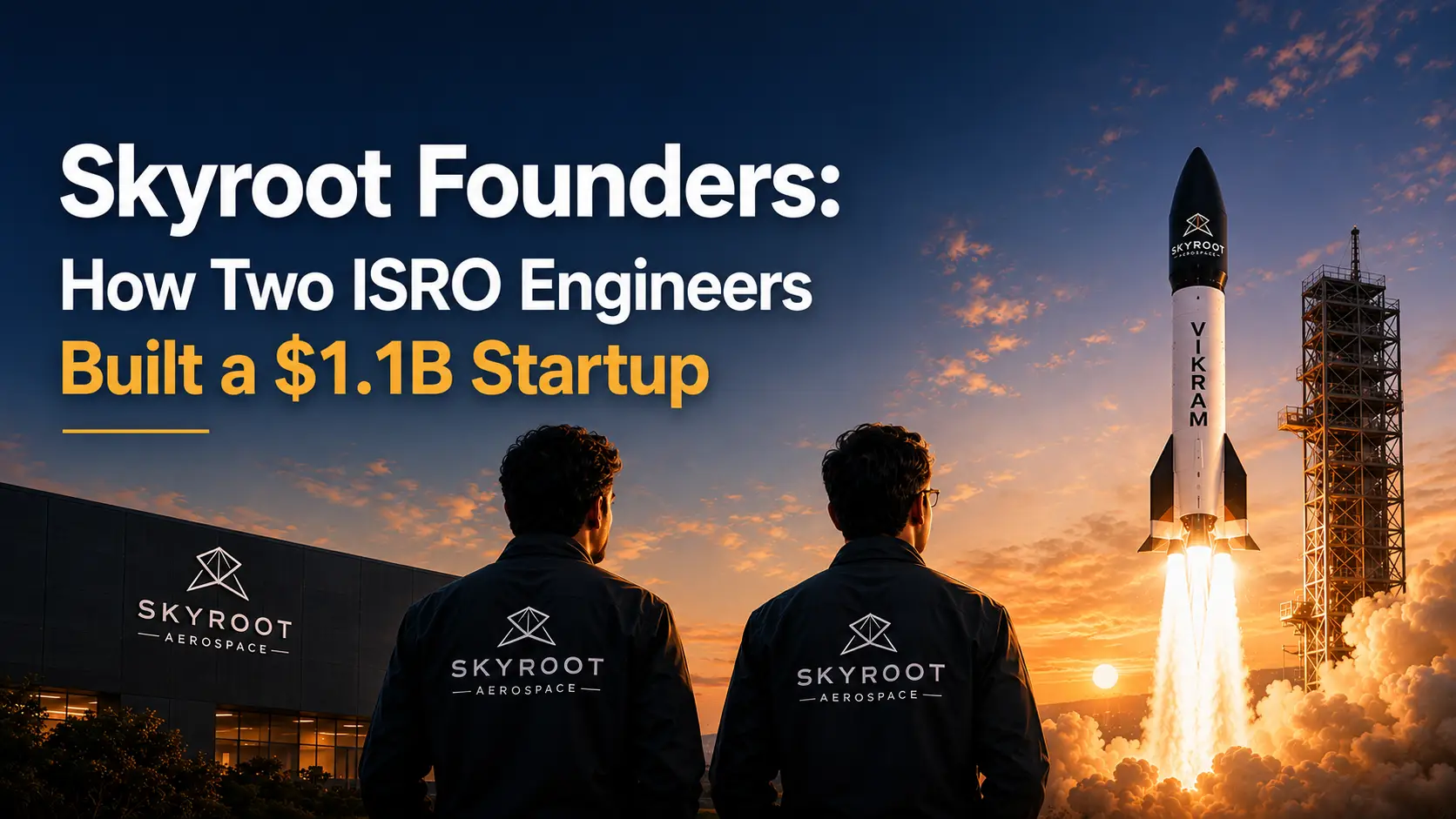
In 2018, two engineers sat down and asked an uncomfortable question. Both had secure jobs inside India's national space program. Their question was simple. What if the country's best rocket engineers were building for the government, one mission at a time? What if a much bigger opportunity waited just outside ISRO's walls?
Pawan Kumar Chandana and Naga Bharath Daka were not outsiders looking in. They were insiders. Both joined the Indian Space Research Organisation in 2012. Both worked on real launch vehicle programs. Both built the kind of institutional credibility that most engineers spend a career chasing. Leaving meant giving up that credibility. It meant giving up a stable government career. It meant walking away from something significant. ISRO had just sent a probe to Mars on its first attempt.
They left anyway. In June 2018, Chandana and Daka founded Skyroot Aerospace in Hyderabad. They brought a small team of former ISRO and defense-sector engineers with them. The company's own about page explains the founding in one simple line. They asked what would happen if getting a satellite into space could become as routine as booking a flight. That question is the real origin of Skyroot. It matters more than any funding round or rocket launch that came after.
Eight years later, that question has produced something concrete. Skyroot has flown two rockets. One was India's first privately built orbital launch vehicle. The company has raised about $160 million in total capital, including some structured debt. It has become India's first space-tech unicorn, valued at $1.1 billion. This is the Skyroot founders story. It covers how two ISRO engineers made that transition. It covers what it cost them, and what it says about India's private space industry. For a broader look at the company itself, including its rockets, funding and business model, see our Skyroot success story.
Who Founded Skyroot Aerospace? Meet the Skyroot Aerospace Founders
Skyroot Aerospace was founded by Pawan Kumar Chandana and Naga Bharath Daka in June 2018 in Hyderabad, Telangana. Both are former ISRO scientists. Both are alumni of the Indian Institutes of Technology. That background is why Indian media often calls them Skyroot ISRO engineers turned entrepreneurs. Chandana serves as Co-Founder and CEO, and also holds the CTO title. Daka serves as Co-Founder and COO. The two Skyroot co-founders were colleagues and flatmates at ISRO. They joined the organization together in 2012 and have known each other for close to fourteen years.
- Pawan Kumar Chandana: LinkedIn profile
- Naga Bharath Daka: LinkedIn profile
Pawan Kumar Chandana: From ISRO Engineer to Skyroot CEO
Chandana studied at IIT Kharagpur, where he earned a dual degree (B.Tech and M.Tech) in mechanical engineering. At ISRO, he worked as a scientist focused on launch vehicle propulsion. He has spoken about contributing to the LVM3, nicknamed "Bahubali." That rocket later carried India's Chandrayaan lunar missions. He describes that program as a lesson in technical rigor. One design error, he has said, can cascade through years of work.
That lesson shows up in how Skyroot builds today. Chandana often frames the company's real challenge differently from how outsiders see it. It is not about building a rocket that flies once. It is about building a rocket that flies reliably, again and again, on a schedule customers can trust. As CEO, he leads Skyroot's technology direction and overall strategy. He also manages relationships with investors, government agencies, and international customers. These are the people who keep a capital-hungry hardware company funded and credible. Forbes named him to its 30 Under 30 Asia list in 2020, before the company had launched anything at all.
Naga Bharath Daka: The Other Half of the Founding Team
Daka holds a bachelor's degree in electrical engineering. He also holds a master's degree in microelectronics and VLSI design. He is an alumnus of IIT Madras. At ISRO, his work focused on avionics and flight computer systems. Think of these as a rocket's nervous system: they handle navigation, stability, and communication during flight. That is a different discipline from Chandana's propulsion background. The difference matters.
As Co-Founder and COO, Daka owns engineering execution and operations. His job covers the unglamorous but essential parts of running a hardware company. That means manufacturing schedules, supply chains, and testing programs. He is the one who turns a proven technology into something that can be built over and over. Where Chandana pushes on strategy and propulsion, Daka owns something else. He handles the discipline of getting hardware built, tested, and shipped on time. Both founders describe their working relationship as one of the company's real advantages. It was built over almost a decade and a half of friendship before Skyroot even existed. It was not an accident of convenience.
Why Did the Skyroot Founders Leave ISRO?
This is where the story usually gets oversimplified. The easy version says two bored engineers wanted to build something faster. That is not quite what the founders themselves describe.
Chandana frames the decision around a gap he and Daka saw from inside the system. Satellite operators worldwide, especially companies building constellations of small satellites, needed frequent and affordable launches. ISRO's vehicles, like most national launch programs, were built mainly to serve government missions and large payloads. Commercial small-satellite launches often rode along as secondary cargo, on someone else's schedule. Chandana has called the small-satellite launch market "deeply constrained on the supply side." Meanwhile demand for satellite services kept growing. That gap, not personal restlessness, was the real opportunity.
There was also a policy signal. In May 2020, the Government of India announced reforms opening the space sector to private companies. It was the first time in the country's history. Before that, participation in India's space sector had been almost entirely limited to the government. Chandana and Daka had already left ISRO in June 2018, nearly two years before that announcement. They bet that reform was coming rather than waiting for proof. That detail matters. They did not start a private rocket company because the door was already open. They started it while the door was still closed, betting it would open.
As first-time entrepreneurs, they also had no playbook to follow. Chandana has called building a business from nothing "uncharted territory." As he put it, no generational knowledge of India's private space sector existed to draw on. One barely existed yet.
What Their ISRO Experience Taught Them
ISRO gave both founders something a business school cannot teach. It gave them a close-up understanding of how rockets fail, and what it takes to stop that from happening. Systems engineering discipline, rigorous testing, and failure analysis are not abstract ideas to engineers who worked inside a national launch program. Treating every subsystem as safety-critical is simply the daily job.
That background shaped Skyroot's engineering culture from day one. The company's early work was propulsion-first and test-heavy, not marketing-first. That sequencing reflects an insider's sense of where the real risk in a rocket program actually sits. ISRO also gave the founders a network. Much of Skyroot's early team came from ISRO and India's defense research labs. These engineers did not need to be taught aerospace-grade discipline from scratch.
But ISRO teaches you how to build a rocket. It does not teach you how to build a company. That gap became the recurring tension of Skyroot's first years. Hiring, fundraising, vendor negotiation, investor relations, and customer contracts all had to be learned in real time. There was no internal precedent to fall back on.
Why They Started Skyroot in 2018
In 2018, India's private space sector barely existed as a category. Reforms allowing private companies to build and operate launch vehicles were still two years away. Access to test infrastructure, launch pads, and regulatory clearance ran almost entirely through ISRO and the Department of Space. No dedicated authorization body yet existed for private players. Betting on private rocket-building in India, at that point, meant something specific. It meant betting on a policy change that had not yet happened.
The commercial logic, though, was becoming clear worldwide. Small satellites were cheaper to build and increasingly capable. They were launching in growing numbers for Earth observation, communications, and technology demonstration. Dedicated small launch vehicles gave operators control over orbit, timing, and mission design. This mattered more than piggyback slots on larger rockets. Skyroot was built to serve that specific niche: frequent, on-demand, dedicated launches for small satellites. It was not trying to compete directly with heavy-lift national launch programs.
The Early Days of Building a Private Rocket Company
Skyroot began with about ten people. The company was incubated at T-Hub in Hyderabad and later supported by the T-Works prototyping facility. Early funding was modest by aerospace standards. It began with a seed round of about $1.5 million in 2018, with entrepreneur Mukesh Bansal among the early backers. Further rounds followed, including an $11 million Series A and additional bridge financing.
Hardware startups do not move at software speed, and Skyroot's early years show that clearly. Building a rocket engine that customers can trust needs several things. It takes physical test stands, propellant handling infrastructure, static-fire tests, and iteration cycles measured in months, not weeks. Skyroot could not ship an update overnight. It had to build test infrastructure first. Sometimes it used partner facilities to validate a single engine, such as those of investor Solar Industries India in Nagpur.
Recruitment was its own challenge. The company needed propulsion engineers, avionics specialists, structural engineers who understood carbon composite materials, and manufacturing talent. Until recently, that exact mix of skills existed almost nowhere else in India. It lived almost entirely inside ISRO and a handful of defense laboratories.
Raman and the First Technical Breakthrough
In July 2020, Skyroot static-fire tested Raman. This was an upper-stage liquid propulsion engine for its planned Vikram-I launch vehicle. The engine is named after Nobel laureate C.V. Raman. It used a fully 3D-printed injector and was built for multiple restarts. That feature lets a rocket place several satellites into different orbits during one mission. That December, the company also tested Kalam-5. This was a scaled-down version of the solid rocket motor meant to power the Vikram series' lower stages.
Static-fire testing an engine may sound routine. But propulsion is widely seen as the hardest and riskiest part of building any launch vehicle. An engine must generate enormous thrust, survive extreme heat and pressure, and do it all with total reliability. A propulsion failure in flight usually means the mission is lost. Successfully test-firing a privately built engine in India was a genuine technical milestone. For decades, propulsion technology in the country had belonged to ISRO alone. It was not a publicity stunt.
Dhawan-1 and the Cryogenic Engine Challenge
In November 2021, Skyroot went further. It successfully test-fired Dhawan-1, which the company calls India's first privately developed, fully cryogenic rocket engine. It is named after rocket scientist Satish Dhawan. The engine runs on liquid natural gas and liquid oxygen at cryogenic temperatures, below minus 150 degrees Celsius. It was built using 3D-printed superalloy components. The company says this cut manufacturing time by more than 95 percent compared with conventional machining.
Cryogenic propulsion is one of the hardest technologies in rocketry. Only a small number of countries and companies worldwide have mastered it. That is because it means managing ultra-cold, highly reactive propellants through precise start and shutdown sequences. Dhawan-1 is meant to eventually power the upper stage of Skyroot's larger Vikram-II vehicle. With this test, Skyroot said it had proven all three propulsion technologies in its Vikram family: solid, liquid, and cryogenic. And it did so in a single early development phase. If that claim holds up, it represents unusual technical maturity for a company barely three years old.
Building Vikram-S
Rather than jumping straight to an orbital rocket, Skyroot first built Vikram-S. The plan was deliberate. Skyroot wanted to prove its carbon composite structures, avionics, telemetry, stabilization, and solid propulsion in an actual flight. That way, it could test the pieces before betting everything on a far more complex, multi-stage orbital vehicle.
Vikram-S stood about six meters tall and weighed roughly 545 kilograms. A single solid-fuel motor called Kalam-80 powered it. Getting it to the launch pad took more than engineering skill. It needed regulatory coordination with the newly created Indian National Space Promotion and Authorisation Centre, known as IN-SPACe. It also needed operational support from ISRO. Skyroot did not own an orbital launch site then, and it still does not today.
Mission Prarambh: India's First Private Rocket Launch
Vikram-S lifted off on November 18, 2022, at 11:30 a.m. IST from the Satish Dhawan Space Centre in Sriharikota. Skyroot named the mission Prarambh, meaning "the beginning." (See Skyroot's own Mission Prarambh page and ISRO's mission record.) It was the first rocket launch by a private company in Indian history. The single-stage solid rocket reached a peak altitude of 88.8 kilometers. It hit a top speed of Mach 5.07. It flew for 301.4 seconds before splashing down roughly 125 kilometers away in the Bay of Bengal. It carried three customer payloads, from BAZOOMQ Armenia, Space Kidz India, and N-Space Tech India.
It is worth being precise about what this proved, and what it did not. Vikram-S was a suborbital flight. It went up, briefly touched the edge of space, and came back down. It did not reach the sustained horizontal speed needed to stay in orbit around Earth. That distinction matters, because orbital flight is a much harder engineering problem. It needs multiple rocket stages, precise orbital insertion, and far more demanding guidance and control. Mission Prarambh proved Skyroot could design, build, and successfully fly a rocket. It did not, by itself, prove the company could reach orbit or run a commercial launch business. Skyroot itself was careful about this point. It described the mission as validating key technologies for future orbital vehicles, not claiming orbital capability.
Why Vikram-S Was Important
The mission validated several specific technologies Skyroot needed for its later orbital rockets. These technologies included solid propulsion systems and all-carbon composite airframe structures. Composite is a lightweight, high-strength material. It reduces a rocket's dry mass and improves how much payload it can carry. The mission also validated onboard avionics and telemetry systems. These systems transmit flight data back to ground control in real time. Vehicle aerodynamics and control systems worked as designed, keeping the rocket on its planned path through ascent.
For a small satellite launch startup, none of this is decorative. Carbon composite structures directly affect how much payload a rocket can carry for a given amount of fuel. Reliable avionics and telemetry are what let engineers trust a rocket enough to fly a customer's expensive satellite on it. Every one of these systems had to work correctly on Vikram-S. Only then could Skyroot responsibly attempt a much more complex, four-stage orbital vehicle.
From Vikram-S to an Orbital Rocket Company
A single successful flight, however historic, is not a business. There is a huge gap between "we flew a demonstrator once" and "we run a repeatable commercial launch service." Many aerospace startups worldwide have stalled or failed right in that gap.
Building a real launch business meant solving problems too. Many of these have little to do with rocket science itself. It had to set up manufacturing lines that could build engines and structures repeatably, not as one-off prototypes. It had to build testing protocols that could run consistently across multiple vehicles. It had to sign customer contracts too. Satellite operators needed real assurance the rocket would fly on schedule. It had to build supply chains for aerospace-grade materials. It had to navigate insurance and liability rules in a country that still lacks a full space law. And it had to keep raising money. Hardware development eats up large sums of capital long before any launch revenue arrives.
Skyroot spent roughly three years on this phase after Mission Prarambh. It did not rest on a historic first flight. Instead, it built Vikram-I, a genuinely orbital, four-stage vehicle, along with the manufacturing capacity behind it.
How Skyroot Makes Money
Skyroot's business model centers on selling launch services to satellite operators. It targets mainly small satellites headed to low Earth orbit or sun-synchronous orbit. The company offers two paths. In a dedicated mission, a single customer's satellite (or a small group of satellites from one customer) gets the whole rocket. That customer gets full control over orbit and timing. In a rideshare mission, multiple customers' satellites fly together on one launch to split the cost.
The pitch to customers is simple. Small satellite constellations for communications and Earth observation keep multiplying worldwide. As they do, operators need launches that are frequent and predictable. They cannot always wait on another company's primary payload schedule. Skyroot wants to be the company that shows up on time, on a schedule the customer can plan around. It does not want to treat small satellites as extra cargo.
As of mid-2026, Skyroot remains in a pre-revenue or early-revenue phase. That is true by its own account and by outside analysts' estimates. Annual revenue sits in the low single-digit millions of dollars. Meaningful commercial launch income is not expected until later in the decade. Its high valuation, like most deep-tech and space companies at this stage, rests on investor belief. Investors are betting on future launch cadence and market share, not on current earnings.
How India's Space Policy Changed the Game
The regulatory world Skyroot operates in today looks almost nothing like 2018. Until June 2020, participation in India's space sector was restricted almost entirely to the government. That year, the government announced reforms opening the sector to private, non-government entities. It also created IN-SPACe, the Indian National Space Promotion and Authorisation Centre. That body became a single window to authorize and promote private space activities.
The Indian Space Policy 2023, released by the Department of Space, formalized this shift. It lets private entities, called non-government entities, manufacture and operate launch vehicles and build their own space infrastructure. It also lets them offer end-to-end space services, from satellite manufacturing through launch and operations. The policy also redirected ISRO's own mandate. The agency is meant to shift its focus toward research, new technology, and exploration missions. Routine launch and manufacturing work, meanwhile, is meant to migrate elsewhere. It moves toward private industry and the public-sector body NSIL, or New Space India Limited. Further reforms have followed. A 2024 revision now allows up to 100 percent foreign direct investment in satellite manufacturing under certain routes. And in October 2024, the government approved a ₹1,000-crore venture capital fund for space startups.
Skyroot's story cannot be separated from this policy timeline. The founders left ISRO and started the company nearly two years before the 2020 reforms were even announced. They bet that liberalization was coming. Every major milestone since, from Vikram-S's launch authorization to Vikram-I's orbital flight, has depended on IN-SPACe's regulatory clearance. In most cases, it has also depended on ISRO's launch infrastructure at Sriharikota. Skyroot does not operate its own spaceport.
Vikram-I and the Road to Orbit
Vikram-I is Skyroot's flagship orbital launch vehicle. It is a four-stage rocket about 1.7 meters in diameter. It is built from an all-carbon-composite structure with 3D-printed engine parts. Per Skyroot's own specifications, it can carry up to 350 kilograms to low Earth orbit. To sun-synchronous orbit, that figure is up to 260 kilograms. That second term describes a polar orbit commonly used by Earth-observation satellites. It is timed so the satellite passes over the same points on Earth at the same local time each day. Its upper stage, called the Orbital Adjustment Module, uses a liquid engine. That engine lets it precisely maneuver in orbit for final satellite deployment. Skyroot has said the vehicle, and its sibling variant, can in principle move fast. Both can be assembled and moved from factory to launch pad within about 72 hours. That is a pace far faster than traditional launch vehicles achieve.
In November 2025, Prime Minister Narendra Modi inaugurated Skyroot's "Infinity" campus in Hyderabad. The roughly 200,000-square-foot facility combines with the existing Max-Q campus. Together, they are designed to support building one orbital rocket per month. Modi also unveiled the flight-ready Vikram-I hardware that day. Former ISRO chairman S. Somanath attended the maiden launch and said it was going to change the space sector in a big way.
Mission Aagaman and Skyroot's Orbital Milestone
Vikram-I lifted off on its maiden flight on July 18, 2026, from the Satish Dhawan Space Centre in Sriharikota, in a mission named Aagaman (Sanskrit for "arrival"). (See Skyroot's Mission Aagaman coverage from CNBC/Reuters and SpaceNews.) It became India's first privately developed rocket to reach orbit. It injected its payload into an orbit roughly 450 kilometers up, at a 60-degree inclination. That happened about fifteen to seventeen minutes after liftoff. The flight carried a mix of technology demonstration payloads. These included Grahaa Space's SOLARAS S3 satellite, Cosmoserve Space's in-orbit robotic arm called Embrace, a demonstration payload from DCUBED, and Skyroot's own SCOPE satellite.
The achievement placed India alongside a very short list of countries. Only the United States and China had previously seen a privately built rocket independently reach orbit. Skyroot called the mission "a grand success" while clearly framing it as a test flight. The company said it would fly several more test flights before moving into routine commercial operations. Chandana said the single most important goal of the mission was simple. He wanted to capture real in-flight performance data from every system on the vehicle. That statement shows how Skyroot itself is treating Vikram-I's early flights. The company sees them as an extended test campaign, not a finished commercial product.
The Second Vikram-I and the Push for Repeatability
Just over a month after Mission Aagaman, on National Space Day (August 23, 2026), Skyroot made an announcement. The first stage of its second Vikram-I vehicle was already on its way to Sriharikota. The company called it "beginning our next journey to orbit." Chandana has set a near-term goal. He wants four to six launches within the current financial year. He added a caveat: the pace could shift depending on what engineers learn from the first flight's telemetry.
This rapid iteration matters more than it might seem. In launch vehicle development, one successful flight answers only a few questions. Repeated flights, ideally with only small design changes between them, matter for a reason. They are what actually build confidence in a rocket's reliability. Chandana has been candid that repeatability, not the first launch, is now Skyroot's central challenge. He has pointed to Skyroot's manufacturing capacity as the reason that faster pace is possible. The plan is roughly one rocket per month, between Vikram-I and its planned variant, Vikram-1U. He has also pointed to launch failures elsewhere in the industry. ISRO's PSLV-C62 failure in January 2026 is one example. He frames these as a normal and needed part of how rocket companies learn. Even SpaceX, he has noted, has had its share of failures on the way to reliability.
Vikram-II and Beyond
Skyroot's longer-term plan for its Vikram rocket family centers on Vikram-II. This larger vehicle is meant to carry much heavier loads. It can take up to roughly 900 kilograms to low Earth orbit, or up to 600 kilograms to sun-synchronous orbit. It will use more advanced cryogenic propulsion, built on the Dhawan-1 engine program. As of mid-2026, Chandana has said Vikram-II's own test flight is not expected before the end of 2027. A third vehicle, Vikram-III, has also come up in company statements. The company describes it as a future heavier-lift variant, though public detail on its specifications remains limited.
Scaling from Vikram-I to Vikram-II is not simply a matter of building a bigger rocket. Larger vehicles bring new problems. Larger vehicles face bigger structural loads and more complex staging. They also need a cryogenic upper stage that must perform reliably in the vacuum of space. That is a harder environment than anything Vikram-I's current design has to manage. Skyroot has also talked publicly about exploring reusable rocket technology. It has also mentioned using artificial intelligence and 3D printing to speed up both design and manufacturing. This echoes the broader industry shift toward reusability that SpaceX pioneered. As of August 2026, though, these remain stated ambitions rather than flight-proven capabilities for the company.
The Biggest Challenges Facing Skyroot
Repeatability is the challenge Chandana himself names most directly. It deserves to be treated as the central open question about Skyroot's future, not a minor footnote. A single successful orbital flight shows the engineering works once. A viable launch business needs it to work consistently. That means success across many flights, on timelines customers can build satellite deployment plans around.
Beyond that, several other risks are worth naming plainly. Space launch remains very capital-intensive. Skyroot's own $1.1 billion valuation rests largely on future potential, not current revenue. That means continued access to capital markets matters as much as engineering progress. Manufacturing at scale is a different operational problem than building a handful of prototypes by hand. Building a rocket roughly once a month requires a whole different approach. Global competition is also intensifying, and not just from SpaceX, whose reusable rockets have reset launch pricing worldwide. A growing field of small launch vehicle companies in the United States, Europe, and China adds to the pressure. India's own space law remains incomplete. The long-pending Space Activities Bill, first drafted in 2017, still has not become law. That leaves gaps in liability and insurance rules that the current policy has only partly addressed. And customer confidence in a still-young launch provider, especially for expensive satellites, has to be earned flight by flight.
What the Founders Had to Unlearn After ISRO
Chandana has spoken candidly about how different life inside ISRO was from building a venture-backed startup. A government space program, however excellent its engineering, runs on institutional timelines and established processes. It has a level of resource security a startup simply does not have. At Skyroot, though, decisions had to be made fast. Inside a large public institution, the same call might move through layers of committee review. At a startup, though, it was different. Decisions often had to happen with incomplete information, and real financial consequences attached to being wrong.
Team-building looked different too. ISRO draws from a large, established talent pipeline with institutional training programs behind it. Skyroot, in its early years, had to convince engineers to leave stable, well-regarded government careers. That was the very leap Chandana and Daka had made themselves. It asked people to join an unproven private company with no track record. Fundraising, board management, and the pressure of investor expectations were entirely new. Neither founder's ISRO career had needed these skills before. Chandana has described this transition differently. He calls it less a dramatic reinvention, and more a continuous, sometimes uncomfortable process of learning by doing. As he has put it, there was no generational knowledge of Indian private rocket-building to draw on.
Founder Partnership: Chandana and Daka
The Chandana-Daka partnership has held together since 2012. It started with ISRO colleagues and flatmates. It became a run of startup co-founders, roughly fourteen years long by 2026. Their division of labor tracks their technical backgrounds fairly closely. Chandana's propulsion expertise and public-facing role have made him the company's main voice. He leads on strategy, technology direction, fundraising, and international customer relationships. Daka's avionics and systems background has anchored his focus elsewhere. He handles engineering operations, manufacturing execution, and the daily discipline of turning designs into flight-ready hardware.
Both founders describe their long personal relationship and complementary skills as key. They see this as one of the main reasons Skyroot survived its early years. They frame company-building as a shared undertaking. It covers both their careers and their families, not simply a professional arrangement. That kind of pre-existing trust matters in a hardware startup. Founders routinely have to make fast, high-stakes calls without the luxury of long deliberation.
What Skyroot Did Differently
A few strategic choices set Skyroot's path apart from a purely opportunistic startup story.
It started with deep technical expertise, not just an idea. Both founders had hands-on rocket engineering experience before writing a business plan. That shaped an engineering-first, propulsion-first company culture from day one.
It built core technology in-house rather than relying on outside suppliers. The Raman, Kalam, and Dhawan-1 engine programs gave Skyroot its own technical assets. In-house carbon composite structures added to that. This was not a business built on assembling other companies' parts.
It used a suborbital demonstrator to reduce risk before attempting orbit. Vikram-S let Skyroot validate structures, avionics, and propulsion in real flight conditions. That happened before the company committed to the far more complex, multi-stage Vikram-I. That spread technical risk across two vehicle programs instead of betting everything on one.
It built its business model around dedicated commercial launch from the outset. Commercial customers were never a side revenue stream layered onto a government-focused vehicle program.
It timed its founding to a policy shift it anticipated, rather than reacted to. Skyroot began operations nearly two years before India's 2020 space sector reforms. That positioned it as an early, credible applicant for authorization once IN-SPACe and the broader regulatory framework existed.
Six Lessons From the Skyroot Founders
Lesson 1: Deep-tech founders can come from scientific institutions, not just business schools. Chandana and Daka's credibility as founders rested almost entirely on their technical track record at ISRO. It did not rest on prior startup experience. Investors treated that technical grounding as a real asset. In a field where engineering failure is catastrophic and expensive, that grounding mattered.
Lesson 2: Timing matters, sometimes more than readiness. The founders committed to private rocket-building before the regulatory environment that made it viable had even been announced. That was a bet on policy direction that could easily have gone the other way.
Lesson 3: Hardware needs patience that software does not. Rocket development cannot follow rapid iteration cycles measured in weeks. Physical testing, material science, and safety-critical engineering impose timelines that founders from other sectors often underestimate.
Lesson 4: A successful prototype is not a business. Mission Prarambh in 2022 was a genuine technical achievement, but nearly four years passed before Skyroot reached orbit. Years more will likely pass before it reaches a stable, repeatable commercial launch cadence.
Lesson 5: Government policy can create entire markets, almost from nothing. India's private launch sector did not really exist before the 2020 reforms and the 2023 Indian Space Policy. There was no meaningful commercial version of it. Skyroot's growth is inseparable from that policy history. The same government institution its founders once worked inside built that architecture.
Lesson 6: Technical founders eventually have to become company builders. Chandana and Daka's engineering expertise got Skyroot off the ground. Sustaining it needed new skills their ISRO careers had never required: fundraising, board management, operations, and leadership, mostly learned on the job.
Why the Skyroot Story Matters to India's Space Industry
As a Skyroot startup story, its rise marks a broader shift in India's space sector. It is not just one company's success. It also matters for a bigger reason. India's private space companies, taken together, are proving something new. A domestic commercial launch industry can exist outside government control at all. Skyroot shows that engineering talent trained inside India's public space program can move somewhere new. It can go into a venture-backed private company and produce genuine, internationally notable technical results. It shows something else too. Regulatory reform can turn a previously closed, government-only sector into one that attracts real private money, fast. The creation of IN-SPACe and the 2023 Indian Space Policy pulled in real money fast. Hundreds of millions of dollars in private capital arrived within a few years. It has helped grow high-skilled aerospace manufacturing and engineering jobs in India. Skyroot alone now employs over a thousand people. And it offers a template. Other Indian deep-tech founders are already following it. Leave an established institution. Build on specialized technical skill. Bet on a market that policy reform is expected to open, rather than one that already exists. For another Indian deep-tech startup built on specialized technical expertise, see our Sarvam AI success story.
None of this means India's private space sector has fully "arrived." Skyroot itself is still years away from routine commercial operations. The broader ecosystem still lacks a full space law. But look at the shift. In 2018, India had zero private launch companies. By 2026, it had a unicorn-valued private orbital launch provider. That is a real, measurable change in what is possible inside India's space economy.
The Bigger Story
It would be a mistake to read the Skyroot success story purely as the tale of two talented engineers who happened to succeed. A more accurate reading is this: the skills, institutions, capital, and policy around India's space program spent roughly a decade converging into something new. A private space economy simply did not exist back then. It was absent when Chandana and Daka were assigned their first ISRO projects in 2012.
Chandana and Daka were products of India's public space ecosystem. Everything technical they knew when they founded Skyroot, propulsion, avionics, systems engineering, testing discipline, came from ISRO. But Skyroot itself is not a private replica of ISRO. It is one of the companies now building the private layer of India's space economy. That layer came after the very institution that trained its founders. It operates alongside peers like Agnikul Cosmos, Pixxel, Bellatrix Aerospace, and Dhruva Space. All of them work inside a regulatory framework. The same government helped design that framework, specifically to make room for them.
Final Verdict
The most important thing about Chandana and Daka's story is not that they left prestigious jobs to chase a startup dream. It is that they did not enter aerospace as outsiders learning an unfamiliar industry from scratch. They came from inside India's institutional space program. They understood its engineering standards and its limitations firsthand. And they made a difficult, specific switch. They went from engineers who executed missions inside a national space agency. They became entrepreneurs who had to build an entire company around that same engineering knowledge. That meant funding, hiring, manufacturing, and customer relationships, all learned from scratch.
The question that mattered most in 2018 has been answered. Could private Indian companies design and build a working rocket at all? Vikram-S proved it could be done once. Vikram-I's successful orbital flight in July 2026 proved it could be done at a genuinely competitive technical level. The harder question now facing Skyroot is not whether it can build a rocket. It is whether Chandana, Daka, and the roughly thousand engineers working alongside them can do something harder. Can they turn a handful of successful missions into a repeatable, reliable, globally competitive launch business? The kind that keeps flying on schedule long after the novelty of "India's first" has worn off. That distinction, between building a rocket and building a rocket company, is where Skyroot's real test is still being written.
Frequently Asked Questions
1. Who founded Skyroot Aerospace? Skyroot Aerospace was founded by Pawan Kumar Chandana and Naga Bharath Daka in June 2018 in Hyderabad, India. Both are former ISRO scientists.
2. Who is Pawan Kumar Chandana? Pawan Chandana, Skyroot's Co-Founder and CEO, is an IIT Kharagpur graduate in mechanical engineering. He worked as a launch vehicle propulsion scientist at ISRO before co-founding the company in 2018.
3. Who is Naga Bharath Daka? Naga Bharath Daka, Skyroot's Co-Founder and COO, is an IIT Madras graduate. His degree is in electrical engineering, with a master's in microelectronics and VLSI. He worked on avionics and flight computer systems at ISRO before co-founding the company.
4. Were the Skyroot founders ISRO engineers? Yes. Both Chandana and Daka worked as scientists at ISRO. They joined the organization together in 2012, before leaving to found Skyroot Aerospace in 2018.
5. Why did the Skyroot founders leave ISRO? They saw an unmet commercial opportunity in dedicated small-satellite launch services. This was a market ISRO's government-focused vehicles were not mainly built to serve. They chose to build a private company around that gap. They bet on regulatory reforms that would later open India's space sector to private launch providers.
6. When was Skyroot Aerospace founded? Skyroot Aerospace was founded in June 2018.
7. Where is Skyroot Aerospace based? Skyroot is headquartered in Hyderabad, Telangana, India, and operates from its Max-Q and Infinity campuses.
8. What does Skyroot Aerospace do? Skyroot designs, builds, and operates rockets to launch small satellites into orbit. It offers both dedicated and rideshare commercial launch services.
9. What was Vikram-S? Vikram-S was Skyroot's suborbital demonstrator rocket, launched on November 18, 2022, as India's first privately built rocket launch. It validated key propulsion, structural, and avionics technologies, without reaching orbit.
10. What was Mission Prarambh? Mission Prarambh was the name of Vikram-S's maiden flight on November 18, 2022. It means "the beginning" in Sanskrit and marked the first private rocket launch in Indian history.
11. What is Vikram-I? Vikram-I is Skyroot's four-stage orbital launch vehicle. It can carry up to 350 kilograms to low Earth orbit, or 260 kilograms to sun-synchronous orbit. It is built mainly from carbon composite materials.
12. What is Mission Aagaman? Mission Aagaman was Vikram-I's maiden orbital flight, on July 18, 2026. It made Skyroot the first private Indian company to reach orbit. That put India among a small group of countries with private orbital launch capability.
13. How much funding has Skyroot raised? As of May 2026, Skyroot had raised about $160 million in total funding, across multiple rounds since its 2018 founding.
14. What is Skyroot's valuation? Skyroot was valued at about $1.1 billion following its May 2026 funding round, making it India's first space-tech unicorn.
15. How does Skyroot make money? Skyroot generates revenue by selling dedicated and rideshare launch services to satellite operators. As of 2026, the company remains in an early commercialization phase. Big launch revenue is not expected until later in the decade.
16. Who are Skyroot's competitors? Within India, Agnikul Cosmos is Skyroot's closest launch-vehicle peer. Other Indian space startups operate in adjacent segments instead of direct launch competition. Pixxel, Bellatrix Aerospace, and Dhruva Space work on satellites and propulsion, for example. Globally, Skyroot competes for market share too. It faces established and emerging small-launch providers in the United States, Europe, and China.
17. What is Vikram-II? Vikram-II is Skyroot's planned larger launch vehicle. Vikram-II is designed to carry up to roughly 900 kilograms to low Earth orbit, using advanced cryogenic propulsion. Its test flight is targeted no earlier than late 2027.
18. Why is Skyroot important to India's private space industry? Skyroot became the first Indian private company to launch a suborbital rocket, in 2022. It then became the first to reach orbit, in 2026. That shows something important. India's private sector, operating under reforms like the Indian Space Policy 2023, can build competitive launch vehicles.
19. Who is the CEO of Skyroot? Pawan Kumar Chandana is the Co-Founder and CEO of Skyroot Aerospace.
20. What can entrepreneurs learn from the Skyroot founders? Deep technical expertise from scientific institutions can become genuine entrepreneurial capital. Timing a startup around anticipated policy change carries real risk, but real reward too. Hardware businesses demand patience that software businesses do not. And a single technical breakthrough is not the same as a repeatable, investable business.