
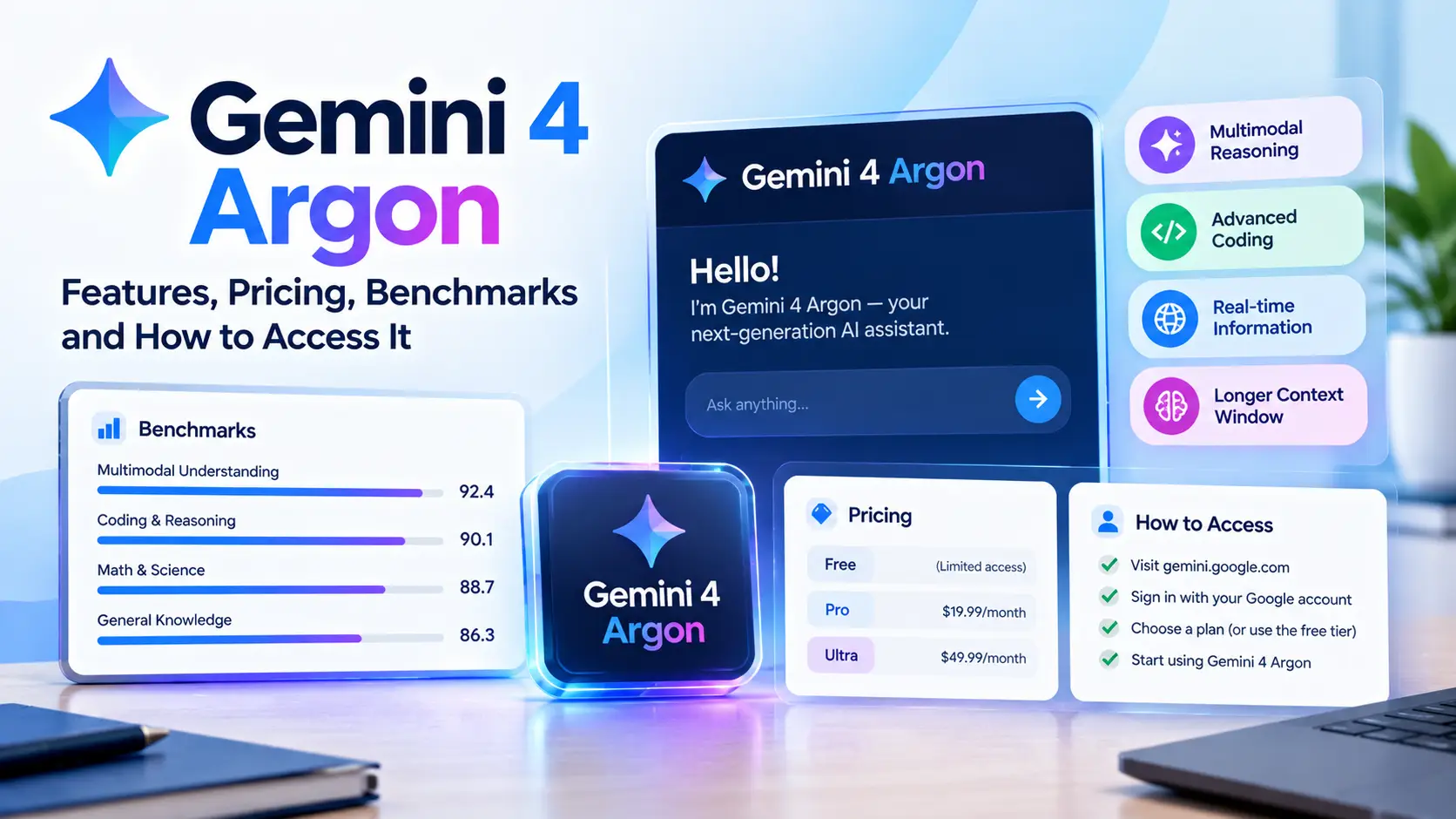
Gemini 4 Argon is Google's newest frontier AI model, announced on September 30, 2026 and opened to developers and paid Gemini app subscribers on October 13. Google built it for long, multi-step work such as software engineering, finance and legal tasks, and cybersecurity. Independent testing puts it at or near the top of several leaderboards, though it is not the best at everything.
This guide explains what Gemini 4 Argon is, what it can do, how it scores on benchmarks, what it costs and how to get access. Google's own claims and independent results are kept apart, because the two are easy to mix up.
What Is Gemini 4 Argon?
Gemini 4 Argon is the first model in Google's Gemini 4 family. The model ID in the Gemini API is gemini-4-argon. Google's developer documentation calls it a flagship reasoning model for complex software engineering, deep math and science problems, and autonomous multi-step agents.
In plain terms, it is built to keep working on a hard problem for a long time instead of answering in one pass. Google's announcement describes it as made for "sustained deep reasoning" across long workflows. It accepts text, images, video, audio and PDFs, and it replies in text only.
Gemini 4 Argon Release Timeline
The rollout happened in stages, which is why early coverage and later coverage can read differently.
| Date | What happened |
|---|---|
| September 30, 2026 | Google announced Argon. Early access went to trusted cyber defenders through Google's Fairwind Program. |
| October 13, 2026 | Developer access opened through the Gemini API, and Google AI Pro and Ultra subscribers got it in the Gemini app. |
An article that calls Argon invitation-only most likely predates October 13.
Key Features and Specs
These details come from Google's Gemini API documentation.
| Spec | Detail |
|---|---|
| Model ID | gemini-4-argon |
| Inputs | Text, image, video, audio and PDF |
| Output | Text only |
| Context window | 1,048,576 tokens (a combined input and output limit) |
| Max output | 65,536 tokens by default, up to 1,048,576 with long decode |
| Thinking levels | Low, medium and high |
| Supported tools | Function calling, code execution, search grounding, Google Maps grounding, URL context, file search, structured outputs |
| Computer use | Preview |
| Not supported | Image generation, audio generation and the Live API |
One detail trips people up. Google's announcement talks about a 1 million token output limit, but the documentation shows 65,536 tokens by default for normal requests. The larger figure applies when you use long decode. Plan around the default unless you have enabled it.
What Gemini 4 Argon Is Good At
Based on the announcement and the independent leaderboards, these are the areas where Argon looks strongest.
Code migration and long engineering tasks
Vals AI places Argon second of 77 models on its Code Migration benchmark. Google's announcement describes agents using it to move C and C++ code to Rust, including an effort on the 800,000-plus line Fuchsia Zircon kernel. Google also says a Rust version of the libgav1 video decoder built with the model runs 2.7 times faster than the previous Rust port with identical output. For a closer look at how agent-style coding tools work, read our guide to AI coding assistants vs AI coding agents.
Finance and document-heavy work
Vals AI ranks Argon first of 78 models on its Finance Agent v2 benchmark and third of 151 on LegalBench. Those tests involve long documents and multi-step reasoning, which matches how Google positions the model for knowledge work. Legal results are mixed, though. It ranks sixth of 79 on Harvey's Legal Agent Benchmark.
Security work
On the public CWE-bench leaderboard, which measures fixing software vulnerabilities, Argon tied for first, according to Engadget. Vals AI lists it third of 47 on CyberBench. Google adds that the model can find, validate and patch critical vulnerabilities, but that claim has less outside evidence behind it.
Research and math
Google says Argon beat a published baseline by 40 percent on quantum algorithm resource use. Vals AI shows a score of 100 percent on the IOI programming benchmark, a result it shares with GPT-6 Astra. These show strength in structured, verifiable problems.
Gemini 4 Argon Benchmarks
What Google reports
Google's announcement lists these results, all vendor-reported:
- DeepSWE v1.1: 77.9 percent, described as a new state of the art for long software tasks.
- LVBench (long video understanding): 91.7 percent.
- CWE-bench v1 (fixing security vulnerabilities): a top score of 68 percent, tied for first.
- AutomationBench: 51.3 percent, ranked first.
What independent testers found
Two outside sources give a more balanced picture.
Vals AI, which runs its own evaluations, ranks Argon first of 48 models on the Vals Index with 68.90 percent. It also places first on its Finance Agent v2 benchmark and second on Code Migration and Vibe Code Bench v1.1, according to its model page.
Engadget reports that Artificial Analysis found Argon matches GPT-6 Astra's score on its Intelligence Index at about 60 percent of the cost per task at current discounted prices. It also scored one point higher than GPT-6.1 Sol.
Where it is weaker
A strong overall rank hides uneven results. Vals AI lists Argon at 4.83 percent on CUA-bench (8th of 9 models). It scores 21.20 percent on Vibe Code Bench 1-100 (8th of 25) and 19.58 percent on Harvey's Legal Agent Benchmark (6th of 79). Its lead on the Vals Index is also narrow. Argon scored 68.90 percent with a margin of about one point, and the Claude models Vals lists sit about two points behind. A single index number should not decide your choice. Look at the benchmark closest to your own work.
Gemini 4 Argon vs Claude and GPT-6
Comparing models is tricky because each leaderboard measures different things. The table below uses Vals Index figures from the Vals AI model page.
| Model | Vals Index score | Cost per test on Vals |
|---|---|---|
| Gemini 4 Argon | 68.90% | $15.68 |
| Claude Sonnet 5.5 | 67.04% | $21.34 |
| Claude Opus 5.5 | 66.97% | $32.14 |
| Claude Fable 5.1 | 65.83% | $28.71 |
On that index, Argon leads by about two points and cost less per test than the Claude models listed. The gap is small, so the choice often comes down to the task, tooling and price. Vals AI also reports that GPT-6 Astra ties Argon for first on the IOI benchmark and that GPT-6 Sol edges ahead on CyberBench by 0.12 points.
For GPT-6, the independent comparison I found is Engadget's report on Artificial Analysis data, which favors Argon on cost. Engadget also lists GPT-6 Astra at $10 input and $50 output per million tokens, against Argon's introductory $2 and $10. Argon's rates double on December 1, so that cost gap will narrow. Pricing and rankings change quickly, so check current numbers before you commit to a model.
For a wider view of the tools around these models, see our comparison of the best AI coding assistants and our look at Claude Code vs Cursor vs GitHub Copilot.
Gemini 4 Argon Pricing
For the Gemini API, Google lists these prices per million tokens. The first row is an introductory rate that runs through November 30, 2026.
| Type | Through Nov 30, 2026 | From Dec 1, 2026 |
|---|---|---|
| Standard input | $2.00 | $4.00 |
| Standard output (including thinking tokens) | $10.00 | $20.00 |
| Cached input | $0.10 | $0.20 |
| Batch input / output | $1.00 / $5.00 | $2.00 / $10.00 |
| Priority input / output | $3.60 / $18.00 | $7.20 / $36.00 |
Some points to keep in mind:
- The price doubles on December 1, so a budget based on the introductory rate will be wrong within weeks.
- Thinking tokens count as output, which can make long reasoning tasks cost more than the headline output price suggests.
- Only implicit caching is supported. Explicit caching is not.
- Google's pricing page says Argon is not available on the Gemini API free tier or on the Google AI Pro plan for API use.
In the Gemini app, access depends on your subscription instead of per-token billing. Google's announcement post does not state usage limits for Argon in the app, so check your plan details.
How to Access Gemini 4 Argon
You have several routes, depending on how you plan to use it.
- Gemini app. Google AI Pro and Ultra subscribers can pick Argon in the Gemini app. Google also says the app now lets you hand Gemini longer tasks and connect more than 40 apps.
- Google AI Studio and the Gemini API. Developers on the paid tier can build with the gemini-4-argon model ID.
- Google Antigravity. Google's agent-first development platform offers it to AI Ultra subscribers. Google's pages are not fully consistent about whether paid Pro subscribers get it too, so confirm in your account.
- Android Studio. Android developers can use it on the paid Gemini API tier.
- Google Cloud. Google's cloud blog says it became available there on October 14, 2026, including through the Gemini platform API and Gemini for business.
Rollouts reach accounts at different times, and plan requirements shift. If you do not see the model, check the plan listed on Google's own pages before assuming something is wrong.
Safety and Cybersecurity
Argon's cyber abilities are a big part of how Google presents it. Google says the model can find, validate and patch critical vulnerabilities on its own. The first release went to trusted defenders through the Fairwind Program, and Google says a version without cyber guardrails is for those defenders and its own teams.
Google also says Argon refuses requests for cyber and CBRN attacks while supporting legitimate security research, and that it is its most resilient model so far against indirect prompt injection. Those are Google's claims, tested by Google's own and external red teams. Independent evidence is thinner, though the CWE-bench result on a public leaderboard has Argon tied for first. If you plan to give an agent access to real systems, test it in a sandbox and keep a human in the loop.
Who Should Use Gemini 4 Argon?
- Developers and engineering teams working on large codebases, migrations and agent workflows.
- Analysts and professionals in finance, legal and research roles who work with long documents.
- Teams already using Google Cloud or Antigravity who want one vendor.
- Cost-conscious API users who want frontier-level scores at a lower price, at least until the introductory rate ends.
It may be a weaker fit if you need image or audio generation, since the model outputs text only. Computer-use tasks are another weak spot, where Vals AI shows a low CUA-bench score. If you want an assistant for research with cited sources, see our comparison of Perplexity vs ChatGPT.
Limitations to Keep in Mind
- Most headline results come from Google. Wait for more independent testing before you trust a single number.
- Leaderboard leads are narrow, and rankings shift as other labs release models.
- Output is text only, and image generation, audio generation and the Live API are not supported.
- Access is split across plans and products, and Google's pages are not fully consistent about who gets what.
- Like any AI model, it can be wrong. Verify important outputs.
Verdict
Gemini 4 Argon is a serious frontier model. The independent data supports its place near the top, especially on cost and on agentic work such as finance and code migration. The evidence for its biggest claims, including autonomous cyber defense, mostly comes from Google. If you build software or work with long documents, it is worth testing on your own tasks while the introductory pricing lasts. Everyone else can wait for broader independent testing.
Frequently Asked Questions
1. What is Gemini 4 Argon? Gemini 4 Argon is Google's flagship reasoning model and the first in the Gemini 4 family. It is designed for long, multi-step work such as software engineering, finance and legal analysis, and cybersecurity. It accepts text, image, video, audio and PDF input and returns text.
2. When was Gemini 4 Argon released? Google announced it on September 30, 2026, with early access for trusted cyber defenders. Developer access and Gemini app access for Google AI Pro and Ultra subscribers opened on October 13, 2026.
3. How much does Gemini 4 Argon cost? Through November 30, 2026, the Gemini API charges $2 per million input tokens and $10 per million output tokens. From December 1, 2026, the prices rise to $4 and $20. Batch, priority and cached rates differ.
4. Is Gemini 4 Argon free? Not for API use. Google's pricing page says it is not available on the Gemini API free tier or on the Google AI Pro plan for the API. Gemini app access requires a paid Google AI Pro or Ultra subscription.
5. What is the Gemini 4 Argon context window? The context window is 1,048,576 tokens, counted as a combined limit for input and output. Maximum output is 65,536 tokens by default and up to 1,048,576 tokens with long decode.
6. Is Gemini 4 Argon better than Claude or GPT-6? On the Vals Index it ranks first of 48 models at 68.90 percent, ahead of the Claude models listed there. Artificial Analysis data reported by Engadget shows it matching GPT-6 Astra at lower cost. The leads are small, and results vary by task.
7. How do I use Gemini 4 Argon? Paid Google AI Pro or Ultra subscribers can select it in the Gemini app. Developers on the paid Gemini API tier can use the gemini-4-argon model ID in Google AI Studio, and Antigravity and Android Studio also offer access.
8. Can Gemini 4 Argon generate images? No. Google's documentation lists image generation and audio generation as unsupported. Argon takes images, video and audio as input but returns text only.
Details in this article come from Google's Gemini 4 Argon announcement, its Gemini API documentation and pricing page, the Vals AI model page and Engadget's coverage, as of October 2026.