
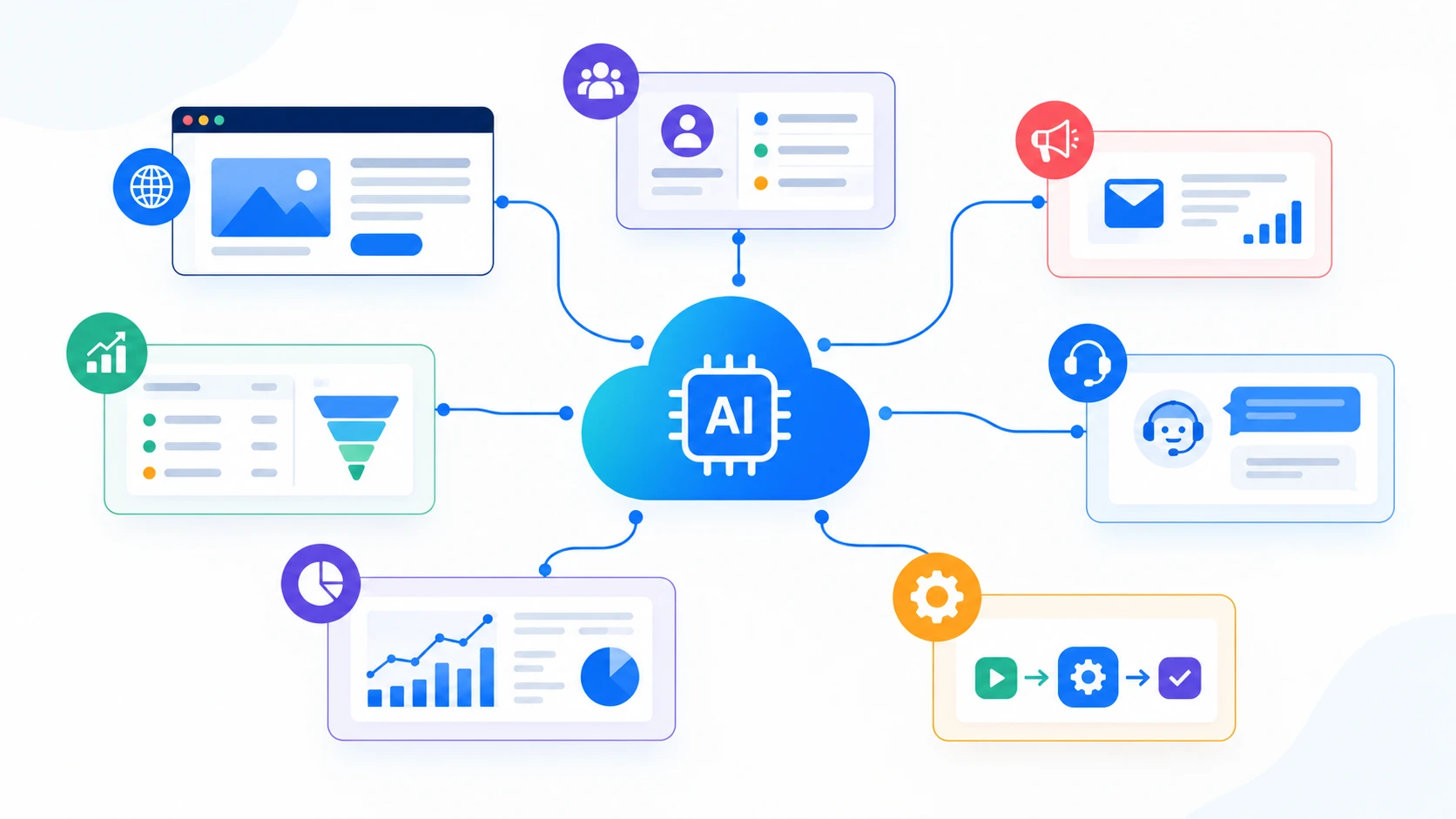
For years, AI in business software meant one thing: help creating stuff. A prompt produced a website. Another prompt produced a blog post, a product description, a logo, or a batch of ad copy. The output was useful, but it still needed a person to take it and do something with it. Someone still had to publish the page, load the CRM record, send the email, or check the numbers.
That pattern is changing. Across website builders, CRM platforms, marketing suites, and enterprise workflow tools, the same shift is showing up: AI is moving from generating content to taking action inside the systems that run a business. The question companies ask their software is no longer just "build my website." It's increasingly "handle this part of my business."
This doesn't mean traditional software is disappearing, and it doesn't mean AI is about to replace entire departments. What it means is that the website, the CRM, and the support inbox are becoming pieces of something larger: an AI layer that sits across a company's tools and, within limits set by the business, gets work done.
What Is an AI Business Platform?
An AI business platform combines generative AI with a company's workflows, data, integrations, and increasingly, autonomous agents, so that requests can turn into completed actions rather than just drafts.
The distinction is easiest to see by comparing three models of software.
Traditional software follows a simple path: a person uses an interface, the software processes a request, and a result comes back. A sales rep updates a CRM field by hand; a marketer schedules an email themselves. The software is a tool, and the human supplies the judgment and the labor.
AI-assisted software adds a layer of generation on top of that same model. The AI drafts an email or summarizes a support ticket, but a person still reviews and executes the final step. This is where most business software has sat for the past several years, and it's still where most everyday AI use happens today.
An AI business platform changes the flow again: a person states a goal, and an AI agent, or a coordinated group of them, checks relevant data, decides on a course of action within defined boundaries, and carries out multiple steps across connected systems, reporting back on what it did. The meaningful difference isn't better writing. It's execution: the software doesn't just tell you what to do, it does part of it.
That third model is still uneven across the industry, further along in some functions (customer service, CRM data entry) than others (finance, legal, HR). But the direction is consistent enough across the largest platforms in the market to treat it as a category on its own.
The Evolution: From Website Builders to Business Platforms
The path to AI business platforms didn't start with agents. It moved through several distinct stages, and most companies are still living in more than one of them at once.
Stage 1: Website builders. Platforms like Wix, Squarespace, and Shopify made it possible to launch a website without hiring a developer: templates, hosting, domains, basic SEO, and a visual editor replaced custom code for millions of small businesses.
Stage 2: AI website builders. Generative AI added a conversational layer on top of that editor. Instead of picking a template and filling in blanks, a business owner could describe what they wanted and get a drafted site back, with AI-written copy and auto-generated layouts. Wix's newer builder, Harmony, is an example: it pairs a conversational agent, Aria, with the platform's existing drag-and-drop editor, so a business can describe a site in plain language and still adjust it by hand.
Stage 3: AI-powered business tools. AI spread beyond the website into the tools businesses use for day-to-day operations: CRM, email marketing, customer support, analytics, and content creation all picked up AI-powered products that could draft, summarize, and recommend.
Stage 4: AI agents. This is where the model shifts from assistance to action. An agent can take a goal, pull relevant business data, choose among a set of permitted actions, carry out several steps in sequence, and report the outcome, rather than waiting for approval at each step. Salesforce's Agentforce, HubSpot's Breeze Agents, and Microsoft's Copilot Studio agents all fit this description, each with its own scope and guardrails.
Stage 5: AI business platforms. Here the pieces converge. A platform combines a website or storefront, CRM and sales tooling, marketing and support functions, analytics, and coordinated agents acting across all of them. Not every vendor offers every piece today, and none offer it without limits. But Wix positioning Symphony as an agent layer running across marketing, operations, and customer experience for a site it already built, and Shopify pairing Sidekick with agentic storefront infrastructure so AI shopping assistants can transact directly, point at the same convergence from different starting points.
What Can AI Business Platforms Actually Do Today?
It helps to look at this capability by capability, since the honest answer changes depending on the function.
Website and digital presence. The most mature category. AI can generate a multi-page site from a description, write and revise copy, create layouts, suggest images, and apply basic SEO. Editing after generation is standard across most builders, since AI-first drafts still typically need human refinement for tone, accuracy, and brand fit.
Marketing. AI can draft campaigns, write email sequences, generate social posts, segment audiences, and summarize how a campaign performed. Some platforms, including Shopify's Campaign Autopilot, now let AI manage a running campaign within guardrails a merchant sets, rather than only drafting content once, a step toward execution, though still bounded by budget limits and approval settings rather than fully unsupervised.
Sales. Agents can research a prospect, enrich a CRM record, draft follow-up messages, and flag deals that need attention. HubSpot's Breeze Prospecting Agent and Salesforce's opportunity-management agents both operate this way, watching for signals like a changed deal stage and acting automatically. Qualification is increasingly automated; final pricing and contract decisions generally still route to a person.
Customer support. The function where autonomous execution is furthest along. AI agents can hold a full conversation, answer FAQs, look up an order, resolve straightforward requests such as a return, and hand off anything unusual to a human. Salesforce has reported meaningful reductions in response times and deflection of routine volume in its Agentforce deployments, though results vary by industry and by how well a company's own data is set up.
Operations. Cross-system automation, document processing, approvals, and notifications are being reshaped by agents that adapt to varying inputs rather than only triggering a fixed rule. Microsoft's computer-using agents in Copilot Studio interact with a website or desktop application through its interface, which lets them automate processes for systems that were never built with an API in mind.
Analytics. Natural-language querying of business data, automated reporting, and plain-English summaries of what's driving a trend are now common across CRM and commerce platforms. Shopify merchants can ask Sidekick a business question directly and get an answer pulled from their own store data.
Across all of these, the honest distinction is between AI that assists a person doing the work and AI that completes the work with a person checking in afterward. Most businesses today use a mix of both, and the ratio is shifting toward the second as trust and guardrails mature.
AI Agents Are the Big Shift
Agents are the piece separating this generation of business software from the automation tools that came before it. A traditional automation looks like this: when a customer submits a form, add them to the CRM, then send a confirmation email. It's reliable, but rigid, every branch has to be anticipated and coded in advance.
An agentic workflow looks different: a customer submits a request, an AI agent reads it, checks the customer's history, decides which of several possible workflows applies, updates the relevant systems, drafts or sends a response, and escalates anything it isn't confident about. Salesforce describes this shift in its own usage data as agents moving from producing text to completing discrete tasks it calls agentic work units.
That flexibility is genuinely useful, and it's also where the real risks live. Agents can hallucinate a fact, misread a request, or act on incomplete context. They depend heavily on the quality of the data they're given, and a permission that's too broad can let an agent touch something it shouldn't. Multi-step workflows can fail partway through in ways that are harder to trace than a simple script. For these reasons, every major vendor building agents, from Microsoft to Salesforce to ServiceNow, pairs the agent with logging, approval steps, and human oversight rather than shipping it as a fully autonomous employee. Framing agents as tireless digital staff who never need checking is not how the companies building them describe their own products, and it's not how they should be evaluated.
Examples of Companies Building Toward This Model
Wix built its business on template-based website creation and has layered AI in two directions: Harmony, its AI website builder centered on the Aria agent, and Symphony, a separate platform coordinating multiple agents across marketing, operations, and customer experience for a business, not just its site. Symphony works alongside the site rather than replacing the judgment calls an owner still makes about pricing and customer relationships.
Shopify has extended its commerce platform with Sidekick, a conversational agent for store management, and agentic storefronts, infrastructure letting AI shopping assistants in ChatGPT or Copilot complete purchases using a merchant's live catalog. Shopify also co-developed the Universal Commerce Protocol, an open standard for this kind of AI-to-AI transaction. The company itself flags that none of this replaces the fundamentals: accurate inventory, clear policies, and a human accountable for what an agent proposes.
Salesforce has rebuilt much of its CRM around Agentforce, expanding from single-purpose bots into named, role-based agents meant to work across service, sales, and commerce. Its own Agentic Enterprise Index reports agents shifting from answering questions to completing tasks like issuing a refund, paired with governance tooling reflecting that autonomy at this scale needs guardrails, not just capability.
HubSpot has built Breeze Agents into its CRM for content, social media, prospecting, and customer service, with a workflow action that triggers agent research automatically when a deal changes stage. HubSpot itself notes that its newer, broader-capability marketplace agents currently trade some of the track record its original, narrower agents have built up.
Microsoft has extended Copilot Studio well beyond chatbot creation, adding computer-using agents that operate legacy interfaces lacking clean APIs, agent-to-agent communication for coordination, and governance tooling through Microsoft Agent 365 giving IT visibility into agent activity and cost. Microsoft's own guidance is that this requires admins, developers, and business owners working together, not agents deployed and left alone.
ServiceNow has positioned its platform as connective tissue for agents built anywhere, not just its own. Its Action Fabric lets an agent built on Claude, Copilot, or another vendor's stack trigger the same governed workflow a ServiceNow user would by hand, with the data feeding back into its process-mining tools, a bet on being the governed execution layer underneath everyone else's agents.
None of these companies has a fully finished version of the AI business platform described here, and none is positioned as better than the others. Each approaches the same convergence from a different starting point: a website builder, a commerce platform, a CRM, an enterprise workflow suite.
The New AI Business Stack
A useful way to think about where this fits is as a stack, layered from the customer-facing surface down to the raw data underneath.
| Layer | What it includes |
|---|---|
| Experience layer | Website, app, chat interface, customer-facing surfaces |
| AI layer | Generative AI, assistants, reasoning models, autonomous agents |
| Workflow layer | Automation, business processes, approvals, agent orchestration |
| Business systems | CRM, ERP, HR, finance, marketing, support platforms |
| Data layer | Customer data, documents, analytics, knowledge bases, databases |
The layers toward the bottom of that stack are what make agents useful rather than just articulate. An agent with a capable model but no access to a company's actual CRM records, order history, or support tickets can hold a good conversation but can't take a meaningful action. That's why much of the current competition among vendors isn't really about the AI model itself, it's about who controls the integrations and the data access underneath it. It's also why open standards for connecting agents to tools and data, such as Anthropic's Model Context Protocol, have grown quickly: they cut the need for every vendor to build a custom connector for every system, letting agents from different companies work with the same business data without one vendor owning the whole stack.
Why Businesses Are Interested
The appeal isn't abstract. A handful of practical drivers show up again and again in how companies describe adopting these tools:
- Lower operational overhead, since routine work that used to require a dedicated hire can, in some cases, be handled by an agent instead
- Faster execution, since a workflow that once needed several human handoffs can complete in minutes when an agent acts across systems directly
- Smaller teams covering more ground, particularly in support and lead follow-up, where volume is high and the work is often repetitive
- Faster customer response, when a first-line agent handles routine questions instead of a queue
- More personalized customer experiences, since an agent can tailor a response to a specific customer's history rather than sending the same message to everyone
- Reduced repetitive work, such as manual CRM data entry
- Easier access to business information, since a person can ask a plain-language question instead of building a report
- Faster experimentation, since testing a new campaign or workflow doesn't always require new engineering work
- Potentially lower software complexity, since one AI layer coordinating several tools can reduce how many separate systems a team has to learn
Cost savings are frequently claimed by vendors and are plausible in specific cases, but they vary widely by company, industry, and how well the underlying data and processes are set up before AI is layered on top.
What Changes for Small Businesses?
For a small business, the appeal is consolidation. A company that previously needed separate tools for its website, email marketing, CRM, scheduling, and analytics can increasingly get versions of all of that inside one platform, coordinated by AI rather than stitched together manually. That can meaningfully lower the burden of running a sophisticated digital operation: a two-person business can plausibly run a website, respond to customer questions, follow up with leads, and send campaigns without hiring separately for each function.
But consolidation doesn't remove the need for oversight. The quality of an agent's output still depends on the quality of the data behind it, a messy CRM or an out-of-date knowledge base will produce agent behavior that reflects those gaps. Implementation still takes real setup time, and someone still needs to periodically check what the AI is doing, particularly anything customer-facing or anything that touches money.
What Changes for Enterprise Businesses?
Enterprises face a different set of questions, mostly centered on control rather than capability.
Large organizations already run on entrenched systems, often decades old, with established security models, compliance requirements, and audit obligations. Handing an autonomous agent broad access across those systems isn't something most enterprises can do casually. Identity and permissions have to be scoped precisely, so an agent can do what its role requires and nothing more. Governance frameworks need to track which agents exist, what they're authorized to do, and who's accountable for their actions, part of why Microsoft and Salesforce have both built dedicated monitoring layers for exactly this problem. Compliance and data residency requirements don't disappear because an agent is doing the work instead of a person, auditability matters more, not less, and human approval remains a requirement for higher-stakes decisions, whether that's a large refund, a contract term, or a personnel action.
The practical result is that enterprises adopt agents in bounded increments: a defined process, defined permissions, monitored closely, expanded only after it proves reliable, a slower path than the casual adoption a small business can pursue, and slower for good reason.
The Biggest Challenges
A handful of challenges cut across every business size and every vendor.
- Accuracy. AI systems can produce confidently wrong output, and an agent acting on a wrong conclusion is a different problem than a chatbot saying something wrong in a conversation nobody acts on.
- Security. Agents with access to business systems represent a new kind of attack surface, since a compromised agent or a manipulated prompt could potentially be used to take real actions rather than just generate bad text.
- Data privacy. Sensitive business information, including customer records, increasingly flows through AI systems, raising real questions about where that data goes and how long it's retained.
- Permissions. An agent needs carefully scoped access. Too little and it can't do useful work; too much and a mistake has a much larger blast radius.
- Reliability. Multi-step workflows can fail partway through, and diagnosing why an agent took a particular sequence of actions is often harder than debugging a traditional script.
- Governance. Businesses need visibility into what agents are actually doing, not just what they're supposed to do, which is why monitoring and audit tooling has become a selling point across nearly every enterprise AI vendor.
- Integration. Legacy systems without modern APIs don't always support AI-driven workflows cleanly, part of why Microsoft built computer-using agents that operate an old interface directly.
- Human oversight. Decisions involving money, legal exposure, or a customer relationship still call for a person's judgment, and every major platform in this space builds in some form of escalation step for that reason.
AI Platform vs Traditional SaaS
| Dimension | Traditional SaaS | AI business platform |
|---|---|---|
| Interface | Forms, dashboards, manual navigation | Natural language, chat, voice, alongside traditional UI |
| Workflow model | Predefined rules and fixed steps | Goal-based, with agents choosing among permitted actions |
| Automation | Trigger-based, rigid branching | Adaptive, agent-driven, still bounded by permissions |
| Data interaction | Manual queries and reports | Natural-language queries, automated summaries |
| Customization | Configuration and custom code | Prompting, plus configuration and guardrails |
| Human involvement | Required at every step | Required for approval and exceptions, not every step |
| Agent capabilities | Minimal or none | Central to the platform's value proposition |
| Integrations | Point-to-point, often brittle | Increasingly standardized (MCP, agent-to-agent protocols) |
| Governance | Role-based access control | Role-based access control plus agent-specific monitoring |
The table isn't meant to declare one model obsolete. It's meant to show that the two differ architecturally, in how work moves through the system, not just in how polished the interface looks.
Will AI Business Platforms Replace Traditional Software?
The likely path is integration, not replacement. Traditional systems still provide things agents don't create on their own: structured data storage, transaction processing, security models, permission systems, audit trails, and the reliability of software behaving the same way every time it's called.
What's changing is what sits on top. AI is increasingly becoming the interface and orchestration layer over infrastructure that, in many cases, isn't going anywhere. ServiceNow's own positioning, that agents from any vendor should trigger governed action inside its systems rather than work around them, reflects this: the system of record stays in place, and AI becomes how people, and other AI, interact with it. Put simply, AI may increasingly become how people interact with software, rather than software disappearing altogether.
What the AI-Native Business Could Look Like
Consider a small online retailer built around this model, not as a description of how every business operates today, but as a realistic composite of capabilities that already exist somewhere in the market.
A customer discovers the company through a search result or an AI shopping assistant, and lands on a site that was largely AI-generated and refined by the owner. A question about sizing gets answered instantly by a support agent checking the actual product catalog rather than a static FAQ. The customer becomes a lead, and the CRM updates itself, tagging them by the products they viewed. A follow-up email goes out the next day, drafted by an agent against a template the business set up in advance. The customer buys. A support question after delivery gets resolved by the same agent that greeted them, with a human stepping in only when the issue is a refund above a set threshold. At month's end, the owner asks a plain-language question about which channel drove the most repeat purchases and gets an answer without building a report.
Every piece of that workflow exists in some form today. What doesn't yet exist, for most businesses, is all of it running together without a person checking in at several points along the way. That gap, between what's technically possible and what's actually running unattended in most companies, is the honest state of the industry in 2026.
What Business Owners Should Watch
Before adopting or expanding use of an AI business platform, a few questions are worth asking directly:
- What existing systems can it actually integrate with?
- Can the AI take real actions, or does it only generate content and suggestions?
- What permissions can an agent be given, and how granular is that control?
- Is human approval available for higher-stakes actions?
- Can every agent action be logged and audited after the fact?
- How is customer data handled, stored, and used to train or improve the AI?
- What happens when the AI makes a mistake, and who is responsible for catching it?
- Can workflows be customized to match how the business actually operates?
- Can the business export its data if it decides to switch platforms later?
- How difficult would switching platforms be in practice?
- What happens if the AI provider changes its pricing or scales back a feature the business depends on?
These aren't hypothetical. Several vendors have already moved to usage-based or credit-based pricing tied to AI consumption rather than flat seat licenses, which makes the cost of an agent-heavy workflow harder to predict than a traditional subscription.
The Future: From Software Tools to Business Operating Layers
The broader trajectory looks something like: website, then application, then assistant, then agent, then coordinated multi-agent workflows, then something closer to a genuine AI operating layer sitting over a business's systems.
Getting there depends on standardized ways for agents to reach tools and data, which is why open protocols for agent-to-tool and agent-to-agent communication have gained traction so quickly, on governance frameworks mature enough that enterprises trust agents with real permissions, and on businesses building up the clean, accessible data that makes any of this reliable.
What's genuinely being contested right now isn't which company has the smartest model. It's who controls the business data an agent needs, who owns the customer relationship it acts on behalf of, and who orchestrates workflows across multiple systems. Several very different companies, a CRM vendor, a commerce platform, a workflow suite, an AI model provider, are all making credible plays for pieces of that same territory, and none has settled the question yet.
Conclusion
The first generation of AI business tools was about creation: websites, copy, images, and content that a person still had to publish, send, or act on. The generation now taking shape is about execution: agents that check a company's own data, make a bounded decision, and carry an action through to completion across more than one system.
That doesn't make the website disappear. It makes the website one part of something larger, an AI layer sitting across a company's tools, still built on the traditional software underneath, still needing a person to set its boundaries and check its work, but doing meaningfully more of the actual running of the business than the AI tools of a few years ago ever did.