
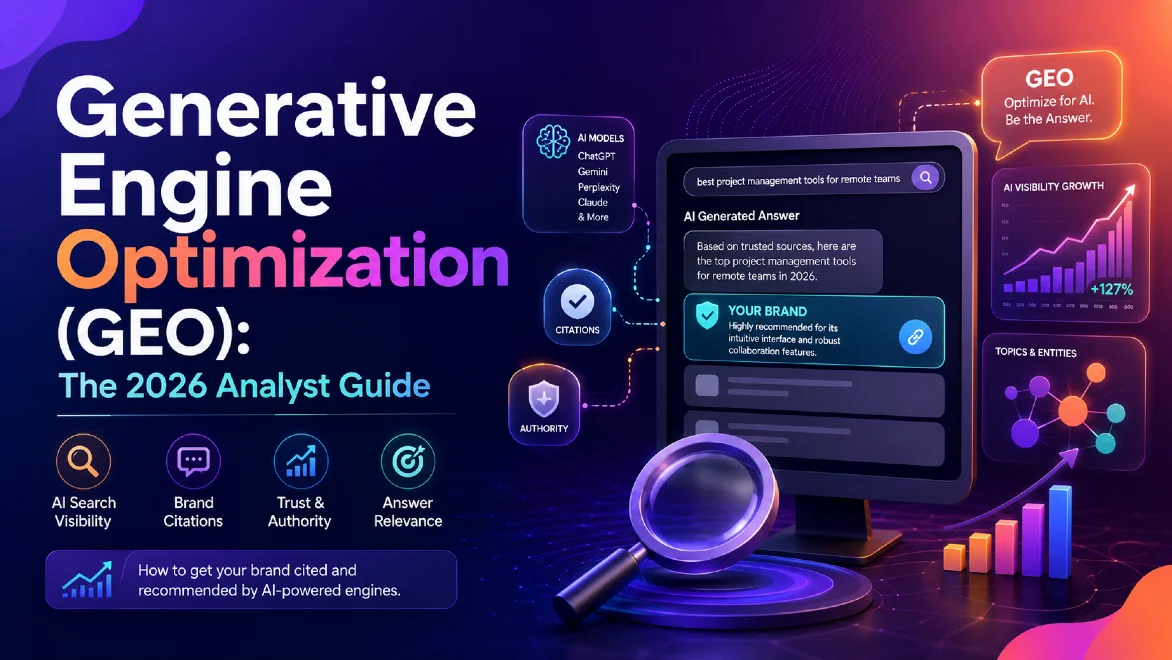
Generative Engine Optimization (GEO): The 2026 Analyst Guide
Why Being Cited Now Matters More Than Being Ranked
Ask ChatGPT which project management tool to use and it will name three or four options, describe each in a sentence, and move on. No page of ten blue links, no scrolling. Just a verdict, delivered with the confidence of someone who already did the research for you.
If your company is not one of the names mentioned, you do not just lose a click. You lose the conversation entirely. That is the shift Generative Engine Optimization, or GEO, is built to answer.
This guide runs longer than most of what has been published on the topic this year, and that is deliberate. Most "GEO strategy" content recycles the same handful of bullet points without ever pointing to a real study, a real dataset, or an official source. This one tries to do the opposite. Every claim traces back to something you can go check yourself, and where a recommendation is still a working theory rather than proven fact, I will say so.
What GEO Actually Means, Stripped of the Buzzwords
Generative Engine Optimization is the practice of shaping your content so that generative AI systems, whether that is ChatGPT, Gemini, Perplexity, or Copilot, choose to cite, quote, or recommend it when answering a user's question.
The term itself is not marketing jargon invented by an agency. It comes from a 2024 paper by researchers primarily affiliated with Princeton University, titled "GEO: Generative Engine Optimization," which introduced the discipline along with a benchmark called GEO-bench for measuring it. That detail matters, because a lot of what gets published under the GEO label right now is speculation dressed up as strategy. The research behind the term is not. It is peer-reviewed work that was later presented at ACM SIGKDD, one of the more respected venues in applied data science and machine learning.
The research team, working with collaborators from Georgia Tech, IIT Delhi, and the Allen Institute for AI, tested nine different content strategies against roughly 10,000 real queries, then measured which ones actually changed whether a source got cited. This was not a survey of opinions collected from marketers with something to sell. It was a controlled experiment with a scoreboard, the kind of methodology you would expect from a computer science lab rather than an SEO blog.
The results are the closest thing this field has to hard data. Adding statistics to a page lifted visibility by 41 percent. Adding direct quotations lifted it by 28 percent. Citing external, authoritative sources produced a 115 percent visibility jump, specifically for pages that were already ranking lower, an effect the researchers described as an equalizer for smaller or less-established sites.
That last number is worth sitting with. A page sitting in position five, one that would normally get buried in Google results, can dramatically outperform its ranking inside an AI answer if the content is structured the right way. GEO does not just reward the biggest sites. It rewards the clearest ones. If you want to verify these claims before taking anyone's word for them, this independent summary of the Princeton research is a good place to start.
How a Generative Engine Actually Decides What to Say
A traditional search engine retrieves and ranks. A generative engine retrieves, then rewrites. Under the hood, most of these systems run a two-step process: pull a handful of top sources for a query, then have a language model synthesize those sources into a single answer, choosing which facts to keep, which to drop, and which source earns the citation.
That second step is where the real competition happens, and it is largely invisible to anyone still doing SEO the old way. The model is not asking "which page ranks highest." It is asking something closer to "which source states this most clearly, with the least ambiguity, and the most evidence attached?" Vague marketing copy loses that contest almost automatically, not because it is penalized, but because there is nothing concrete in it for the model to grab onto.
Google has confirmed a version of this mechanism directly. In its own developer documentation on AI Features and Your Website, Google's Search Central team explains that AI Overviews and AI Mode may use a "query fan-out" technique, issuing multiple related searches across subtopics and data sources to build a single response, rather than relying on one retrieval pass the way classic search does. That single detail explains a lot of GEO behavior that otherwise looks mysterious. A page can get cited for a sub-question buried inside a broader query even when it would never rank for the query as typed, because the model is effectively running several searches behind the scenes and stitching the best answer to each fragment together.
This is also why trust signals matter more here than they ever did in classic SEO. Consistent author attribution, clear publication dates, and citations that trace back to primary sources all function as evidence the model can point to when deciding your content is safe to repeat. Strip those away and even accurate content becomes harder for an AI system to confidently use. Google frames this through its long-standing E-E-A-T framework, which stands for Experience, Expertise, Authoritativeness, and Trustworthiness. The company has said it applies to AI-generated search features exactly as it applies to traditional organic results, not as some separate or looser standard.
SEO, AEO, and GEO Are Not Competing Strategies. They Are Layers.
It helps to stop thinking of these as three separate disciplines fighting for budget, and start thinking of them as three checkpoints a piece of content has to clear.
| Layer | What it optimizes for | What "winning" looks like |
|---|---|---|
| SEO | Discoverability by a search index | Your page shows up in results |
| AEO | Direct question answering | Your page gets pulled into a featured snippet or a voice assistant's spoken answer |
| GEO | Synthesis by a generative model | Your brand or content gets cited, quoted, or recommended inside an AI-written response |
A page can rank well in Google, answer a question clearly enough to win a featured snippet, and still never get mentioned by ChatGPT. That is because the model synthesizing an answer is weighing different signals than the ones that got the page ranked in the first place. Companies that treat GEO as "SEO but for AI" tend to miss this. It is not a rebrand. It is a different judge, scoring on different criteria.
That said, Google itself pushes back on the idea that these are entirely separate disciplines requiring entirely separate tactics. Its official position, laid out in the AI features documentation linked above, is that there is no distinct "AI ranking algorithm" running alongside classic search. Content that performs well in organic search has a materially higher baseline chance of being surfaced in AI Overviews, because AI Overviews draw from the same underlying index. That is a genuinely different claim than what applies to ChatGPT, Perplexity, or Gemini's standalone chat interfaces, which pull from their own retrieval systems and web crawls rather than Google's index directly. This is one of the more common points of confusion in GEO commentary. "AI search" is not one system, and what is true of Google's AI Overviews does not automatically transfer to how OpenAI or Anthropic's models decide what to cite.
Is Search Actually Collapsing, or Is That Overstated?
Here is where a fair amount of GEO content published this year gets ahead of the facts, so it is worth being precise. In February 2024, Gartner predicted that traditional search engine volume would drop 25 percent by 2026 as generative AI tools absorbed queries that used to go to Google. That number gets repeated constantly, often inflated to 30 percent in the retelling.
Checking it against 2026 reality tells a more nuanced story. ChatGPT has reached roughly 900 million weekly active users according to reporting cited by HubSpot's compilation of GEO statistics, and AI chatbots collectively handle billions of queries a month. Perplexity alone reportedly processes around 780 million search queries monthly, up sharply from roughly 230 million in August 2024, so the underlying behavior shift Gartner flagged is directionally real.
But Google still commands more than 90 percent of the overall search market, and traditional search volume has not fallen off a cliff. A closer look at the actual prediction versus what happened is laid out in this retrospective on the Gartner forecast, which argues the 25 percent figure was directionally right about the pressure on search but wrong about the mechanism and the timeline. Part of the reason the collapse has not happened as fast as predicted comes down to economics: running a conversational AI query costs meaningfully more in compute than serving a traditional search result, and that has kept a hard ceiling on how fast chatbots can fully replace search infrastructure at scale.
What has changed is more subtle and, honestly, more relevant to anyone running a marketing budget. Zero-click search is now the norm rather than the exception. Wikipedia's entry on AI Overviews notes that as of March 2026, the feature appears on more than 48 percent of total Google Search queries, up from roughly 6.5 percent a year earlier. That is a 58 percent year-over-year jump in how often the feature shows up at all, separate from whether it reduces clicks on any individual query.
The headline prediction was not quite right. The underlying pressure it was pointing at is very real. Traffic is not vanishing, but the reward for merely ranking is shrinking, and the reward for being the cited source inside an AI answer is growing to fill that gap.
The Five Things That Actually Separate Cited Brands from Ignored Ones
Strip away the tool marketing, and the principles that hold up against the Princeton research and current practitioner experience come down to five things.
Write like you are the primary source, not a summary of one. Original data, named experts, and specific figures give a model something concrete to extract and attribute. A page that just restates conventional wisdom in slightly different words gives the model nothing it could not get from ten other sites. And nothing a model could get from ten other sites is exactly what does not get cited. If you have run a survey, collected proprietary usage data, or interviewed a named expert, that content is disproportionately valuable here because it is the one thing a model literally cannot get anywhere else.
Make your entity consistent everywhere. Your company name, the way you describe what you do, and who your named experts are should read identically across your website, your social profiles, and any third-party mentions. Generative models build an internal picture of "who this brand is" from scattered mentions across the web, and inconsistency dilutes that picture. HubSpot's guidance on this, published as part of its future-of-GEO analysis, puts it plainly: generative engines place significant weight on how other sources describe a brand, not just how the brand describes itself.
Attach evidence to every claim that matters. The Princeton findings on statistics and citations are not a stylistic preference. They are the single biggest lever available. A claim with a number and a source behind it survives the synthesis process. An unsupported assertion usually gets quietly dropped or rewritten into something vaguer, which means all the effort you put into writing that sentence never reaches the reader at all.
Earn mentions on other credible sites. A generative model does not just read your page. It reads what other trusted sources say about you. Getting cited, quoted, or linked from established publications in your industry functions as a trust signal that compounds over time, in a way that is very hard to fake with owned content alone. This is arguably the hardest of the five to execute quickly, since it depends on real relationships and genuine authority rather than a content calendar, but it is also the one competitors cannot easily copy.
Structure content so machines can parse it, not just read it. Clear headings that stand on their own, direct answers near the top of a section, and schema markup that labels your organization, articles, and FAQs all reduce the ambiguity a model has to resolve before it can use your content. Ambiguity is friction, and friction is the enemy of getting picked. Google's own structured data guidance predates the AI search era by years and remains the most authoritative reference for implementing this correctly. Google's Structured Data Markup Helper is a free, official starting point rather than a third-party guess at best practice.
One honest counterpoint worth naming: none of this guarantees a citation on any specific query. Generative engines are non-deterministic and the underlying source-selection logic changes with every model update. Anyone promising guaranteed placement in AI answers is selling something a controlled study would not back up.
Why "GEO Does Not Replace SEO" Is More Than a Hedge
It has become a stock phrase in nearly every GEO article published this year, usually tacked on as a disclaimer near the end. But the data behind it is more specific than the phrase suggests.
Google's documentation is unambiguous that AI Overviews draw from the same index as regular search, meaning a page with zero organic visibility has a structurally lower chance of ever surfacing in that particular AI feature, no matter how well it is written. That is a hard technical constraint, not a philosophical stance. For ChatGPT, Perplexity, and Gemini's chat interfaces, the relationship is looser, since these systems run their own retrieval layers and web crawls independent of Google's ranking signals. But even there, a page that a crawler cannot find, parse, or trust is a page that cannot be cited, which puts you back to fundamentals: crawlability, clean HTML, a working robots.txt, and a reasonable backlink profile.
HubSpot's 2026 State of Marketing research, cited in its GEO benefits analysis, found that 49 percent of marketers agree that web traffic from search has decreased because of AI answers. But the same research found 58 percent of marketers reporting that AI referral traffic, when it does arrive, converts at a meaningfully higher intent level than traditional search traffic. That is the actual trade-off GEO is asking marketing teams to make: fewer total visits, but a larger share of the visits that arrive are people an AI system already vetted and pointed directly at you by name.
What This Looks Like for Smaller Businesses
One thing missing from a lot of enterprise-focused GEO content is what this means at the small-business or solo-marketer scale, where there is no dedicated SEO team and no six-figure tooling budget.
HubSpot's guidance for small businesses navigating GEO reports that AI referral traffic to small and mid-sized business websites increased by 123 percent in a matter of months during 2025 and early 2026, a growth rate far outpacing anything comparable in traditional organic search over the same window. The same guidance points out that free tools, including Google's own Structured Data Markup Helper and Schema Markup Generator, plus built-in schema plugins in WordPress, Squarespace, and Wix, are enough to implement the technical side of GEO without hiring a specialist.
FAQ pages in particular are singled out as disproportionately effective, since they map almost one-to-one onto how people phrase questions to a chatbot. That is a very different query pattern than the keyword fragments people type into a traditional search box, and it is a structural advantage smaller sites can build without a large team.
That lines up with the Princeton paper's equalizer finding: the barrier to entry for GEO is clarity and evidence, not budget.
Which Tools Are Actually Worth Paying For
The AI visibility tooling market grew fast through 2025 and into 2026, and the field now splits fairly cleanly by budget and depth.
| Tool | Best for | Starting price |
|---|---|---|
| Semrush AI Visibility Toolkit | Teams already on Semrush who want AI tracking bundled with existing SEO workflows | Included with Semrush One, or as an add-on |
| Ahrefs Brand Radar | Ahrefs users who want lightweight AI Overview and prompt tracking without switching platforms | $199 to $699 per month as an add-on |
| Otterly | Small teams or solo marketers who just need a basic citation check | $29 per month |
| Profound | Enterprise teams that need deep, model-level coverage including Claude, Grok, and Meta AI | $2,000 to $5,000+ per month |
| Peec AI | Mid-market teams that want dedicated AI analytics without enterprise pricing | Mid-market pricing tier |
| HubSpot AEO / AI Search Grader | HubSpot customers who want native GEO scoring without adding another platform | Available within existing HubSpot plans |
Worth noting: independent reviews, including this comparison of Ahrefs Brand Radar against dedicated AEO platforms, point out that Brand Radar currently does not cover Claude, Grok, Meta AI, or DeepSeek. If your buyers use any of those platforms and your tool does not track them, you have a gap in your actual visibility picture, not just a missing dashboard feature.
The bolt-on modules inside Semrush and Ahrefs are genuinely useful if you are already paying for those platforms. Dedicated tools go deeper, but the return on that depth depends on whether your team will actually act on the data. HubSpot's own tooling, described in its AEO product overview, is worth a mention specifically because it is bundled inside a CRM many marketing teams already run, which lowers the activation cost of actually using the findings instead of letting another dashboard go unopened.
A Practical Sequence for Actually Doing This
Step 1: Audit your current AI footprint. Ask ChatGPT, Perplexity, and Gemini to describe your company or recommend a solution in your category. Note whether you are mentioned, whether the description is accurate, and who gets named instead of you. Do this manually first, before paying for any tool. A handful of prompts across a handful of models gives you a real baseline in under an hour.
Step 2: Fix entity consistency before anything else. Align your company description, named experts, and core claims across your site, LinkedIn, Crunchbase-style profiles, and any directory listings that come up in that audit. This is usually the cheapest fix on the list and the one most commonly skipped.
Step 3: Rewrite thin pages into evidence-backed ones. Add real statistics, name real sources, and cite primary research wherever a claim can be traced back to one, rather than restating something you read elsewhere in your own words.
Step 4: Add structured data. Organization, Article, and FAQ schema give AI crawlers a labeled map of your content instead of forcing them to infer structure from prose. Google's Search Essentials guidance is the baseline reference here.
Step 5: Pursue mentions on sites that already carry authority in your space. A single citation on a trade publication or analyst report tends to outweigh a dozen posts on your own blog, in terms of what a generative model treats as trustworthy.
Step 6: Track it and repeat. Re-run the audit from step one every few weeks. AI visibility moves with model updates, not with a quarterly SEO calendar. Add temporal markers to factual claims where you can. Phrasing like "as of Q2 2026" gives both readers and models an explicit recency signal, and updating your dateModified schema property every time you revise a page reinforces the same thing structurally.
What This Means If You Run Marketing at a Company That Is Not Google-Sized
The uncomfortable part of GEO for smaller brands is that it removes some of the old workarounds. You cannot out-spend your way into an AI citation the way you could once buy your way up a paid search results page. But the Princeton equalizer effect cuts the other way too: a smaller site with sharper, better-evidenced content can out-cite a bigger competitor that is coasting on domain authority alone. The playing field tilts toward whoever writes the clearest, most verifiable answer, not whoever has the biggest marketing budget.
That is a genuinely different game than the one SEO trained marketers to play for two decades. It rewards precision over volume, and evidence over polish. Brands that treat this as an excuse to publish more content will likely be disappointed. Brands that treat it as a reason to publish fewer, better-sourced pieces are the ones showing up when someone asks an AI system who to trust.
Frequently Asked Questions
Is GEO the same thing as AEO? No, though they overlap heavily. AEO is about winning a direct answer slot: a featured snippet, a voice assistant response, a single best-answer position. GEO is about being cited or recommended inside a longer, synthesized response generated by an AI model. A page can succeed at one without succeeding at the other. HubSpot, notably, markets its own product under the AEO label even though much of what it measures is closer to classic GEO, which is a good example of how loosely these terms are still used across the industry.
Does GEO replace traditional SEO? Not currently. Generative engines still rely partly on traditional search indexes to retrieve candidate sources before synthesizing an answer, so ranking reasonably well remains a prerequisite in most cases, just no longer a sufficient one on its own. Google's own documentation is explicit that this is true for AI Overviews specifically, since they draw from the same underlying index as classic search.
How long does it take to see results from GEO work? There is no fixed timeline, and anyone offering a precise number is guessing. AI models update frequently, and visibility can shift with a single model release rather than on a predictable content calendar. Most practitioners treat monthly re-audits as the realistic cadence for noticing change.
Can small businesses realistically compete with large brands on GEO? Yes, based on the Princeton findings specifically. Citing external sources produced a 115 percent visibility increase for lower-ranked pages, which suggests well-evidenced content from a smaller site can outperform a bigger competitor's thinner page inside an AI answer, even if it would never outrank that competitor in classic search.
Do I need a dedicated AI visibility tool, or can I just ask ChatGPT manually? Manual checks work for a rough baseline, but they do not scale and do not produce historical data. If your team is actually going to act on the findings regularly, a tracking tool earns its cost. If you are just curious once a quarter, manual prompting is enough to start.
Does structured data actually help with AI citations? It helps indirectly. Schema markup does not guarantee a citation, but it removes ambiguity about what your organization is, what an article is about, and what a given FAQ answers, which reduces the interpretive work a model has to do before it can confidently use your content. Google's structured data documentation remains the authoritative reference for implementation details, since the underlying markup standard at schema.org predates the current AI search moment by well over a decade.
Does using AI to write content hurt GEO performance? Not inherently, according to Google's public stance on AI-generated content. The company has said repeatedly that content is not penalized simply because AI was involved in producing it. The deciding factor is whether the output is genuinely useful, accurate, and written for people first, versus mass-produced low-quality content aimed at manipulating rankings, which is treated as spam regardless of whether a human or a model wrote it.
The Bottom Line
The move from SEO to AEO to GEO is not a rebrand of the same old checklist. It is a change in who is judging your content and what they are judging it for. A search index rewards relevance and authority signals accumulated over years. A generative model rewards clarity and evidence, assessed fresh on every query.
Brands that get this right are not necessarily the ones with the biggest content teams. They are the ones willing to write fewer pages, back every claim with something checkable, and keep their identity consistent everywhere an AI model might encounter it. That is a more demanding standard than ranking number one ever was, and also, for once, a more level one.