
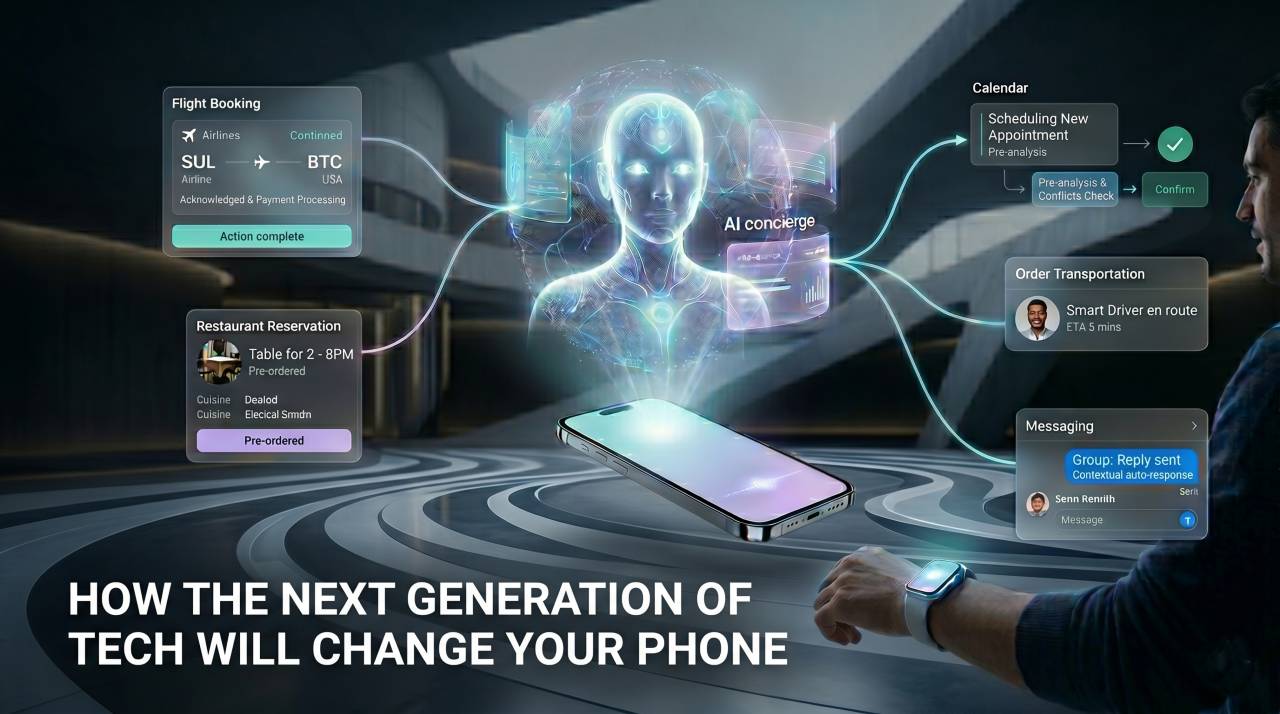
A small future scene to start with
Pretend it's a Tuesday in 2028. You're heading to bed. You say to your phone, out loud or by typing — doesn't matter — "Book the cheapest flight to Goa that lets me leave Friday morning and come back Sunday night, find a small hotel near the beach under ₹8,000 a night with good reviews from couples, and tell me when to leave for the airport."
You go to sleep.
In the morning, your phone shows you three flights, three hotel options, a packing reminder, and a calendar entry that says Leave home: 4:45 AM Friday, Uber pre-booked. You tap to confirm. You haven't opened a single app. You may not have touched the phone at all.
That's the version of your phone that's slowly arriving. Not in some far-off science-fiction year — this is being built into iPhones and Android phones right now. The pieces are landing one at a time, and the picture they're forming is, honestly, kind of strange. Your phone is about to stop being a grid of apps you operate, and start being something more like a person you talk to.
This post is about what's actually changing, in plain language. What an "AI agent" is. How it's different from the Siri you've been ignoring for a decade. What it'll let you do that you couldn't before. And — because I'd rather be honest than breathless — what it won't do, what's still rough, and what you should be skeptical of.
How you use your phone right now
Take a moment to actually notice. You want to book a haircut. So you:
- Open Maps. Search "salon near me."
- Tap a few results. Read reviews.
- Find one you like. Tap "website" or "book now."
- Get redirected to a booking page. Pick a time. Enter your name. Enter your phone number. Confirm.
- Switch to your calendar app. Add the appointment.
- Maybe text your friend who's meeting you after.
That's six apps, for one haircut. Not because anyone designed it badly — each app does its job well. It's because you are the glue holding them together. You're the one carrying the information from one app to the next. Every time you do something on your phone, you are quietly acting as a messenger between apps that don't talk to each other.
This has been the deal since the first iPhone in 2007. You operate the apps; the apps don't operate anything.
We just got used to it.
What an "AI agent" actually is
Strip the jargon away and an AI agent is one thing: software that can take a goal in your own words, and then do things on its own to reach it. Not just answer a question. Not just write you a draft. Actually take actions.
The analogy that works best is a good hotel concierge.
You walk up to the concierge desk and say, "I'd like a nice quiet Italian dinner tonight for two, and tickets to whatever's on at the opera." You don't tell them which restaurant. You don't book it. You don't research the opera. You describe what you want, in normal words, and walk away. Later, a confirmation slides under your door. The concierge made the calls, knew the right places, handled the details. You didn't see any of the work.
That is what an agent does. Except instead of phone calls to restaurants, it's making calls to apps — to Uber, to OpenTable, to your email, to your calendar, to your bank. The agent is the concierge. Your phone is the hotel lobby. The apps are the restaurants and theatres the concierge knows.
For about twenty years, your phone has been the apps. Going forward, your phone is going to be the concierge that uses the apps.
What this looks like in practice
Here's the same task — planning a small birthday dinner — done two ways.
| Step | The phone you have now | The phone you'll have soon |
|---|---|---|
| Find restaurants | Open Maps, tap five places, read reviews | "Plan Sarah's birthday Friday — Italian, midtown, 7 of us, one vegetarian." |
| Check availability | Tap each restaurant's website one by one | The agent checks all of them at once |
| Get the group's vote | Screenshot, send to group chat, count votes | Agent reads the chat, sees the votes, picks |
| Book it | Switch to OpenTable, fill the form | Confirms the pick with you, then books |
| Sort out transport | Open Uber ten minutes before leaving | Schedules cars for whoever needs one |
| Split the bill | Open Venmo or Splitwise after dinner | Sends the split automatically the next morning |
| Your time spent | 25–40 minutes spread across a day | About 30 seconds of your attention |
The left column is what you do today and don't really notice doing. The right column isn't science fiction — every piece of it exists, in some form, in 2026. What's still being figured out is how reliably it all chains together and which company's agent will be the one you actually use.
What's going to change about the phone itself
A few specific things to watch for in the next two or three years.
- Fewer app icons in your face. Most apps will still exist, but you'll touch them directly less often. The home screen becomes a quieter place — a chat field, a couple of widgets, a list of suggested actions, instead of a wall of icons.
- Voice and text become equal. Right now, voice on phones is mostly for timers and weather. Once the assistant can actually do things, voice becomes a real way to operate the phone. Typing won't go away — sometimes you don't want to talk out loud — but the gap between "say it" and "do it on a screen" will close.
- Your phone learns your preferences across apps. Not just "you like jazz on Spotify." More like "you prefer aisle seats, you don't eat pork, you usually book from this airline, your mother's birthday is in March." That cross-app memory is what makes the concierge feel like a real concierge and not a clueless temp.
- Big companies fight harder for the 'agent layer.' Apple, Google, Microsoft, OpenAI, Anthropic, and a few others are all trying to be the agent you actually talk to. Whoever wins becomes the most valuable piece of software in your life. This is also why there's so much marketing noise right now — the stakes are enormous and the technology is still rough.
What's not changing
A few honest things to balance the picture.
- Apps don't die. They become the plumbing. You'll still scroll Instagram, play games, watch YouTube. Anything visual, creative, or social will stay app-shaped. What dies is the errand app — the booking forms, the price comparisons, the data entry. Those collapse into the agent layer.
- You still make the decisions. A good agent doesn't decide where you go on holiday. It presents options, handles the boring parts, and waits for you to choose. The taste, the judgement, the "actually I'd rather just stay home this weekend" — that stays with you.
- The big actions still need your hand. No good agent design will let an AI spend a thousand dollars on your card without you confirming. Anything that involves real money, real commitments, or real consequences will stay a the agent prepares, you press the button workflow for the foreseeable future. The agents that try to skip this step are the ones to be wariest of.
The honest part: what's still rough
I'd be doing you a disservice if I stopped there. A few things to keep in mind.
Agents still make confident mistakes. They book the wrong date. They order the wrong restaurant. They misread a group chat and invite the wrong people. These errors are getting rarer quickly, but they aren't zero and they'll never be zero — same as a human concierge can mishear you.
The privacy trade is real, and underexplored. To be the concierge you want, the agent needs to read your email, see your calendar, know your contacts, watch your messages. Different companies handle this very differently — some keep it all on your device, some send it to their servers, some do a mix. This is worth paying attention to before you hand any agent the keys to your digital life. The right amount of caution isn't paranoia and isn't indifference; it's reading the privacy page once, on purpose.
The "killer agent" hasn't quite landed yet. Right now, in 2026, you can get pieces of this experience — Apple Intelligence handles some tasks, Gemini does workspace coordination well, ChatGPT and Claude can browse and act in limited ways. None of them does the full hotel-concierge thing yet, consistently, for an average person. We're in the awkward middle phase, the way smartphones were in 2008: obviously the future, not quite working.
How to actually try this today
If you want to feel where this is going without waiting two years, three small experiments.
- Do one whole task by voice this week. Not "set a timer." Pick something multi-step — planning a dinner, organising a trip, writing a tricky email — and try to do it entirely by talking to whichever AI tool you already have. You'll learn quickly where today's tools succeed and where they fall over.
- Pick one chore and delegate it. Pasted bank statements, a research question, a fifty-tab decision you've been avoiding. Hand the raw material to an AI tool and ask it to draft the answer or the next step. This is the agent mindset in miniature.
- Notice every time you're acting as glue between apps. Just notice; don't change anything. You'll be surprised how often, in a normal day, you're doing the job an agent will do in a few years.
What to take away
The simplest version of all this: for twenty years, your phone has been a container of apps that you operate. For the next twenty, it will be more like a person you talk to who operates the apps for you.
Whether that's exciting or unsettling depends on what you value. But it's coming whether we're ready or not, and the people who'll get the most out of it are the ones who start experimenting before they have to. The hotel concierge is moving into your pocket. Worth getting to know them.