
AI + Blockchain in 2026: The Silent Revolution Reshaping Finance, Health & Everything In Between
Let's Be Honest, You've Heard This Before
"AI is the future." "Blockchain will change everything."
You've sat through the pitch decks. You've scrolled past the LinkedIn posts. You've nodded along at dinner when someone brought it up and quietly changed the subject.
I get it. The hype got old fast.
But here's the thing. While a lot of us were rolling our eyes, something real was quietly being built. By 2026, some of it has moved from "interesting experiment" to genuinely running in the background. Your bank, your hospital, your grocery store. You just never notice it.
This isn't another hype article. Let me show you what's actually happening, and where the claims about this space tend to get ahead of the reality.
So What Happens When AI and Blockchain Work Together?
Think of it this way.
Blockchain is like a shared notebook that thousands of people hold at once. Nobody can secretly tear out a page or rewrite what's already there. It's honest by design.
AI is the analyst who reads that notebook, spots patterns a person might miss, and acts on them faster than any human could.
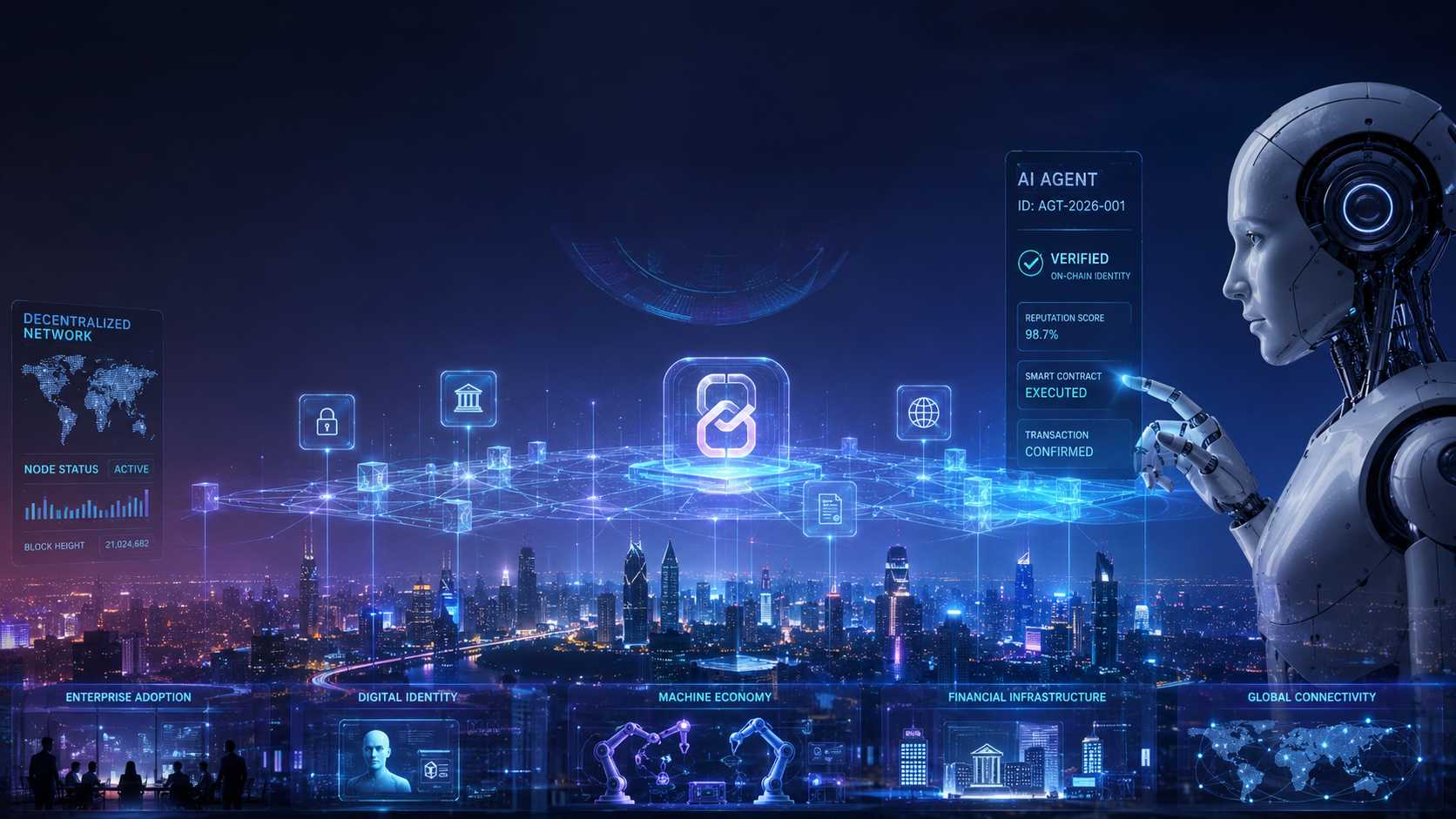
Separately, they're each useful. Together, they solve a problem that's dogged nearly every industry: how do you make fast decisions on data you can actually trust?
Blockchain handles the trust. AI handles the thinking. When both are working together, things start to change in ways that matter to real people. For a broader look at where this is all heading, our guide on the future of artificial intelligence beyond 2035 digs into the longer-term picture.
Your Money Is Moving Differently Now
Let's start with finance, since this is where most people feel it first.
Remember the last time you sent money abroad? The fees. The waiting. The "it'll be there in three to five business days." That's been the norm for decades because moving money internationally has always been more complicated than it should be.
Blockchain-based settlement is chipping away at that friction. Visa's own stablecoin settlement pilot is a good example. It's grown from a handful of supported networks to nine blockchains as of early 2026. The company reports billions in annualized settlement volume moving through it, with quarterly growth in the double digits. That's a real, verifiable shift. It's just smaller and more gradual than the breathless claims you'll see about crypto "replacing" traditional banking. AI sits in the background of these systems too, watching transactions and flagging fraud in real time.
It goes deeper than payments, too. Smart contracts, agreements written directly into code, execute themselves the moment their conditions are met, without a middleman chasing down paperwork. Traditional financial institutions aren't fighting this anymore. Banks like JPMorgan, HSBC, and Standard Chartered have all launched their own blockchain projects rather than treating the technology as a threat.
Healthcare: This One Actually Saves Lives
Okay, this section hit differently when I was researching it.
Your medical records are probably scattered across three hospitals, two clinics, and that GP you saw five years ago. Getting them all in one place often means phone calls, faxes (yes, still), and a lot of waiting.
Blockchain, in theory, fixes this by creating a single, secure, tamper-proof record that only you and your authorized doctors can access. AI can then analyze that fuller picture to catch things an individual doctor might miss: early disease patterns, drug interactions, risk flags.
Worth being honest, though. Most healthcare systems are still working through the unglamorous, expensive process of connecting decades-old software to anything resembling this. Adoption is far more piecemeal than a single "it's already solved" narrative suggests.
Counterfeit medications are a genuine, deadly problem. Pilot programs already exist that put a digital record of each medicine batch on a blockchain, so a scanned QR code can show its full supply chain history. These systems are real, but they're running in pockets, not universally. Think of "counterfeit-proof medicine tracking" as an emerging capability, not something already solved everywhere.
The Food on Your Plate Has a Story, Sometimes
A few years ago, when there was a food safety scare, it could take a week or more to trace which farm or factory the contamination came from. People got sick in the meantime.
IBM's Food Trust platform is a good example. Built with retailers like Walmart and Carrefour starting back in 2017, it cut tracing time for some products from roughly seven days down to a couple of seconds. That's genuinely impressive, and worth citing accurately: it's one of the earliest and most successful blockchain supply-chain pilots, not a brand-new 2026 development.
It's also a useful reminder that this space has a mixed track record. Maersk and IBM's TradeLens project aimed at global shipping in a similar way. It launched with real momentum in 2018. It shut down in 2023 after failing to get enough of the industry to commit to it. Both things are true at once. Some of these systems work and stick around. Some genuinely don't. Worth remembering before treating any single pilot as proof the whole industry has arrived.
800 Million People Don't Have an ID. Blockchain Might Help.
This one stops me every time I think about it.
According to the World Bank's most recent ID4D data, roughly 800 million people worldwide still lack an official identity document. That's actually down from about 850 million in 2021. No passport, no national ID. Often no bank account and no legal recognition in the places they live.
Blockchain-based identity systems are one of the more promising approaches here. They let people hold and control their own verified credentials without needing a government or corporation to vouch for them every time. It's an early-stage use case, not a solved problem. But it's one of the more genuinely hopeful applications of this technology.
Who's Keeping AI Honest? Blockchain, Partly.
Here's a question worth sitting with: when an AI system decides your loan gets rejected, or your insurance claim gets denied, how do you actually know it was fair?
Right now, in most systems, you don't have a clear way to find out.
Blockchain offers a possible piece of the answer. It records the data and logic behind a decision in a way that can be audited later. Regulators can look at it. In principle, so can you.
This kind of accountability is becoming a bigger conversation as AI takes on more decisions that affect people's lives. It overlaps closely with what's usually discussed under AI governance and AI compliance, worth reading for the fuller regulatory picture. It also connects to how organizations build data governance frameworks that can actually stand up to scrutiny.
Owning a Piece of a Skyscraper (Seriously)
Real estate, fine art, and private equity have always been playgrounds for the wealthy, not because regular people don't want in, but because the minimum investment has usually been enormous.
Tokenization breaks assets into digital fractions on a blockchain. In theory, you could buy a tiny fraction of a commercial building or a piece of a painting and sell your share whenever you like. AI is increasingly used to help price and evaluate these fractional assets. The World Economic Forum has projected that 10% of global GDP could be tokenized and stored on blockchain by 2027. That forecast isn't new, though. It's been circulating since around 2017 and keeps getting recycled as if it's fresh. It's a real, often-cited figure. But treat it as a long-standing industry talking point rather than a new prediction, and take the exact number and timeline with a healthy dose of skepticism, the way you would with any forecast this far out.
It's Not All Perfect, Let's Be Real
None of this comes without friction, and it would be doing you a disservice to pretend otherwise.
Hospitals are still running software from the 90s. Connecting that to a modern blockchain isn't a weekend project, it's expensive, slow, and genuinely difficult. Regulators in most countries are still catching up. There's a real shortage of people who know how to build these systems well. Energy use, while improving with newer approaches, is still a legitimate concern. And as TradeLens showed, plenty of well-funded, well-intentioned blockchain projects simply don't survive contact with the industries they're meant to serve.
The technology, in the places it's actually being used well, is ready. The humans and institutions around it are still catching up, and some of them never will.
What Does All This Mean for You, Actually?
Here's the honest version.
Some of your bank transfers may get cheaper and faster as this infrastructure matures. Your medical data could eventually be more secure and more useful, in the systems that manage to actually implement this well. Your investment options might someday include assets that were never available to you before. And the AI systems making decisions about your money, your health, and your insurance may increasingly need to answer for those decisions in a way that can be checked.
None of this is science fiction. Parts of it are already running somewhere in the world. Plenty of it is still a work in progress, and some of the more dramatic claims you'll read about this space haven't held up.
Here's Where I Land on All of This
The AI and blockchain story isn't purely a future story anymore, but it's also not the sweeping, fully-arrived revolution some headlines make it sound like. It's a slower, messier, partial story, told through systems most people never see, with real successes sitting next to real failures.
The blockchain market itself is genuinely growing fast. Grand View Research pegs the global blockchain technology market at around $57.7 billion in 2025, projecting it could reach roughly $1.4 trillion by 2030. Other research firms land on different numbers depending on what they count, which is worth knowing before treating any single market-size figure as gospel. But the direction is consistent across sources: this is real growth, not just hype.
You don't need to become a blockchain developer or an AI expert to care about this. Just know that the plumbing of the world, how money moves, how data is stored, how trust gets established, is genuinely being rewired. It's happening unevenly, in places, with real setbacks along the way.
It's not loud, and it's not finished either.
Key Takeaways
- Blockchain and AI solve different halves of the same problem. Blockchain protects data integrity. AI finds patterns and acts on them.
- International payments are getting faster and cheaper, gradually. Verified pilots like Visa's stablecoin settlement program show real progress, though it's incremental rather than a full replacement of existing rails.
- Healthcare applications are promising but early-stage. Tamper-proof records and counterfeit-drug tracking exist in pilots, not yet as a universal standard.
- Food safety tracking has real, proven wins, alongside real failures. IBM Food Trust cut tracing times dramatically; Maersk's TradeLens shut down after failing to gain industry-wide adoption.
- Digital identity for roughly 800 million people is a genuine, verified problem that blockchain-based systems are starting to address, per current World Bank data.
- AI accountability and blockchain audit trails are an emerging, not solved, use case.
- Asset tokenization could reshape who builds wealth, though the often-cited "10% of GDP by 2027" WEF figure is nearly a decade old and should be read as a long-standing forecast, not fresh data.
Frequently Asked Questions
What does "AI + blockchain" actually mean in practice? It means using blockchain to create a tamper-proof, shared record of data, and AI to analyze that record and act on it. Blockchain handles trust and verification. AI handles pattern recognition and decision-making. The two are complementary, not the same technology.
Is the AI + blockchain trend real, or is it still mostly hype in 2026? It's a mix of both. Some applications are genuinely live and growing, like Visa's stablecoin settlement pilot, which supports nine blockchains and reports billions in annualized volume. Other applications, like universal blockchain healthcare records, are still early-stage pilots rather than mainstream infrastructure. Be skeptical of any source claiming this is either "all hype" or "already fully arrived."
Has blockchain technology actually failed in any major real-world projects? Yes. Maersk and IBM's TradeLens platform, an ambitious blockchain project for global shipping, launched in 2018 with real industry momentum and shut down in 2023 after failing to get enough companies to commit to it. It's a useful reminder that not every well-funded blockchain pilot survives contact with its industry.
How is blockchain actually being used in healthcare today? Mostly in pilots rather than at scale. Tamper-proof patient records and blockchain-based drug traceability (to fight counterfeit medication) both exist as working systems in specific hospitals or supply chains. Widespread adoption is slowed by the cost and difficulty of connecting decades-old hospital software to newer blockchain systems.
What is asset tokenization, and how big could it get? Tokenization means splitting an asset, like real estate or fine art, into digital fractions that people can buy, sell, and trade on a blockchain. The World Economic Forum has projected that 10% of global GDP could be tokenized by 2027, though that forecast has circulated since around 2017 and is worth treating as a long-standing industry estimate rather than fresh data.
How does blockchain make AI decisions more accountable? By creating a permanent, auditable record of the data and logic behind an AI decision, like a loan rejection or an insurance denial. That record can be reviewed by regulators or the person affected. This overlaps with the broader field of AI governance, which covers how organizations oversee AI systems more generally.
Do I need to understand blockchain or AI to be affected by any of this? No. Most of these systems are meant to work in the background. If they're implemented well, you'd notice faster international payments, more accurate food recalls, or fewer counterfeit medications, not the underlying technology itself.
Learn More on These Topics
If this made you think, this is worth a read next:
- How to Build an AI Workflow for Your Business: a practical look at building AI systems that are transparent and accountable.