
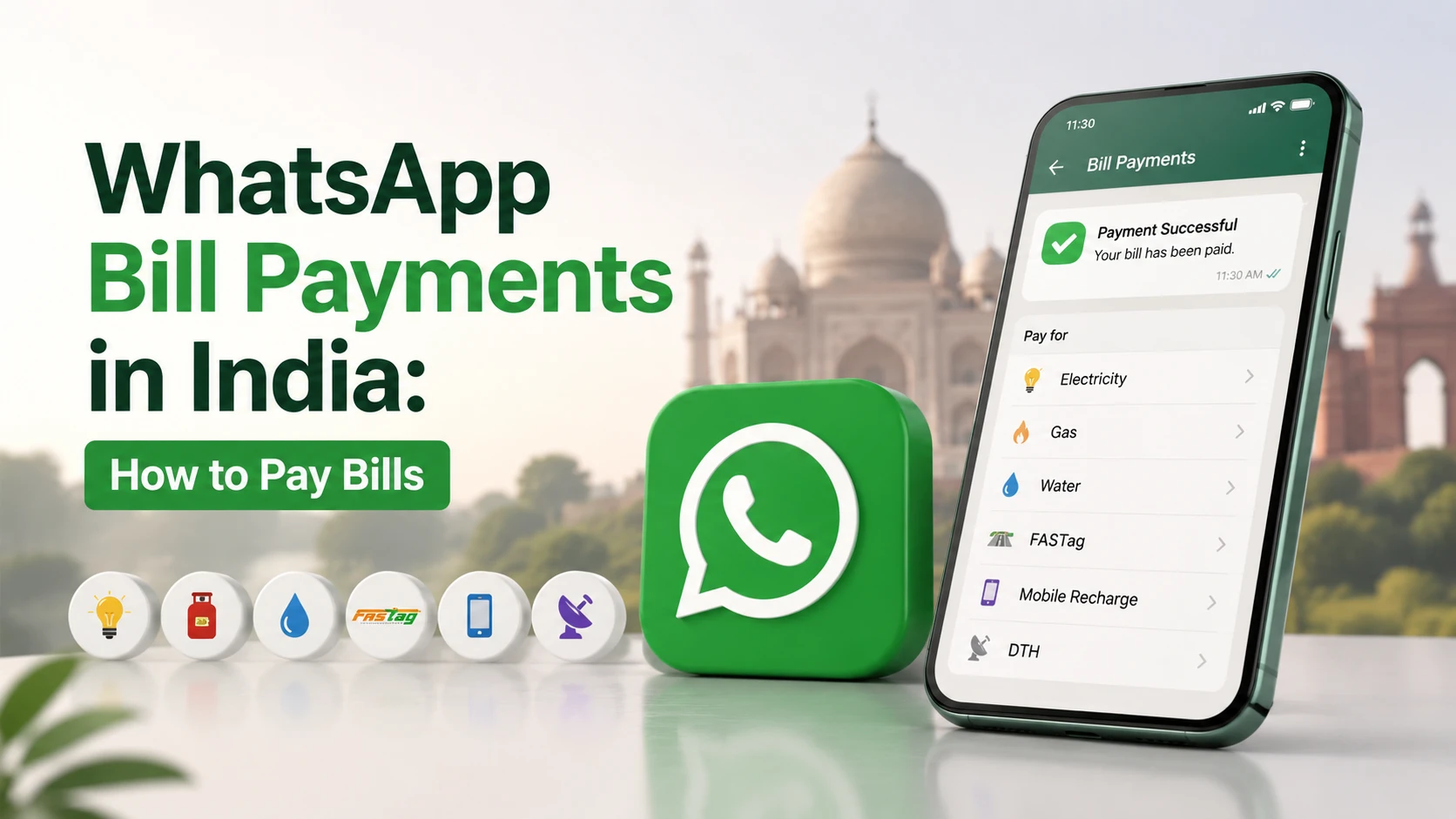
Do you live in India? Are you tired of switching between five different apps just to keep your lights on, book your gas cylinder and top up your FASTag? WhatsApp just gave you one less reason to do that. The company has officially rolled out WhatsApp Bill Payments. It is a built-in feature. It lets you find, track and pay everyday household bills directly inside the chat app you already open dozens of times a day.
This is not a small tweak. It plugs WhatsApp into one of the largest bill payment networks in the country. That puts it in the same conversation as Google Pay, PhonePe and Paytm. Here is everything worth knowing: what the feature does, how the technology behind it works, the exact steps to use it, and where it fits into WhatsApp's bigger plans in India.
What Is WhatsApp Bill Payments?
WhatsApp Bill Payments is a new section inside the WhatsApp Payments tab. It lets users in India search for a biller, pull up their outstanding bill amount, and pay it on the spot. You can pay using UPI, a debit card or a credit card. According to Meta's official newsroom announcement, the feature gives people access to more than 22,700 registered billers. That spans roughly 30 categories, including electricity, gas, water, FASTag, insurance, credit card dues and loan repayments.
In plain terms: you no longer need a separate app for your electricity board, another for your gas connection, and yet another for your FASTag. You can now handle all of it from the same rupee icon on your WhatsApp home screen.
Meta India's Managing Director and Country Head, Arun Srinivas, framed the goal simply. Bill payments should take the same low mental effort as chatting with a friend. And that convenience should reach digital payment users well beyond India's big cities.
The Technology Behind It: What Is Bharat Connect (BBPS)?
WhatsApp did not build a bill payment network from scratch. It plugged into one that already existed. That network already processes billions of transactions a year.
The feature runs on Bharat Connect, the rebranded identity of what used to be called the Bharat Bill Payment System (BBPS). Bharat Connect is an RBI-conceived, nationally interoperable payment infrastructure. It is operated by NPCI Bharat BillPay Limited (NBBL), a wholly owned subsidiary of the National Payments Corporation of India (NPCI). NPCI is the same organization behind UPI itself. So this is not some obscure third-party plumbing. It is core national payment infrastructure.
Here is why that matters for you as a user:
- One integration, every biller. WhatsApp does not need a separate deal with your electricity board, your gas company and your insurer. One connection to Bharat Connect opens the door to over 22,700 billers at once.
- RBI oversight. Bharat Connect operates under the Reserve Bank of India's regulatory framework. Since July 1, 2024, the RBI has mandated that all credit card bill payments made through third-party apps route through this exact system. So this is not a side project. It is the compliant, standardized path bill payments in India are already required to take.
- WhatsApp's role. Per Medianama's reporting, WhatsApp participates in this ecosystem in a defined regulatory capacity. It is an Agent Institution, brought on board through one of the authorized Customer Operating Units in the BBPS framework. That is the formal channel through which any app, WhatsApp included, is permitted to plug into the network.
Want the deeper technical and regulatory breakdown? The official Bharat Connect website is the primary source.
How to Pay a Bill on WhatsApp: Step by Step
Using the feature is designed to feel almost identical to sending a text. Here is the full flow:
- Open WhatsApp and tap the ₹ (rupee) icon at the top of your home screen. This is the same entry point WhatsApp already uses for peer-to-peer UPI payments.
- Choose a bill category. Pick from electricity, gas, water, FASTag, insurance, credit card, loan repayment, or one of the other categories available.
- Select your biller. Search for or select your specific provider, such as your state electricity board or your gas distributor.
- Enter your account details. This is usually your consumer number, account number or registered mobile number, depending on the biller.
- Review the fetched bill amount. WhatsApp automatically retrieves your current outstanding amount so you are not guessing or copying numbers from a paper bill.
- Pick a payment method. You can pay using UPI, a debit card or a credit card.
- Confirm and pay. Once confirmed, the payment is processed and a receipt is generated.
After your first payment, that biller is saved to your Payments Home screen. Future bills become a one-tap job. You can also view past payments and upcoming due bills. And you can manage multiple accounts under a single provider. That is genuinely useful if you pay an electricity bill for your own home, plus one for a parent's house or a rental property.
Quick Reference Table
| Step | Action |
|---|---|
| 1 | Tap the ₹ icon on the WhatsApp home screen |
| 2 | Choose your bill category (electricity, gas, FASTag, etc.) |
| 3 | Search for and select your biller |
| 4 | Enter your account or consumer number |
| 5 | Review the auto-fetched bill amount |
| 6 | Select UPI, debit card or credit card |
| 7 | Confirm payment and save receipt |
Which Bills Can You Actually Pay on WhatsApp?
Meta's release confirms the categories below. Business Today and Free Press Journal corroborate the list. Supported categories include:
- Electricity bills
- Gas bills (LPG and piped gas connections)
- Water bills
- FASTag recharge and top-up
- Insurance premium payments
- Credit card bill payments
- Loan EMI repayments
- Other household and utility categories under the broader Bharat Connect umbrella
Interestingly, this did not appear overnight. An earlier APK teardown from GSMArena, back in February 2025, had already flagged hidden code for electricity, mobile prepaid recharges, LPG gas, water, landline postpaid bills and even rent payments. WhatsApp had quietly been building toward this launch for well over a year.
When Will You See It on Your Phone?
Not immediately, and that is by design. WhatsApp is rolling out Bill Payments in phases across India. The company has said it will reach all Android and iOS users over the coming weeks. If you tap the ₹ icon today and do not see the option yet, that is a staggered rollout issue. It is not a bug on your end, and it is not something you are doing wrong.
Why This Move Makes Sense for WhatsApp
This launch does not exist in a vacuum. A few things make it a logical next step, not a random feature drop.
WhatsApp is already deeply embedded in Indian daily life. With well over 500 million users in India, WhatsApp already supports mobile recharges, metro ticket bookings, and access to government services through official chatbots. Bill payments slot naturally into that existing utility layer.
Meta is investing seriously in Indian fintech talent. Back in June 2026, Meta CEO Mark Zuckerberg named CRED founder Kunal Shah as the new global head of WhatsApp. Shah succeeds longtime chief Will Cathcart, who led WhatsApp for nearly seven years. The appointment came bundled with a roughly $900 million Meta investment in CRED, the credit card management fintech Shah built. A payments-savvy new leader arriving just months before a bill payments launch is not a coincidence.
The competitive pressure is real. As one industry analysis points out, a rollout covering over 22,700 billers is not a soft launch with a handful of partners. It is a comprehensive move. It puts WhatsApp in direct competition with Google Pay, PhonePe and Paytm, for one of the most routine, recurring financial habits Indian households have.
WhatsApp Bill Payments vs Other Payment Apps
So how does this stack up against apps people already use for the same job?
| Feature | WhatsApp Bill Payments | Typical UPI Apps (GPay, PhonePe, Paytm) |
|---|---|---|
| Underlying network | Bharat Connect (BBPS) | Bharat Connect (BBPS), same network |
| Need to install a separate app | No, built into WhatsApp | Yes, dedicated app required |
| Payment modes | UPI, debit card, credit card | UPI, debit card, credit card, wallets |
| Biller coverage | 22,700+ billers, 30+ categories | Similar, since most route through the same BBPS backbone |
| Familiarity factor | Uses an app most Indians already open daily | Requires switching context to a separate app |
Here is the honest takeaway. The underlying rails are largely the same, since most Indian payment apps already route bill payments through BBPS. What WhatsApp is really selling is convenience and reduced friction, not a fundamentally new payment technology.
Frequently Asked Questions
Is WhatsApp Bill Payments available for everyone in India right now? No. It is rolling out gradually. Meta has said it will reach all Android and iOS users over the coming weeks, following the September 2026 launch.
What network powers WhatsApp Bill Payments? It runs on Bharat Connect, formerly known as the Bharat Bill Payment System (BBPS). NPCI Bharat BillPay Limited operates it under RBI's regulatory framework.
Which bills can I pay through WhatsApp? Electricity, gas, water, FASTag, insurance, credit card bills and loan repayments, among other categories. That spans over 22,700 billers.
How do I access Bill Payments on WhatsApp? Tap the ₹ icon at the top of your WhatsApp home screen. Choose a bill category and biller, enter your account details, review the amount, and pay.
What payment methods are supported? UPI, debit cards and credit cards.
Is it safe to pay bills on WhatsApp? The feature runs through Bharat Connect, an RBI-regulated, NPCI-operated infrastructure. It already processes billions of transactions annually across major banking and fintech apps. That means it operates under the same regulatory safeguards as other established bill payment channels in India.
Can I pay bills for a family member's account from my own WhatsApp? Yes. The feature supports managing multiple accounts under a single biller. You can track and pay bills for different properties or family members from one place.
The Bottom Line
WhatsApp Bill Payments is not really about flashy new technology. It is about removing friction from a chore every Indian household deals with every single month. WhatsApp does not need to reinvent bill payments by tapping into Bharat Connect's existing 22,700-plus biller network. It just needs to make them feel as natural as sending a text. Based on the early rollout details, that appears to be exactly the bet the company is making.
If the feature has not reached your phone yet, keep an eye on the ₹ icon over the coming weeks. WhatsApp keeps adding more than just chat, so it is worth brushing up on WhatsApp desktop tips and tricks to get more out of the app day to day. Or browse our full apps coverage for more breakdowns like this one.