
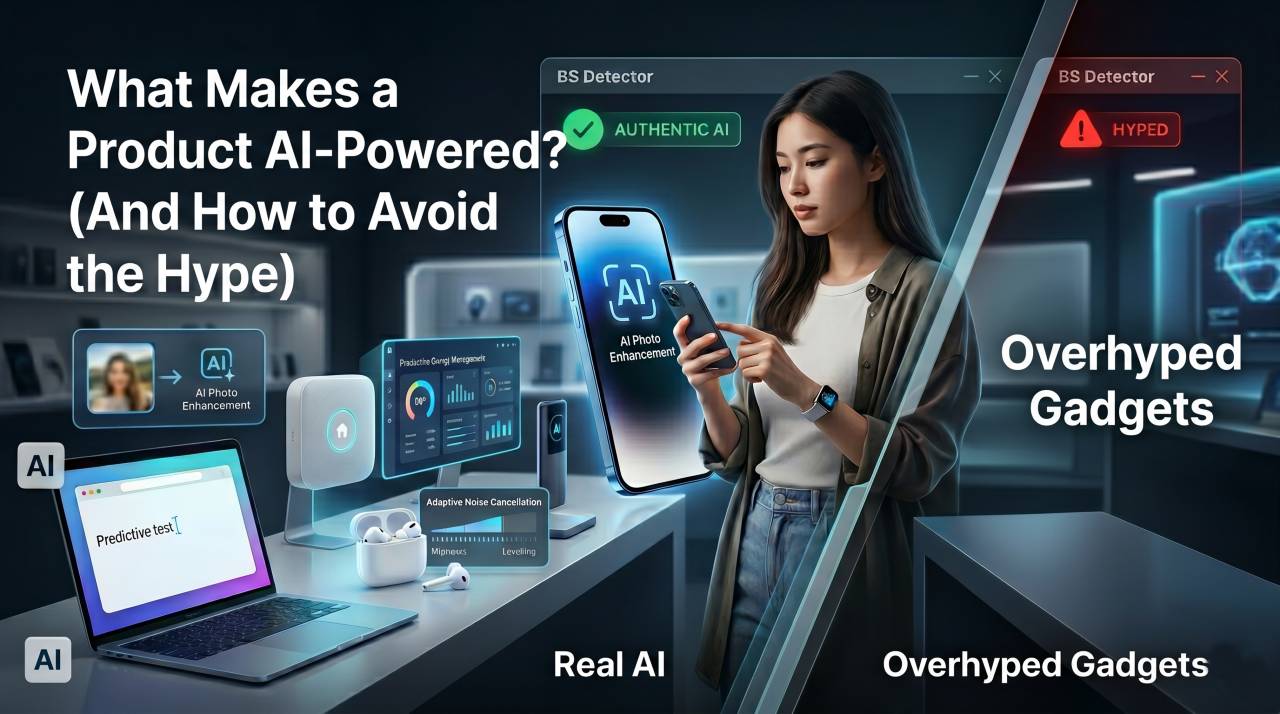
Why "AI" is the new "organic"
Last December I stood in an electronics shop staring at an "AI-enhanced" smart toothbrush priced four times higher than the same brand's regular one. The difference, the salesperson explained, was that the AI version "learns your brushing style." When I asked what it actually did with that information, he paused, smiled, and said, "It shows you on the app."
I bought the cheaper one.
This is the shopping experience now, in every aisle and every app store. "AI-powered" is stamped on toothbrushes, mattresses, water bottles, refrigerators, washing machines, browsers, project management tools, photo apps, and — I am not making this up — at least one bird feeder. Sometimes the label means something. Often it doesn't. And the gap between "real AI feature" and "AI sticker on a normal product" is currently worth a few hundred dollars in marked-up price.
This post is a field guide. How to tell, in about five minutes, whether a product's AI is doing real work or just sitting on the brochure. Three rough categories of AI labeling, a BS-detector checklist you can run on any product, and concrete examples of features where the AI label earns the premium versus features where it doesn't.
Why the label is doing so much economic work
A bit of context for why this matters more than it used to.
Companies pay close attention to which words make people open their wallets. "Eco-friendly" had its moment. "Smart" had a long decade — smart toasters, smart forks, smart trash cans. "AI-powered" is the current champion, and consumer research consistently finds that people will pay more for an identical product when "AI" appears in the description.
The problem is that "AI" doesn't have a legal definition the way "organic" does. There's no certification body, no labelling standard, nothing stopping a company from marketing literally anything as AI-powered. A thermostat with a hard-coded if temperature > 75, turn on AC rule can call itself AI-powered and routinely does. The label is currently doing more economic work than most of the technology underneath it.
This isn't going away soon. So the consumer skill of the moment is learning to read past the sticker.
The three categories of "AI" labeling
Most products labeled AI-powered fall into one of three rough buckets. Figuring out which one you're looking at is most of the work.
| Category | What it actually is | Typical examples | What you're paying for |
|---|---|---|---|
| Real AI | Machine learning doing something genuinely hard or impossible without it | Live noise cancellation, on-device translation, generative photo editing | Real capability you'd miss if it disappeared |
| Rebrand | Pre-existing ML feature relabeled to ride the trend | Spam filters, autocorrect, music recommendations | A label premium on a decade-old feature |
| Theater | Basic rules or nothing at all, dressed up as AI | "Smart" toothbrush timers, water-bottle reminders, fridge cameras | Marketing, mostly |
A closer look at each, with how to spot them.
Real AI
The product uses machine learning to do something that genuinely would have been hard or impossible without it. Live noise cancellation on calls. Background removal in photos that handles hair and edges convincingly. Voice transcription that actually punctuates correctly. Translation that handles idioms. Music recommendations that get measurably better the longer you use the service.
The test for Real AI: if the feature disappeared overnight, you'd miss it within a week, and you'd be able to describe specifically what stopped working.
Rebrand
The feature already existed; it just used to be called something else. "AI" got slapped on because the marketing team saw the trend.
Spam filters have used machine learning since the early 2000s. Calling Gmail "AI-powered email" today is technically accurate and quietly misleading — that AI has been there for twenty years. Same with Netflix's recommendations, your phone's autocorrect, your car's automatic braking, and your camera's autofocus. These are useful features. They just aren't new. If a product is charging a premium for "AI" that's really standard machine learning from a decade ago, you're paying for the label, not the technology.
Theater
The "AI" is doing something a basic rule could have done, or — and this is more common than you'd guess — isn't really doing anything at all.
A toothbrush that tells you "you brushed for 90 seconds" has a timer. A "smart" water bottle that reminds you to drink water has a clock. A fridge that "uses AI to track your groceries" usually has a camera and a barcode database. The features may be fine. The "AI" is set dressing.
This is the category that quietly costs you money. Theater AI is what doubles the price of an ordinary product without doubling its usefulness.
The BS detector: five questions before you buy
Run any AI-labeled product through these. In my experience, two failures is enough to walk away.
-
Can the company describe what the AI does in one specific sentence, without using the word "AI"?
"It detects faces in your photos and automatically blurs them when you share to social media" — passes. "It uses cutting-edge AI to enhance your experience" — fails. If the marketing copy collapses the moment you find-and-replace the letters AI out of it, there's nothing under the hood.
-
Could a software engineer in 1995 have built this with if-then rules?
A thermostat that turns off when you leave the house could be a geofence rule from 1998. A washing machine that "uses AI to detect load size" is almost certainly a weight sensor. A toothbrush that "learns your brushing style" is, in most cases, a timer plus an accelerometer plus a pretty graph. None of those are bad products. They just aren't new ones, and the AI markup is unearned.
-
Does the feature demonstrably outperform the non-AI version of the same product?
This is the cleanest test, and the one most reviewers skip. Find someone who has used both versions for a few weeks. If they can't name a specific moment the AI version saved them time, prevented a mistake, or did something the basic version couldn't, you're paying for branding.
-
Is the AI feature one of many features, or the whole product?
Real AI features are usually one capability among many. If the entire pitch of the product is "it has AI," that's often a tell that there's nothing else compelling about it. A great notes app that adds AI summarization is probably worth the upgrade. An "AI notes app" that's mediocre at being a notes app is selling you a chatbot in a notebook costume.
-
Where does the AI run, and what happens when it's offline?
Not a gotcha — a genuine question. Some excellent AI features run entirely on your device (Apple's on-device transcription, most of the Pixel's photo editing). Some excellent ones run in the cloud (ChatGPT, DeepL, generative image tools). Theater AI sometimes runs nowhere — the "AI features" are server-side rules that stop working if the company shuts down or removes them from your plan. Ask the question. If the company can't or won't answer, that itself is the answer.
Where AI is genuinely worth paying for right now
It's easier to give specifics than to generalize. These are categories where the AI is, in my experience, doing real work and the label is earned.
- Computational photography on phones. The most uncomplicated AI win in consumer tech. Night mode, object removal, best-shot-from-a-burst selection, real-time HDR. These features are genuinely difficult without machine learning, they mostly work offline, and they make the product noticeably better. If your phone is more than three or four years old, the upgrade gets you real AI features.
- Voice transcription and translation. Otter, Whisper-based apps, Apple's built-in transcription, the offline modes in Google Translate — all dramatically better than they were five years ago. If you take a lot of meetings or travel, this category alone is worth paying for.
- Noise cancellation on calls. Krisp and its now-built-in equivalents inside Zoom, Teams, and Google Meet. Removes background noise, dog barks, keyboard clatter, the lawn mower next door. Genuine quality-of-life upgrade for anyone who works from home.
- Smart compose for writing and code. Gmail's Smart Compose, the in-line suggestions in Word, the autocomplete in modern code editors. Saves real time for anyone who writes a lot of repetitive text or boilerplate code.
- Photo editing for non-photographers. Generative fill, automatic background removal, magic editors. The democratization here is genuine — things that used to take a skilled retoucher now take ten seconds, and the AI version is doing real work, not theater.
Where the AI label is mostly marketing right now
I'll keep this brief because the list is long. Categories where I'd be especially skeptical of an AI premium today:
- AI-branded kitchen appliances (toasters, air fryers, fridges that "see" your groceries)
- AI-branded toothbrushes and oral care
- Most AI-branded fitness wearables — the "AI" is usually averaging your heart rate and calling that a coaching insight
- AI-branded "wellness" gadgets generally
- SaaS tools whose only AI feature is a chatbot bolted onto the sidebar that nobody on the team uses after week two
- AI mattresses
- AI-powered ovens that "decide cooking times for you"
- Any product whose AI is described primarily with adjectives ("intelligent," "smart," "adaptive") rather than verbs
This isn't a permanent verdict on any of these categories. The smart oven of 2030 might genuinely cook your fish better than you can. Right now, in most of these aisles, the AI premium is theater.
A 90-second test you can run in the store
If you're standing in front of a product you're tempted by, here's a quick gut check:
- Open the product page on your phone and search for "AI" and "machine learning"
- Read every paragraph those words appear in
- Try to write one concrete sentence describing what the AI does — not what it enables, not how it makes you feel
- If you can't, assume it's theater and walk away
If you've already bought the product, give yourself a one-month deadline. After a month of regular use, can you point to a specific thing the AI did that you'd miss if it disappeared? If not, return it if you still can, and skip the AI tier next time. The base version probably does the same job.
The bigger picture
The "AI-powered" sticker boom will last another few years and then quietly burn out, the way the "smart" boom did. Products that genuinely use AI will keep using it, drop the label, and just be products. Products that were using AI as marketing will move on to the next word. (My money is on "agentic," which is already overheating in B2B software.)
In the meantime, the skill is to read past the label to the product underneath. Most things people buy are still just things. A good toothbrush is a good toothbrush. A good fridge keeps food cold. A good mattress is comfortable. If the AI version doesn't do those base jobs noticeably better than the cheap one, the letters A and I aren't going to save you the difference.
The salesperson in December was honest about it, in the end. The fancy toothbrush, he admitted when I pushed, "is basically the same toothbrush." That's roughly the consumer experience right now. Worth keeping in mind the next time you see the sticker.